The notice was still taped to the register when I came in for the late shift.
I had read it a dozen times the night before, and I read it again while the coffee machine hissed and the fluorescents buzzed their thin, tired song over the aisles. Four words in a hand I would have known anywhere. I had watched that hand learn to write steady again after the accident that broke his leg. I had watched it shake over hospital forms and heal into something strong and sure. *The night-shift cashier stays. — E.H.*
It should have frightened me more than it did. What frightened me was how much it didn't. Some treacherous part of me — the part that was still eighteen and stupid with love — had stood in front of that register and felt something dangerously close to relief. He hadn't fired me. He hadn't bought the station just to watch me lose it. He had written my job into his purchase the way a man marks something he intends to keep within reach.
Relief is a dangerous thing to feel about Ethan Hale. I knew that better than anyone alive. So I folded the feeling up small and put it away where I kept everything I couldn't afford, and I went about closing the store.
Noah was asleep in the back room, curled on the cot behind the stock shelves with his shoes lined up neatly beneath it and his white cane folded on the blanket beside him, its red tip catching the light every time I passed the doorway. He slept the way he did everything — carefully, one hand fisted in the blanket, his whole body listening even in dreams. Rain had started again around ten, needling the windows, turning the forecourt lights into smeared halos over the pumps. The lot was empty. The highway beyond it was empty too, just wet blacktop and the far-off sigh of trucks that weren't stopping.
I counted the till twice. I wiped down a counter that was already clean. I told myself I was doing my job, and I did not admit that I was waiting.
I was reaching for the deadbolt when the lock turned.
Not the bell. The lock. A key, sliding home smooth as you please, and then the door swung open and the rain walked in with him.
Of course he had a key. Owners have keys.
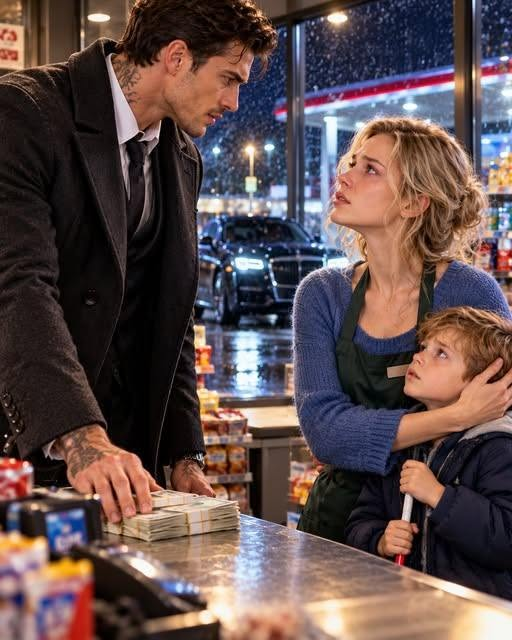
Ethan stood in the doorway in his black overcoat, rain beaded on his shoulders, his dark hair damp at the ends. He didn't stamp the cold off his boots. He didn't look around like a customer deciding whether the place was worth entering. He looked at me the way a man looks at something that has recently become his property and hasn't yet decided what it's for.
"You work for me now, Claire."
He said it the way other men say *good evening*. Mild. Almost bored. He let the door fall shut behind him and turned the sign in the window to CLOSED with two fingers, and the little plastic click of it sounded louder than the rain.
"I signed the papers this afternoon," he said. "Miller cried on the phone. Told me this place was his whole life. I paid him enough that it doesn't have to be." He walked slowly down the first aisle, trailing one tattooed hand along the shelves like an inspector, like a king touring a province he'd annexed out of spite. "The accountants were puzzled. It's a poor investment, this station. Thin margins. Bad roof. A pump that leaks vapor in July." He stopped at the end of the aisle and looked at me over the cigarette rack. "So I told them it was about the land. Trucks stop here. The parcel has value."
"And is it?" I asked. "About the land?"
"No," he said. "That's what I told the accountants."
He came around the counter. My counter. The one he had thrown five hundred dollars across two nights ago, money I'd pushed back at him with hands that shook. He stood too close, the way he had then, and I made myself not step back, and hated that he could see me making myself.
But he wasn't looking at me. Not then. His eyes had gone past me, slow and thorough, the way they must have moved across rooms full of men deciding whether to lie to him — and I watched those eyes find my life, piece by piece, in the place I'd least wanted them to find it.
The drawing. Taped to the side of the register at the height of his hip, curling at the corners, where I'd put it so it would be the last thing I saw on the worst nights: thick wax crayon pressed down hard enough to shine, a house with a square door, a sun with nine rays that Noah had counted out one by one with the tip of his finger, and two figures standing under it — a tall one and a small one, holding hands by a single straight crayon line. Beside it, hooked over the register's edge, his spare sweater. Child-sized. Still smelling faintly of the dryer at the laundromat.
And beyond me, the back room door stood open two inches, lamplight falling through the gap across the stock shelves, and in that narrow slice of light Ethan could see what anyone could see: the cot with the folded blanket. The little blue cup on the crate I used for a table. The pair of small shoes lined up under the cot, toes pointing out, waiting.
"Lucas didn't tell me about the drawing," Ethan said at last, very quietly. "Or the cot."
"Sitters cost money," I said. "He sleeps. I work. It's warm back there."
"Everything in this place is an answer, Claire," he said. "You just keep hoping I won't ask the questions in the right order."
"You didn't have to buy a gas station to hate me, Ethan," I said. "That's a lot of money for a grudge."
"I've spent more on less." His voice stayed soft, and that was worse than shouting. Ethan at eighteen had shouted. Ethan at eighteen had thrown his crutch across the trailer and wept and begged. This man had learned what the world charged for volume, and he no longer paid it. "Besides. I don't hate you. Hatred would require me to still not understand you. I intend to understand you. That's what the money's for."
"Ethan—"
"Lucas found Blake."
He said it without any change of tone at all, which is how I knew it was a blade and he'd been carrying it all evening, waiting for the exact place to put it.
"You remember Blake," he went on. "The rich boy. The one with the car and the future. The one you climbed in beside while I stood in the rain on a broken leg and watched you go." He leaned against the counter, arms folded, unhurried. "Lucas is very good at finding people. Blake sells insurance in Ohio. He has a wife, a mortgage, a daughter who plays softball. And do you know what Lucas couldn't find, Claire? You. In any of it."
My fingers found the edge of the counter and held on.
"Blake told my man he drove you home that night because you asked him to, and that you cried the whole way, and that he never saw you again. No calls. No letters. No weekends, no photographs, no neighbor in seven years who remembers a rich boy coming around." His eyes never left my face. "You told me you chose him. You told me you'd picked the life I could never give you. But you never had him at all. Not for one single day after you used him to leave me."
"People's lives aren't always—" I started.
"Then Lucas looked for the life instead," Ethan said gently. "The beautiful house. The expensive life. The man who could give you things. He found a bus ticket, Claire. He found a room over a laundromat and two jobs and a woman who cleaned motel rooms with a baby on her hip. He found a hospital bill you paid off in installments over four years." He paused, and I flinched, and I saw him see it. "There. That. You never flinched when I talked about Blake. You're flinching about a hospital bill."
"Stop," I whispered.
"He found a little boy in a back room," Ethan said, quieter now, and every word laid down like a card on a table. "And a mother who has never, in six years, told anyone his birthday. No parties. No pictures with a cake. His pediatrician has a date, of course — doctors insist on dates — but you paid that office in cash too, at first, didn't you? Until you couldn't anymore." His jaw moved. "Children have birthdays, Claire. People celebrate them. Unless the date itself is a secret. Unless the date says something all by itself, to anyone who knows how to count backward."
The store was very quiet. The rain had thinned to almost nothing, the way it does right before it decides whether to come back.
I could feel the drawer.
It was under the counter, at my right knee, where it had been for seven years — a plain steel drawer with a little brass lock that the old key ring opened, the drawer nobody else at Miller's had ever had a reason to look inside. Miller thought I kept the good pens there. The girls who'd worked summers thought I kept my tips there. What I kept there was an old hospital receipt, gone soft at the folds from being opened and refolded more times than I would ever admit, and underneath it a photograph folded in quarters that I had carried through two apartments and one eviction and could not, could not, throw away.
My hand moved. I didn't decide it. My hand moved the way a hand moves toward a stove burner it already knows is hot — drawn, stupid, honest — down at my side, toward the drawer, toward the one thin piece of paper in the world with Ethan Hale's name printed on it in the space where a father's name goes.
One turn of a key. One piece of paper. Seven years of his hatred, dissolved by a line of type. I could watch the understanding cross his face. I could finally, finally stop being the villain of the story I'd written to save him.
And then I thought of Vince Caruso — the name I had not said aloud in seven years, the name I had once heard spoken in a parked car with the rain coming down exactly like this — and my hand stopped, because Vince Caruso's world had ears in places I couldn't see, and some part of it was always, always listening.
The sound came then. Small. Wrong.
Not the bell. Not the register. A *tap*. Rhythmic, light, patient — a cane's tip on wet concrete.
*Outside.*
"Noah—" I was already moving, but the counter was between me and the door, the whole length of the store was between me and the door, my shoes were squeaking on the clean tile. Through the front glass I saw him: my son, in his pajamas, one hand trailing the ice machine the way he trailed walls, his cane sweeping ahead of him in the dark — out past the pumps, toward the noise. The side door. The side door hadn't latched properly since February; I'd wedged it a hundred times and told myself I'd tell Miller, and Miller was gone, and I had not told anyone, and Noah had woken in a strange-smelling dark and followed the sound of voices and the little bell toward his mother, and now he was walking, careful and trusting, straight across the forecourt.
Straight toward the delivery truck idling at the far pump — the night delivery, early tonight, its driver just climbing back up into the cab, its engine dropping into gear with a growl I felt in my teeth.
"Noah! NOAH, STOP—"
Ethan was already gone from the counter.
He moved the way he must have moved in the other world he'd built, the one men lowered their voices about — no hesitation, no wasted motion, just a decision his whole body had already made. He was out the door before I'd cleared the counter. I saw the truck begin to roll. I saw my son lift his face toward the sound of it, curious, unafraid, one small step from the path of it — and I saw Ethan's hand close around Noah's hand and pull him back, hard, up and into his body as the truck's horn tore the night open and the wheels ground past close enough to spray rain across both of them.
And then Ethan lifted him.
Not the way a stranger lifts a child — awkward, at arm's length, by the armpits. He swung Noah up and settled him against his chest in one motion, one arm under him, the boy's legs straddling his hip by pure instinct, and Noah — who did not let strangers hold him, who went stiff as a board in the arms of nurses — put his small hands around Ethan's neck and held on, and pressed his face into the black wool of that coat like he'd been lifted that way a thousand times.
Ethan's tattooed hand spread wide across my son's back. Holding him steady. Holding him like the most natural thing in the world.
And then my son's hands — free now, no longer clinging — began to do the thing they always did with anything new in his world. They went exploring. Small, careful fingers traveled down from Ethan's neck to the hand that held him, and they read that hand the way Noah read everything: slowly, thoroughly, storing it away. Over the knuckles. Along the black lines of the ink, which his fingertips seemed to catch on, curious at the places where the skin ran faintly raised. Across the callus at the base of the thumb. Around to the wrist, where his whole small hand couldn't close, and the pulse was.
Ethan watched his own hand being learned by heart, and I swear before God I saw the most feared man in Chicago forget how to breathe.
"He reads with those," I said, and my voice wasn't steady. "That's how he knows things. He'll remember your hand now. He never forgets a hand."
Ethan didn't answer. His thumb moved once, absently, against Noah's back, the way you'd soothe a child in a church pew while the sermon went on without you.
Nobody said anything for a moment. The truck's taillights shrank down the highway. The rain came back, softly, deciding.
I reached them with my hands shaking so hard I had to press them flat against my thighs to still them. "Give him to me," I said, and my voice came out scraped raw. "Ethan. Give him to me."
He looked down at the boy on his hip. Noah's trembling had already begun to slow — I could see it in his shoulders, the way I had seen it a thousand times, except I had never seen it happen against anyone else's heartbeat.
"He's all right," Ethan said, strangely quiet. "He's not hurt."
"I know he's not hurt. Give him—"
And then Noah, calming himself the way I had taught him — *when you're frightened, sweetheart, hum so I can find you, hum so your heart remembers it's safe* — began to hum.
Softly. Tunefully. The melody rising and falling in the rain-damp air between the pumps, as familiar to me as my own pulse.
Chopin. The Nocturne in E-flat.
The piece I had played at sixteen on the upright in the school hall with my hair falling out of its braid. The piece I had played through the open window of his trailer on summer nights so he could fall asleep to it when the pain in his leg kept him up. The piece I had played for exactly one person in my entire life — whispered it across a piano once, a hundred years ago, and told him, laughing, drunk on being loved: *This one's only yours. I'll never play it for anyone else.*
I had not played it since the night I left him. Not once. Not for seven years. I had taught my blind son to hum it in the dark instead — my one stolen piece of Ethan, passed mouth to ear like contraband, the only inheritance I had ever let myself give Noah from his father.
Ethan went absolutely still.
"Where did he learn that?"
I took Noah from him then — he let me, his arms loosening with a reluctance I pretended not to feel — and I held my son too tight and buried my face in his damp hair and said, too fast, "Daycare. There's a woman at his daycare, she plays piano, the children all hum things. Or the radio. There's a station that plays classical at night, I leave it on for him, he picks up everything, you know how children are, they absorb—"
"Claire."
"—or the church on Sundays, Mrs. Abernathy plays before the service, it could have been any—"
"Claire." He said it the way he must say men's names in rooms where the windows don't open. "You taught me that song. On a piano with two dead keys, in a trailer that smelled of rain. You told me it was mine." His voice dropped until the rain nearly had it. "You told me you'd never play it for anyone else as long as you lived."
"I didn't," I said. "I haven't. I never played it for him. I hummed it. It's different—" I heard what I'd admitted a half-second after I admitted it, and the silence that followed had weight, like the pause before a roof gives.
"Is he mine, Claire?"
He didn't raise his voice. That was the terrible thing. He asked it the way a man asks for the time, standing in the wet forecourt with his coat ruined by rain, his tattooed hand still open at his side, shaped like the child it had just been holding.
And God help me, I wanted to say it. The truth was *right there*, risen all the way up my throat, bright and enormous — *yes, he's yours, he's been yours every day of his life, he's the reason I did all of it, look at him, look at his hands, look at the way he holds his head when he's listening, he's yours he's yours he's yours.*
But I could hear Vince Caruso's voice too, seven years gone and clear as a bell: what happens to Ethan Hale if he comes home. What happens, now that Ethan was not a poor boy with a broken leg but a king with an empire — what happened to a six-year-old boy, a blind six-year-old boy, the moment he had a name that men in that world could use. A son was a lever. A son was a door into Ethan Hale that no lock could close. And Ethan, standing in front of me with his heart cracking audibly in his chest, would not hide him. He would declare him. He would go to war for him, and men would die, and one of the people who died might be small, and might be holding a white cane with a red tip.
Somewhere out there, even now, that world was still listening. I had built my whole life on believing it. I couldn't stop believing it in the one moment it might cost me everything — because the one moment was exactly when it would be listening hardest.
So I looked Ethan Hale in the eyes — the man I had loved since I was a girl, the father of the child trembling in my arms — and I lied to his face.
"He's not yours."
Something in his expression closed. Quietly, like a door in a house where everyone has gone to bed. He nodded once, slowly, as if I had confirmed something he had written down long ago and only needed to hear read back to him. He set Noah's cane — I hadn't even seen him pick it up off the wet concrete — gently against the ice machine where my son's hand would find it.
Then he walked to the door of the store. *My* store. His store. He opened it, and the little bell over it rang, cheerful and stupid, and he stopped on the threshold with his hand on the frame and did not turn around.
"Then why," Ethan said, very quietly, "does he hum the song you swore you'd only ever play for me?"
The door swung shut behind him. The bell settled. Through the glass I watched the black coat cross the wet lot and fold into a black car and become nothing at all — and I stood in the empty light of the store with my son in my arms and my back against the counter, the locked drawer an arm's length from my knee, keeping everything it had ever kept.