Three years passed in the villa, and they passed the way years pass in a house that is loved: slowly on the surface, and all at once underneath.
Giulia became the heart of the house. She was not the housekeeper — Rosa still ruled the kitchen, and the maids still answered to Rosa — but she was something the villa had never had before: a person who belonged to no one's fear. The gardeners asked her opinion about the roses. The driver, old Tomas, told her his troubles with his daughter. The maids came to her when they were frightened, and they were frightened often, because the villa was the home of a man whose name made the whole city careful.
And Raphael Carbone, who had never once asked anyone in his house for their opinion, began to ask Giulia.
It started with small things. He would find her in the library in the evening, and he would stand in the doorway, and he would say, "The new shipment comes on Thursday. The men want to use the north warehouse." And she would look up from her book and say, "The north warehouse floods when it rains. You told me so yourself last winter." And he would nod, and the shipment would go to the south warehouse, and no one in the house would ever know that the most feared man in the city had changed his plans because a woman in a plain dress had told him he was wrong.
It went on to larger things. One evening he came into the library carrying a letter, and he laid it on the table in front of her without a word. It was a letter from a man who owned a small restaurant by the harbor, a man who had borrowed money from the family years ago and could not pay it back. The letter begged for more time. It begged in the careful, trembling handwriting of a man who was afraid.
"What would you do?" Raphael asked.
Giulia read the letter twice. "I would give him the time," she said. "He has a wife and two children. He is not refusing to pay. He is drowning. You do not drown a man for being in deep water."
"He owes the family forty thousand dollars," Raphael said.
"Then let him pay it back slowly," Giulia said. "A man who pays slowly still pays. A man you ruin pays nothing, and his children remember who ruined him."
Raphael looked at her for a long time. Then he took the letter, folded it, and put it in his jacket pocket.
"The restaurant man gets six months," he told Charles the next morning. "And no one touches him before then."
Charles DeLuca, his consigliere, raised one eyebrow. Charles had served Raphael's father before him, and he had seen many things, but he had never seen the boss change his mind because of a woman's opinion. He said nothing. Charles was a wise man, and wise men know when to be silent.
But Giulia knew. She knew because Rosa told her, in the kitchen, while kneading dough, that the boss had never once shown mercy to a debtor in twenty years. And she knew because that night, when she came down to the library, there was a small box waiting for her on the table.
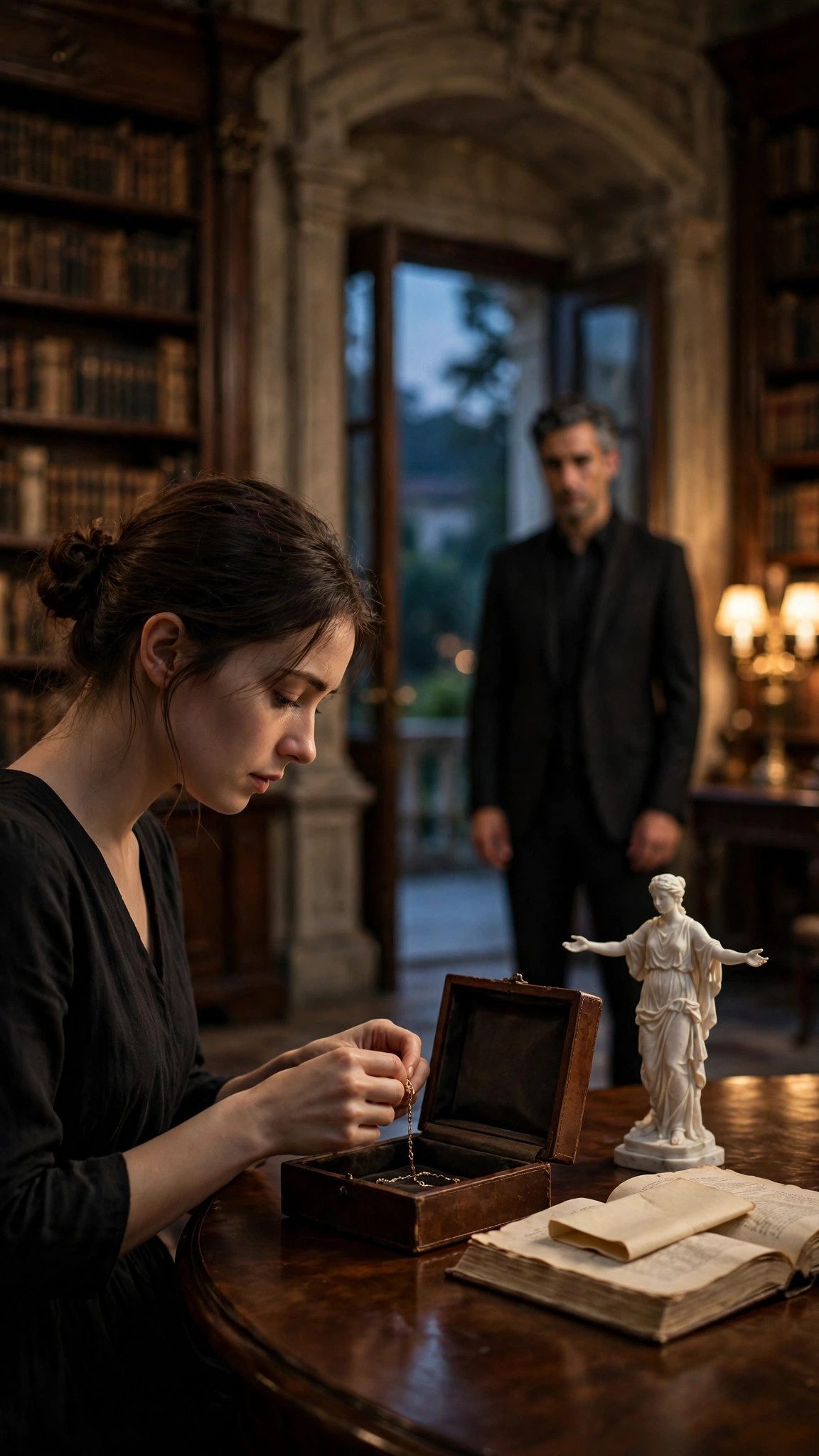
Inside the box was a necklace. Not a grand one — a simple silver chain with a small pendant shaped like a leaf. It was beautiful, and it was worth more than three months of her wages, and Giulia held it in her hands and understood, with a clarity that frightened her a little, that this was how he spoke. Raphael Carbone did not know how to say thank you. He did not know how to say you were right. He did not know how to say I listened to you. He knew how to give things. Gifts were his language, the only language the family had ever taught him.
She put the necklace on, because it would have hurt him to refuse it, and because it was beautiful, and because she told herself that a gift was only a gift, and that it meant nothing more than gratitude.
But the gifts kept coming. A dress, deep green silk, left folded on her bed with no note. A pair of earrings, small pearls, in a velvet box on the library table. A shawl, soft as smoke, draped over the back of her chair one cold morning. Each gift was chosen with a care that surprised her. He noticed things. He noticed that she liked green. He noticed that she never wore gold except for the bracelet. He noticed that she read late into the night and that her hands got cold, and so the shawl appeared, and she wore it, and she told herself again that a gift was only a gift.
The house noticed too. Rosa watched her with knowing eyes. The maids whispered. Old Tomas, the driver, smiled at her in a way that made her uncomfortable, as if he knew something she did not.
"You are the only person in this house who is not afraid of him," Rosa said to her one afternoon, while they shelled peas together in the kitchen. "Do you know that?"
"I am not afraid of him," Giulia said, and it was true. She had never been afraid of him, not from the first day on the stairs. She had seen the boy in him, the boy who had picked dandelions, and once you have seen the boy, the man is harder to fear.
"Then you are the only one," Rosa said. "And he knows it. That is why he gives you things. He does not know what else to do with a person who is not afraid."
The annual ball came that autumn, as it did every year. It was the family's great event, a night when the villa opened its doors to the city's important people, when the chandeliers blazed and the orchestra played and the champagne flowed, and when everyone who mattered came to show Raphael Carbone that they respected him. Giulia had helped prepare for it every year since she came to the villa. She arranged the flowers. She checked the table settings. She stood in the background, in her plain dark dress, and watched the glittering people move through the rooms like fish in an aquarium.
That year, something was different. A week before the ball, a dressmaker came to the villa, a thin woman with pins in her mouth and measuring tape around her neck, and she measured Giulia from shoulder to hem, and she did not explain why. Two days later, a dress arrived, wrapped in tissue paper, the color of midnight, silk that moved like water. Giulia held it up, and Rosa, standing in the doorway, clapped her hands together.
"He wants you at the ball this year," Rosa said. "Not in the background. At the ball."
Giulia wore the dress. She wore the silver necklace and the pearl earrings. She pinned her dark hair up the way Elena had once shown her, and she looked in the mirror, and for a moment she did not recognize herself. She looked like a woman who belonged in a ballroom.
Raphael found her at the top of the stairs, just before the first guests arrived. He stood at the bottom, looking up, and for a moment his face was not the face of the boss. It was the face of a man who had been given something he did not know how to hold.
"You look beautiful," he said, and his voice was quiet, almost rough, as if the words had cost him something to say.
"Thank you," Giulia said.
He offered her his arm, and she took it, and they walked down the stairs together, into the light and the music and the eyes of the whole room. And for one evening, Giulia let herself believe that this was a story with a simple ending: a man who had forgotten how to be kind, and a woman who had reminded him, and a house that had learned to breathe again.
She did not know then that the gifts were getting heavier. She did not know that each one was a stone added to a wall she could not yet see. She only knew that the music was playing, and that his hand was warm on hers, and that the boy who had picked dandelions was standing beside her in a black suit, trying, in the only language he knew, to say that she mattered.
That night, after the last guest had gone and the chandeliers had been dimmed, she found a marble statue on the table in the library. It was a small thing, a woman with her arms open, carved from white stone, and it was the most beautiful object she had ever seen. There was no note. There never was. But she stood looking at it for a long time, and she understood that he had given her the statue because he could not give her the words. And she understood something else, something that frightened her more than the gifts ever had: she was beginning to love him. Not the boss. Not the name that made rooms go quiet. Him. The man who left coffee cups outside study doors and who noticed that her hands got cold. And she did not know whether that love was a gift or a danger, only that it was there, growing quietly in the dark, like the roses in Elena's garden.
She learned how deep that love already ran on a rainy afternoon in March, when she heard shouting in the courtyard and went to the window to see one of Raphael's men, a broad-shouldered enforcer named Enzo, gripping a delivery boy by the collar and shaking him. The boy could not have been more than seventeen. A crate of wine lay shattered on the wet stones, red running into the gutters like blood, and the boy was crying and saying he was sorry, he was sorry, the crate had slipped, it had been raining, he had not meant it.
Giulia did not think. She went down the stairs and out into the rain, and she walked straight up to Enzo, and she put her hand on his arm, and she said, "Let him go."
Enzo stared at her. He was a man who had broken bones for the family, and he had never once been spoken to that way by a woman in a plain dress with rain in her hair.
"The boy broke a crate," Enzo said. "The boss will want to know."
"Then tell the boss that a crate broke," Giulia said, "and that the boy is seventeen, and that he is soaked to the skin, and that if you frighten him any further, he will never deliver anything to this house again, and neither will anyone else who hears about it."
She took the boy's arm, and she led him into the kitchen, and Rosa dried him with a towel and gave him hot tea, and Giulia paid for the broken wine out of her own wages, because she would not have the boy owe the family anything. When she came back out into the courtyard, Enzo was still standing there in the rain, looking at her the way a man looks at a door he has never noticed before.
"You are not afraid of me," Enzo said, and it was not a question.
"No," Giulia said. "Should I be?"
Enzo shook his head slowly. "No one has ever said that to me. Not ever. Not even the boss."
That evening, Raphael came to the library, and he stood in the doorway, and he said, "Enzo told me what happened in the courtyard."
Giulia looked up from her book. "And?"
"And Enzo has worked for this family for twelve years," Raphael said. "In twelve years, no one has ever stopped him from doing his job. Today, you stopped him. And he thanked me for it."
"He thanked you?" Giulia said, surprised.
"He said that for the first time in twelve years, he went home and felt like a man instead of a weapon," Raphael said. "He said it was because of you."
He came into the room then, and he sat down across from her, and for a while neither of them spoke. The rain was falling outside, and the fire was low, and the marble statue stood on the table between them, white in the firelight.
"My mother used to say that a house is only as good as the people in it," Raphael said quietly. "I never understood what she meant. I thought a house was walls and gates and men with guns. But she was right. It is the people. And you are the best person in this house, Giulia. I want you to know that I know it."
It was the closest he had ever come to saying what he felt, and Giulia felt her heart turn over in her chest, because she understood that he was trying, in the only language he knew, to tell her that she mattered more than the house, and more than the family, and more than the name that made rooms go quiet.
She reached across the table, and she put her hand over his, and his hand was warm, and it was still, and she said, "Then be the kind of man this house deserves. That is all I have ever asked of you."
Later that week, Giulia found Elena's garden journal in the library, tucked between two leather-bound volumes no one had opened in years. It was a small book, its pages soft with handling, filled with Elena's careful handwriting: notes about the roses, about when to prune them and when to feed them, about the lemon trees and the fountain and the exact week the dandelions came up in the spring. On the last page, in handwriting that shook a little, Elena had written: "A garden is like a man. If you only ever cut it back, it will grow hard and thorny. If you tend it gently, and you are patient, it will surprise you." Giulia pressed the journal to her chest, and she thought about the man across the table, and about the statue on the shelf, and about the boy who had picked dandelions, and she knew, with a certainty that settled over her like evening light, that Elena had left the journal for her to find, and that it was not really about the garden at all.