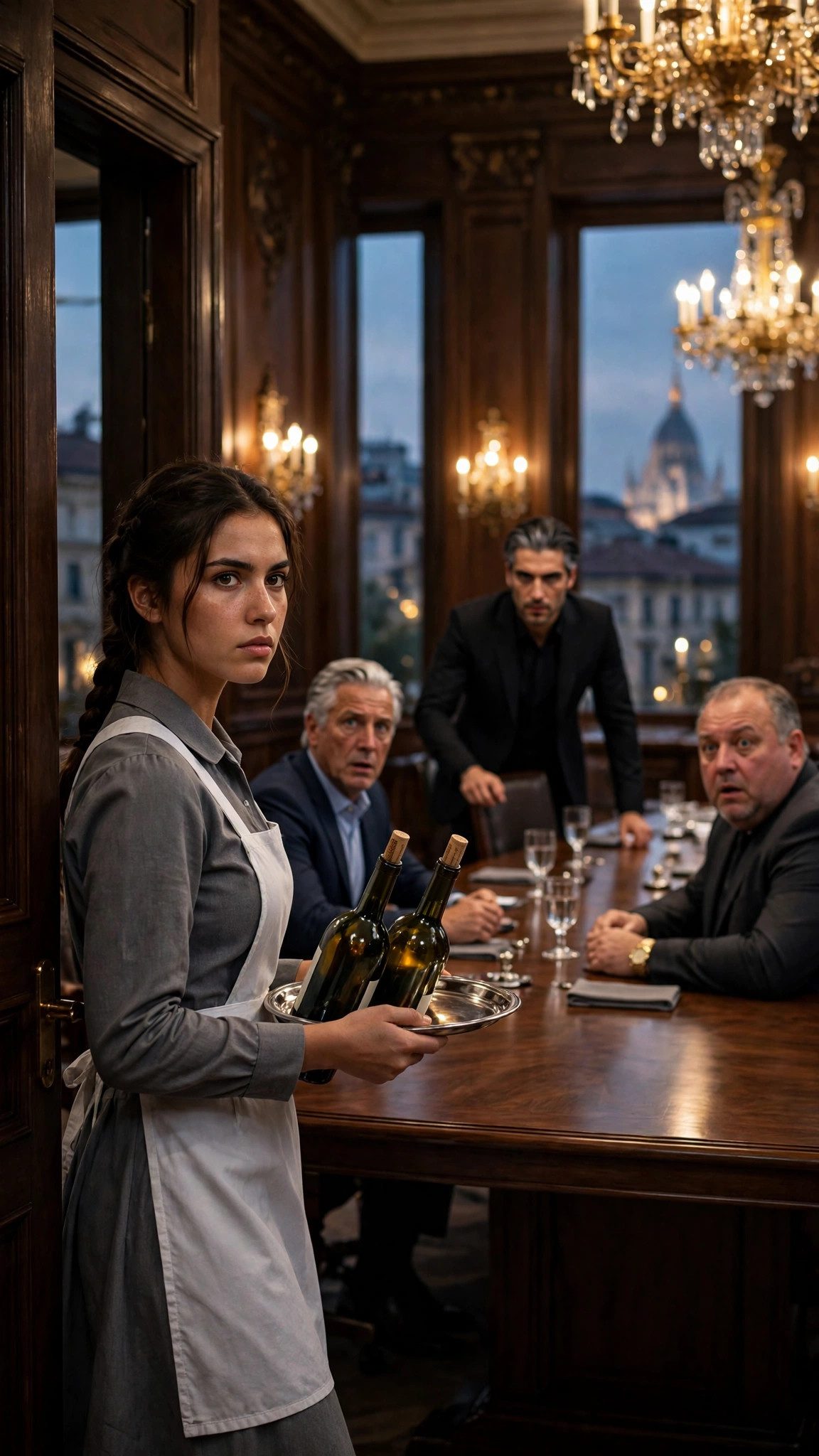
The morning after my sleepless night, I told Alessandro about the voice from Naples.
We were in his study, the door closed, the fire burning low. I told him what Rosa had heard in the garden, and what I had heard on the telephone, and why I believed Paolo had not acted alone. I told him that the mistranslations had been too perfect, too precise, and that someone else had chosen the words.
He listened the way he always listened, without interrupting, his hands flat on the desk, his eyes fixed on mine. When I finished, he stood up and walked to the window, and he stood there for a long time, looking out at the garden where his brother had once played as a boy.
"Naples," he said at last. "My brother died in Naples. Two years ago. A car bomb, outside a restaurant. The Castellanos denied it, and no one was ever arrested, and I have spent two years looking for the man who planted it."
"Do you think Paolo knew something about Enzo?" I asked.
"I think Paolo knew many things," he said. "And I think I sent him to Naples with a ticket and a warning, and that if the wrong men find him there, he will not live long enough to tell anyone what he knows."
He turned around. His face was hard, but his eyes were different. There was something in them I had never seen before. Not anger. Not suspicion. Something softer, and more dangerous.
"Lucia," he said, "I am going to ask you to do something that may put you in danger. If you refuse, I will understand, and you will keep your rooms, and your salary, and your place in this house. No one will think less of you."
"What is it?" I asked.
"Find the man from Naples," he said. "The man who was afraid. The man who told Paolo, 'They will kill me if you don't.' He is still in this house, or he comes to this house, and he knows who ordered the mistranslations, and he may know who killed my brother. You are the only person who can find him, because you are the only person in this house who listens."
I thought about Rosa's warning. I thought about my father's notebooks, and my mother's photograph, and the letter that said one day the world would need me. I thought about the three years I had spent being invisible, and how safe it had felt, and how small.
"I'll do it," I said.
He nodded, as if he had expected nothing else. "Then you will need protection. From today, a man named Enzo will be with you whenever you leave the house. Not the driver. A different Enzo. He is my most trusted guard, and he is loyal, and he is very good at his job."
"Enzo," I repeated. "Like your brother."
"Yes," he said quietly. "Like my brother. I named him myself, after Enzo died. He was my brother's best friend. He will keep you alive."
That afternoon, I met Enzo. He was thirty years old, broad-shouldered, with a scar through his left eyebrow and kind eyes that did not match the rest of his face. He shook my hand gently, as if he were afraid of breaking it, and he said, "Don Alessandro told me to keep you alive, signorina. I intend to do exactly that."
The next few days were the strangest of my life. I translated for Volkov's lawyers in the morning, and in the afternoon I walked through the house, listening. I listened in the kitchen, where the cooks gossiped in dialect. I listened in the garden, where the guards smoked and complained. I listened in the corridors, where the maids whispered about the new interpreter who used to be one of them. And I listened for a voice from Naples, a voice with an accent from the south, a voice that was afraid.
The next day was my first full day of listening as the Don's interpreter, and I learned that listening, when you are allowed to do it openly, is a very different thing from listening in secret.
In the morning, I translated for a German supplier, a stiff man from Hamburg named Herr Weber, who wanted to sell the family a fleet of refrigerated trucks. I spoke German with him for an hour, and I caught him trying to hide a clause about maintenance costs, and I translated it exactly, and Alessandro renegotiated the price on the spot, and Herr Weber left looking as if he had been robbed by a ghost.
In the afternoon, I walked through the kitchen, and I heard the cook's assistant, a thin boy named Matteo, whispering on his telephone in the pantry, selling the family's movements to a journalist for fifty euros a story. I told Alessandro. Matteo was gone by evening, with a warning and a month's wages, because Alessandro said a boy who sells gossip for fifty euros is a boy who has never been given anything better, and that the family should give him something better, or at least not destroy him for being poor.
That night, Alessandro found me in the library. I was shelving books, the way I always did when I could not sleep, and he stood in the doorway for a moment, watching me, and then he said, "My father kept this library locked. He said books made men soft. I think he was afraid of them."
"Books don't make men soft," I said. "They make men wide. There's a difference."
He smiled, and he came in, and he took a book from the shelf at random — a volume of Russian poetry, my mother's favorite kind — and he handed it to me. "Read me something," he said. "In Russian. I want to hear what it sounds like when it's beautiful."
So I read to him. I read Pushkin, the way my mother used to read it to me when I was small, and the words filled the dark library like music, and Alessandro closed his eyes, and when I finished, he was quiet for a long time.
"I don't understand a word," he said at last. "But I understand that it matters. My father never understood that. He thought power was the only language. You are teaching me that there are others."
He left then, and I stayed in the library for a long time, among the books, thinking about the man who had locked this room because he was afraid of softness, and the son who had opened it because he was learning to be wide.On the second day, I sat in on a dinner with two of the capos, translating nothing, only listening, because Alessandro had asked me to learn the sound of the house when it thought no one was paying attention. The capos argued about the docks in a thick Sicilian dialect, about which ships should be searched and which should be waved through, and I understood every word, and I wrote none of it down, and I remembered all of it. That evening, Rosa brought dinner to my rooms herself, a plate of pasta and a glass of wine, and she sat with me while I ate, and she said, "You are doing what your father did, Lucia. You are building bridges. He would be proud. Eat. You will need your strength."
On the third day, I found it.
I was in the library, shelving books that did not need shelving, because the library was the one room in the house where men went to be alone and to talk on the telephone, believing no one was listening. And a man was talking on the telephone, in a low voice, in Italian with an accent from Naples, and he was saying, "I did what you asked. The deal is dead. No — the girl saved it. The maid. She speaks Russian, she speaks everything, she heard — no, I don't know how she heard. Please. I did what you asked. Tell him I did what he asked."
I froze behind the bookshelf. My heart was beating so hard I was sure he could hear it. I pressed myself against the spines of the books, and I listened, and the man said, "Paolo is gone. They sent him to Naples. If they find him, he will talk. You have to —" And then he stopped. And then he said, in a different voice, a frightened voice, "Yes. I understand. I will be there tonight."
He hung up. I heard his footsteps cross the room. I heard the door close. I waited until I could not hear him anymore, and then I stepped out from behind the bookshelf, and I saw, on the desk where he had been standing, a glass of water, and a cigarette burning in an ashtray, and a photograph, face down.
I turned the photograph over. It was a picture of a woman and a small boy, standing in front of a house by the sea. On the back, in faded ink, someone had written: "Mama and Marco, Naples, 1987."
Marco. The name stayed in my head all afternoon. Marco, Naples, 1987. A man with a wife and a son, or a mother and a brother. A man who was afraid. A man who had been told to do something, and who had done it, and who was now being told to be somewhere tonight.
That afternoon, when I returned to my rooms, I found that someone had been inside them. Nothing was taken. Nothing was broken. But my father's notebooks, which I always kept in a neat stack on the desk, had been moved — the top one was now at the bottom, and a page I had marked with a ribbon was no longer marked. Someone had been looking for something. Or someone had wanted me to know that they could come in whenever they wished. I told Enzo. He searched the rooms, and he found nothing, and he said, "They are trying to frighten you, signorina. Do not let them." I straightened the notebooks. I put the ribbon back. And I understood, with a clarity that frightened me, that the men who had paid Paolo knew my name now, and knew where I slept, and that the next move would not be a search. It would be something worse.
That evening, I told Alessandro. I told him about the library, and the telephone call, and the photograph, and the name Marco.
He went very still. "Marco," he said. "There is a man in this house named Marco. Marco Bellini. He is my head of security for the docks. He has worked for me for six years. He has a wife and a son in Naples. His mother lives in a house by the sea."
"Then he is the man," I said.
"Or he is a man with the same name," Alessandro said. But his voice was flat, and I knew he did not believe that. "Tonight," he said, "he was told to be somewhere. Where?"
"I don't know," I said. "He didn't say."
Alessandro stood up. He walked to the door and opened it, and Enzo was standing outside, as if he had been waiting there all along.
"Follow Marco Bellini tonight," Alessandro said. "Do not let him see you. Find out where he goes, and who he meets. And Lucia —" He turned back to me. "Stay in the house tonight. Lock your door. Do not open it for anyone except Rosa or me."
I went to my rooms. I locked the door. I sat by the window, and I waited, and I thought about Marco Bellini, a man with a wife and a son in Naples, a man who was afraid, a man who had done what he was told because someone had threatened the people he loved. I thought about my own parents, and the rainy night on the autostrada, and the way the world can take everything from you in a single moment, and I wondered if Marco had been given a choice at all, or if he had simply been a man with a gun to his family's head, doing what any man would do.
Late that night, there was a knock on my door. Three knocks, soft and quick. I froze. I did not move. The knock came again.
"Lucia," Rosa's voice said, low and urgent. "Open the door. Quickly."
I opened it. Rosa came in, her face pale, her dressing gown pulled tight around her.
"Enzo is back," she said. "Marco went to the old warehouse by the docks. He met a man there. A man from Naples. And Lucia —" She took my hand, and her hand was shaking. "The man from Naples told Marco that Paolo is dead. They found him at the station. And they told Marco that if he talks, his wife and his son will be next. And then the man said something else. He said, 'The girl is the problem now. The girl who hears everything. Take care of her, or we will.'"
I sat down on the edge of my bed. My legs would not hold me.
"Alessandro knows," Rosa said. "He has doubled the guards. Enzo is outside your door right now, and he will stay there all night. But Lucia, child, you must understand something. The men who killed Paolo are the same men who killed the Don's brother. And they are not afraid of the Don. They are afraid of you. Because you are the one person who can hear them."
I looked at her. I looked at the small room, and the window, and the garden beyond it, dark and still.
"Then they will come for me," I said.
"Yes," Rosa said. "They will. And when they do, you must be ready."
I nodded. I did not sleep that night. I sat by the window, my father's notebooks open on my lap, and I listened to the house, and I waited for the morning, and I thought about what my mother had written in her letter, that one day the world would need me.
The world needed me now. And the world, it turned out, was coming to kill me for it.