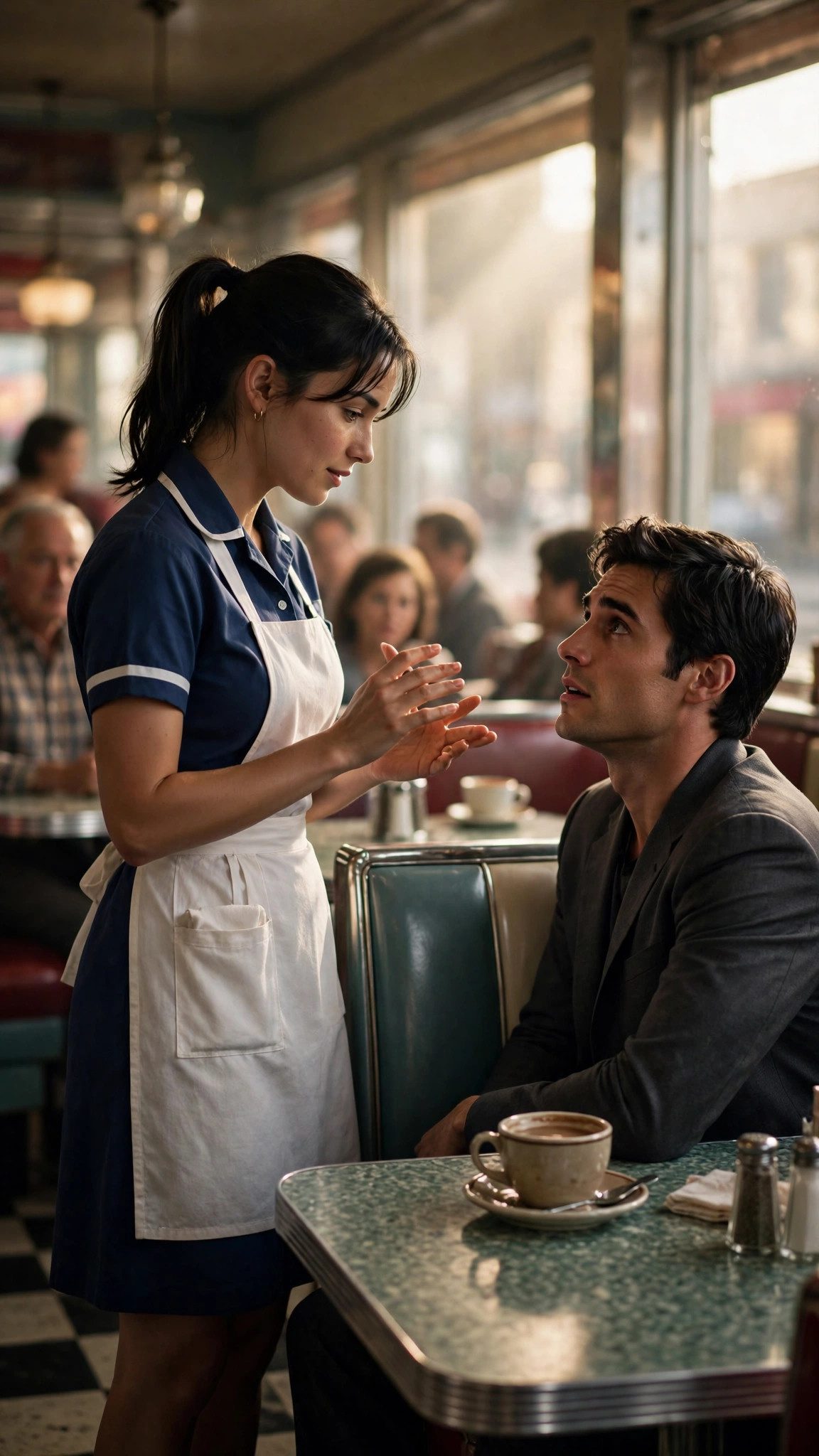
The family sit-down happened on a Friday night, in a private room at a restaurant on the other side of the city, a room with no windows and one door and a long table with twelve chairs. I wasn't there. I didn't need to be there. Tommy told me everything the next morning, sitting in the back booth of the diner with a cup of coffee going cold in front of him, his voice low and his eyes tired.
"Salvatore walked in at eight o'clock," Tommy said. "Enzo was already there, sitting at the head of the table, like he owned the place. The other capos were there. The lawyers were there. Everybody who matters in the family was in that room. And Salvatore, he didn't sit down. He stood at the end of the table, and he looked at Enzo, and he didn't say a word. Not one word. He just stood there, and the room went quiet, because when Salvatore Marquetti stands in a room and doesn't speak, everybody listens."
Tommy took a sip of his coffee. "Then Salvatore lifted his hands, and he signed. And I translated, because I am the only one in that room, besides Salvatore, who speaks sign language. And I translated every word, exactly as he signed it, and I watched Enzo's face go white."
"What did he say?" I asked.
"He said, 'Enzo Falcone, you paid a man fifty thousand dollars to kill me. You gave him my schedule. You told him I come to the Whitfield Diner every day at eleven forty, and you told him I would never hear the gunshot coming. You told Vincent Castellano that the Marquetti family was yours to sell. And you were wrong. About all of it.'"
Tommy set his cup down. "And then Salvatore put the evidence on the table. The phone records, showing forty-seven calls between Enzo and Castellano in the last three months. The bank transfer, fifty thousand dollars from Enzo's shell company to Danny Cole's account, two days before the shooting. Danny Cole's written confession, signed in front of two police detectives. And a photograph, from a security camera, of Enzo meeting Castellano in a parking garage on a Tuesday night, shaking his hand like they were old friends."
I stared at him. "What did Enzo say?"
"He tried to deny it," Tommy said. "He said the phone calls were business. He said the bank transfer was a loan. He said Danny Cole was lying to save himself. He said all of it very loudly, and very fast, and nobody in the room believed him, because Salvatore just stood there, quiet, and let the evidence speak for itself. And then Salvatore signed one more thing, and I translated it, and the room went so quiet you could hear the air conditioning."
"What did he sign?" I asked, my voice barely a whisper.
"He signed, 'I am deaf. I have been deaf since I was seven years old. And in all the years I have run this family, I have never once needed to hear a man lie to me to know that he is lying. I can see it in his hands. I can see it in his eyes. I can see it in the way he cannot sit still. And I can see it in you, Enzo. I have always been able to see it. I just chose not to, because you were my father's friend, and I thought loyalty meant something to you. I was wrong. Loyalty means nothing to you. Money means everything. So here is what is going to happen. You are finished in this family. You will leave Chicago by dawn, and you will never come back. Your men will stay, and they will work for me, and they will be treated fairly, because they are not guilty of your crimes. And if you ever come back, if you ever contact Castellano again, if you ever come near my family, or my business, or the Whitfield Diner, or Valentina Cruz, I will not be merciful a second time.'"
Tommy was quiet for a moment, and then he said, "Enzo stood up, and he looked around the room, looking for someone to stand with him, and nobody stood. Not one person. The capos looked at the table. The lawyers looked at their papers. And Enzo walked out of that room alone, and by dawn, he was gone. Exiled. Finished. And the family voted, right there, that night, to stand behind Salvatore. All twelve of them. Unanimous. Because for the first time in eleven years, they had seen their boss stand up in a room and speak the truth, without raising his voice, without firing a gun, without anyone dying. And they realized that the deaf boss was not weak. He was the strongest man in the room."
I felt tears sting my eyes, and I didn't try to stop them. "And Castellano?" I asked.
"Castellano is next," Tommy said. "The FBI has the evidence now. The phone records. The bank transfers. Danny Cole's confession. Agent Daniel Reyes, the one who has been building a case against Castellano for two years, he has everything he needs. It is only a matter of time."
"And the diner?" I asked. "What happens to the diner?"
Tommy smiled then, a real smile, the first one I had seen from him in days. "That is the best part, Miss Cruz. After the sit-down, after Enzo was gone, Salvatore stood in front of the whole family, and he signed something else, and I translated it, and I want you to hear it exactly as he said it, because it was about you."
"What did he say?" I asked.
"He said, 'There is one more thing. The Central Illinois Collection will not be buying the Whitfield Diner. The gallery will be built around it, not through it. The diner stays. And Mr. Whitfield, when he is ready to retire, will sell the diner to someone who loves it as much as he does. I have already spoken to my lawyers. The diner will have a twenty-five-year lease, at one dollar a year, and the woman who runs it will be Valentina Cruz, who saved my life, and who taught this family something I could not teach them myself: that silence is not weakness, and that the people who show up every day are the people who matter most.'"
I sat there in the back booth of my diner, with Tommy across from me and the coffee going cold between us, and I cried. I cried for the diner, and for Mr. Whitfield, and for my mother, and for Chris, and for Salvatore, and for all the years I had spent showing up every day, not knowing if anyone would ever notice.
And then I wiped my eyes, and I stood up, and I went back to work, because that is what I do. I show up.
That night, Salvatore came to the diner after closing time. He knocked on the door, and Mr. Whitfield let him in, and the three of us sat at table twelve, with the chairs up on the other tables and the lights low, and Salvatore signed to Mr. Whitfield, through me, because Mr. Whitfield doesn't sign, and I translated, the way I had translated for my mother at Chris's school meetings when I was fifteen years old.
"Mr. Whitfield," Salvatore signed, "I want to thank you. For forty-one years, you kept this diner open. For ten years, you gave Valentina a job. For three weeks, you let me sit in your booth and eat your eggs. And I want you to know that this diner will never close. Not while I am alive. Not while Valentina is alive. I have signed the papers. Twenty-five years. One dollar a year. And when you are ready to retire, you will retire knowing that this place is safe."
Mr. Whitfield looked at me, and then he looked at Salvatore, and then he did something I had never seen him do in ten years. He cried. Just for a second. Just one tear, running down his weathered face, before he wiped it away and pretended it never happened.
"Thank you," he said, his voice rough. "Thank you. I didn't think I would live to see this day. I thought I would die with a for-sale sign in my window. And now, because of you, and because of Val, this diner is going to outlive me. That is the greatest gift anyone has ever given me."
Salvatore nodded, and then he turned to me, and he signed, "Valentina, I have one more thing to ask you. Not as a boss. As a man. Will you be the manager of this diner? Not just a waitress. The manager. With a share of the ownership. With the power to hire, and to fire, and to change the menu, and to paint the walls any color you want. Will you take this diner, and make it yours?"
I looked at him, and I looked at Mr. Whitfield, and I looked around the dark, quiet diner, at the counter and the booths and the coffee machine and the window that was still boarded up, waiting for new glass, and I felt like my heart was going to burst out of my chest.
"Yes," I signed, and my hands were steady now, steady as they had ever been. "Yes. I will."
And Mr. Whitfield laughed, a big, warm laugh that filled the whole empty diner, and he said, "Well, it's about time. I've been waiting ten years for someone to say yes to this place. And Val, you are the only person I would ever trust with it."
We sat there for a long time, the three of us, in the dark diner, talking and signing and laughing, and for the first time in my life, I felt like I had a future that was bigger than just surviving. I had a diner. I had a brother with a job. I had a mother who could finally rest. And I had a man who had looked at my hands and seen a language, and who had decided that the diner where it happened was worth saving.
But there was still one thing left. One man left. Vincent Castellano. And until he was gone, none of us would be truly safe. I knew it. Salvatore knew it. And we both knew that the next chapter of this story would be the hardest one of all.
It took three weeks. Three weeks of waiting, and watching, and jumping every time the bell over the door rang. Three weeks of Salvatore's men sitting at the counter, pretending to be truck drivers, watching the door. Three weeks of me checking every stranger's jacket, every hand that drifted too close to a pocket, every man who didn't order.
And then, on a Tuesday morning, Tommy came into the diner with a newspaper in his hand, and he laid it on the counter in front of me, and he pointed at the headline.
"CASTELLANO ARRESTED IN FEDERAL RAID," it said. "Rival Crime Boss Charged With Conspiracy, Attempted Murder."
"He is gone," Tommy said, his voice quiet and full of relief. "Agent Daniel Reyes arrested him at his office this morning, in front of all his lawyers. The FBI had everything. The phone records. The bank transfers. Danny Cole's confession. Enzo's testimony, from wherever he is now, because he gave it to them in exchange for a lighter sentence. Castellano is facing life in prison. No parole. It is over, Miss Cruz. It is finally over."
I read the headline twice, just to be sure, and then I read it a third time, and I felt something in my chest let go, something I had been holding tight for weeks, something I hadn't even known I was holding. I felt safe. For the first time in weeks, I felt safe.
That same week, Chris started his job at the gallery. I drove him there on his first morning, and we stood outside the big glass building downtown, with the Central Illinois Collection sign over the door, and he was wearing a new suit that Salvatore had bought him, and he was so nervous his hands were shaking.
"What if they don't like me?" he signed.
"They will love you," I signed back. "You are the smartest person I know. And you are the only person in that building who can talk to a deaf child and make them feel like art is for them too. That is not a small thing, Chris. That is everything."
He took a deep breath, and he nodded, and he walked through those glass doors, and I stood on the sidewalk and I watched him go, and I thought about the little baby my mother had brought home from the hospital nineteen years ago, the baby who couldn't hear, the baby I had promised to protect, and I thought about how far he had come, and how far we had all come, and I cried, right there on the sidewalk, in front of the whole city, and I didn't care who saw me.
That evening, Salvatore took me to a place I had never been before. A cemetery, on a hill outside the city, where the grass was green and the trees were old and the air smelled like rain. He led me to a grave, a simple stone with a woman's name on it, and he knelt down in front of it, and he put his hand on the stone, and he signed, not to me, but to the stone, to the woman buried beneath it.
"Mama," he signed. "I brought someone to meet you. Her name is Valentina. She works at the Whitfield, the diner where you used to take me for pancakes. She speaks sign language, Mama. She learned it for her little brother, who is deaf like me. And she saved my life, Mama. She saw a gunman, and she signed to me, and I am alive because of her. And I love her, Mama. I love her, and I think you would have loved her too."
I stood behind him, crying quietly, watching a man who had never once raised his voice to me kneel in front of his mother's grave and sign his heart out to the sky, and I understood, finally, what silence really was. Silence was not emptiness. Silence was not weakness. Silence was a language, and it was a love, and it was a life, and Salvatore Marquetti had spent thirty-three years speaking it to a world that refused to listen.
And then he stood up, and he turned to me, and he took my hands, and he signed, "Thank you for coming with me. I have never brought anyone here before. Not in fourteen years. You are the first. And Valentina, there is something I want to ask you, but not here. Not in front of my mother. Somewhere else. Somewhere that is ours."
"Where?" I signed.
"You will see," he signed, and he smiled, a small, secret smile, and he took my hand, and we walked back through the cemetery together, hand in hand, in the rain, and I had never felt so happy, or so afraid, or so alive, in my entire life.