I woke up on the cot in the back room with my son's white cane digging into my ribs and the smell of fresh paint in my nose.
For a moment I didn't understand the paint. Then I remembered the night before — the glass, the shouting, the sound of the front window giving way — and I sat up so fast the room tilted. Noah was asleep beside me, one hand fisted in the hem of my shirt, breathing the slow, even breath of a child who had decided the world was safe again because I had told him so.
The door to the shop was open a crack. Through it I could hear men talking in low voices, the scrape of a ladder, the whine of a drill being used gently, the way you'd use a drill in a house where a child was sleeping.
I got up, tucked the blanket around Noah, and went out front.
My gas station had been put back together overnight.
The shattered window was new glass, so clean I could see the pumps doubled in it. The shelves that Caruso's men had knocked over stood straight and stocked. Someone had swept, mopped, and repainted the scuffed wall by the register. A crew of three men in work clothes was finishing the trim around the doorframe, and outside — parked at angles that looked casual and weren't — were two dark cars with Ethan's men in them, men who nodded at me like I was somebody's wife.
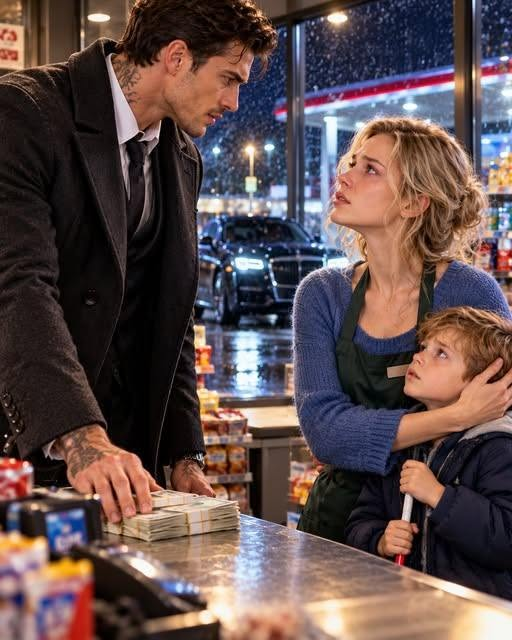
Ethan was behind my counter. My counter. He had a screwdriver in his hand and the register's side panel open, and there was a smear of dust across the front of a shirt that probably cost more than my car.
"You fix registers now?" I said.
His head came up. He looked like I felt — like the night had taken something out of him that sleep hadn't given back. "The drawer was sticking before they ever touched it," he said. "It wasn't the attack. It's just old."
"It sticks if you slam it. It works fine if you don't."
"I'll remember that." He set the screwdriver down with more care than it needed. "Claire. The crew leaves when they're done. The men outside stay until I say otherwise. That's not a discussion I'm having with you this morning — that's just me telling you what's true."
A week ago I would have fought him for the tone alone. That morning I poured two cups of coffee from the pot his men had apparently also replaced, and I put one in front of him, and I said, "Okay."
He looked at the cup like it might be a trick. Then he wrapped both hands around it, and for a while neither of us said anything, and the quiet wasn't the kind we'd had in this store before. It was just tired. We were just two tired people standing in the wreckage of everything we'd done to each other.
"I'm sorry," I said first, because I'd had seven years to practice and he'd only had one night. "Not for leaving — I'd leave again, Ethan, if the choice was the same, and I need you to hear that from me plainly. I'm sorry for how I did it. I stood in the rain and I made it as cruel as I could make it, on purpose, because I needed you to believe it and a clean break wouldn't have fooled anyone watching. I told you loving you was a mistake. I've thought about your face when I said that — I have thought about it every single day for seven years, and I am sorry, I am so sorry, for the words I chose."
His jaw worked. "You were eighteen. You were a kid with a gun to your head that I couldn't see."
"I was still the one who said them."
"Yeah." He turned the cup in his hands. "You were. And I've used them every day since to build — " He stopped. Gestured, once, at the store, the cars outside, himself. "All of it. I built all of it on what you said in the rain. So when I walked in here and saw you in that apron, scanning cigarettes — Claire, I didn't come in here to buy anything. I came in here to win. The money on the counter. That was me winning. Five hundred dollars to prove the poor kid from the trailer park could buy and sell the girl who wanted a richer man." His voice dropped. "And 'congratulations.' I said that to a mother holding her blind six-year-old in a freezing store, and I'd like you to know I've heard myself say it about four hundred times since. I'm sorry. For the money and for that word most of all."
"You didn't know about Noah."
"I knew enough to be better than I was." He met my eyes then, and held them. "I'm not going to keep saying it until it stops meaning anything. But it needed saying once, properly."
"It did," I said, and my eyes were burning, and neither of us pretended otherwise. "Thank you."
Lucas came in at nine with a folder under his arm and the particular expression of a man who has been up all night moving pieces off a board. He waited until Ethan nodded before he spoke, and what he said, he said to both of us, which I would remember later as the moment I stopped being a problem Lucas managed and became someone he reported to.
"Vince Caruso was taken into federal custody at four this morning," he said. "His own people rolled on him before the cars were even cold — two of them were wearing wires and had been for months. But that's not the part that matters." He put the folder on the counter and slid it toward Ethan. "The part that matters is Blake."
I think my heart actually stopped. "Blake?"
"Blake Caruso walked into the FBI field office in Philadelphia yesterday evening with his father's books. Seven years of them. Ledgers, recordings, names, accounts — everything, going back to before you two were eighteen." Lucas looked at me, and there was something almost gentle in it. "The Bureau's had an open seat at that table for a decade, ma'am. He sat down in it. Vince is finished. And the doctors at the federal medical center say he's dying on his own schedule regardless — the cancer's in his liver and his lungs. He'll be dead before a trial could have started. Weeks, they said. Maybe less."
The store was very quiet. The drill had stopped. One of the workmen was pretending hard not to listen.
"It's over?" I said. It came out smaller than I wanted. "The — all of it. It's actually over?"
"The threat to you was Vince Caruso," Lucas said. "Not the organization — him, personally. And he's in a locked ward with federal marshals on the door and his own son handing the government the keys to everything he built. Whatever's left of his outfit is going to spend the next decade running from indictments. Nobody's coming to a gas station in Pennsylvania, ma'am. Not ever again."
I put my hand flat on the counter because the room had gone slightly unsteady. Seven years. Seven years of locks and drawers and looking over my shoulder in parking lots, and it ended not with a bang but with a man in a hospital bed and his son in a federal office, and Lucas Grant saying ma'am.
Ethan hadn't moved. He was looking at the folder, and something in his face I recognized from when we were kids — the look he got the one time he talked about his stepfather, flat and far away. "Where is he?" he said.
"Ethan," Lucas said carefully.
"Which hospital. Which floor. Don't make me ask twice."
Lucas told him. Of everything in that day, that's the part I've turned over most since: Lucas told him. No argument, no delay. Whatever passed between them in that look was older than me and deeper than my history with either of them, and Ethan stood up, took his coat off the back of my register stool, and walked out to his car, and I watched seven years of careful survival stand up and walk out the door with him.
"Claire," Lucas said quietly, when the sedan pulled away. "Don't."
"Don't what?"
"Don't assume." He picked up the folder. "I don't know what he's going to do. But I watched him read a hospital receipt last night and put his gun on your counter with the safety on, and I have never — in nine years, I have never seen him put it down before a thing was finished. So don't assume."
He was gone four hours.
I worked. I don't know how. I sold gas and cigarettes and a gallon of milk; Noah sat on his stool behind the counter and counted the beeps of the scanner and announced every total like a game-show host; the workmen finished and left and Ethan's men rotated in silence outside. And at a little past one, his car came back down the road at exactly the speed limit, and he parked it the way ordinary men park cars, and he came through the door of my store with his hands empty and visible.
I didn't trust my voice, so I didn't use it. He came around the counter. He stopped close enough that I could see how exhausted he was, how red his eyes were, and he said, "I sat in that parking garage for three hours."
"Ethan — "
"Marshals let me get as far as the elevator. I want you to understand that I could have gotten further. There are men in that building who owe me their whole lives, Claire. One phone call. That's all it ever was going to take." He swallowed. "I sat there and I did the math every way I know how. And every way I did it, I kept seeing the same thing. Noah, older. Noah at ten, at fifteen, asking where I go on the anniversary of a date he doesn't understand. Noah figuring out what his father is from the shape of what's missing." His voice broke on the next words and he let it. "My son is not growing up visiting graves. Not Vince's, and not — " He stopped. "I called Lucas from the garage and I called it off. All of it. Vince dies in a bed the government pays for, with the government watching, and the law can have what's left of him. Let them have him. He's not worth my son having that kind of father."
I put my arms around him in the middle of my gas station, in front of the cigarette rack and the whole trembling world, and Ethan Hale — who men twice his age feared, whose name emptied rooms — put his forehead down on my shoulder like the eighteen-year-old boy in the rain, and shook, once, and then was still.
"Okay," I said into his hair. "Okay. Come home. There's somebody who wants to inspect you."
Because that's what Noah had called it. When I'd told him, that morning, that Ethan would be around the store — that Ethan was, in the careful words we'd chosen, his father — my son had considered this with the gravity of a building inspector and announced that he would have to inspect him. That evening, Ethan Hale reported for duty at Miller's Fuel & Grocery at six o'clock sharp, in a plain dark sweater with the sleeves pushed up, and submitted to inspection.
It was the most serious I've ever seen him take anything, including the night before.
"Stand there," Noah said, pointing at a spot on the floor he'd chosen by some private mathematics. "Don't move. I'm counting."
Ethan stood. Noah walked the length of the store and back with his cane sweeping, unhurried, and then came and stood in front of Ethan and held up his hand. "Footsteps," he said. "Walk to the cooler and back. Normal."
Ethan walked to the cooler and back.
"Eleven there, eleven back," Noah said. "You walk loud on the left. Mommy walks seven. Lucas walks nine but he's quicker." He said it the way other children recite state capitals — pure data, proudly held. "Now hands."
I watched Ethan kneel — actually kneel, on my swept floor, in front of a six-year-old — and hold out his hands. Noah took them with the unhesitating confidence of a boy who has read the world by touch since birth, and his small fingers moved over Ethan's hands the way mine used to move over piano keys: knuckles, calluses, the ridge of a scar, and then the tattoo that ran down from Ethan's wrist, raised ink under the skin.
"Pictures," Noah said, with deep satisfaction. "You have pictures on your skin. Mommy said. What are they?"
"An anchor," Ethan said hoarsely. "Here. And a date, here, in numbers. And this one's a compass rose — it's like a star that shows you which way is north."
"Why do you need it on your hand?"
"So I don't get lost going home."
Noah considered this a completely reasonable answer, and moved on to the important work: the store. For the better part of an hour my son led the most feared man in Chicago around a failing gas station by the hand and taught him where things lived. "Cleaners are here — smell first, they smell like lemons, don't drink them. The milk is the cold door that hums. Candy is low because of children. That's the rule. The counter bell is for pressing when Mommy can't hear you, and you are only allowed if it's real." And Ethan learned it the way Noah taught it — by touch, by smell, by counting steps — and asked questions, and got corrected, and was grave and diligent and once, turning too fast at the end of the chip aisle, knocked into a display he'd been specifically warned about, and stood there in the raining chips saying, "Inspector. I've had an accident in aisle two," in the voice of a man confessing to a crime, and Noah laughed so hard he had to sit down on the floor.
I laughed too, standing in the doorway with my arms folded, and some time during it I realized that my shoulders had come down from around my ears, possibly for the first time since I was eighteen.
There was one more thing that day, and it came from Ethan, and it came the way he now did difficult things: directly, and before he could lose his nerve about my answer.
He'd made calls, he said. Dr. Amara Okafor, at the children's hospital in Pittsburgh — a name pediatric ophthalmologists said to each other the way mechanics say the name of the one man who can fix anything. Ethan had gotten Noah's records sent over, with my signature forged by no one — he'd left the consent forms on the counter that morning like a coward, he admitted, where I'd find them next to the register — and Dr. Okafor had reviewed them and called him back herself. Noah's blindness was retinal damage from being born too early; the retinas had never finished the work they were supposed to do. There was a surgery — not a miracle, she had been careful to say. A window. If it was done in the next few months, while Noah's visual pathways were still young enough to learn, there was a real chance — she would not put a number on it over the phone, she said, but she had used the word real — of partial sight. Shapes. Light and shadow that meant something. Maybe faces, one day, at close range. The window would not stay open. It was already, slowly, closing.
"She'll do it," Ethan said. "I asked who the best pair of hands in the country was and her secretary laughed at me, Claire. She said I was already talking to her office. Whatever it costs — it doesn't matter. It's nothing. Don't look at me like that."
"Like what?"
"Like I'm buying something." He turned his coffee cup in a full slow circle. "I know what you're doing. You're adding it up. You're deciding what it costs you to let me do this, and whether you can afford to owe me. So I'm going to say this once and then you can argue and I'll listen. This is not my gift to you, and it's not a debt, and it's not a price. It's Noah's. It belongs to Noah the same way his name does. A father pays for his son's surgery the way a father buys his son shoes — it's not generosity, it's just the job, and I am seven years behind on the job. You don't owe me anything for it. You couldn't owe me anything for it. It's his."
I argued anyway, because I didn't know how to just be handed a thing like that — I'd run my whole adult life on a ledger where every kindness had a column, because the one time I'd let someone pay my costs, a man named Vince Caruso had presented the bill. And Ethan listened, all of it, the whole shaking inventory of my pride, and when I ran out he said, "You kept him alive for six years on a cashier's pay. You kept him happy. Listen to him, Claire — he's the happiest person I've ever met, and I've met men who own islands. I am not rescuing anybody in this family. I'm applying for a position in it. There's a difference, and the difference is that you're in charge."
I signed the forms. My hand shook so badly on the second one that the signature looked like a stranger's, and Ethan pretended not to notice, and took them, and folded them into his coat like something precious rather than something legal.
We closed the store together at nine. Noah was asleep in the back room before the lights were half out — worn clean through by the serious business of inspecting a father. Ethan carried in the sidewalk sign. I locked the drawer he'd fixed, which no longer stuck, which I did not comment on. And then I stood in the back-room doorway to check on Noah one last time, and Ethan came up behind me, quiet in his socks — eleven steps, loud on the left; I'd counted without meaning to — and we stood there together looking at our son asleep on the cot with his cane beside him like a knight's sword.
Noah stirred. His hand came up out of the blanket, small and certain, moving the way his hands always moved — reading the air. Ethan, without a word, eased past me and knelt by the cot and put his tattooed hand, palm up, compass rose and anchor and all, within reach of those searching fingers.
Noah's hand found it. Closed around it. And my son, half in a dream, his eyes not open because his eyes had never needed to be, smiled in his sleep and said, clear as anything:
"You sound like the man in Mommy's stories."
I had told him those stories for six years. Every night of his life, in the dark, I had told him about a boy who lived in a trailer by the railroad tracks, who was brave and funny and kind, who fixed things with his hands and promised a girl the whole world and meant it, who was far away and couldn't come — but who was, I always said, the best man I had ever known. I had never said the word father. I had never needed to. Noah had kept him the way I kept him: by voice, in the dark, where we could both hold him safely.
Ethan didn't move. His shoulders started to shake, silently, his tattooed hand held prisoner by six small fingers, his face turned down toward the boy he'd met the day before yesterday.
And I stood in the doorway and cried — and it was different, it was nothing like the crying I'd done in this room for seven years, on this cot, in this dark. This time it didn't hurt. This time it was the feeling of a window, somewhere deep in the architecture of my life, finally, quietly, opening.
"Yeah, buddy," Ethan whispered. "I'm going to be around to hear the rest of them."