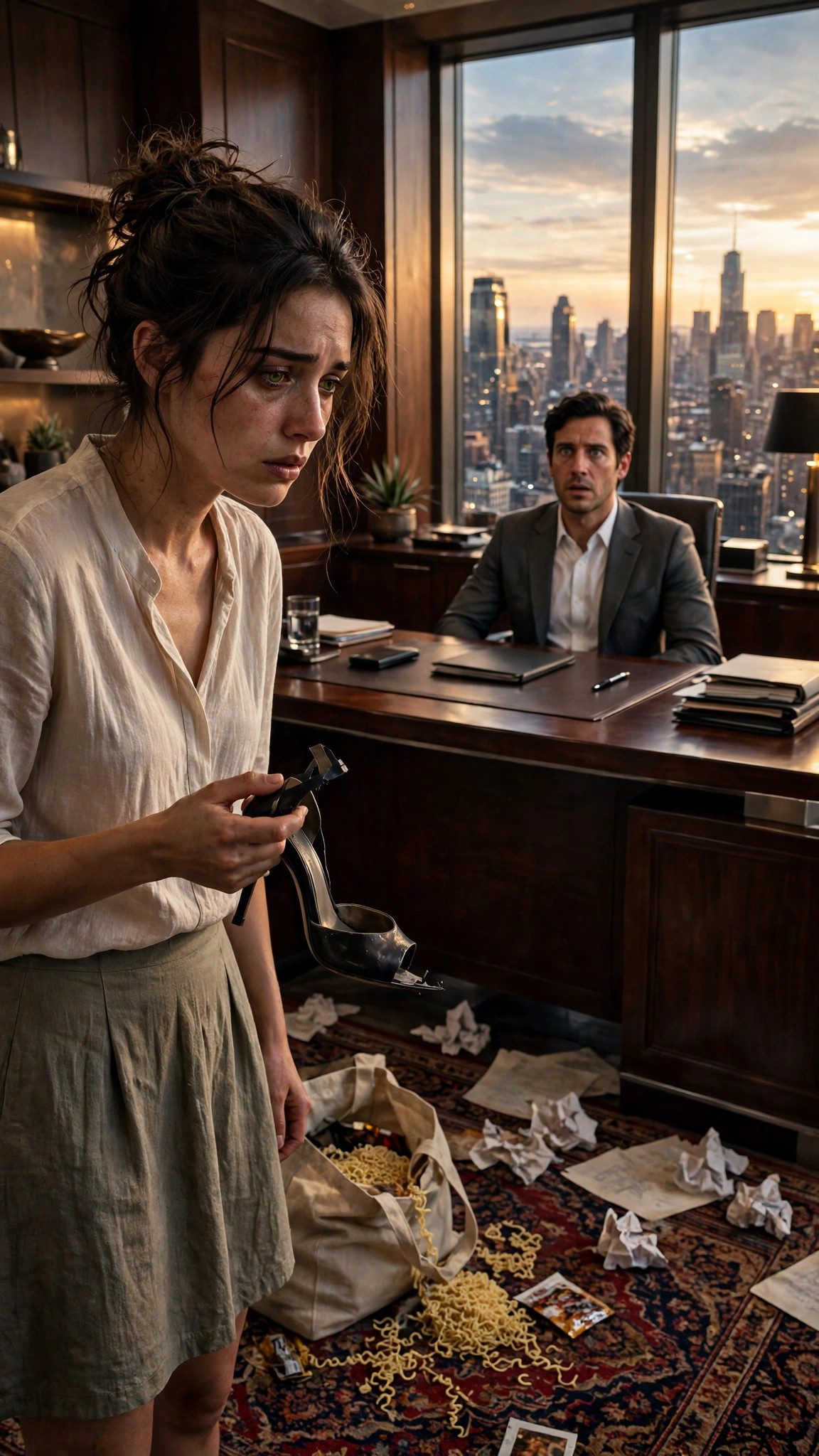
Seventeen assistants had already been fired before I walked into Lorenzo Conti's office wearing one broken heel and accidentally called him Leonardo.
I know that now. I did not know it then. Then, all I knew was that the subway grate on Eighth Avenue had eaten my shoe, my mother's insurance company had eaten five hours of my morning, and the man behind the desk in front of me was the most frightening person I had ever seen in my life, and I was too tired to be properly afraid of him.
He was staring at me the way rich men stare at problems they have already decided how to solve. He did not stand up. He did not offer his hand. He sat behind a desk the size of a small car, in a charcoal suit that probably cost more than six months of my rent, and he looked at my ruined shoe, and then at my face, and then he said nothing at all for a very long time.
Silence, I would learn, was Lorenzo Conti's favorite weapon. He used it the way other men used shouting. He let it sit in the room and grow until the person across from him started apologizing for things they had not done, confessing things they had not meant to say, and agreeing to things they had not meant to agree to. It was a good weapon. It was a patient weapon. It did not work on me, because I had spent the morning arguing with an insurance company about my mother's medication, and I had nothing left in me to give to silence.
"Do you know who I am?" he finally asked.
"You're the man paying six thousand dollars a month for a glorified secretary," I said. Then I frowned, because something about him was wrong, something about the shape of his face and the set of his jaw, like a photograph I had seen once and forgotten. "Leonardo?"
His eyes narrowed. Just a fraction. Just enough for me to notice, and to wish I had not noticed.
"Lorenzo," he said. "Lorenzo Conti."
My tote bag chose that exact moment to fall over. It slid off my shoulder, hit the edge of his Persian rug, and spilled everything I owned across the floor of his immaculate office: two packets of ramen noodles, a bottle of aspirin, a granola bar, a hair tie, three pens that did not work, and a stack of my mother's medical bills, held together with a rubber band that had seen better days.
I dropped to my knees and shoved everything back inside, my face burning. I could feel him watching me. I could feel the whole room watching me, the glass walls and the skyline and the men in the outer office who had gone very quiet.
"I spent five hours arguing with her insurance company this morning," I said, without looking up, because if I looked up I would have to see his face, and his face was doing something to my nerves. "They denied coverage for her medication. Again. So I'm highly caffeinated, deeply irritated, and I really need this job."
He glanced down at my bare foot. My left shoe was gone — the heel had snapped clean off in the subway grate and I had left the whole ruined shoe in a trash can on Eighth Avenue, because there was no point carrying a dead shoe to a job interview.
"You're missing a shoe," he said.
"Excellent observation," I said.
I pulled a pair of black flats out of my bag, put them on, and pointed at the filing cabinet in the corner, which looked like it had been hit by a small explosion. Papers stuck out of every drawer at wild angles. A stack of folders leaned against it like a drunk against a lamppost.
"Do you want me to fix that?" I asked.
For some reason, he hired me.
That was the hook. That was the beginning. But a beginning is never really the beginning, and if you want to understand how a woman ends up calling the most dangerous man in New York by the wrong name in his own office, you have to start earlier. You have to start at 5:40 in the morning, in a fourth-floor walk-up in Queens, with a woman who cannot feel her own legs and a daughter who has not slept properly in three years.
My name is Mia Sullivan. I am twenty-eight years old. My mother is Margaret Sullivan, and she has multiple sclerosis, and multiple sclerosis is a thief. It stole her balance first, then her hands, then her legs on the bad days, and it has been trying to steal the rest of her ever since. The medication that keeps it managed costs more than I make in a month, and the insurance company has a game they like to play, which is to deny the claim and then make you fight for it, and then deny it again, and then make you fight harder, until you give up or you die or you run out of mornings.
I had not given up yet. That morning, I had woken up at 5:40 to my mother's voice from the bedroom, thin and careful, asking me if I could help her to the bathroom, and I had lifted her the way I had learned to lift her, slow and steady, one arm under her shoulders and one under her knees, and I had made her tea, and I had counted out her pills, and then I had sat at our kitchen table with the phone pressed to my ear for five hours while a woman named Denise told me, in the polite voice of a person who will never have to live with the consequences of what she is saying, that the medication was not covered under my mother's current plan.
"She needs it," I said, for the fourth time.
"I understand your frustration," Denise said, in the voice of a person who did not understand my frustration at all.
"She cannot walk without it."
"There is an appeals process."
"The appeals process takes six weeks."
"I can send you the form."
I wanted to scream. I wanted to throw the phone through the window. Instead I said, "Send me the form," and I wrote down the reference number in the notebook where I kept all the reference numbers, and then I went to the bathroom and stared at myself in the mirror and practiced looking like a person who could be hired.
I wore my best blouse, which was not very good. I wore a skirt I had bought on sale three years ago. I wore the black heels that had carried me through two job interviews and one funeral, and I packed a tote bag with ramen and aspirin and a granola bar and my mother's medical bills, because I never went anywhere without them anymore, and then I kissed my mother's forehead and told her I would be home by seven, and I ran for the subway.
The subway grate on Eighth Avenue ate my heel at 8:47. I heard the crack before I felt it. One second I was walking, the next I was limping, and the heel of my left shoe was wedged between two iron bars, bent at a horrible angle, and I knew, with the calm certainty of a woman who has learned not to waste time on things that cannot be fixed, that the shoe was dead.
I pulled it off. I threw it in a trash can. I walked the last four blocks in one heel and one stocking foot, and by the time I reached the Conti Enterprises building on Park Avenue, my foot was filthy and my temper was gone and my last nerve had left the building sometime around the insurance call.
The receptionist looked at my shoe, or rather at the absence of my shoe, and her mouth opened and closed like a fish. She pointed me toward the elevator anyway. The elevator was glass and gold and silent, and it rose forty-two floors without a sound, and when the doors opened, a woman with perfect hair and a perfect suit looked at my foot and said, "Mr. Conti is waiting," in a voice that suggested Mr. Conti did not wait for anyone, ever, and that I was already in trouble.
The outer office was full of men. That was the first thing I noticed after the shoe. Men in dark suits, standing in small groups, talking in low voices, stopping when I walked past. They were not office men. Office men do not stand like that, with their shoulders set and their eyes moving the way those eyes moved, checking the doors and the windows and the people coming in. These were the kind of men my mother had warned me about when I was a girl, the kind of men you cross the street to avoid, and they were all standing in the reception area of a legitimate Manhattan corporation, drinking coffee out of paper cups, like it was the most normal thing in the world.
I walked past them. I had no energy left to be afraid. Fear requires fuel, and I had burned all of mine on Denise from the insurance company.
And then I was in his office, and he was behind his desk, and I was dropping my broken heel into his wastebasket, and I was calling him Leonardo, and I had no idea that the name I had just said out loud was the name of his dead brother, or that it would change everything, or that the man everyone had warned me never to underestimate had been waiting for me to walk through his door for a very long time.
He hired me on the spot. He did not ask about my qualifications. He did not ask about my references. He looked at my bare foot, and he looked at the filing cabinet, and he said, "You start Monday. Nine o'clock. Don't be late."
"I won't be late," I said. "I'm never late. The subway was late. The shoe was late. I am never late."
"Monday," he said, and he turned back to his papers, and I understood that I had been dismissed, and I walked out of his office on one heel and one flat shoe, past the dangerous men in the outer office, past the receptionist with the perfect hair, and into the elevator, and down forty-two floors, and out onto Park Avenue, where the sun was shining and the city was loud and my mother was waiting for me at home, and I had a job.
I did not know then that Lorenzo Conti had known my name before I walked into his office. I did not know that he had known my mother's name, or where she filled her prescriptions, or what her medication cost, or that he had been paying for it for months without telling anyone. I did not know that the second document he would slide across his desk three weeks later would have a name printed beneath my mother's name, and that the name would be Leonardo, and that my whole world would turn over in a single second.
I knew none of that. All I knew, standing on Park Avenue in one good shoe, was that I had a job, and that the man who had just hired me was the most dangerous person I had ever met, and that I had called him by the wrong name, and that he had hired me anyway.
That should have been my first warning. It was not. I was too tired to hear it.
I rode the subway home to Queens that evening with my tote bag on my lap and my one good shoe tapping against the floor, and I thought about the man behind the desk, and the office full of dangerous men, and the filing cabinet that looked like it had been hit by a small explosion, and I thought about the way he had looked at me when I said the name Leonardo, the way his whole face had changed, like a door slamming shut, and I thought about the way he had hired me anyway, without asking a single question about my qualifications, and I knew, in the part of my brain that still worked after five hours on the phone with Denise, that none of it made sense.
My mother was awake when I got home. She was sitting in her chair by the window, with a blanket over her legs and a book in her lap, and when she saw me, she put the book down and she said, "Well?"
"I got the job," I said.
She closed her eyes, and she let out a breath, slow and shaky, like a woman who has been holding her breath all day. "Thank God," she whispered. "Oh, Mia. Thank God."
"He's frightening," I told her, sitting down on the floor beside her chair, the way I had sat beside her when I was a little girl. "The man I work for. His name is Lorenzo Conti. He's a billionaire, and everyone says he's dangerous, and his office is full of men who look like they could break you in half, and his filing cabinet is a disaster, and I called him Leonardo by accident, and he hired me anyway."
"Leonardo," my mother repeated, slowly, the way you repeat a word you have heard before but cannot place. "Leonardo. That is a beautiful name."
"It was an accident," I said. "I don't know where it came from. It just came out."
My mother was quiet for a moment, looking out the window at the street below, at the lights coming on in the windows across the way. "Sometimes," she said, "names come out because they were waiting. Because they belonged to someone, once, and they never really went away."
I did not know what she meant. I did not ask. I was too tired to ask, and she was too tired to explain, and we sat there in the darkening room, mother and daughter, with the city humming below us, and I thought about the photograph in Lorenzo's desk drawer, face down, the one I had turned over and put back, the young man smiling in front of a lake, and the name written on the back in faded ink, and I felt a strange prickle at the back of my neck, like a memory trying to surface, and then it was gone.
That night, I lay awake for a long time, staring at the ceiling, listening to my mother breathe in the next room, slow and even, and I thought about the morning. The insurance call. The subway grate. The broken heel. The Persian rug. The ramen noodles spilled across the floor of a billionaire's office. It should have been the worst day of my life. It should have been a disaster. And yet, underneath the exhaustion and the fear, there was something else, something small and stubborn and unfamiliar, like a seed pushing up through concrete.
Hope. I had not felt hope in a very long time, and I did not trust it, and I did not want it, because hope is a dangerous thing when you have a sick mother and a stack of medical bills and an insurance company that denies every claim. But it was there, anyway, small and stubborn, and I fell asleep with it in my chest, and I dreamed about an office with glass walls, and a man in a charcoal suit, and a name I had never heard before, and a lake I had never seen, and a boy who was laughing.
The next morning, I woke up at six. I made my mother's tea. I counted out her pills. I put on my best blouse, and I braided my hair, and I wore two matching shoes, and I packed my tote bag — ramen, aspirin, granola bar, medical bills — and I kissed my mother's forehead, and I told her I loved her, and I walked to the subway, and I did not step on a single grate.
I was going to be the best assistant Lorenzo Conti had ever had. I was going to fix his filing cabinet. I was going to learn his calendar. I was going to survive his dangerous men. And I was going to find out, someday, why the name Leonardo had come out of my mouth like it belonged there.
I just did not know, then, that someday was going to be very soon.