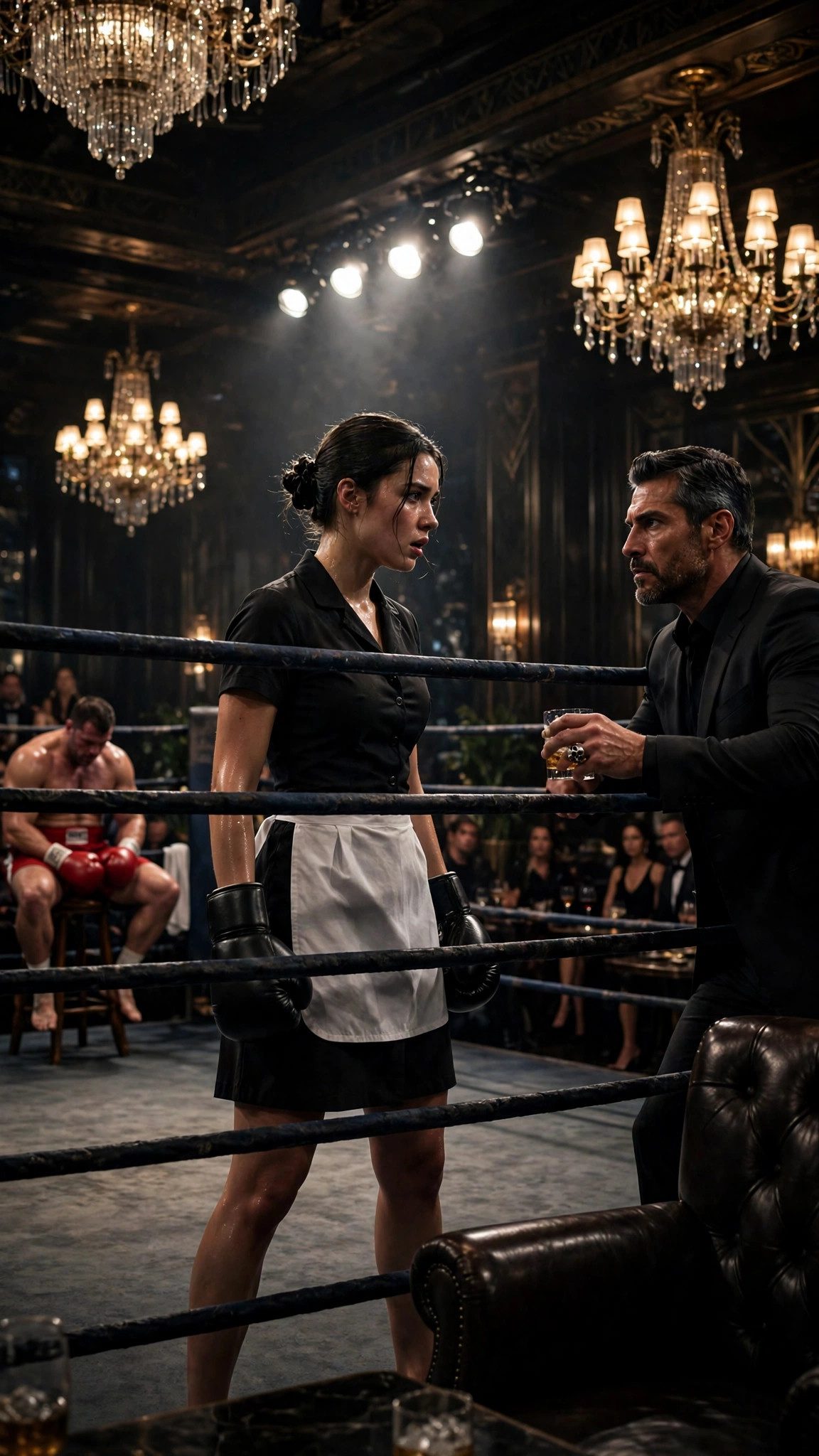
The next morning, Dominic Russo did something he had not done in twenty years. He opened his father's files.
Salvatore Russo had been dead for six years, and his office on the top floor of the Velvet Ring had been locked since the day of his funeral. Dominic kept the key in his desk drawer, and he had never used it, because he had never wanted to know what was inside. That morning, with Sadie standing beside him in the empty lounge, he took the key out of his drawer, and he walked up the stairs, and he unlocked the door, and he pushed it open, and the smell of his father's cigars came rolling out like a ghost.
The office was exactly as Salvatore had left it. The big oak desk. The leather chair. The filing cabinets along the wall. The photograph of Dominic's mother on the desk, the only photograph in the room, because Salvatore Russo had not been a man who kept photographs of people he loved. He had kept ledgers instead. Ledgers full of numbers, and names, and dates, and the careful, cold arithmetic of a man who bought and sold other people's lives.
Dominic pulled open the bottom drawer of the filing cabinet, the one his father had always kept locked, and he took out a thin black folder, and he laid it on the desk, and he opened it, and inside were three pieces of paper. Three pieces of paper that had been waiting for twenty years to be read.
The first was a betting slip, dated October 14th, twenty years ago, for fifty thousand dollars on the challenger in the title fight, the fighter James Callahan's boy was supposed to lose to in the third round. The slip was made out in Salvatore Russo's name.
The second was a note, written in Salvatore's own handwriting, short and cold, the way all of his notes were. It said, "Castellano handles Callahan. The boy refused. See that the boy understands what refusal costs."
The third was a photograph. It was a photograph of Vincent Castellano, twenty years younger, standing outside Callahan's Gym on the night of October 14th, twenty years ago, with two men beside him, both of them holding something in their hands that I did not want to look at too closely. On the back of the photograph, in Salvatore's handwriting, were the words, "Done. The circuit is ours."
Sadie stood beside the desk, and she looked at those three pieces of paper, and she did not cry. I had expected her to cry. I had expected her to break down, or to scream, or to hit something. But she did not cry. She stood very still, and she looked at the photograph for a long time, and then she reached into her duffel bag, and she took out her father's old boxing notebook, and she laid it on the desk next to her father's killer's photograph, and she opened it to the last page.
"My father knew," she said, and her voice was steady, which surprised me, because nothing else about her was steady. "He knew Castellano was coming. He wrote it here. 'He is the one who will come. Not the boy. Him.' My father knew the boy would put the gun down. He knew you, Dominic. He knew you better than your own father did."
Dominic looked at the notebook, and he looked at the photograph, and he looked at Sadie, and he said, "There is something else you should know. Something I have never told anyone."
He walked to the window, and he looked out at the river, and he stood there for a long time, and when he spoke again, his voice was so quiet I had to lean close to hear him.
"After your father died, after your mother took you to Cleveland, I did not forget you. I could not forget you. I was the one who carried you out of that gym, Sadie. I was the one who put you in your mother's arms. And for twenty years, I have been watching over you from a distance, because it was the only way I knew how to keep the promise I made over your father's body. When your mother got sick, five years ago, I paid for her care. Anonymously. Through a lawyer in Cleveland. The hospice, the nurses, the medicine, all of it. I paid for it, because I owed your father a debt I could never repay, and it was the only thing I could do."
Sadie stared at him. "You paid for my mother's hospice?" she whispered. "All those bills that kept getting marked 'paid in full' when I knew we had no money? That was you?"
"It was me," Dominic said. "And I would do it again. I would do it a hundred times. It was the least I could do, and it was not enough, and it will never be enough, but it was all I had."
I stood there in Salvatore Russo's office, and I looked at the man who had paid for my mother's last year of life without ever telling me, and I felt the last of my anger begin to slip away, and in its place came something I had not expected to feel for Dominic Russo. It was not love. Not yet. It was something quieter than love, and older than love, and it felt like the beginning of trust.
"Then we need more proof," I said. "A betting slip and a photograph and a note in your father's handwriting are not enough to put Vincent Castellano in prison. We need someone who was there. We need someone who saw him do it. We need a witness."
Dominic nodded. "There is one man who was there that night who is still alive," he said. "His name is Eddie Marcone. He was Castellano's driver twenty years ago. He drove the car that night. He has been hiding in a little house in Gary, Indiana, for fifteen years, afraid that Castellano would come for him the way he came for your father. I have been paying him, too. A little money every month, to keep him alive, to keep him quiet, to keep him ready for the day I could use him."
"Then it is time to use him," I said.
That afternoon, Dominic and I drove to Gary, Indiana, in Dominic's black car, and we knocked on the door of a little house with peeling paint, and an old man with shaking hands opened the door, and he looked at Dominic, and he looked at me, and he said, "You are James Callahan's girl. You have his eyes."
Eddie Marcone let us in. He made us coffee with hands that shook so badly he spilled half of it on the table. And he told us everything. He told us about the night of October 14th, twenty years ago, when he drove Vincent Castellano and two of his men to Callahan's Gym, when he waited in the car while they went inside, when he heard the sounds from inside the gym and did nothing, because he was afraid, because Castellano had told him that if he said a word, he would end up the same way. He told us about the money Castellano paid him the next day, five thousand dollars in cash, and about the way Castellano had looked at him and said, "You were never here, Eddie. You never drove this car. You never saw anything."
And then Eddie Marcone opened a drawer in his kitchen, and he took out a little black notebook, and he handed it to me, and he said, "I wrote it all down. Every night. Every job. Every name. I have been keeping this book for twenty years, because I knew that one day somebody would come asking, and I wanted to be able to tell the truth. Take it. Take it and use it. I am an old man, and I am tired of being afraid."
I took the notebook. It was thin, and the pages were filled with Eddie Marcone's small, cramped handwriting, and on the first page, dated October 14th, twenty years ago, were the words, "Drove V.C. to Callahan's Gym, 11:40 p.m. Two men with him. Heard three shots. V.C. came out smiling."
We had our witness. We had our notebook. We had the betting slip, and the photograph, and Salvatore's note. We had everything we needed to put Vincent Castellano in prison for the rest of his life. All we needed now was to get it to the right person, and to do it before Castellano found out what we were doing.
But Castellano had a man inside the Velvet Ring. He had a man who had been watching Sadie since the day she arrived, a man who had reported every question she asked, every name she mentioned, every step she took. His name was Ray Deluca, the manager of the lounge, the thin man with the slicked-back hair and the smile that never reached his eyes, and that night, while Dominic and I were driving back from Gary with Eddie Marcone's notebook in my bag, Ray Deluca was on the telephone in his office, telling Vincent Castellano everything.
"She knows," Ray said into the phone. "The waitress knows. She has the notebook. She has the driver. Russo is helping her. You need to do something, Vincent, and you need to do it tonight."
On the other end of the line, Vincent Castellano smiled the way a man smiles when he has been waiting twenty years for a problem to come back, and he has already decided how to solve it.
Eddie Marcone walked us to the door of his little house, and he stood on the porch, and he looked at Sadie, and he said, "Miss Callahan, your father was a good man. He was a stubborn man, and he was a brave man, and he did not deserve what happened to him. I have carried that night for twenty years, and I am tired, and I am old, and I am ready to tell the truth. If you need me to testify, I will testify. If you need me to stand in a courtroom and point at Vincent Castellano, I will do it. I am not afraid anymore. Not now that you are here."
Sadie took his shaking hand in both of hers, and she held it, and she said, "Thank you, Mr. Marcone. Thank you for keeping that notebook. Thank you for being brave enough to write it all down."
We drove back to Chicago in the dark, and the highway was empty, and the rain had started, a thin, cold rain that made the road shine under the headlights. Dominic drove in silence for a long time, and then he pulled off the highway at a little diner outside Hammond, a place with a neon sign that said "OPEN" in pink letters, and he said, "I need coffee. Do you want coffee?"
We sat in a booth by the window, and the waitress brought us two cups of coffee, and Dominic wrapped his hands around his cup, and he looked out at the rain, and he said, "My mother died when I was nineteen. She was the only person in my father's house who was kind to me. She used to take me to the Whitfield Diner on Sundays, for pancakes, and she would tell me stories about her father, who had been a fisherman in Sicily, and she would say, 'Dominic, you do not have to be what your father wants you to be. You can be what you want to be.' And then she got sick, and she died, and my father did not cry at her funeral, and I understood, for the first time, that my father did not know how to love anyone. He only knew how to own people."
He looked at me across the table, and he said, "Your father knew how to love people, Sadie. That is why he is dead, and that is why my father is dead, and that is why Castellano is still alive. Because in this world, the men who know how to love are the ones who get killed, and the men who only know how to own are the ones who survive. I have spent twenty years trying to decide which kind of man I am going to be. Tonight, sitting here with you, I think I have finally decided."
"What kind of man are you going to be?" I asked.
"The kind your father wanted me to be," Dominic said. "The kind my mother wanted me to be. The kind of man who puts the gun down."
We finished our coffee, and we drove the rest of the way back to Chicago in silence, and when Dominic dropped me at my little room above the laundromat, he said, "Get some sleep, Sadie. Tomorrow is going to be a long day. And keep those notebooks close. Do not let them out of your sight. Not for a minute."
I did not sleep. I sat on the edge of my bed with Eddie Marcone's notebook open on my lap, and I copied every entry by hand into a second notebook, slowly, carefully, because I did not want to lose a single word, and because I wanted to have a copy hidden in a separate place, in case anything happened to the original. I copied the dates, and the names, and the amounts, and the places, and when I was finished, at four in the morning, I put the copy inside my father's old boxing notebook, and I put both notebooks in my duffel bag, and I put the duffel bag under my bed, and I lay down, and I stared at the ceiling, and I thought about my father, and about Dominic, and about the diner outside Hammond, and about the rain on the highway, and about the fact that tomorrow, everything was going to change.
"Burn the gym," Castellano said. "Burn Callahan's Gym to the ground, with everything in it. And bring me the girl."