FBI Agent Daniel Reyes had been waiting twenty years for Vincent Castellano.
He had been a young agent in New York when Castellano first came onto his radar — a name in a file, a face in a photograph, a man who owned shipping companies and nightclubs and politicians, and who had never once been convicted of anything, because every witness against him either disappeared or changed their mind, and every piece of evidence against him either burned or was ruled inadmissible.
Reyes had watched Castellano for two decades. He had built a case against him three times, and three times the case had fallen apart — once because a witness was found dead in his car, once because a ledger went missing from an evidence locker, and once because a judge had been bought and no one could prove it.
He had almost given up. He had almost requested a transfer to white-collar crime, where the criminals wore suits and the worst thing they did was lie on a form.
And then, on a Friday night in Boston, five men had walked into a restaurant with guns, and a waitress had pulled a fire alarm, and a mafia boss had sat calmly at a table and refused to run, and the whole careful machine Castellano had built had begun, very slowly, to come apart.
Reyes met Nathaniel Caldwell for the first time on Sunday morning, in a conference room on the top floor of the federal building, with a view of the harbor and a pot of coffee that had been sitting too long.
"Mr. Caldwell," Reyes said, "I want to be clear about something. I am not your friend. I have spent my career building cases against men like you. If I could put you in prison, I would. Do you understand that?"
"I understand it," Nathaniel said. He sat with his hands folded on the table, the black onyx ring catching the fluorescent light. "And I want to be clear about something too, Agent Reyes. I am not your informant. I am not going to wear a wire. I am not going to testify against my own family. But I am going to give you Vincent Castellano, because he tried to kill me in a restaurant full of innocent people, and that is a line I do not cross, and a line I do not forgive."
Reyes studied him for a long moment. He had interrogated a hundred men like Nathaniel Caldwell — men who spoke quietly and dressed well and believed, absolutely, that they were different from the criminals he usually dealt with. Most of them were lying. Most of them were exactly the same.
But there was something different about this one. Reyes could not have said what it was, exactly. It was in the stillness. It was in the way Nathaniel did not posture, did not threaten, did not bargain. He simply sat, and stated what he would do, and what he would not do, and waited.
"Marcus Hale is going to testify," Nathaniel said. "He is going to give you everything — the payments, the shell companies, the phone records, the names of every man Castellano owns in Boston. And Dominic Voss is going to testify too, about the hit team, about the money, about the orders. Between the two of them, you will have enough to put Castellano away for the rest of his life."
"Why?" Reyes asked. "Why are you doing this? Men in your position do not hand their enemies to the FBI. They handle it themselves."
Nathaniel was quiet for a moment. He looked out the window, at the harbor, at the ships moving slowly through the grey water.
"Because I made a promise," he said at last. "To my father, and to myself. This family survives because we keep our promises. And one of my promises is that we do not kill our own, and we do not kill in front of innocent people. Castellano broke that rule. He sent five men with guns into a restaurant full of families, full of couples celebrating anniversaries, full of a waitress who was only trying to earn a living. He did not care who else died, as long as I did. That is not business. That is not even war. That is cruelty. And I will not answer cruelty with cruelty. I will answer it with the law."
Reyes nodded slowly. "And what do you want in return?"
"Nothing," Nathaniel said. "I want you to arrest Castellano. I want you to protect the people who testify. And I want you to leave my family alone, because we are not the ones who tried to kill a man in a restaurant."
It was the beginning of the end for Vincent Castellano.
Marcus Hale walked into the FBI office on Monday morning, with his lawyer beside him, and he talked for nine hours. He talked about the payments. He talked about the shell companies. He talked about the men Castellano had bought, the judges he had bribed, the shipments he had moved through the Boston docks in the middle of the night. He talked until his voice gave out, and then he drank water, and he talked some more.
Dominic Voss talked too, from his cell, through his own lawyer, in exchange for a reduced sentence — thirty years instead of life, and protective custody for his family. He talked about the hit team, about the orders, about the fifty thousand dollars, about the night at Lumière, and about the man who had sat calmly at a table and told him to sit down, and how that calm had frightened him more than any gun ever had.
And on Wednesday morning, in a dawn raid that the newspapers would call the largest organized-crime takedown in New England in twenty years, the FBI arrested Vincent Castellano at his home in New York, along with eleven of his lieutenants, and seized ledgers, phones, and bank records that would keep prosecutors busy for years.
Nathaniel Caldwell watched the news in his office, alone, with the sound turned down. He watched Castellano — an old man now, seventy-one years old, his hair white, his shoulders stooped — being led out of his house in handcuffs, blinking in the camera flashes. He felt no triumph. He felt no joy. He felt only the quiet that comes after a storm has passed, when the damage is done and the work of rebuilding begins.
He thought about the men who had stood beside him for years, and about the one who had betrayed him, and about the price of loyalty, and the price of mercy. He had chosen mercy for Marcus — not because Marcus deserved it, but because the family deserved better than another grave. Marcus would go to prison, and he would testify, and he would spend the rest of his life knowing what he had thrown away. That was punishment enough. It was more than enough. It was the kind of punishment that lasted.
And he thought about Viviana Marchetti.
He had not seen her since the night at Lumière. He had sent her flowers — white roses, a dozen of them, because white roses were what his mother had loved, and because he did not know what else to send a woman who had pulled a fire alarm and saved lives. The card had said only "Thank you. — N.C." He had not signed his full name. He had not wanted to frighten her.
But now, with Castellano in custody and Marcus testifying and the immediate danger past, Nathaniel found that he could not stop thinking about her. Not about the fire alarm, or the supply room, or the way she had stood in the kitchen doorway with her hand gripping the frame. He thought about the way she had looked at his ring — not with fear, but with recognition. As if she had seen it before. As if she understood what it meant.
He had asked Asher about her. Asher had told him what he knew: that she was twenty-six, that she had worked at Lumière for three years, that her father had been a jeweler in the North End, that her mother was ill, that her brother was at Boston University, that she counted her money in envelopes on a kitchen table and made it add up every month, the way good people do when the world does not give them enough.
Nathaniel had listened, and he had understood something that surprised him.
He wanted to see her again. Not because she had saved his life — though she had, in her own way, by pulling that alarm and giving Asher the second he needed. Not because she knew about the ring, or because she was beautiful, though she was. He wanted to see her again because she was the first person in a very long time who had looked at him and seen a man, not a title, not a threat, not a fortune.
She had looked at his ring and understood it. And she had stayed anyway.
On Thursday evening, Nathaniel Caldwell walked back into Lumière.
The restaurant had reopened that morning, after three days of cleaning and repairs. The chandeliers had been polished. The broken glasses had been swept away. The table beside the overflowing trash can had been cleared and reset, and a new tablecloth had been laid over it, white and crisp, as if nothing had ever happened there.
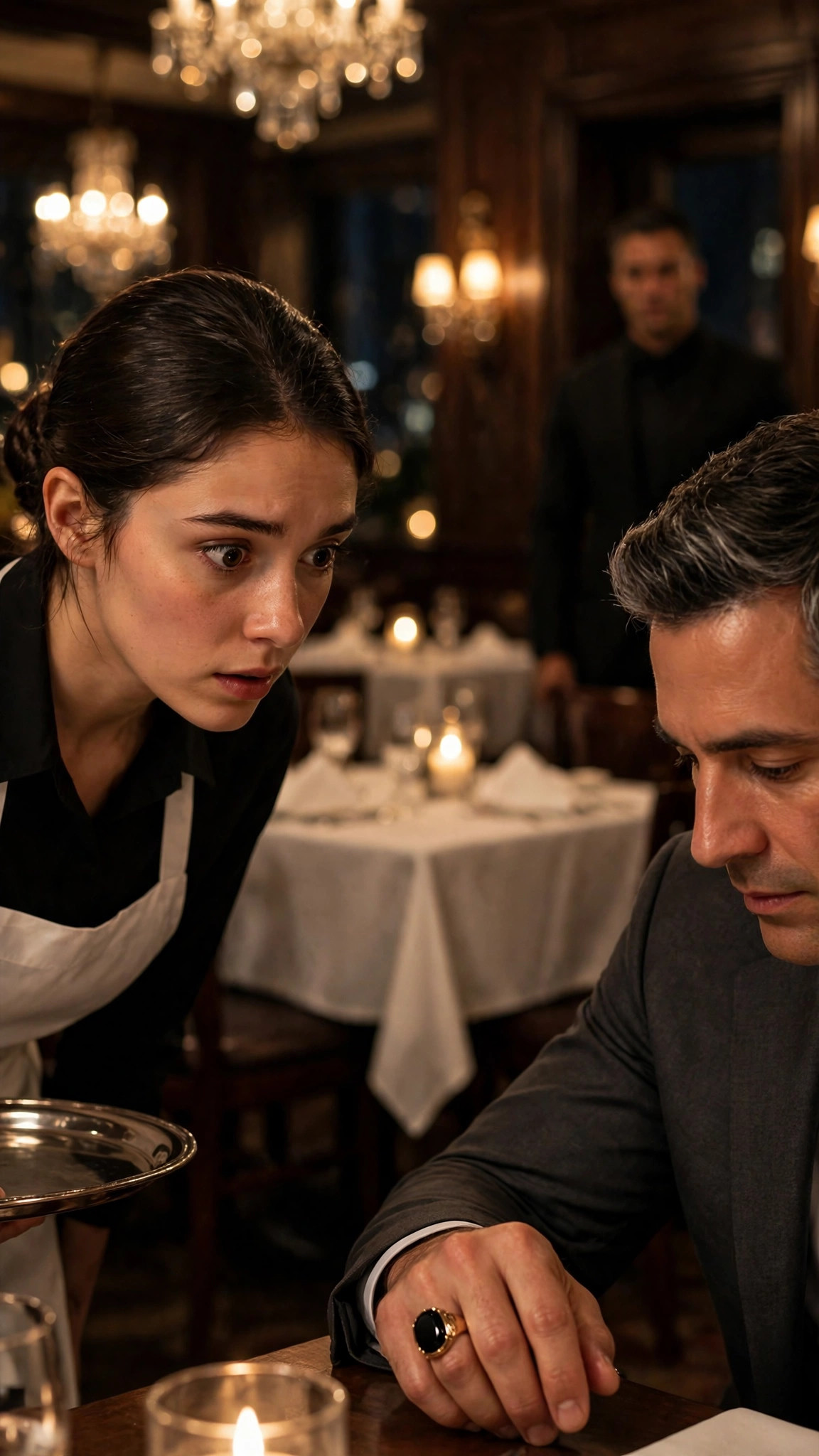
Viviana was working the front room again, in her black uniform and white apron, her dark hair in its low bun, her tray balanced on her palm. She saw him the moment he came through the door, and her hand stopped halfway to the tray, exactly the way it had stopped the first time.
He did not go to the front desk. He walked straight to her table — her section, the tables she had served for three years — and he sat down, at a table by the window this time, a good table, and he looked up at her, and he said, very quietly, "I would like a table. If one is available."
Viviana looked at him. She looked at the ring on his fourth finger. She looked at his grey eyes, and at the way he sat — calm, still, patient, a man who had all the time in the world and none of it to waste.
"Yes," she said. "Yes, there is a table. This one. It is yours."
And as she set down the water glass and unfolded his napkin with hands that only shook a little, Nathaniel Caldwell understood that the second half of the promise — the half his father had never explained, the half he had spent eighteen years trying to understand — was not about loyalty to a family, or to a name, or to a ring.
It was about finding the one person who would look at the weight you carried, and choose to help you carry it.
And he had found her, in a restaurant, on a Friday night, because a hostess had told him there was nowhere to sit.
The raid on Castellano came at dawn on a Wednesday, and Agent Reyes would later tell a reporter — off the record, and only once — that it was the cleanest takedown he had ever run, because for once, the witnesses were not afraid.
Marcus Hale had given them everything. Not just the payments and the shell companies, but the names — every man Castellano owned in Boston, every judge, every cop, every dockworker on his payroll. He had given them the routes, the schedules, the codes. He had sat in a room with two FBI agents and a pot of coffee for nine hours, and he had talked until his voice gave out, and then he had asked for water, and he had talked some more, because he understood, finally, what he had done, and because the only way to live with it was to undo as much of it as he could.
Dominic Voss had given them the rest. From his cell, through his lawyer, he had described the hit team, the money, the orders — and the night at Lumière, in detail, including the part where the target had sat calmly at a table and told him to sit down. "I have killed men," Voss had said, in his recorded statement. "I have done things I am not proud of. But I have never been as afraid as I was in that restaurant, looking at a man who was not afraid of me."
Castellano was arrested at his home in New York, in his dressing gown, blinking in the camera flashes, an old man of seventy-one who had spent twenty years trying to take Boston and had finally been beaten — not by a gun, and not by a rival family, but by a waitress with a fire alarm, an enforcer with a phone, and a boss who had chosen the law over revenge.
The news ran for days. The newspapers called it the largest organized-crime takedown in New England in twenty years. The television stations ran the footage on a loop — Castellano in handcuffs, his lieutenants in handcuffs, the boxes of ledgers being carried out of his house. And in Boston, in the rooms where the real business was done, the men who had watched and waited understood one thing: Nathaniel Caldwell was not soft. He was something far more dangerous than soft. He was patient. And he was untouchable, because he had done the one thing no one had expected him to do.
He had let the law win.
Meanwhile, at Lumière, life went on — or tried to. The restaurant reopened on Monday, exactly as Madame Colette had promised, and the regulars came back, and the anniversary couple came back, and the string quartet came back, and Viviana went back to work, because that was what she did, and because the envelopes on the kitchen table did not stop needing to be filled just because five armed men had walked into her restaurant.
But it was not the same. The customers asked questions — gentle ones, curious ones, the kind of questions people ask when they have heard a story on the news and want to know if they were there. "Were you here that night?" they asked. "Did you see it? Were you afraid?" Viviana answered them all the same way: yes, she was there; yes, she saw it; yes, she was afraid. And then she smiled, and changed the subject, and brought them their bread, because that was her job, and because some stories are not for telling over dinner.
What she did not tell them — what she did not tell anyone, not even her mother — was that she thought about him every day. About the man in the charcoal suit, sitting calmly at the worst table in the house, with a black onyx ring on his finger. About the way he had looked at her, across the room, in the middle of the chaos, and nodded — just once, a small, almost invisible nod, as if to say: I see you. Thank you.
She thought about that nod every night, as she counted the money in the envelope, and she wondered if she would ever see him again, and what she would say if she did.
She did not have to wonder for long.
And he had found her, in a restaurant, on a Friday night, because a hostess had told him there was nowhere to sit.