Roman told me later that he did not notice I was gone until the third day. He told me this the way he told me everything that mattered: flatly, without looking at me, like a man reading a report about someone else's life.
"The first day, I thought you were sick," he said. "The second day, I thought you had quit. The third day, I went down to the kitchen myself, and the stove was cold, and the coffee wasn't made, and I stood there for a long time, and I understood that something was wrong, because you had never once, in five years, failed to make the coffee."
He did not say what he felt in that kitchen. He did not have to. I had seen his face in the library that morning, when he whispered "Mom, get down" in his sleep, and I knew what fear looked like on Roman Calder, even if he would never call it fear.
What he did, on the third day, was call Mrs. Delaney into his office and ask her where I was. Mrs. Delaney told him that I had not called, and I had not come, and no one had heard from me. He asked her if I had a family. She told him about Caleb. She told him about the apartment on Fayette Street, and the neighbor, Mrs. Alvarez, and the little boy who was nine years old and had no one else in the world.
Roman sent his driver, Marcus Hale, to the apartment. Marcus was a big man with a shaved head and a quiet voice, and he had worked for Roman's father before he worked for Roman, and he was the only man in the organization who was allowed to disagree with Roman to his face. He knocked on the door of the apartment, and Mrs. Alvarez opened it, and behind her, sitting by the window with a dented tin box in his lap, was Caleb.
Marcus told me later that the boy did not cry. He just looked up and said, "She promised she'd be home before dark. That was three days ago. Is she dead?"
Marcus said no. He said it firmly, the way you say something when you need it to be true. Then he went back to the estate and told Roman what he had found, and Roman Calder, who had not left his house for anything but business in six years, got into his car and drove to Fayette Street himself.
Caleb told me about that visit, much later, sitting on the edge of his bed with Barnaby the one-eyed dog in his lap, and he told it the way a nine-year-old tells a story that is too big for him, in short sentences, with long pauses.
"He came to the door," Caleb said. "He was tall. He had a scar on his face. Mrs. Alvarez was scared of him. I wasn't scared. I asked him where Maya was. He said he didn't know, but he was going to find out. I told him she makes the best oatmeal. I told him about the notes in the shoebox. I told him about the tin box. He asked me what I was saving for, and I said it was classified, and he almost smiled. Then he said, 'Your sister is coming home, Caleb. I promise you that.' And I believed him, because he said it the way you say it when you mean it."
Roman did not tell Caleb then what he already suspected. He did not tell him that a woman does not simply vanish from a job she has held for five years, from a brother she has raised since he was a baby, without someone making her vanish. He did not tell him that the first person he suspected was the woman he was engaged to marry.
He suspected Evelyn from the beginning. He told me that, too, later, in the same flat voice, staring out at the harbor.
"She asked about you," he said. "The week before you disappeared. She asked Mrs. Delaney how long you had worked here. She asked the driver what time you left at night. She asked the housekeeper whether you had any family. I thought she was being kind. I thought she was taking an interest in the staff, the way a future wife of the house should. I was wrong. She was doing reconnaissance."
He started with her driver, a man named Danny Cole, who had worked for the Sterling family for twelve years and had a gambling problem and a daughter in college in Ohio. Roman's men found Danny in a bar in Fell's Point on the fourth night, and they brought him to a room in the back of a restaurant Roman owned, and Roman asked him, very quietly, where Maya Hart was.
Danny Cole did not answer at first. He said he didn't know anything. He said he just drove the car. Roman asked him again. And Danny Cole, who had a daughter in college and a gambling problem and a conscience he had been trying to drown for twelve years, told him about the warehouse.
It was a warehouse on the edge of the old industrial district, leased three months earlier through a shell company called Bellini Holdings, a company with no office and no employees and no reason to exist except to hold a lease on a building where a woman could be kept for six days without anyone noticing. The lease had been signed by a lawyer who worked for Charles Sterling. The payments came from an account in Evelyn Sterling's name.
Roman told me he sat in that room for a long time after Danny left, with his hand on the scar along his jaw, and he thought about his mother.
His mother had been named Elena Calder, and she had been a schoolteacher before she married Vincent Calder, and she had hated the life, and she had stayed in it because she loved her husband and her son, and she had died when Roman was ten years old, on a Tuesday night in November, in the parking garage beneath their building, because a bomb had been wired to the ignition of her husband's car, and she had gone down to the car first.
"Mom, get down," Roman had whispered in his sleep, in the library chair, with a blanket around his shoulders. He had been ten years old, standing at the top of the stairs, watching his mother walk down to the garage. He had seen the men. He had seen the car. He had shouted, and she had turned, and the bomb had gone off, and the scar on his jaw was from a piece of flying glass, and he had carried it for twenty-eight years, and he had never once talked about it to anyone.
Not to his father, who went to prison two years later and died there. Not to his men, who would have died for him without a word. Not to Evelyn, who had asked him once, at a dinner party, where he got the scar, and he had looked at her for a long moment and said, "I don't remember," and changed the subject.
He told me. He told me on the fifth night, sitting beside my hospital bed, while I was still too weak to sit up on my own, and he told me because he needed me to understand why he had come for me himself, instead of sending his men.
"When I heard her ask you for your last wish," he said, "I heard my mother. I heard a woman begging for someone she loved, and I heard another woman deciding whether she deserved to live. And I understood that I had spent twenty-eight years becoming the kind of man who could stop that from happening, and I had almost failed, because I was too blind to see what was happening in my own house."
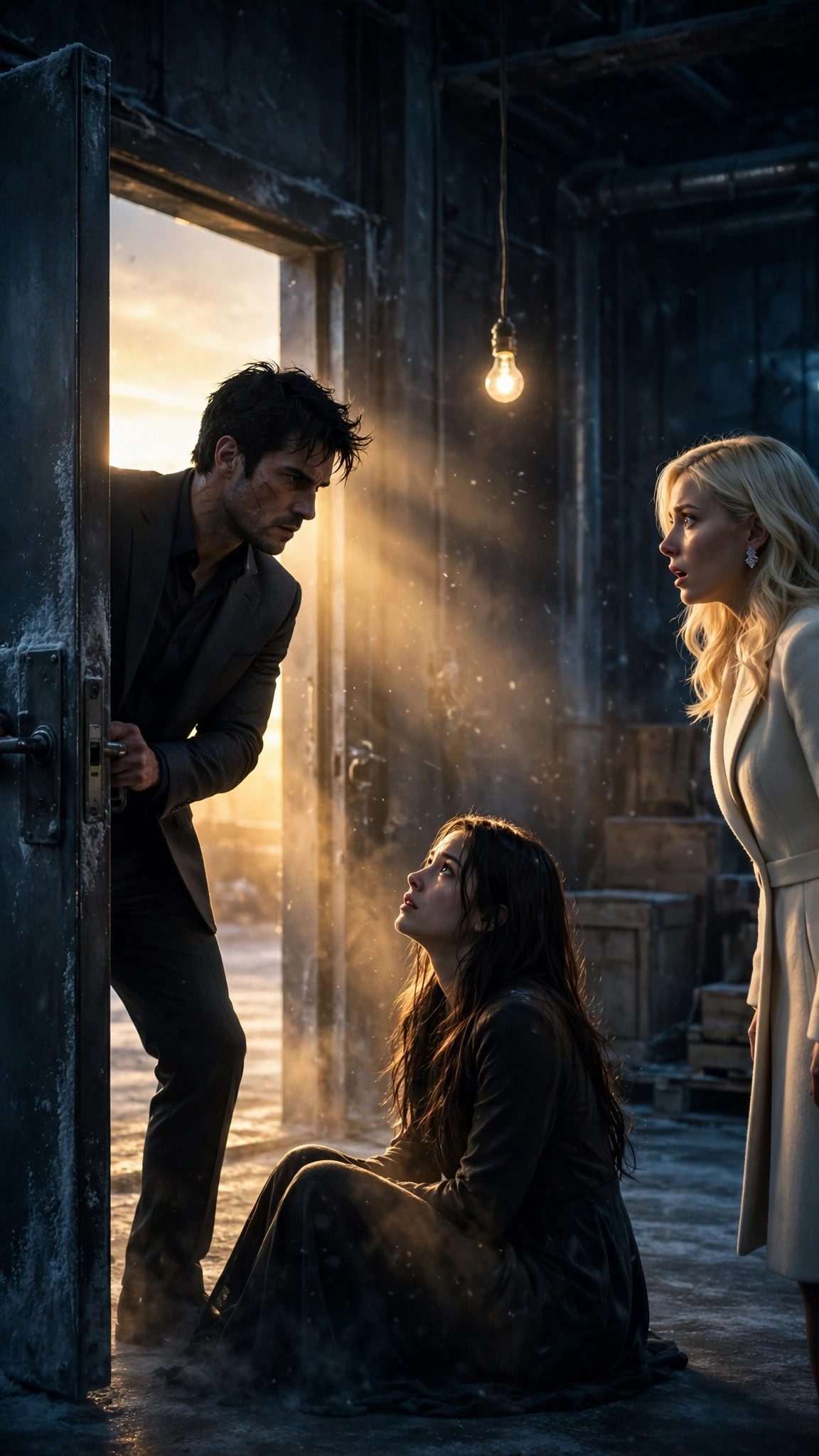
On the fifth day, Roman's men watched the warehouse. They watched the van come and go. They watched the man with the scar through one eyebrow carry water and bread inside. They watched Evelyn's white car arrive, and they watched her walk in alone, and Roman, who had been waiting in a black car two streets away, got out and walked to the steel door and pressed his hand flat against the cold metal, and he listened.
He heard Evelyn ask me for my last wish. He heard my voice break. He heard me say, "Tell him I didn't leave him." He heard Evelyn say, "By tomorrow, everyone will believe you did."
And something inside him shattered. Not loudly. Not the way a man's heart shatters in the movies. Quietly, the way a lock breaks when the key finally turns.
He did not wait for his men. He did not call for backup. He put his shoulder to the steel door and drove it inward, and the light came flooding into the warehouse, and the six days of darkness ended all at once.
That is what Roman told me. And Caleb told me the other half, the half Roman left out, because Roman would never tell it himself.
Caleb told me that on the sixth day, while I was lying on the warehouse floor, he had sat by Mrs. Alvarez's window with his tin box in his lap, and he had counted the coins in it, one by one, and he had told Mrs. Alvarez that he was saving the money to buy Maya a birthday present, because her birthday was in three weeks, and she never bought anything for herself, and he wanted to buy her something beautiful, something she would never buy for herself, something that would make her smile the way she smiled when he got a good grade.
He had been saving for eleven months. There were forty-seven dollars and thirty-five cents in the box.
And when Roman Calder came to the apartment on the third day, and asked him what he was saving for, Caleb had said it was classified, because a birthday present is classified until the birthday. And Roman, who had almost smiled, had gone back to his car and sat there for a long time with his hand on the scar along his jaw, thinking about a ten-year-old boy who watched his mother die, and a nine-year-old boy who was waiting by a window for his sister to come home before dark.
That was the man who broke down the steel door of the warehouse. Not Baltimore's most feared man. A man who had made a promise to a nine-year-old boy, and who had never once, in his entire life, broken a promise he made to a child.
There were other parts of the search that Roman did not tell me, and that I only learned later, piece by piece, from Marcus Hale, and from Mrs. Delaney, and from Agent Reyes, and I keep them here because they belong to the story, and because they explain how a man who barely knew my name found me in a city of six hundred thousand people.
On the fourth day, Marcus went back to the estate and checked the gate cameras. The estate had cameras at every entrance, and Marcus watched six nights of footage, hour by hour, until he found it: my bus, late, and me getting off two stops early and walking, and then, at the corner of Charles Street, a white van with no plates pulling up beside me, and a door sliding open, and me gone in four seconds. Four seconds. That was all it took to erase a woman from the world.
Marcus took the footage to a man he knew in the city traffic department, and the man traced the van through three more cameras, to a gas station on the edge of the industrial district, and then the trail went cold, because the van had no plates and the driver wore a cap, and the gas station camera had been broken for a month. But Marcus had the district, and he had the time, and he started with the warehouses, one by one, checking leases, asking questions, paying for answers in cash, the way Roman's men had always done.
At the same time, Caleb's teacher, a kind woman named Mrs. Okafor — no relation to the old cook, though Caleb liked to pretend they were cousins — called Mrs. Alvarez and said that Caleb had not been himself at school, that he sat by the window during recess and did not play, and that he had told another boy that his sister was gone and the police did not care. Mrs. Alvarez went to the school and sat with Caleb in the principal's office, and she told the principal that Maya Hart had raised that boy since he was a baby, and that she would never leave him, and that if the school did not help, she would go to the newspapers. The principal called the police again, and the police, this time, took a report, and the report sat on a desk for two days, and nothing happened.
But Mrs. Alvarez did something else, too. She went to the estate, and she asked for Mrs. Delaney, and she told her everything, and Mrs. Delaney, who had worked in that house for thirty years and had seen things she would never speak of, went straight to Roman's office and knocked on the door, and she told him about the boy by the window, and the tin box, and the shoebox full of notes, and she said, "Mr. Calder, sir, that girl has never once been late in five years, and if she is gone, then someone has taken her, and you are the only man in this city who can find her."
Roman listened. He did not interrupt her. And when she finished, he said, "Thank you, Mrs. Delaney," and she told me later that it was the first time he had ever said thank you to her, in thirty years, and she cried in the hallway afterward, because she knew, in that moment, that he was going to find me or die trying.
The last piece came from Danny Cole, in the bar in Fell's Point, and it came the way truths usually come in Roman's world: not from kindness, but from fear, and from a man who had a daughter in college and a conscience he could no longer drown. Danny told Roman's men about the warehouse, and about Bellini Holdings, and about the lawyer who signed the lease, and about the account in Evelyn Sterling's name, and he begged them not to tell Evelyn that he had talked, because he was afraid of what she would do to his daughter. Marcus told him, "Son, Evelyn Sterling is finished. The only person you need to be afraid of now is the law. And the law is going to be kinder to you than she ever was."
That was the search. Six days of cameras and cash and phone calls and a housekeeper who finally said what she had been thinking for thirty years, and a neighbor who refused to be ignored, and a little boy who would not stop waiting by a window. It was not one man who found me. It was all of them, together, each doing the small thing they could do. And Roman Calder, standing in front of that steel door with his hand pressed flat against the cold metal, was only the last of them, and the loudest.