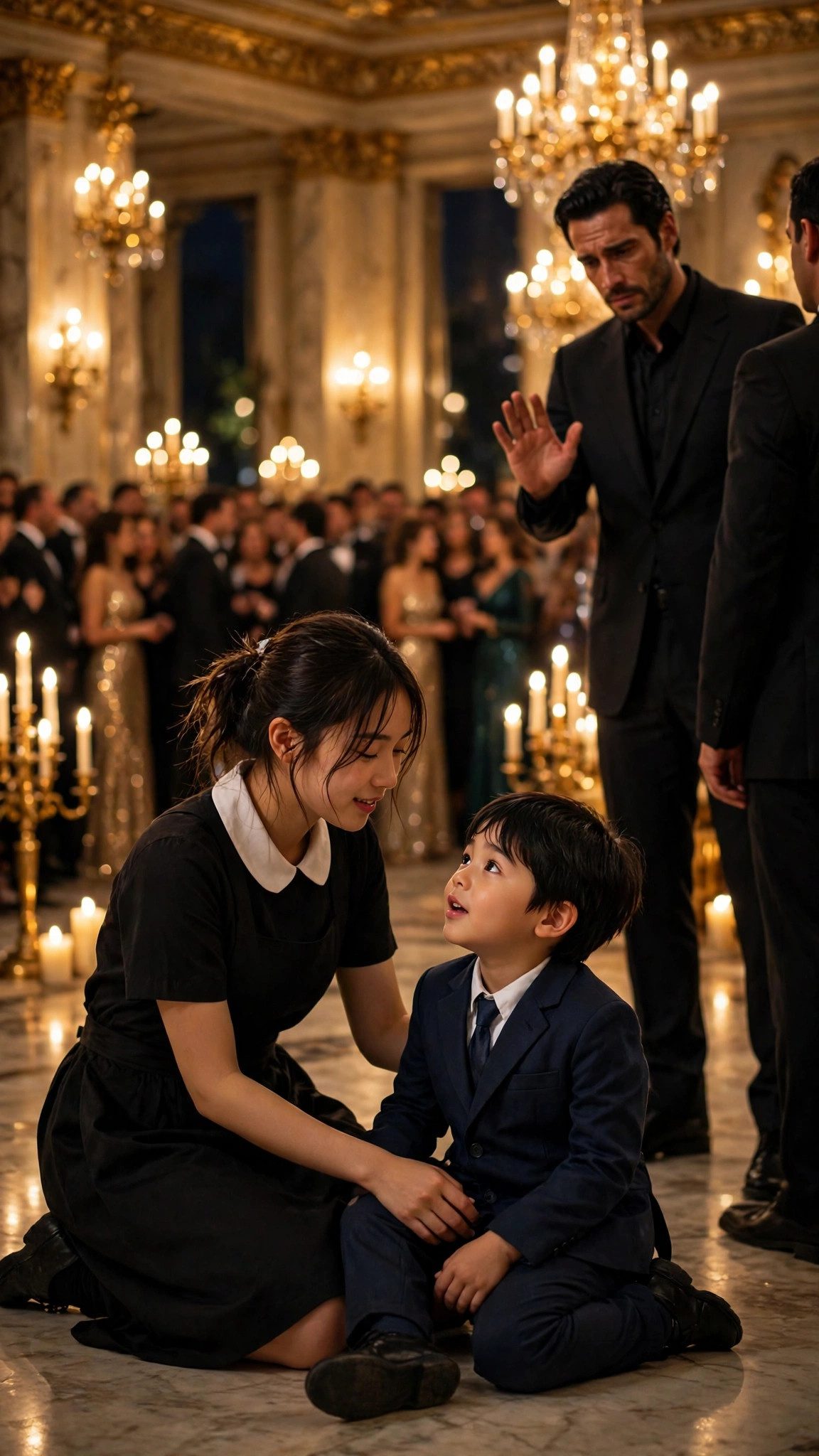
Daniel Reyes called back in thirty-six hours, not forty-eight, and his voice on the phone was the voice of a man who had found something he did not want to find.
"Preston," he said, "I need you to listen to me very carefully, and I need you to do exactly what I say. Do not confront anyone. Do not ask questions in your house. Do not let your uncle know you called me. Can you do that?"
"I can do that," Preston said, though his hand was tight around the phone.
"Good," Reyes said. "Here is what I found. Nurse Maria Alvarez did not move to Florida. She moved to a small town in Arizona, and she changed her name, and she has not spoken to anyone from St. Catherine's in over a year. I found her yesterday. She was terrified, Preston. She cried for twenty minutes before she would talk to me. And when she finally talked, she told me this. On the night your wife died, at approximately two in the morning, a man in a dark coat came to the nurses' station and told her that Mr. Hale — you — had asked for her to check on a patient on another floor. She went. When she came back, forty minutes later, the alarm was sounding. She told me she has lived with it every day since. She told me she knew something was wrong, but she was afraid, and she had a daughter, and she did not know who the man was, only that he had known your name, and her name, and exactly which floor to send her to."
Preston closed his eyes. "Did she describe him?"
"Tall. Gray hair at the temples. A scar on his left hand, she said, like a burn. And a ring. A heavy gold ring with a dark stone. She remembered the ring because it caught the light when he pointed down the hallway."
Preston felt the floor tilt beneath him. Gray hair at the temples. A burn scar on the left hand. A heavy gold ring with a dark stone. He had seen that ring a thousand times. He had seen it across poker tables, and at family dinners, and at his own wedding, raised in a toast. It belonged to Marcus Hale, his uncle, his consigliere, the man who had sat in his nursery reading to his son.
"There is more," Reyes said. "The Hale Foundation. I pulled the financials. For three years, money has been moving out of the Foundation's accounts into a shell company called Bellini Holdings, and from there into accounts controlled by Vincent Castellano. Small amounts, carefully spread out, never enough to trigger an audit. Your wife was on the Foundation's board, Preston. She would have seen the accounts. She was a careful woman. She would have noticed."
"Serena found the skimming," Preston said, and it was not a question.
"I believe she did," Reyes said. "And I believe she was going to expose it. Her assistant at the Foundation told me Serena asked for a full audit the week before she went into the hospital for the last time. She never got it. But she kept a notebook. Her assistant says Serena carried it everywhere in those last weeks, a small leather notebook, and that she told her, 'If anything happens to me, the truth is in the blue book.'"
"A blue book," Preston repeated.
"Her assistant does not know where it is now. But she says Serena kept it in her dressing room, in the drawer with her scarves. Preston — if that notebook still exists, it is evidence. And if your uncle knows it exists, he will be looking for it. Do not search for it yourself. Do not let anyone in your house know you are looking. I am coming to Chicago tomorrow, and I am bringing a team. Until then, keep your son close, and keep that maid close, because if Marcus Hale killed your wife to protect a skimming operation, then the maid and the boy are the two people in the world who can destroy him. And he knows it."
Preston put the phone down and stood in his study for a long time, staring at nothing, and then he did the hardest thing he had ever done in his life. He did nothing. He went downstairs and ate dinner with his son and Emma, and he smiled, and he asked Oliver about his blocks, and he listened while Emma hummed the lighthouse song, and he acted as if his world had not just turned upside down. And all the while, he was thinking about a blue leather notebook in a drawer full of scarves, and about a man with a burn scar on his left hand, and about the fact that the man who had killed his wife had been sitting in his nursery, reading to his son, less than twenty-four hours ago.
That night, Emma could not sleep. She lay in her small room above the kitchen, listening to the house settle, and thinking about Oliver's words, and about the way Preston had looked at dinner — calm on the surface, and underneath it, something she had never seen in him before. Not anger. Something colder and more focused. The look of a man who has finally found the thing he has been hunting.
At two in the morning, she heard a sound outside her door. A floorboard, creaking. Then another. She sat up in bed, her heart hammering, and reached for the small lamp on her nightstand, and then the door opened, and a man stepped into her room, and the moonlight from the window caught the edge of his face, and she saw that it was not a stranger. It was Eddie Marcone, one of the estate's guards, a man she had served coffee to a hundred times, a man who had always been polite to her. And he was holding a cloth in his hand, and he was looking at her the way a man looks at a job he does not want to do but has been paid to do.
"Do not scream," he said quietly. "I do not want to hurt you. But you need to come with me. Mr. Marcus wants to talk to you."
Emma did not scream. She stood up slowly, her legs shaking, and she said, "Let me put on my shoes."
"You do not need shoes," Eddie said, and he took a step toward her, and that was when the door behind him flew open, and Preston Hale filled the doorway, and his face was like stone.
"Step away from her," Preston said, and his voice was so quiet that Eddie froze where he stood.
"Mr. Hale," Eddie said, "I was only—"
"I know what you were only doing," Preston said. "And I know who sent you. Tell Marcus that if he wants to talk to Emma Carter, he can talk to me first. And tell him that I am done being patient."
Eddie backed out of the room with his hands raised, and Preston closed the door, and turned to Emma, and for a moment the stone face cracked, and she saw the fear underneath it — not fear for himself, but fear for her, and for Oliver, and for everything he had left to lose.
"Pack a bag," he said. "You and Oliver are moving into the main house tonight. Into the rooms beside mine. No one will touch you there. I swear it on Serena's name."
Emma packed her bag with shaking hands, and Preston carried Oliver, still asleep, down the dark hallway to the rooms beside his own, and he posted two of his most trusted men outside the door, and he sat in a chair in the hallway until morning, awake and watching, a gun on his knee, because the man who had killed his wife was sleeping three floors below him, in a house Preston had built, and Preston Hale had finally understood that the danger had never been outside his walls. It had been inside them all along.
The next morning, while Marcus was at breakfast, Preston went to Serena's dressing room. He opened the drawer with her scarves, the silk ones she had loved, blue and green and gold, and he lifted them out one by one, gently, as if they might break, and at the very bottom of the drawer, beneath a folded green scarf, he found it. A small leather notebook, blue, worn at the edges, with Serena's neat handwriting on the first page.
"For whoever finds this," it said. "If you are reading this, then something happened to me, and I need you to know the truth. The Hale Foundation is being robbed. Money is moving into a company called Bellini Holdings. I have traced it for three months. The man doing it is Marcus Hale, and the man receiving it is Vincent Castellano. I told Marcus I knew. I told him I was going to tell Preston. He told me I was mistaken. He told me to forget what I had seen. I will not forget. I am writing this down so that no one can make me forget. And if I die before I can tell Preston myself, then let this book tell him. Let it tell him that I loved him, and that I loved our son, and that the truth is worth more than my life."
Preston sat on the floor of his dead wife's dressing room with the blue notebook in his hands, and he wept for the first time since her funeral. Not the silent, controlled grief he had carried for two years, but real weeping, the kind that shakes a man's whole body, because Serena had known. She had known who was robbing the Foundation, and she had known who would kill her for it, and she had written it all down, and she had hidden it in a drawer full of scarves, waiting for someone to find it.
And now he had found it. And Marcus Hale, downstairs at breakfast, eating eggs and reading the newspaper as if nothing in the world were wrong, had no idea that his nephew was sitting three floors above him, holding the evidence that would end his life as he knew it.
Preston wiped his eyes, and he put the notebook inside his jacket, close to his heart, and he went downstairs to call Daniel Reyes, and to tell him that the blue book was real, and that it was in his hands, and that it was time.
Serena's notebook was small, but it held three months of truth.
Preston read it twice that night, sitting in his study with the door locked, and every page made his hands shake a little more. The entries were dated, precise, written in Serena's neat hand, the hand of a woman who had been an accountant before she became a wife, and who believed that numbers did not lie.
"March 3," one entry read. "Forty thousand dollars moved from the Foundation's children's fund to Bellini Holdings. No invoice. No explanation. I asked Marcus about it. He told me it was a consulting fee. There is no consultant."
"March 17," another read. "Sixty-two thousand dollars. Same company. Same signature. Marcus signed the transfer himself."
"April 2," a third read. "I told Marcus I knew. I told him I was going to tell Preston. He told me I was mistaken. He told me to forget what I had seen. He put his hand on my shoulder when he said it, and his hand was shaking. I have never seen Marcus afraid before. I am afraid now, too. But I will not forget. I am writing this down so that no one can make me forget."
The last entry was dated the day before Serena went into the hospital for the final time. "If anything happens to me," it read, "the truth is in this book. Preston, my love, I am sorry I did not tell you sooner. I wanted to protect you from what your own family had become. Forgive me."
Preston closed the notebook and sat in the dark study for a long time, and he thought about his wife, sitting at her desk in the last weeks of her life, writing down the truth in a small blue book while the man who would kill her ate breakfast downstairs. He thought about her courage, and about his own blindness, and he made a promise to her, there in the dark, that her death would not go unanswered.
At dawn, Daniel Reyes's team arrived in unmarked cars, parking along the road outside the estate like ordinary visitors. Emma watched them from the nursery window, holding Oliver's hand, and she felt afraid, and she felt something else, too — relief, because the waiting was almost over, and the men who had killed Serena were about to learn that the truth, written in a small blue book, had finally found its way home.
In the hours before dawn, while Preston sat in the hallway with a gun on his knee, Emma lay awake in the room beside Oliver's, listening to the house breathe. She thought about the man who had come to her door with a cloth in his hand, and about the way Preston had filled the doorway behind him, and about the promise he had made on Serena's name. She thought about her mother, and about the narrow bed at St. Agnes, and about the promise two girls had made to each other thirty years ago, and she understood, for the first time, what her mother had meant when she said, "You will know what to do." She had known. She had walked out of the service entrance and sung a song, and the song had opened a door that two years of silence had kept shut. And now, behind that door, there was a truth that someone was willing to kill for, and Emma Carter, a maid in cheap shoes with no family and no fortune, was standing in the middle of it, holding a little boy's hand.