I was seven years old the first time I realized I could hear things other people could not.
It was a Tuesday afternoon in a church basement in Milwaukee, and my father was tuning an old upright piano that had not been played properly in years. I sat on a wooden folding chair with my legs dangling, watching his hands move across the keys, listening to the notes wobble and settle as he turned his wrench.
"Listen, Elena," Dad said, pressing a single key. The note came out flat and sour, like a lemon left too long in the sun. "What do you hear?"
"It sounds sad," I said.
He laughed — the warm, surprised laugh he always had when I said something he had not expected. "Sad is right. Now listen again." He turned the tuning pin a fraction of an inch and pressed the same key. The note came out clean and true, and it seemed to fill the whole basement with light. "What about now?"
"It sounds like morning," I said.
Dad went very still. He looked at me the way people look at a door they have just discovered in a wall they thought they knew. "Say that again," he said quietly.
"It sounds like morning," I repeated, confused. "Like when the sun comes through the kitchen window and you make coffee."
He set down his wrench and picked me up and sat me on the piano bench beside him, and he played a simple melody — a nursery song, nothing fancy — and asked me to play it back. I did. Every note, in order, without a single mistake. Then he played a harder one, a piece from a hymnal, and I played that back too. Then he played two notes at once and asked me which one was higher, and I told him, and then he played three, and I told him all three, in order, like reading names off a list.
My father, Daniel Carter, had spent his life tuning pianos in churches, schools, theaters, and private homes throughout the Midwest. He was not a rich man. He was not a famous man. But he knew sound the way other men know the weather, and that afternoon in the church basement, he realized that his daughter could hear the world differently than other people did.
"Elena," he said, holding my small hands in his big, calloused ones, "you have a gift. Do you understand what that means?"
I shook my head. I was seven. Gifts, as far as I knew, came in boxes with ribbons.
"A gift isn't a crown," Dad told me, and he would repeat those words to me a hundred times over the years, until they were carved into me like initials into a tree. "It's a responsibility. It means you have something the world needs, and it is your job to take care of it."
By nine, I was playing pieces my father struggled to remember. By twelve, he finally realized what he could do — or rather, what he could not do. We could not afford a conservatory. We could not afford a teacher who charged by the hour and wore a suit to lessons. So Dad taught me everything he knew, and everything else, I learned through rehearsal doors, church balconies, borrowed recordings, broken uprights, and abandoned practice rooms.
I learned to play by listening. I would sit in the balcony of a concert hall while my father tuned the piano below, and I would memorize the music the orchestra played, note by note, until I could go home and reproduce it on the battered upright in our living room. I would stand outside the door of a university practice room, listening to a student struggle through Chopin, and I would hear every mistake she made and know exactly how to fix it, even though I had never seen the sheet music.
Dad called it my "second hearing." He said most people hear music the way they see a painting — all at once, as a single picture. I heard it the way a watchmaker sees a watch: every gear, every spring, every tiny moving part, all at once and separately, and I knew when one of them was even a fraction out of place.
He tested me constantly, not to show me off, but because he genuinely wanted to know where the edges of the gift were. One evening, when I was ten, he brought home a recording of a violin concerto he had never heard before, and he played it for me once — once — on the record player in the living room, while I sat on the floor with my eyes closed. Then he lifted the needle, turned to me, and said, "Play the second theme on the piano."
I did. I had never seen the music. I had never heard the piece before that evening. But the melody was in my head, complete and clear, like a photograph I had taken without knowing it, and my fingers found it on the keys without any help from me. Dad sat down beside me on the bench, and he did not say anything for a long time. Then he put his arm around my shoulders and said, "Elena, you are going to have to be careful with this. People will want to use it. People will want to own it. Don't let them. It belongs to the music, not to anyone who hears it."
When I was thirteen, the school held a spring recital, and my teacher — Mrs. Alvarez, a kind woman with gray hair who had taught piano to half the children in Milwaukee — asked me to play. I chose the Chopin nocturne in E-flat major, the one Dad loved best, the one that sounds like remembering someone you loved. I practiced it for weeks, in the evenings, after my homework, while Dad tuned pianos in the next room and hummed along under his breath.
On the night of the recital, the school auditorium was half full — parents, mostly, and a few bored teenagers dragged there by their mothers. I walked onto the stage in a dress Mom had sewn for me before she died, a blue dress with white flowers that was already too small in the sleeves, and I sat down at the school's battered grand piano, and I played. When I finished, the auditorium was silent for a moment, and then Mrs. Alvarez stood up in the front row, and she was crying, and she said, loud enough for everyone to hear, "That child plays like an old soul." Dad was standing at the back of the auditorium, near the door, with his tuning case in his hand, and he was crying too, and he mouthed two words at me across the room: "Thank you." I never asked him what he was thanking me for. I think he was thanking me for the gift, and for taking care of it, and for proving that his faith in it had not been misplaced.
He never let me become proud of it. "Pride is what happens when you forget that the gift was given to you," he would say, wiping rosin dust off his hands. "You didn't earn your ears, Elena. You were loaned them. Play like someone who is grateful for the loan."
Our life was small and ordinary and entirely ours. Dad tuned pianos by day and played in a jazz trio at a restaurant on Friday nights, and I went to public school and did my homework at the kitchen table and practiced on our old upright until the neighbors knocked on the wall. Mom had died when I was four — a car accident on an icy road, sudden and senseless — and it was just the two of us, Dad and me, and the piano in the living room that was older than I was and out of tune in exactly the same three places every winter.
When I was sixteen, Dad got sick.
It started with a cough that would not go away, and then with tiredness that sleep did not fix, and then with a doctor's appointment that turned into a specialist's appointment that turned into a word none of us wanted to hear. I will not write the word here in the way the doctors wrote it on the forms, because in my memory it is not a word. It is a door closing. It is the sound of a piano lid coming down for the last time.
The last year of his life was measured in hospital visits and medicine bottles and bills that arrived in envelopes I learned to open with steady hands. Dad kept working as long as he could, because that was who he was — a man who tuned other people's pianos even when his own hands shook — but eventually he could not climb the stairs to the church balcony, and then he could not lift his tuning case, and then he could not get out of bed at all.
I played for him every night in that last year. I would sit at the old upright in the living room, and he would lie on the couch with his eyes closed, and I would play the pieces he loved — the hymns, the jazz standards, the Chopin nocturnes that made him smile even when the medicine made him sick. Music was the only thing that still worked when everything else was failing. It was the only language we had left that did not have the word "dying" in it.
The night he died, I was holding his hand, and he squeezed my fingers once, weakly, and whispered, "Play it again tomorrow, Elena. The one with the morning in it."
He meant the Rachmaninoff. The Second Concerto. The piece that begins with eight quiet chords like waves gathering far out at sea. It had always been his favorite, and mine too, though I had never told him that it was also the hardest piece I had ever learned — the one I had taught myself note by note from a borrowed recording when I was seventeen, sitting in the dark with headphones on, rewinding the same passage twenty times until my fingers knew it better than my mind did.
I did not play it the next day. I did not play anything the next day, or the day after that, or the month after that. I packed away the sheet music. I closed the piano lid. I sold the old upright to a young couple who needed one for their daughter, and I watched it go out the front door on a dolly, and I felt nothing at all, which frightened me more than grief would have.
Music carried too many memories. Every note was a room my father had stood in. Every melody was a hand on my shoulder. I had spent my whole life learning to hear everything, and suddenly I could not bear to hear anything at all.
So I stopped. I got a job that had nothing to do with music. I answered an advertisement for housekeeping staff at Hawthorne Estate, a grand old mansion on the north side of Chicago that hosted charity galas and weddings and fundraisers for people whose names appeared in the newspapers. The salary was decent. The medical benefits had helped during the final year of my father's life — the estate's insurance plan had covered the last round of his prescriptions, and I have never forgotten that kindness, even though it came from a human resources form and not from a person.
The staff housing saved me when the hospital bills nearly emptied everything I had. A small room on the third floor, with a window that looked out over the gardens and a radiator that clanked at night. It was not much. It was enough. It was mine.
For three years, I worked at Hawthorne Estate, and I was good at my job. I learned to fold napkins into swans. I learned which guests wanted to be noticed and which ones wanted to be left alone. I learned to carry a tray of champagne through a crowded ballroom without spilling a drop, and to smile politely at people who looked straight through me, and to be invisible while standing in the middle of a room.
Nora Briggs became my friend in my second week, when she found me crying in the linen closet on the anniversary of my father's death and sat down beside me on a stack of folded tablecloths and said, "I don't know what happened, but I brought cookies, and I am excellent at sitting quietly." She was. She still is. She is the only person at Hawthorne who knows I used to play the piano, and she only knows because she once caught me humming a Chopin nocturne while I polished silverware, and she asked me what it was, and I told her before I could stop myself.
"You should play again," Nora said that day, wiping a fork with a cloth. "Whatever it is you're running from, it's not going to stop chasing you just because you stopped running toward it."
"I don't run from it," I said. "I just don't play anymore. Those are different things."
Nora gave me a look — the particular look she gives people who are lying to themselves — and went back to her forks. "Sure," she said. "Different things."
I believed her. I also did not believe her. Both things were true at the same time, the way two notes can be true at the same time even when they clash.
That was my life for three years. Quiet. Orderly. Safe. I served champagne to people whose names I knew from magazines. I watered flowers by the east staircase. I went to bed at ten and woke at five and never once sat down at a piano.
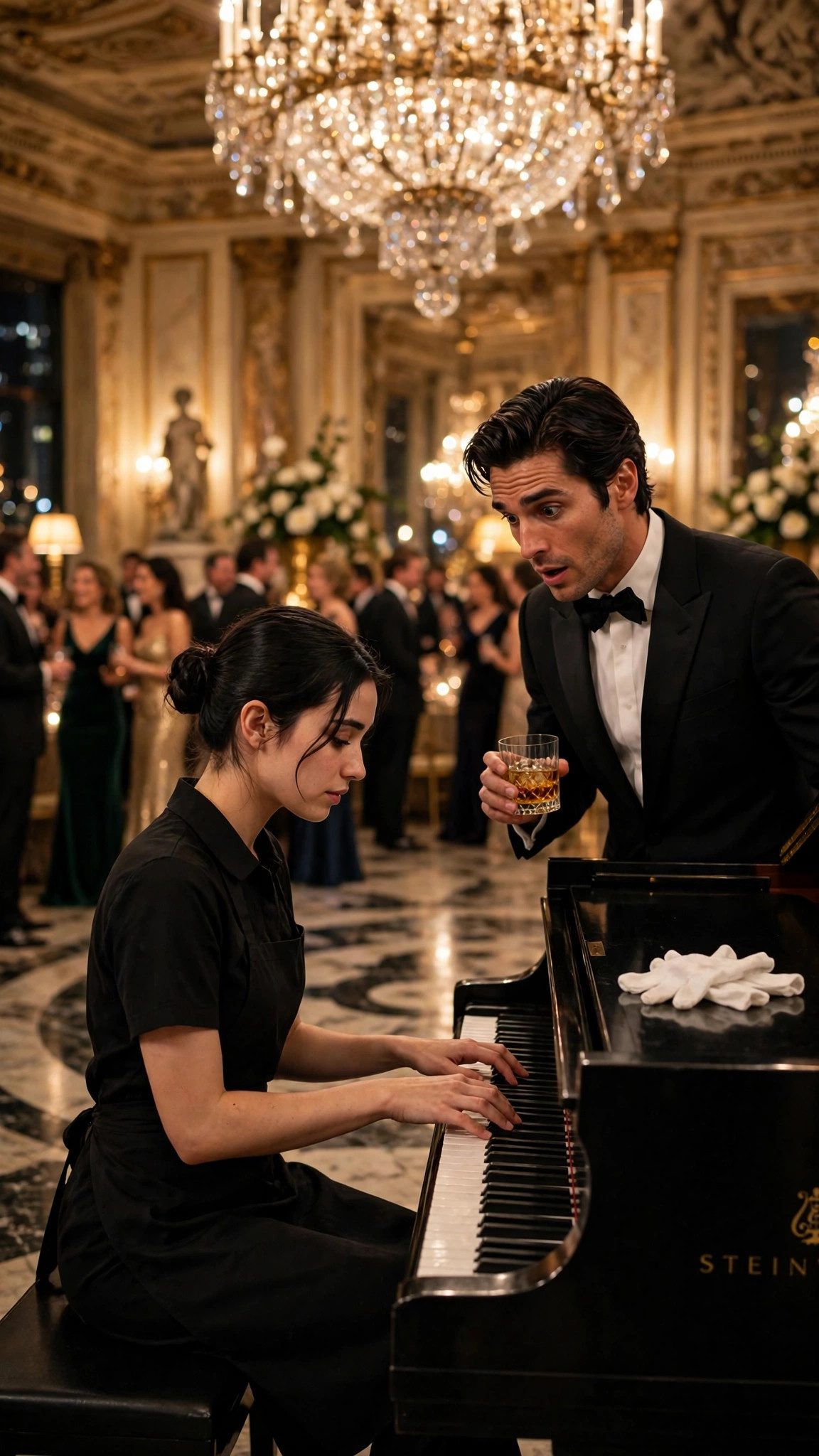
Until the night the Steinway arrived, polished until the chandelier shimmered across its black surface like stars, and Dominic Vale stood up in the middle of his own ballroom and made a promise he never expected anyone to collect.
"A gift isn't a crown," my father used to say. "It's a responsibility."
I had spent two years pretending I had returned the gift. But a gift like mine does not go back into the box just because you close the lid. It waits. It waits in the dark, patient as a piano in an empty ballroom, until the night someone says the wrong thing — or the right thing — and the lid comes open again.
Caroline Whitmore said, "Why don't you try, Elena?"
And the lid came open.