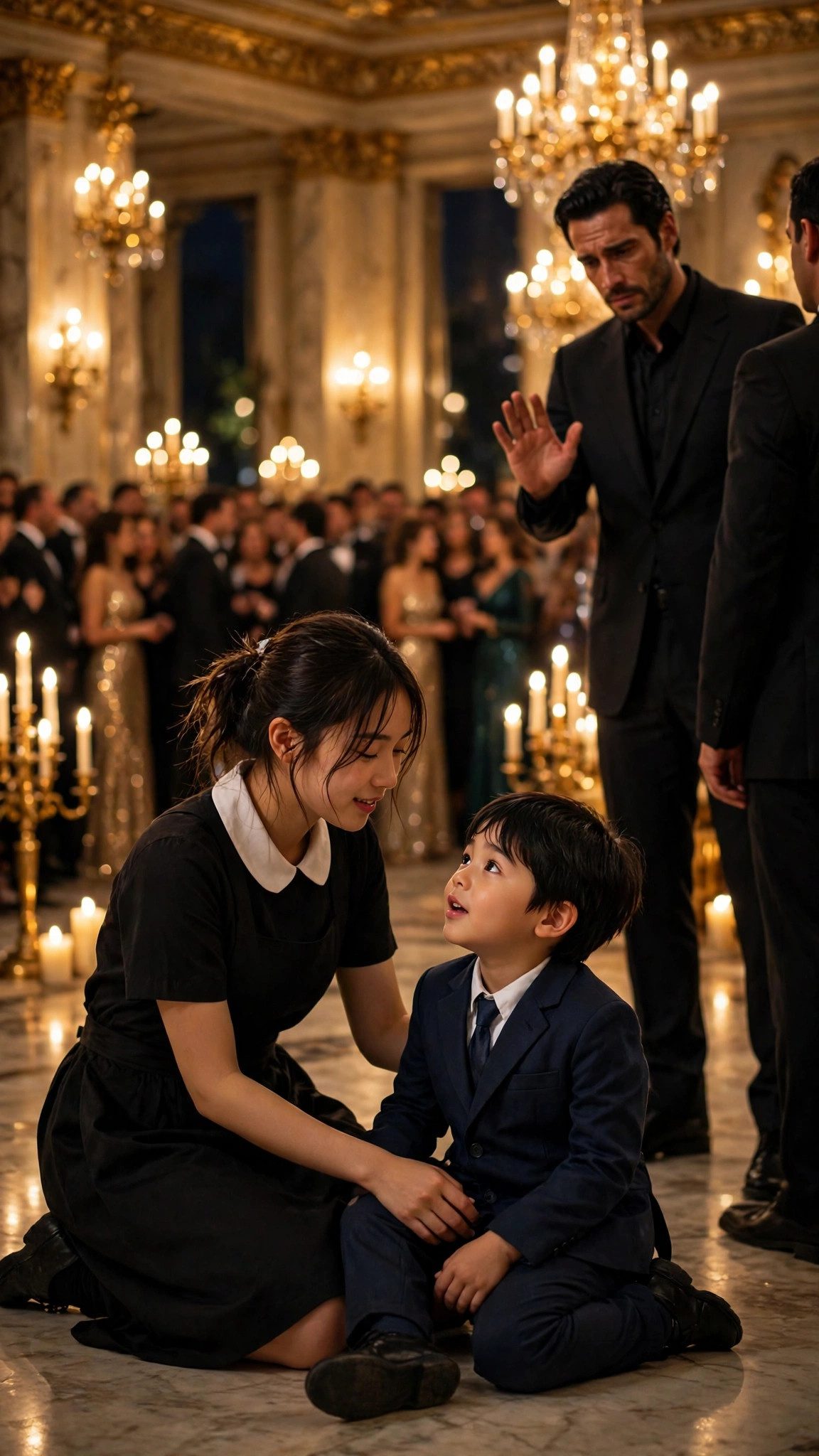
The wedding was held in the garden in June, beneath the oak tree where Serena had once read to Oliver on summer afternoons, and the whole estate smelled of roses and rain-washed earth.
Emma wore a simple white dress, not the kind of gown the society pages would have chosen, but the kind her mother would have loved — plain, honest, beautiful in the way true things are beautiful. She carried a small bouquet of white roses, and in her hair she wore a silver pin shaped like a lighthouse, a gift from Preston, made by a jeweler in the city from a drawing Oliver had made in blue crayon.
Oliver stood beside his father in a navy suit, the same suit he had worn to the gala, though it had been let out twice since then, because he was growing the way six-year-old boys grow when they are finally happy. In his hands he carried a small wooden boat, the one Emma had found on the nursery shelf on her third day in the house, and he held it carefully, the way you hold something precious.
Mrs. Delaney cried through the entire ceremony. The staff stood in a row along the garden path, dressed in their best clothes, and even the guards, hard men with guns on their hips, wiped their eyes when the time came. Daniel Reyes sat in the third row, in a suit that did not quite fit him, and smiled like a man who had seen justice done and was glad of it.
The minister spoke the words, and Preston took Emma's hands in his, and he said his vows in a voice that did not shake, because he had rehearsed them for weeks, and because he meant every word.
"I promise to love you slowly and honestly," he said. "I promise to protect this family with the law, and not with fear. I promise to sing to my son, even when my voice breaks. And I promise that this house will be kind, for as long as I live."
Emma's vows were simpler. "I promise to stay," she said. "I promise to sing. And I promise to love Oliver as my own, and to love you as you are, and not as the world says you should be."
And then the minister said, "You may kiss the bride," and Preston kissed Emma beneath the oak tree, and the garden erupted in applause, and Oliver, who had been waiting very patiently for his moment, stepped forward, and tugged on his father's sleeve, and said, in a clear voice that carried across the whole garden, "Daddy, can I sing now?"
Preston knelt beside him. "Of course you can, son. Sing."
And Oliver Hale, six years old, who had not spoken a single word for two years, stood beneath the oak tree in his navy suit, holding his little wooden boat, and sang the lighthouse song in a small, clear voice that made every person in the garden weep.
"Sleep, my little sailor, the lighthouse keeps the light. Sleep, my little sailor, and I will keep you through the night."
Emma sang with him, her voice joining his, soft and steady, and then Preston joined in, his deep voice rough at the edges but true, and then Mrs. Delaney, and then the staff, and then the whole garden was singing, four hundred voices raised together beneath the oak tree, and the song that had begun in a narrow bed at St. Agnes Home for Girls, and had traveled through two mothers and two deaths and two years of silence, finally came home.
After the wedding, Preston did what Serena had always wanted him to do. He took the Hale Foundation and rebuilt it from the ground up, with new accountants, new oversight, and a new mission. The money that Marcus had stolen was recovered, every dollar of it, and Preston put it into a program for children carrying invisible grief — children like Oliver, children who had lost a parent and stopped speaking, or stopped laughing, or stopped believing the world was safe. He named the program after Serena, and he asked Emma to run it, because no one in the world understood grieving children better than the woman who had sung a six-year-old boy back to life.
The first child the program helped was a little girl named Lily, eight years old, who had not spoken since her father died in a car accident. Emma sat with her for three afternoons, and on the third afternoon, she sang the lighthouse song, and Lily whispered, "Again," and Emma sang it again, and Lily smiled, and Preston, watching from the doorway, thought about how a song could travel from one grieving child to another, like a light passed from hand to hand in the dark.
Marcus Hale was sentenced to life in prison, without the possibility of parole, for the murder of Serena Hale and for the theft of millions of dollars from the Hale Foundation. Vincent Castellano received the same sentence, on the same evidence, and his empire crumbled within a year, the way empires built on fear always crumble. Vivian Castellano left Chicago and was never heard from again, except for a single letter she sent to Emma, six months after the trial, in which she wrote, "I am sorry. I did not know what my father was. I hope your son keeps singing."
Eddie Marcone testified against Marcus and received a reduced sentence. When he was released, Preston gave him a job at the Foundation, driving children to their appointments, because Preston believed that a man who tells the truth deserves a second chance, and because Eddie had a daughter of his own, and Preston understood what it meant to be afraid for your child.
Nurse Maria Alvarez came back from Arizona to testify, and when the trial was over, she stayed in Chicago, and she took a job at the Foundation's new children's clinic, and she told Emma, on her first day, that she had thought about Serena's little boy every day for two years, and that she was glad he was speaking again.
One year after the wedding, on a warm evening in June, Preston came home from the Foundation office to find Emma and Oliver in the garden, sitting beneath the oak tree, and Oliver was reading aloud from a picture book, his voice confident and clear, stumbling only on the longest words, and Emma was listening with her eyes closed, smiling, and the silver lighthouse pin was shining in her hair.
Preston sat down beside them on the grass, and Oliver climbed into his lap, and Emma leaned against his shoulder, and the three of them sat there together as the sun went down and the first stars came out, and Preston thought about everything he had lost, and everything he had found, and about the night he had stood beneath the chandeliers and offered everything he had to anyone who could make his son speak.
He had offered money. He had offered property. He had offered protection. He had offered marriage. And in return, he had received something no amount of money could have bought. He had received his son's voice. He had received a wife who loved him for who he was, and not for what he owned. He had received a home that was kind again. And he had received the truth about the woman he had lost, a truth that had waited two years in a blue leather notebook, in a drawer full of scarves, for someone brave enough to find it.
"Daddy," Oliver said, looking up at him with Serena's dark eyes, "will you sing the lighthouse song with us tonight?"
Preston smiled, and he took his son's small hand in his, and his wife's hand in his other hand, and he began to sing, his deep voice rough and true, and Emma joined him, and Oliver joined them both, and the song rose up through the garden and over the rooftops of Lake Forest, and out across the lake, where the lighthouse — the real one, far away on the shore — kept its light burning through the dark, just as it always had, and just as it always would.
"Sleep, my little sailor, the lighthouse keeps the light. Sleep, my little sailor, and I will keep you through the night."
The reception was held on the terrace, beneath strings of golden lights, and the first dance belonged to Preston and Emma, swaying slowly to a song the orchestra had learned just for them — the lighthouse song, arranged for strings, soft and low. Oliver watched from his chair, his chin in his hands, and when the song ended, he climbed onto a chair and raised his glass of apple juice, and said, in a voice that carried across the whole terrace, "My mommy sang this song. Now Emma sings it. Now Daddy sings it too. And I sing it, because I am not scared anymore."
There was not a dry eye on the terrace.
The Foundation's new children's center opened that autumn, in a bright building with yellow walls and a garden full of sunflowers. On the first day, a little girl named Lily arrived, eight years old, clutching her grandmother's hand, and she had not spoken since her father died in a car accident six months earlier. Emma sat with her for three afternoons, in a small room with a window full of light, and on the third afternoon, she sang the lighthouse song, and Lily whispered, "Again," and Emma sang it again, and Lily smiled, a small, brave smile, and whispered, "My daddy used to sing to me, too."
Preston, watching from the doorway, thought about how a song could travel from one grieving child to another, like a light passed from hand to hand in the dark, and he thought about Serena, and about Grace, and about Mrs. Delaney of St. Agnes, and about all the women who had kept the light burning, one voice at a time, until it reached his son.
That Christmas, Oliver hung a lighthouse ornament on the tree, a small glass one that caught the light and threw it in every direction, and Emma pinned the silver lighthouse pin into her hair, and Preston gave her a gift wrapped in blue paper: a framed copy of Serena's handwritten sheet music, the lighthouse song, in its original ink, with Serena's note beneath it, "For Oliver, when he is afraid." Emma hung it in the music room, above the piano, where the morning light fell on it first.
And in the evenings, when the house was quiet and the day was done, the three of them would sit in the music room together, and Preston would open the piano, and Emma would sit beside him on the bench, and Oliver would climb onto the bench between them, and they would sing, all three of them, their voices rising together through the old house, filling the rooms that had been silent for so long.
The song had begun in a narrow bed at St. Agnes Home for Girls, where two frightened little girls had promised never to forget each other. It had traveled to a small kitchen on the South Side, where a mother sang it to her daughter. It had traveled to a grand house in Lake Forest, where a mother sang it to her son. And now it lived in that house again, sung every night by a father, a mother, and a little boy who had found his voice, and who would never lose it again.
Two years after the wedding, on a bright morning in September, Oliver started school. He wore a new navy blazer and carried a small backpack with a lighthouse embroidered on the front, a gift from Emma, and he walked through the school gates holding his father's hand on one side and his mother's hand on the other, and he did not look back once. His teacher, a kind woman named Mrs. Alvarez — no relation to the nurse, though Emma smiled at the coincidence — told Preston at the end of the first week that Oliver was the brightest child in her class, and that he had stood up on the first day and told the whole class about the lighthouse song, and that by the end of the week, all twenty children in the class knew the words by heart.
Emma framed the drawing Oliver had made on his first day of school — a lighthouse, of course, in blue crayon, with yellow light spilling from its top — and hung it in the music room, beside Serena's sheet music, where the morning light fell on it first. And every night, before bed, the three of them sang the song together, father, mother, and son, their voices rising through the old house, and the house, which had been silent for so long, was silent no more.
The following spring, Preston took Emma and Oliver to St. Agnes Home for Girls, the old brick building where Grace and Serena had grown up. The home was still there, still drafty, still full of frightened little girls with suitcases and no one left in the world, and the woman who ran it now was a kind, tired woman named Mrs. Okafor, who showed them around with pride. In the dormitory, there was still a row of narrow beds, and in the common room, there was still an old piano, its keys yellowed with age.
Emma sat down at the piano, and she played the first notes of the lighthouse song, and the little girls gathered around her, drawn by the melody, and she taught it to them, line by line, the way her mother had taught it to her, and the way Mrs. Delaney had taught it to her mother and to Serena, so many years ago. Oliver stood beside the piano and sang with her, his voice clear and strong, and the little girls sang with them, and the old building, which had heard so many sad songs over the years, rang with a happy one.
Before they left, Preston wrote a check to the home — a large one, enough to repair the roof and to buy new beds and new books — and he told Mrs. Okafor that the Hale Foundation would support St. Agnes for as long as it stood. "Two girls made a promise in this house," he said. "My wife was one of them. My wife's best friend was the other. Everything good in my life began with that promise. I intend to honor it."
On the drive home, Oliver fell asleep in the back seat, his head resting against Emma's shoulder, and Emma looked out the window at the fields going by, and she thought about her mother, and about Serena, and about the narrow bed, and about the long road the song had traveled to bring her here, to this car, to this family, to this life. She had come to the big house in Lake Forest with nothing but a name and an address, and she had found a son, and a husband, and a home. And she knew, with a certainty that settled deep in her bones, that her mother had been right all along. She had known what to do. She had always known the song better than anyone.
The End.
THE END