The makeup artist's name was Vincent, and he had hands like a surgeon and the patience of a saint, and he flew in from Los Angeles twice a year to make me ugly.
That is a strange sentence to write, but it is the truth, and after ten years of it, the strangeness wore off, the way all strange things do when they become routine. Twice a year, in a small room at the back of a salon on Oak Street that my father paid to keep empty on those days, Vincent would lay out his case of silicone pieces on a clean white towel, and he would clean my face with something cold that smelled like alcohol, and he would fit the pieces onto my skin one by one, pressing the edges down with a small brush and a glue that stung for a moment and then went warm.
The first piece was the scar. It ran from my right temple down across my cheek to my chin, thick and puckered, with a ridge in the middle where the skin had supposedly split and healed badly. Vincent told me once that he had modeled it on a real burn scar he had seen on a stuntman, and that the trick to making it believable was not the color but the texture — real scars catch the light differently, he said, they shine where the rest of the face does not.
The second piece sat across the bridge of my nose and spread it wider, flatter, blunter. The third piece thickened my jaw and pulled the corner of my mouth down on one side, as if the muscles there had been damaged too.
Then the glasses, heavy black frames with thick plain lenses that made my eyes look small and dull behind them. Then the hair dye, a flat brown with no warmth in it, cut straight across at the shoulders with no shape. Then the clothes — grey, brown, beige, nothing fitted, nothing bright.
When Vincent was finished, the girl in the mirror was not me. She was a stranger with a ruined face and tired eyes, and I would look at her for a moment, and then I would turn away, because looking too long made my chest hurt in a way I did not have a name for.
"You're a good girl, Mara," Vincent said to me once, in his soft voice, while he packed away his brushes. "Your father is a lucky man."
I did not answer him. I did not know what to say to a man who was paid to erase me.
Ruth was the only person who ever saw my real face after I turned seventeen. On Sundays, when I visited her at the facility, I would go into the little bathroom off her room, and I would peel the pieces off, one by one, and wash the glue from my skin, and sit with her for an hour as myself. She would look at me and smile, and sometimes she would say, "There you are," as if I had been lost and had finally come home.
"You're so pretty," she would say, touching my cheek with her thin fingers. "You look just like your mother."
"Tell me about her," I would say, because I was always hungry for pieces of my mother, and Ruth would tell me the same stories, over and over, because her memory was slipping and the old stories were the ones that stayed.
"She had your eyes," Ruth said. "And your laugh. She laughed at everything, your mother. She laughed when the bread burned. She laughed when the rent was late. She said, 'Ruth, if we stop laughing, they win.'"
"Who are they?" I asked once.
Ruth frowned, as if she were trying to remember something important. "The people who want us small," she said. "Don't let them make you small, Mara."
I promised her I would not. It was a promise I broke every single day for ten years, in exchange for keeping her safe, and I do not regret it, because Ruth was the only person in the world who loved me, and love is worth more than a face.
The facility was called Sunrise Gardens, and it was a good place — clean, bright, with a garden full of roses and a dining room where the residents ate together, and nurses who knew Ruth's name and the way she liked her tea. It cost nine thousand dollars a month. Nine thousand dollars a month, every month, paid by my father, on time, without fail, as long as I obeyed.
The morning of my wedding, I woke up in the small apartment above the florist's shop, and I went through the routine I had gone through ten thousand times. I cleaned my face. I fitted the scar. I fitted the nose. I fitted the jaw. I put on the glasses. I dyed the roots of my hair, because the brown was growing out and my real hair underneath was dark gold, the color my mother had. I put on a grey dress that hung on me like a sack.
Then a car came for me, a black car with a driver who did not speak, and it took me to the big house on Astor Street, where a woman I had never seen before was waiting with a wedding dress in a garment bag and a makeup case and a face full of pity.
"You're the sister," she said, not unkindly. "The other one."
"Yes," I said.
"Well," she said, looking at my scar, "at least the dress is pretty."
The dress was ivory, plain, with long sleeves and a high neck and no sparkle anywhere. It was the dress Celeste had rejected, because Celeste had wanted something with a low back and a long train and diamonds sewn into the bodice, and this dress was none of those things. It fit me almost right, which was to say it did not fit me at all, but it was a wedding dress, and I was getting married, and nobody had asked me if I wanted any of it.
While the woman was pinning the dress, Celeste came into the room. She was wearing a silk robe and her hair was up in curlers, and she looked like a magazine photograph that had wandered into the wrong house. She looked at me in the mirror, at the dress that had been meant for her, and she laughed, a short, sharp laugh, like a door slamming.
"God," she said. "He's going to take one look at you and ask for his money back."
"He's not paying for me," I said. "Father is paying him."
"Same thing," Celeste said, and she walked to the dressing table and opened a drawer and took out an envelope, and she held it out to me.
Inside was a receipt. Sunrise Gardens. One month. Paid in full. Ruth's name at the top, in neat printed letters.
"Your rent," Celeste said. "For this month. Don't say I never gave you anything."
I took the envelope with shaking hands, and I put it in my bag, and I told myself that was all that mattered. Ruth was safe for one more month. Whatever happened at the altar, whatever happened after, Ruth was safe for one more month.
Then Celeste opened another drawer, and she took out a dark bottle, and she set it down on the dressing table beside my makeup, with a small, deliberate click.
"Amaro," she said. "Italian. Very old. Very expensive. A wedding gift, from me to you. Pour Adrian a glass before midnight. He drinks first. You drink afterward."
Something about her smile made my skin crawl. It was the smile of a person who knows something you do not, and who is enjoying the knowing.
"Why?" I asked.
"Because it's tradition," Celeste said. "The bride pours the first drink for her husband on their wedding night. It's romantic. Don't you want to be romantic, little sister?"
I looked at the bottle. It was dark green glass, with a label I could not read, and a cork sealed with black wax. It looked like a bottle of amaro. It smelled, when I uncorked it for a second, like herbs and oranges and something bitter underneath.
"Pour it before midnight," Celeste said again, and she leaned close to me, so close I could smell her perfume, and she whispered, "He drinks first. You drink afterward. Don't get it backwards."
Then she walked out, and the woman with the pins finished the dress, and the car took me to the cathedral, and I slipped the bottle into my bag, and I told myself it was just amaro, just a wedding gift, just a tradition, and that Celeste's smile was just Celeste being cruel, the way she always was.
I was wrong. I know that now. I know that the bottle was never a gift, and the tradition was never real, and that if I had poured that drink before midnight, and if Adrian had drunk first and I had drunk afterward, we would both be dead before the morning, and my father would have told the police it was a tragedy, and Celeste would have cried at our funerals, and Ruth would have been left alone in Sunrise Gardens with no one to pay the bills and no one to visit on Sundays.
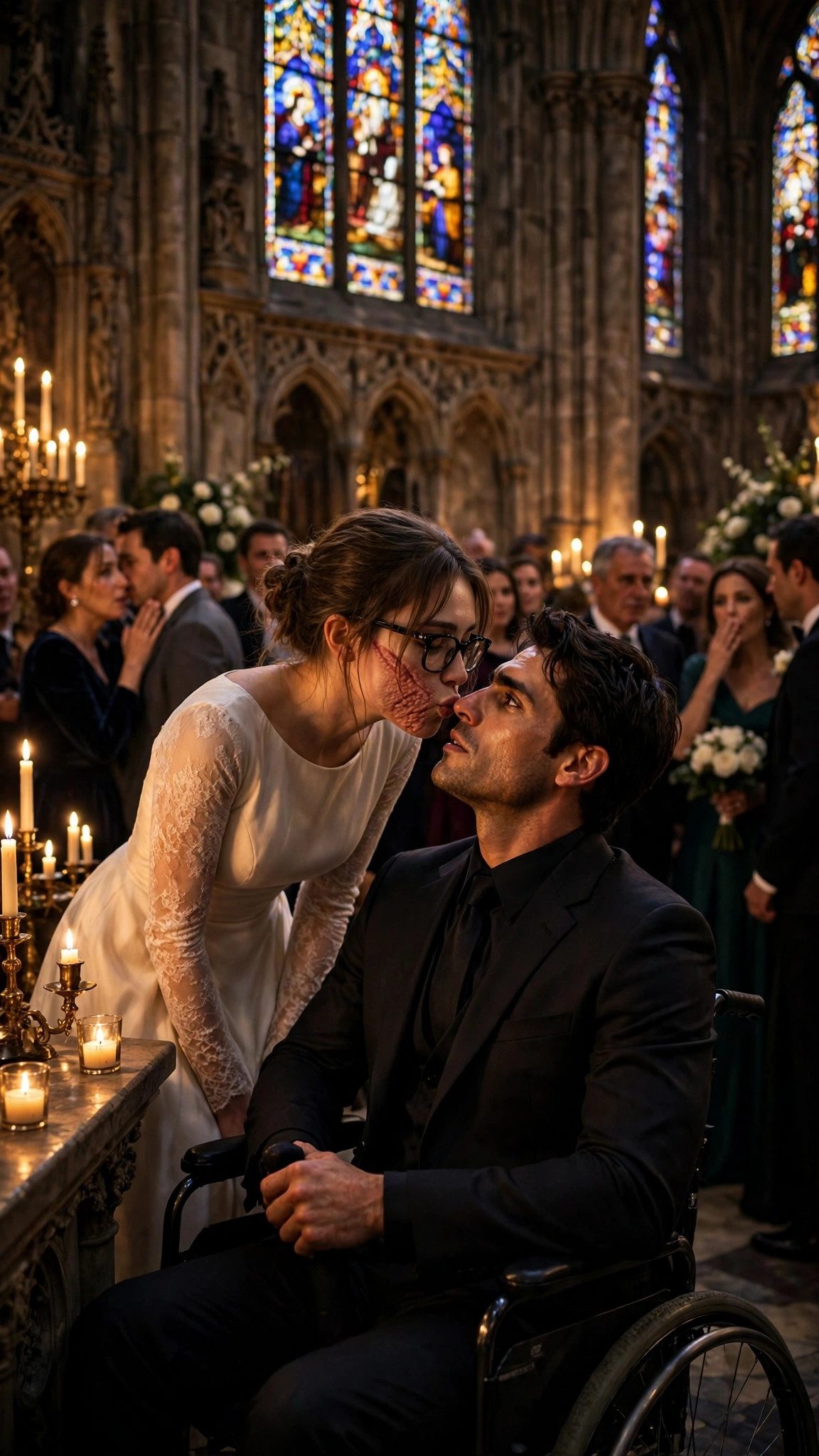
But I did not know any of that then. I knew only that I was walking down the aisle of a cathedral in a dress that did not fit, toward a man in a wheelchair who was the most feared man in Chicago, and that one hundred and twenty people were trying not to laugh at us, and that my face was fake, and my marriage was a setup, and that somewhere in that room, someone was hiding a lie darker than all of mine.
The priest asked if anyone objected. Nobody did. Of course nobody did. You do not object at the wedding of Adrian Vitali unless you want to be carried out of the cathedral in pieces.
I said "I do" in a voice so quiet I barely heard it myself. Adrian said "I do" in a voice like gravel and smoke, and his eyes never left my face, and I had the strangest feeling that he was not looking at my scar at all, but at something underneath it, something I had spent ten years hiding, something I had forgotten was even there.
Then I bent down to kiss him, because he could not stand, and I whispered "I'm sorry," and his fingers tightened on the armrest, and he said, "Say that again."
And that was the moment everything began to change.
The Sunday before my wedding, I went to see Ruth, the way I always did, and I peeled off the silicone in her little bathroom, and I sat with her for an hour as myself, and she looked at me, and she smiled, and she said, "There you are."
"I have something to tell you, Ruth," I said. "I'm getting married on Tuesday."
Ruth's eyes widened. "Married? To whom?"
"To a man named Adrian Vitali," I said. "He's… important. In Chicago."
"Is he kind?" Ruth asked, and it was the only question that mattered to her, and it was the question no one else had asked me, not my father, not Celeste, not anyone.
"I don't know," I said honestly. "I've never met him."
Ruth frowned, and she took my hand, and her fingers were thin and cool, and she said, "Then you must find out quickly, Mara. A husband who is not kind is worse than no husband at all. Your mother used to say that. She said, 'Ruth, a man can be rich and still be poor, if he has no kindness in him.'"
"My mother said that?" I asked.
"Many times," Ruth said. "She was a wise woman, your mother. She laughed at everything, but she saw everything too. She saw your father for what he was, the first time she met him. She told me, 'Ruth, that man will love me until I am inconvenient, and then he will forget me.' And she was right."
I had never heard that story before, and I sat very still, holding Ruth's hand, and I asked, "Did she love him?"
"She loved him the way you love a fire," Ruth said. "It keeps you warm, and then it burns the house down. But she loved you more. She loved you from the first moment she held you. She used to sing to you, you know. In Italian. A lullaby about a little bird who flew too far from home and found her way back by following the stars."
"Sing it for me," I said.
And Ruth sang, in a thin, wavering voice, a few lines of a song I had forgotten I knew, and as she sang, something in my chest loosened, something that had been tight for years, and I closed my eyes, and for a moment, I was four years old again, and my mother was alive, and the world was small and warm and safe.
When the song ended, Ruth patted my hand, and she said, "Whatever happens on Tuesday, Mara — remember the little bird. She found her way home by following the stars. You will find your way home too."
"I don't have a home, Ruth," I said.
"Yes, you do," she said. "Home is wherever someone loves you for who you are, not for what you can do for them. You'll find it. I promise."
I stayed with her until the nurse came to say visiting hours were over, and I put the silicone back on in the bathroom, and I kissed Ruth goodbye, and I walked out into the October afternoon, and the air was cold and clean, and I thought about the little bird, and the stars, and my mother, and I wondered if she was watching me, somewhere, and if she was proud, or if she was frightened, the way I was frightened.
I did not know then that I would see Ruth again in a different facility, under a different name, paid for by a man who had come back to a flower shop four times just to see if I was still there. I did not know that the little bird was about to find her way home.
I knew only that on Tuesday, I was getting married, and that I was afraid, and that Ruth believed in me, and that sometimes, that is enough to keep going.