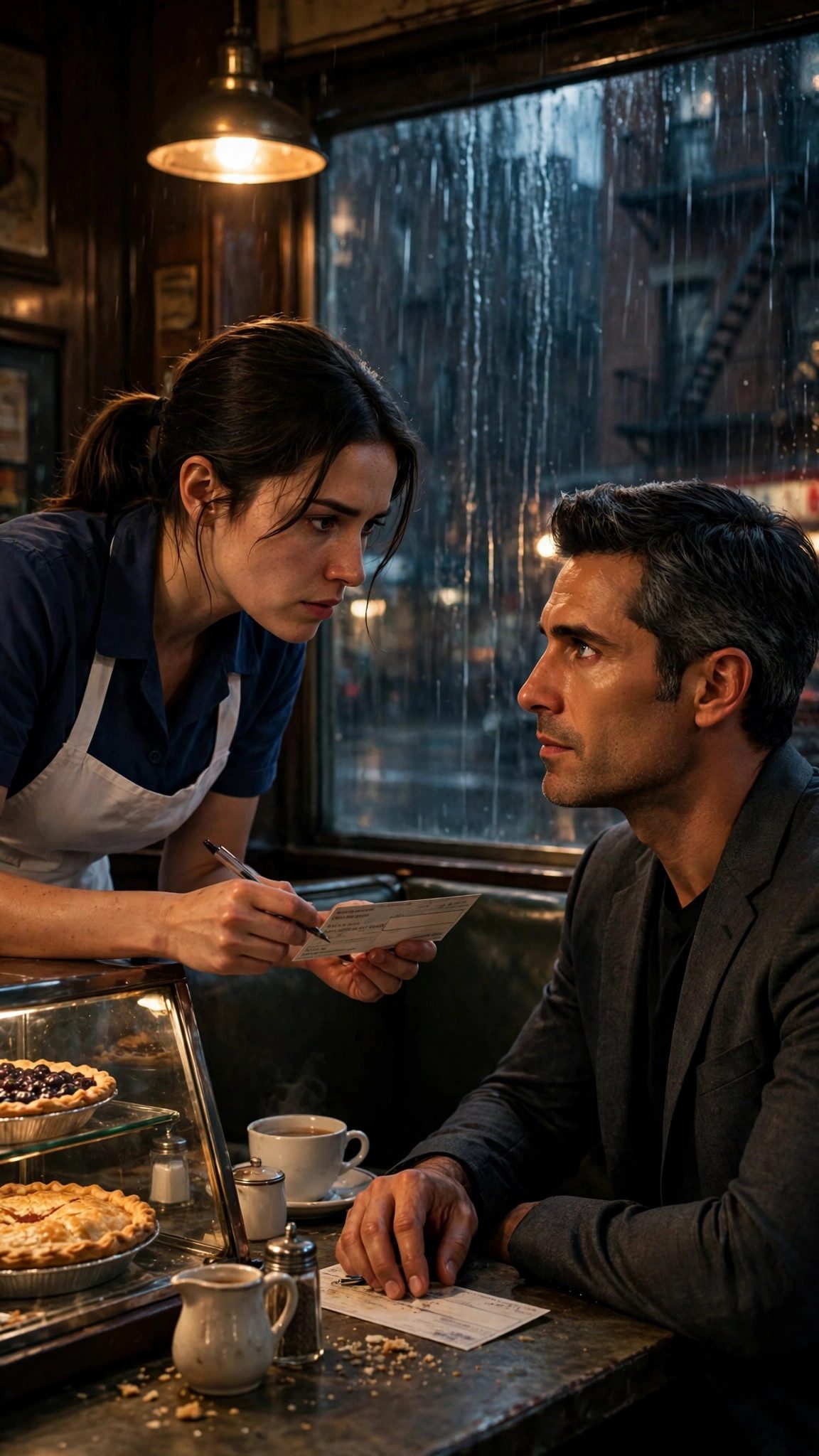
I did not call the number the next day. I did not call it the day after that, either. I went to work, poured coffee, carried plates, counted tips, and went home. I followed the rule the way I had followed it for three years, and I told myself that the night at the Blue Anchor had been a single strange event, already over, already behind me.
It was a lie, and I knew it was a lie, because the card was still on my kitchen table next to Danny's chipped mug, and every time I walked past it, my hand reached toward it before I could stop it.
On the third day, Marcus cornered me in the kitchen during a slow stretch and said, "You're going to tell me what happened that night, or I'm going to keep asking until you do."
Marcus was the closest thing I had to family in Brooklyn. He had hired me three years ago when I walked into the Blue Anchor with one suitcase and no references and asked for the night shift. Joe Barone had looked at me like I was a problem he didn't need, but Marcus had looked at my hands — steady, quick, the hands of a girl who had waited tables before — and said, "She'll do." He had taught me the coffee machine, the pie rotation, and the regulars. He had never asked me where I came from or why a twenty-three-year-old girl with no family and no history had shown up in Brooklyn with a suitcase and a flinch every time a car backfired.
"Nothing happened," I said, wiping down a tray that was already clean.
"Emily." He put his hand over mine and held it still. "I've worked this kitchen for twenty years. I know the difference between a bad night and a scared girl. You've been scared for three days. So either you tell me, or I start worrying, and I am too old to start worrying."
I looked at him for a long moment. Marcus was sixty-two, with flour permanently under his fingernails and a scar across his left knuckle from a knife that had slipped when he was twenty. He had a daughter in Ohio he talked about twice a year, at Christmas and on her birthday, and a wife who had died a decade ago. He understood loss the way only people who have buried someone understand it — quietly, without demanding that you explain yours.
"I wrote a number on a man's bill," I said finally. "A number my brother taught me. And the man understood it."
Marcus was quiet for a moment. Then he said, "Was it the Moretti man?"
I stared at him. "How did you know?"
"Because you're not scared of the truck drivers, kid. You're scared of the men in suits. And the only man in a suit who came in here this week was Adrian Moretti." He let go of my hand and went back to the grill. "My brother-in-law drove a truck for the Morettis for fifteen years, back in the eighties, before old man Salvatore died. Good money. Dangerous work. The family takes care of its own, or so they say. My brother-in-law came home every night, so maybe they do."
"What does that mean?" I asked.
"It means the man you warned is not the worst man in this city, and that is not nothing." He flipped a burger with more force than necessary. "But it also means you stepped into something, Emily, and stepping back out is not as easy as stepping in. So you need to decide what you're going to do with that card in your pocket."
I didn't tell him the card was on my kitchen table. I didn't tell him about the five hundred dollars, either. I had put the money in an envelope and hidden it in the back of my sock drawer, because spending it felt like accepting payment for something I didn't understand yet, and keeping it in my apron felt like carrying a target.
That night, after my shift, I sat at my kitchen table and did the thing I had avoided doing for three years. I opened Danny's notebook.
I had kept it in a shoebox under my bed, wrapped in a plastic bag, next to his old watch and the photograph of the two of us at Coney Island the summer I turned sixteen. The notebook was small, black, the kind you buy at a drugstore for two dollars, and Danny's handwriting filled every page in tight, careful lines. Names. Numbers. Times. License plates. I had read it a hundred times in the first month after he died, looking for the answer to the only question that mattered — why — and I had found everything except that.
Now I read it differently. I read it the way Adrian Moretti might have read it, looking for the patterns instead of the grief.
On the third page, there was a list of names under the heading "PHILADELPHIA — TUESDAYS." One name was circled twice: "A.M." Beside it, a phone number I had never called, and a note in Danny's handwriting: "He keeps his word. If anything happens to me, find him. He'll know what 317 means."
My hands started shaking. For three years I had carried that notebook across state lines and up three flights of stairs and I had never really seen that page, because grief had made me read it like a memorial instead of a map. Danny had known. He had known he might not come back from that warehouse, and he had left me a direction. A.M. Adrian Moretti.
I turned the page. There were more notes. "V.C. wants the docks. V.C. wants the routes. V.C. will not stop." The initials V.C. appeared eleven times in the notebook, always with the same tight, angry pressure on the pen, as if Danny had pressed harder every time he wrote them. I didn't know who V.C. was then. I would learn soon enough that the whole city knew the name Vincent Castellano, and that the whole city was afraid to say it out loud.
On the last page of the notebook, Danny had written a single sentence, dated three days before he died: "If I don't come home, Em, it wasn't an accident. Don't let them tell you it was."
I sat at my kitchen table until the sun came up, with the notebook open in front of me and the card beside it, and I cried for the first time in months — not the quiet crying I had learned to do in the shower so the neighbors wouldn't hear, but the kind of crying that shakes your whole body and leaves you empty afterward.
When I finally stopped, I made coffee and I made a decision. I was going to call the number. Not because I wanted to get involved. Not because I wanted revenge, or justice, or any of the big words people use when they talk about dead brothers. I was going to call because Danny had left me a direction, and for three years I had been too afraid to follow it, and the night at the diner had proved that the direction was real — that somewhere in this city, a man named Adrian Moretti had looked at three numbers and understood them, and that understanding was the only thread I had left to my brother.
I picked up the card. I dialed the number. My hand was steady. That surprised me more than anything.
It rang twice. Then a voice said, "Yes."
It was him. I knew it instantly — the same low, even voice from the diner, the voice of a man who never raised it because he never needed to.
"This is Emily Rivers," I said. "From the Blue Anchor Diner."
A pause. Then: "I know who you are."
"I need to know how you know that number," I said. "317. I need to know where you learned it."
Another pause, longer this time. I could hear street sounds in the background, and then a door closing, and then silence, as if he had stepped into a room alone.
"Not on the phone," he said. "Come to the diner tomorrow night. After closing. Two a.m. I'll be there. Bring the notebook."
My blood went cold. "What notebook?"
"The one your brother kept," he said. "The one you've been carrying for three years. Bring it, Emily. And don't tell anyone."
The line went dead.
I sat with the phone in my hand for a long time, staring at the wall, and I realized two things. The first was that Adrian Moretti knew about Danny's notebook, which meant he knew about Danny, which meant he had known who I was the moment he read that bill. The second was that I had just agreed to meet the most feared man in Brooklyn alone in a diner at two in the morning, and the only reason I wasn't terrified was that I had already been terrified for three years, and terror, like everything else, gets boring after a while.
I went to work that night the way I always did. I poured coffee. I carried plates. I counted tips. But my eyes kept going to the windows, and every black car that passed made my heart jump, and every man who walked in alone made me check his hands for a phone.
At midnight, a black Lincoln pulled up across the street and parked. It stayed there for an hour, its engine off, its windows dark. I told myself it was nothing. A man waiting for someone. A driver on a break. But when I left at 2 a.m. — no, when I was supposed to leave, because I didn't leave, because Adrian was coming at two and I had agreed to be there — the Lincoln was still there, and I understood that it was not nothing. It was a guard. Adrian had put a man on me, or on the diner, or on both, and he had done it without asking me, the way men like him do things.
At 2:05, Joe Barone locked the front door, counted the register, and left through the back, the way he always did. Marcus stayed to finish the grill, and when I told him I would lock up, he looked at me for a long moment, then nodded and left too, without asking. Marcus knew. I don't know how he knew, but he knew.
At 2:15, the back door opened, and Adrian Moretti walked in alone, carrying a paper bag from a bakery that had been closed for hours.
"You didn't eat tonight," he said, setting the bag on the counter. "You never eat on your shift. I watched."
"You watched me?" I said.
"I watch everything, Emily. It's how I've stayed alive this long." He pulled out a stool and sat down, the way a regular customer would, and for a moment he looked almost ordinary — a tired man in a good suit, sitting in a closed diner at two in the morning with a bag of bread.
"How do you know about the notebook?" I asked.
"Because your brother showed it to me," he said. "Three years ago, in Philadelphia. He carried it everywhere. He said it was his insurance. He said if anything ever happened to him, the notebook would tell his sister where to find me."
The room went very quiet. The neon sign buzzed. The refrigerator hummed.
"Tell me about Danny," I said. "All of it. From the beginning."
And Adrian Moretti, the most feared man in Brooklyn, put his hands flat on the counter, looked me in the eye, and began to talk.
The next morning, I woke up before my alarm, which never happened. I lay in bed and listened to the laundromat machines humming below my window, and I thought about the notebook, and the circled initials, and the phone number I had never called. I got up, made coffee, and sat at the kitchen table with the notebook open to the page Danny had marked "PHILADELPHIA — TUESDAYS." I read every name on that list twice, slowly, the way you read a list when you are looking for someone you know. Most of the names meant nothing to me. They were just names — men Danny had driven, men he had watched, men he had written down because writing things down was how he stayed alive. But one name, near the bottom, made my breath catch. "Rosa M." Beside it, in Danny's handwriting, a single word: "kind." I stared at that word for a long time. Danny had met Adrian's mother. He had written her down as kind. And in that moment, I understood something about my brother that I had never understood before: he had not just worked for Adrian Moretti. He had been part of a family — a strange, dangerous, complicated family — and he had cared about the people in it, the way he had cared about me.
Later that day, before my shift, I walked to the corner store to buy milk, and I practiced what Danny had taught me when I was twenty and he was twenty-four and he had decided, for reasons I never understood, that his little sister needed to know how to spot a tail. "Walk normally," he had said, on a summer afternoon in Philadelphia, while we walked to the corner store for ice cream. "Don't look back. Look at the windows. Windows tell you everything. If the same car is in two windows, it's following you. If the same man is on two corners, he's following you. And if you see something wrong, Em, you don't run. Running tells them you're scared, and scared people are easy. You walk into the nearest crowded place, and you stay there until the street is empty again."
I looked at the windows on my street that afternoon, the way Danny had taught me. A blue sedan I didn't recognize. A man in a gray coat reading a newspaper on a bench. Neither of them followed me. Neither of them looked at me twice. But I walked into the laundromat below my apartment anyway, and I stayed there for ten minutes, folding a towel I didn't need to fold, until the street was empty again. Old habits. Danny's habits. They had kept me alive for three years, and I wasn't ready to give them up — not yet, not while men were still making plans in hallways and writing notes and sliding them under my door.
That night at the diner, Marcus watched me the way he always watched me when something was wrong — sideways, while pretending to watch the grill — and finally, during a slow stretch, he said, "My brother-in-law drove for the Morettis, you know. Fifteen years. He told me once that the family had a code. Numbers, he said. For when you couldn't talk. He never told me what the numbers were, and I never asked, because some things you don't ask about. But he said the men who knew the code were the men the boss trusted with his life."
"Did your brother-in-law know Adrian?" I asked.
"He knew his father," Marcus said. "Old Salvatore. Hard man. Fair, my brother-in-law said, but hard. He said Adrian was different. Softer, in the beginning. Then his father died, and Adrian got hard too, the way sons do when the weight lands on them all at once." Marcus wiped his hands on his apron. "My brother-in-law retired five years ago, and he still gets a check every month. The family takes care of its own. That's what he always said. The family takes care of its own."
I thought about that for the rest of the shift. The family takes care of its own. Danny had been one of their own. And now, somehow, so was I — not because I had asked to be, but because I had written three numbers on a bill, and a man had looked at them and understood, and understanding, it turned out, was a kind of family too.