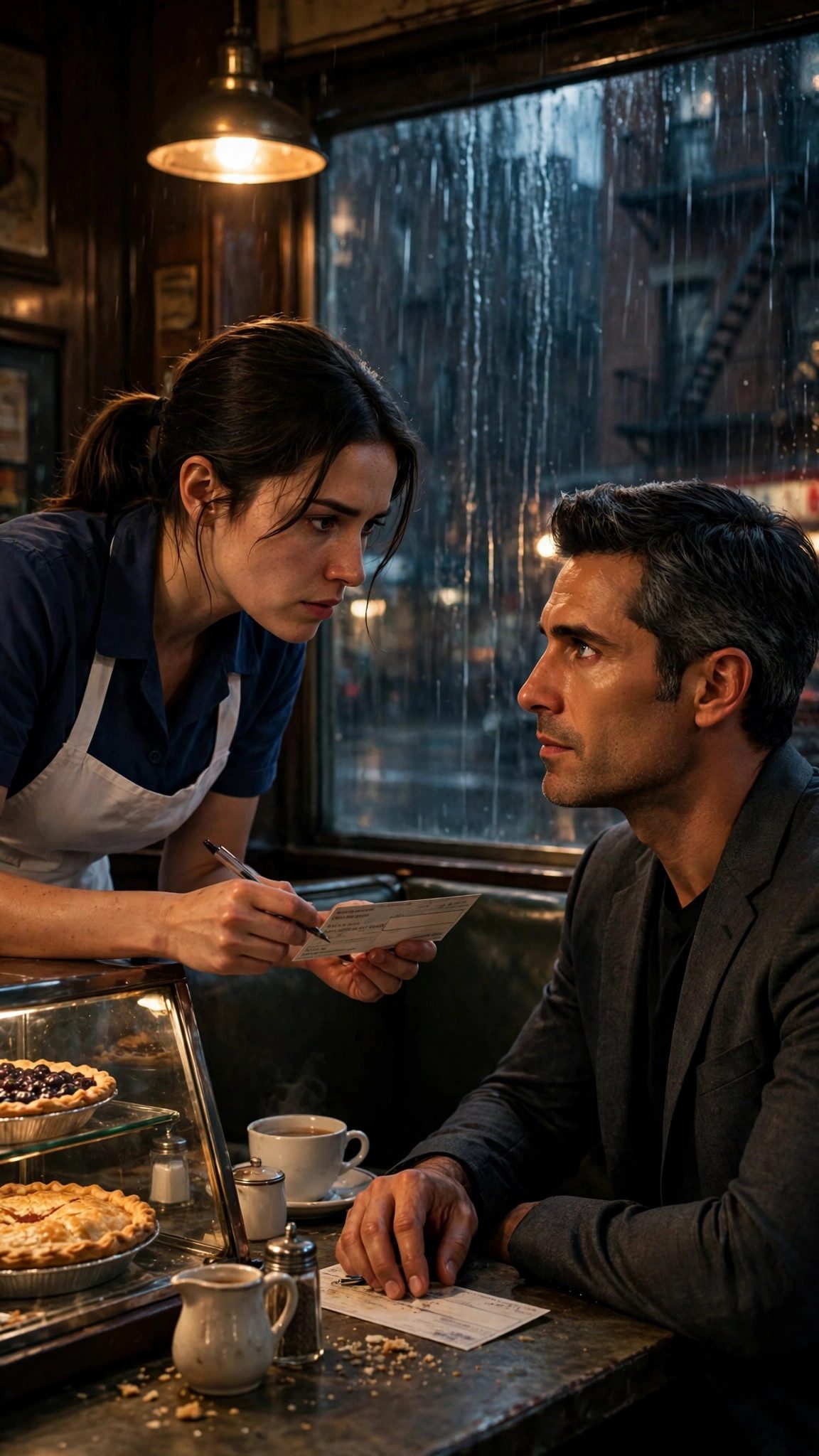
Six months later, the Blue Anchor Diner looks almost the same, and completely different. The neon sign still buzzes when it rains. The pie case still holds the same apple pie, and the same cherry, and the same lemon meringue that nobody ever orders but Joe refuses to stop making. Marcus still works the grill. The truck driver still sits at the far booth. The nurse still comes in after her double shifts.
But the building belongs to someone new now. When the landlord tried to triple the rent in January, Adrian bought the building — not the diner, just the bricks and the roof and the land underneath it — and he gave Joe Barone a twenty-year lease at the old rent, and he gave me a piece of paper that said I was a partner in the business, with a share of the profits and a vote in every decision.
"You don't have to do this," I told him when he handed me the paper.
"I know," he said. "That's why I'm doing it."
I still work nights. I still pour coffee and carry plates and count tips. But now, when I count them, I count them as a partner, not as a girl hiding from her own life. And now, when a black car pulls up outside, I don't flinch. I just look up, and usually it's Marco, coming in for pie, or Luca, coming in to check on me the way Adrian asked him to, or Adrian himself, coming in for dinner after a long day of turning a criminal empire into a construction company.
The trial took four months. I testified for three days. Enzo testified for five. Cole Brandt testified for one, and then stopped talking when his lawyer told him to, but by then it didn't matter. The phone records spoke. The notebooks spoke. Danny's notebook, and Enzo's notebook, sat on the evidence table in the courtroom like two small black books that had brought down a king.
Vincent Castellano was convicted on every count. Racketeering. Conspiracy. Murder — my brother's murder, named out loud in a courtroom, in front of a jury, with his name written in the record forever. The judge sentenced him to life in prison without parole, and when the sentence was read, Castellano looked at me across the courtroom, and for the first time, he looked afraid. Not of me. Of the fact that a waitress from a diner, and a dead driver from Philadelphia, and a notebook full of names, had been enough to end him.
Enzo Falcone got eight years, as promised. He wrote me a letter from prison, in a shaky hand, apologizing for everything. I read it once, and I put it in a drawer, and I have never read it again. Some apologies are for the person who writes them, not the person who receives them.
Cole Brandt got fifteen years. His partner got twelve. The two men across the street — the ones who pretended to wait for a bus — were never found, and Agent Reyes told me not to worry about them, because without Castellano, they were just two men with nowhere to go.
Rosa Moretti comes into the diner every Sunday now, and she sits in the corner booth — Adrian's booth — and she orders coffee and pie, and she tells me stories about Adrian as a boy. About the time he brought home a stray dog and hid it in the garage for a week. About the time he got into a fight defending a smaller boy and came home with a black eye and a grin. About the day his father died, and the way Adrian stood at the funeral with his shoulders back and his face still, and the way she knew, in that moment, that her son was going to carry something heavy for a very long time.
"He doesn't carry it alone anymore," she told me last Sunday, patting my hand. "That's because of you, child. Don't forget that."
Tonight is a different kind of night. Tonight, the diner is closed early, and the lights are low, and there are flowers on every table, and Marcus is wearing a suit for the first time in twenty years, and Joe Barone is crying into a napkin in the corner, and I am standing in the back room in a white dress that Rosa helped me choose, with my hands shaking the way they shook the night I wrote three numbers on a bill.
Adrian is waiting for me in the garden behind the house in Bay Ridge — the house with the warm light in the windows, the house where his mother fed me pasta on the night everything changed. There are forty people there. Marcus. Joe. Luca. Marco. Agent Reyes, in a suit that doesn't quite fit, standing next to his wife. Rosa, crying and laughing at the same time. And at the front, under an arch of white roses, Adrian Moretti, in a charcoal suit, with gray eyes that have never looked at me the way they are looking at me now.
I walk down the aisle on Marcus's arm, because Marcus is the closest thing I have to family, and because he asked, and because I said yes before he finished the sentence. The music is a piano, played by a woman Rosa hired from a restaurant in Manhattan, and it is the most beautiful thing I have ever heard.
Adrian takes my hands, and the minister says the words, and I say the words back, and when it is over, Adrian kisses me, and the garden erupts, and for a moment, I forget everything — the warehouse, the notebook, the trial, the fear — and all I know is that I am standing in a garden in Brooklyn, married to a man who keeps his word, surrounded by people who love me.
After the ceremony, after the dinner, after the dancing, Adrian takes me aside, to a quiet corner of the garden, and he pulls a napkin from his pocket and a pen from his jacket, and he writes three numbers on it. 317.
"What does it mean now?" I ask him.
He looks at me, and he smiles, and he says, "It means I'm here. You're safe. And I'm not going anywhere."
I take the napkin and I fold it carefully, and I put it in my pocket, next to my heart, where it belongs.
Later, when we go back inside the house, I see it hanging on the wall in the hallway, in a simple wooden frame, next to the photograph of Danny leaning against the black car with his arm around a younger Adrian. It is the receipt from that first night at the Blue Anchor Diner. Sixty-three dollars. And beneath the total, in my handwriting, three numbers. 317.
Rosa framed it. She told me she found it in Adrian's jacket pocket the morning after the diner, and she knew what it was the moment she saw it, and she knew that it belonged on the wall, where everyone could see it.
"That receipt saved my son's life," she told me. "And it brought you to us. And that makes it the most valuable piece of paper in this house."
I stand in the hallway and look at it for a long time, and I think about Danny, and about the night he taught me the code at our kitchen table in Philadelphia, and about the night I used it on a stranger, and about all the nights in between, when I was running and hiding and learning how not to get involved.
Danny taught me that 317 meant "Don't speak. You're being watched." He was right. But he didn't know the whole truth, because the whole truth is that sometimes, when you write three numbers on a bill, the right person sees them. And sometimes, the right person is the one who taught your brother the code in the first place. And sometimes, the numbers don't just save a life. They bring two broken people together, and they build something new out of the pieces.
My name is Emily Rivers. Three years ago, I lost my brother, and I learned how to disappear. One night, I wrote three numbers on a diner bill, and I learned how to come back.
The numbers were 317. The man was Adrian Moretti. And the rest — the rest is the story of how a waitress from a diner and the most feared man in Brooklyn stopped running, stopped hiding, and started living.
Together.
The wedding was small, the way Rosa wanted it — forty people, in the garden, under the white roses — but the preparations took weeks, and they were the happiest weeks of my life. Rosa took me shopping for a dress, and she argued with the saleswoman about the neckline, and she cried when I tried on the third one, and she said, "You look like a bride, child. A real bride." Marcus insisted on making the wedding cake himself, in the diner kitchen, at two in the morning, after his shift, and he refused to let anyone help him, and when it was done, it was the most beautiful cake I had ever seen — three layers, white frosting, with a tiny sugar waitress on top holding a tiny sugar coffee pot. Joe Barone paid for the flowers. Luca drove me to every appointment. Marco stood guard outside the dress shop, because old habits die hard, and Adrian said it made him feel better, and I said it made me feel better too.
The morning of the wedding, I woke up in Rosa's guest room, and Rosa brought me coffee in bed, and she sat on the edge of the mattress and told me about her own wedding, fifty years ago, in a church in Sicily, with a dress her mother had made and shoes that pinched her feet for the entire ceremony. "Marriage is not about the dress," she said. "It's about the man. And the man you are marrying — he is a good man, Emily. He was always a good man. He just needed someone to remind him."
After the ceremony, after the dinner, after the dancing, after Adrian wrote 317 on a napkin and I put it in my pocket next to my heart, we went back to the diner. Not the garden. Not a hotel. The diner. Because the diner was where it had all started, and Adrian said that the first night of our married life should begin in the place that had saved his life, and I agreed, because the diner was where I had stopped running, and where I had started living.
Marcus had left the lights on for us, and the pie case was full, and there was a bottle of champagne on the counter with two glasses beside it. Adrian poured, and we sat in the corner booth — his booth, our booth now — and we drank champagne out of coffee mugs, because there were no champagne flutes in the Blue Anchor Diner, and we laughed about it, and then we were quiet, and then Adrian said, "Do you remember the first night? What I said to my men?"
"'Nobody leaves,'" I said.
"That's right," he said. "And I meant it. Nobody leaves. Not my men. Not my family. Not you. You are mine now, Emily Rivers Moretti, and nobody leaves."
I leaned across the table and kissed him, and the neon sign buzzed, and the rain started outside, soft and steady, and the diner smelled of coffee and pie and rain, and I thought about how strange and wonderful it was that a life could change so completely because of three numbers on a bill.
In the months that followed, we settled into a life that was ordinary in the best possible way. Adrian went to work in the morning, in a suit, carrying a briefcase instead of a gun. I worked nights at the diner, and on my days off, I helped Rosa in her garden, and I learned to make sauce the way she makes it, and I learned the names of all her roses. On Sundays, we had dinner at Rosa's house, all of us together — Rosa, Adrian, Marco, Luca, Marcus, Joe — a family made of people who had chosen each other, which is the only kind of family that really matters.
And every morning, when I open the diner, I look at the framed receipt on the wall in the hallway at home — sixty-three dollars, and beneath the total, in my handwriting, three numbers — and I remember the night I wrote them, and the man who understood them, and the brother who taught them to me, and I say a quiet thank you to Danny, wherever he is, for teaching me the code, and for trusting me to use it, and for leading me, in the end, to the life I was always meant to live.
The numbers were 317. The man was Adrian Moretti. And the rest — the rest is the story of how a waitress from a diner and the most feared man in Brooklyn stopped running, stopped hiding, and started living. Together. Forever. With the diner lights on, and the coffee hot, and the door open, and nobody — nobody — ever having to leave again.
One more thing I should tell you, because it matters, and because Danny would have wanted me to say it. Last week, a young man came into the diner — twenty-four, nervous, with a delivery uniform and a flat tire on his truck outside. I watched him from the counter, and I saw Adrian watch him too, and I saw Adrian walk outside into the rain, without an umbrella, and help him change it. The young man tried to pay him. Adrian refused. He just smiled and said, "Pass it on." And when he came back inside, wet and grinning, he sat down in the corner booth and said to me, "Danny would have liked that kid." And I knew, in that moment, that the code was not just numbers on a bill. It was a way of living. A way of seeing people. A way of choosing, every single day, to be the person who stops and helps, instead of the person who walks past. Danny lived that way. Adrian lives that way now. And so do I.
The End.
THE END