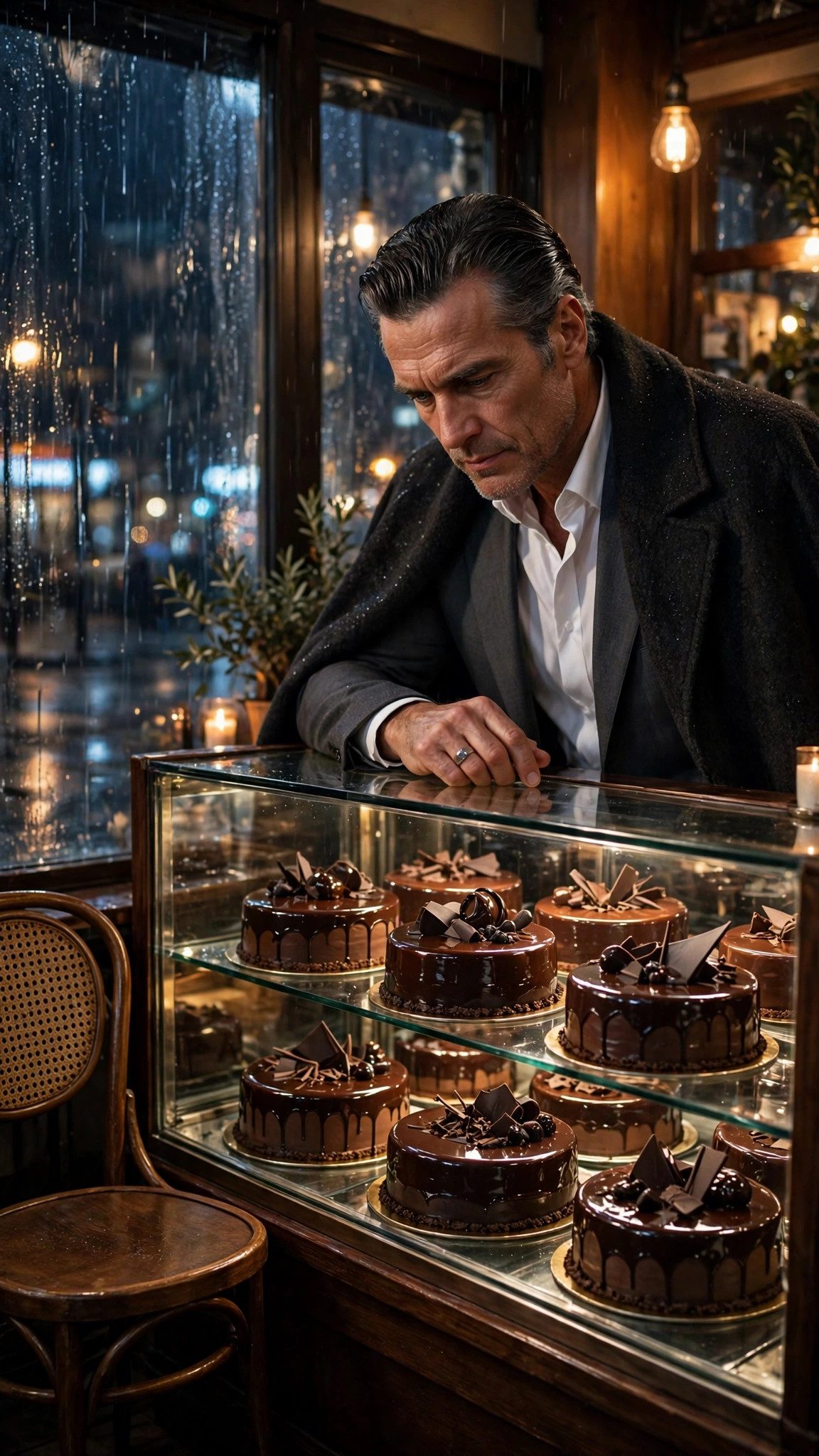
The next morning, Gabriel Rossy did not go to his office. He did not take his usual calls. He did not meet with the men who waited for him every morning in the leather chairs of his building on the hill, men who had learned to read his moods the way sailors read the sky.
Instead, he went to the little corner cafe on Maple Street, and he sat in the corner booth, and he asked Antonio Marchetti to sit down across from him.
Antonio had been awake most of the night. He had gone home to his small apartment above a laundry and sat at his kitchen table with a glass of grappa he did not drink, thinking about the little girl and the mafia boss and the question Gabriel had asked him — That girl's father. The baker. What was his name? — and the answer he had given, and the thing Gabriel had said after it, the thing he had not finished saying. Then you know who really —
He knew what Gabriel had been about to say. He had known it for twenty years, and he had carried it like a stone in his pocket, heavy and silent, because some truths are too dangerous to say out loud in a neighborhood like theirs. But this morning, when Gabriel Rossy walked into the cafe before it opened, dismissed the cook with a look, and pointed at the chair across from him, Antonio understood that the twenty years of silence were over.
"Sit down, Antonio," Gabriel said. His voice was calm. That was what frightened Antonio most. Gabriel Rossy shouting was a storm you could see coming. Gabriel Rossy calm was a deep river with something moving under the surface.
Antonio sat. His hands shook. He folded them on the table to hide it, and Gabriel watched him do it, and said nothing.
"Tell me about Daniel Hart," Gabriel said.
Antonio swallowed. "He was a good man, sir. The best baker on Maple Street. Everybody loved him. His chocolate cake —"
"I know about the cake," Gabriel said. "Tell me about the debt."
The silence that followed was long enough for the rain to start again outside, pattering softly against the windows. Antonio looked at his folded hands. He looked at the display case, where the chocolate cakes stood in their neat rows. He looked anywhere except at Gabriel Rossy's grey eyes.
"My father," Antonio said at last, his voice low and rough, "my father, Enrico Marchetti, owned this cafe. Thirty years he owned it. He built it with his own hands, sir. He borrowed money to buy the ovens. He borrowed from your father."
Gabriel did not move. "Go on."
"It was during the territorial dispute. The Castellanos were squeezing everyone on the street. Protection money, they called it, but it was not protection. It was theft. My father could not pay them and pay the loan too. He went to your father — to Don Salvatore — and he begged for mercy. He begged for more time. Your father said no."
Antonio's voice cracked. He coughed, and went on.
"Your father called the loan in. All of it, at once. My father did not have it. He was going to lose the cafe — the cafe he had built with his own hands, sir — and Daniel Hart, who was his friend, who supplied the bread for this cafe for ten years, Daniel stepped in. He said, 'I will sign for it. Put the debt on me. Give Enrico time.' My father begged him not to. I begged him not to. But Daniel —" Antonio shook his head. "Daniel was that kind of man. He signed the note. He took the debt onto himself. He lost his bakery within a year. He lost the house above it. He lost everything. And then —" Antonio's hands tightened into fists on the table. "Then he died. A heart attack, the doctors said. He was forty-one years old, sir. He left a wife and two small children. And the debt — the debt went to the Castellanos. They bought it for pennies. They own this street now, sir. They own all of it."
Gabriel sat very still. He had known, in some buried part of himself, that there was a story like this. He had grown up hearing fragments of it — his father's voice in the study, late at night, talking about loans and notes and men who could not pay. He had chosen, for twenty years, not to hear it. He had chosen to believe that the Castellanos were the ones who had destroyed the small shops on Maple Street, because that belief had given him a target, and a target had given him a purpose, and a purpose had given him a life.
Now the purpose was gone. Now there was only the truth, sitting across the table from him in the shape of a frightened waiter with shaking hands.
"Where is the note?" Gabriel asked.
Antonio looked up, startled. "Sir?"
"The note Daniel Hart signed. Where is it?"
"I — I don't know, sir. The Castellanos have it, I think. Or your father's people had it. I never saw it again after that day."
Gabriel stood up. He put on his overcoat, and he looked down at Antonio, and his face was unreadable, carved out of something cold and grey, like the sky before a storm.
"Thank you, Antonio," he said. "You have done nothing wrong. You will not be punished for telling me the truth. No one will touch you, or this cafe, while I am alive. Do you understand me?"
"Yes, sir," Antonio whispered.
Gabriel left the cafe and got into his car, and Marco drove him up the hill to the big house where his father's study still stood exactly as Don Salvatore had left it the day he died — the heavy desk, the leather chairs, the shelves of ledgers bound in dark green cloth, each one labeled in his father's precise, slanted hand.
Gabriel had not opened those ledgers in ten years. He had not needed to. The family business ran itself now, through Tommy Rizzo, his consigliere, a careful man with careful hands who kept the books and never asked questions. But this morning Gabriel needed to see it with his own eyes. He needed to see the name.
"Tommy," he said into the phone, "come to the house. Bring the key to the study safe."
Tommy Rizzo arrived within the hour, a small, neat man of sixty with silver hair and a suit that was always perfectly pressed. He had served Gabriel's father before Gabriel, and he had the particular stillness of a man who has spent a lifetime keeping other men's secrets.
"Boss," Tommy said, "what are we looking for?"
"A loan," Gabriel said. "Enrico Marchetti. The cafe on Maple Street. About twenty years ago. A note signed by Daniel Hart."
Tommy's face did not change. That, more than anything, told Gabriel the truth before he even opened the ledger. Tommy knew. Tommy had always known.
"It is in the third ledger from the left, boss," Tommy said quietly. "Second shelf. Your father kept the old notes in the back of that one."
Gabriel took the ledger down. It was heavy in his hands, the leather worn smooth by years of handling. He opened it to the back, where loose papers had been tucked between the pages — promissory notes, yellowed with age, each one signed in a different hand. He went through them slowly, one by one, until he found it.
A single sheet of paper, creased from being folded and unfolded many times. The handwriting was neat and plain, the handwriting of a man who had not gone to university but who had taken pride in writing his name clearly.
I, Daniel Hart, promise to pay the sum of forty thousand dollars to Salvatore Rossy, for the debt of my friend Enrico Marchetti, in the amount owed, in full, within one year.
Below it, a signature. Daniel Hart.
And below that, in his father's slanted hand, a single line: Paid in full — bakery seized, 14 March.
Gabriel stood at his father's desk, holding the note in his hands, and he felt the floor tilt under his feet. Forty thousand dollars. A bakery. A house. A man's life. All of it, for a debt that had not even been his. And the name at the top of the paper — the name that had called the debt in, the name that had seized the bakery, the name that had destroyed Daniel Hart and left his widow cleaning offices at night and his little boy dying in a hospital three blocks from the cafe where it had all begun —
The name was Rossy.
His name. His father's name. His family's name.
He had spent twenty years believing that Vincent Castellano and his family had destroyed the small shops on Maple Street. He had spent twenty years planning his revenge against the Castellanos, building his power, taking the streets back, telling himself that he was the avenger, the protector, the man who would make it right.
And all the while, the ruin had started here. In this room. At this desk. With his father's pen.
He remembered, suddenly and with a clarity that hurt, being twelve years old and standing in the doorway of this very study, watching his father turn away a shopkeeper — a thin man with a grocer's apron, begging for one more month on a loan, his hands shaking as he held his cap. His father had not raised his voice. He had not needed to. He had simply said, "A debt is a debt, Mr. Calloway. Pay it, or lose the shop." And the grocer had gone away, and Gabriel had never seen him again, and the shop on the corner had become a Castellano liquor store within a year.
That night, his mother, Rosa, had come to his room and sat on the edge of his bed, and she had told him, in a voice so low he had to strain to hear it, "Your father is a strong man, Gabriel. But strength without mercy is just cruelty with good manners. Remember that, when it is your turn." She had died two years later, of a sickness the doctors could not name, and Gabriel had forgotten her words for twenty years — or told himself he had forgotten them, which was the same thing.
"Tommy," Gabriel said, "how many more notes like this one are there?"
Tommy was quiet for a long moment. Then he said, "Eleven, boss. Eleven more, that I know of. The florist on Fifth. The tailor on Grand. The grocer. The cobbler. All the same story. All signed by good men who were trying to save someone else."
Gabriel closed his eyes. Eleven more Daniel Harts. Eleven more families. Eleven more little girls, somewhere out there, counting coins in the rain.
"Pull them all," Gabriel said. "Every note. Every name. Every address. I want a list on my desk by tonight, and I want to know what the Castellanos own now — what they bought, what they took, what they are pressing for. And Tommy —" He paused, and his voice, when it came, was quieter than Tommy had ever heard it. "When this is over, we are going to pay them back. All of them. Every family. Every name on that list. I do not care what it costs. I do not care how long it takes. We are going to pay them back."
"Boss," Tommy said quietly, from the doorway. He had not moved. He had been watching Gabriel's face, and what he saw there made him take a small step back. "Boss, your father — he did what men in his position did. It was business. Daniel Hart chose to sign."
"Did he?" Gabriel said. His voice was very low. "Or did my father give him a choice that was not a choice at all? Sign, or watch your friend lose everything? That is not a choice, Tommy. That is a trap with a kind face."
He set the note down on the desk, carefully, as if it might burn him. He looked at the shelves of ledgers, at the whole long history of his family written in dark green cloth and his father's slanted hand, and he wondered, for the first time in his life, how many other notes were tucked into those pages. How many other Daniel Harts. How many other little girls counting coins in the rain.
"Find out," he said. "I want to know every note like this one. Every shop. Every family. Every name. And I want to know what the Castellanos own now — what they bought, what they took, what they are pressing for."
Tommy nodded. "And then, boss?"
Gabriel looked down at Daniel Hart's note, at the neat, plain signature of a good man who had died at forty-one for a friend's debt.
"And then," Gabriel said, "my revenge comes in a different way."
He did not explain what he meant. He did not need to. He folded the note carefully and put it in his coat pocket, next to his heart, and he walked out of his father's study and down the long hallway of the big empty house, past the rooms he never entered, and out into the thin grey light of the morning, where Marco waited with the car.
"Where to, boss?" Marco asked.
"The hospital," Gabriel said. "St. Agnes. I want to see the boy."
Marco did not ask which boy. He started the car, and they drove down the hill, through the wet streets, past the shops and the cafes and the little houses, and Gabriel sat in the back seat with Daniel Hart's note in his pocket, thinking about a nine-year-old girl who had asked for the slice nobody wanted, and about a debt that had taken twenty years to come due —
And about the fact that the man who owed it most was him.