Six years ago, I was twenty-three years old, and I believed that love was enough to survive anything.
I met Matthew Vieri on a Tuesday in March, in the rain, outside a flower shop on Madison Avenue. I had just come from my shift at the library — I was a librarian then, before everything changed, before the big house and the guards and the dinners where no one ever said what they meant — and I was carrying a paper bag of groceries that was falling apart in the wet. A man in a charcoal suit stepped out of a black car, took one look at the bag splitting in my hands, and caught the oranges before they could roll into the gutter.
"You should get a better bag," he said.
"You should mind your own business," I said, because I was twenty-three and I had never learned to be careful with strangers.
He smiled then — a real smile, sudden and unguarded, the kind of smile that changed his whole face — and said, "You're right. But I have a car, and it's raining, and you have three blocks to walk. Let me drive you."
I should have said no. Every sensible rule I had ever learned said no. But there was something in his eyes — not danger, not yet, just a quiet steadiness, like a man who had decided something and would not be moved from it — and so I said yes. He drove me home. He carried my groceries up three flights of stairs. He asked if he could take me to dinner on Friday, and I said yes again, and that was the beginning of everything.
I did not know who he was. Not then. I knew his name was Matthew, and that he owned a shipping company, and that he was kind in a careful, deliberate way, as if kindness were a language he had learned late and was still practicing. He brought me flowers on our second date — white roses, because he had noticed I always stopped to look at them in the shop window. He remembered that I took my coffee with one sugar and no milk. He listened when I talked about books, really listened, the way most people only pretend to.
It was my best friend, Anna, who told me the truth. She called me three weeks after I met him, her voice low and frightened, and said, "Sofia, do you know who you're dating?"
"Matthew Vieri," I said. "He owns a shipping company."
"Sofia," she said. "The Vieri family runs half of New York. His father was Salvatore Vieri. Matthew took over two years ago. People don't say his name out loud in certain rooms."
I sat down on my bed and held the phone very tightly. "He's not like that," I said.
"He's exactly like that," Anna said. "That's the whole point. He's the head of the family. The stillness you love? That's not peace, Sofia. That's control. That's a man who never has to raise his voice because everyone in the room already knows what he can do."
I should have listened to her. I know that now. But I was twenty-three, and I was in love, and Matthew looked at me the way no one had ever looked at me — as if I were the only steady thing in a world that never stopped moving. So I stayed.
For two years, it was beautiful. We married in a small ceremony in the garden of his mother's house, with only thirty guests and white roses everywhere, and I wore a simple dress and no veil, because Matthew said he wanted to see my face. His mother, Elena, took my hands afterward and said, "You are the best thing that has ever happened to my son. Don't let this life change you."
I promised her I wouldn't. I meant it.
The first year, I believed the promise would be easy to keep. Elena invited us to Sunday dinner every week at her house, and I learned to make her lasagna the way she liked it, with extra basil and no onions, and she taught me to play cards while Matthew and his cousins argued about football in the next room. On those Sundays, Matthew was the man I had met in the rain — he laughed, he stole food from my plate, he danced with me in the kitchen when no one was looking. I thought the life would always be like that. I thought the Sundays would last forever.
Then Salvatore died. Matthew's father had a heart attack in his office on a Tuesday afternoon, and by Wednesday the whole family was in black, and by Friday Matthew was sitting in his father's chair, signing papers he had never wanted to sign, taking calls from men who had never respected him and now had to. I watched him change in the weeks after the funeral — not all at once, but the way a light dims when someone turns the switch slowly. He stopped coming home for dinner. He stopped dancing in the kitchen. He started taking his coffee black and his phone calls behind the study door, and when I asked him how his day had been, he said "fine" in a voice that meant "don't ask."
Elena noticed it too. One Sunday, while Matthew was on the phone in the garden, she took my hands and said, "He is becoming his father, Sofia. That is what this life does to good men. It takes the soft parts first. You must hold on to the soft parts for him. That is what a wife does."
I tried. God knows I tried. I held on to the Sundays. I held on to the white roses. I held on to the man who had caught my oranges in the rain. But the life kept taking, grain by grain, day by day, and I could feel myself getting smaller inside it, the way a room gets smaller when someone keeps moving the walls.
But the life changed me anyway. Slowly, the way water changes stone — not all at once, but grain by grain, day by day. The big house on the hill, with its guards at the gate and its cameras in the trees. The dinners where men in suits talked in low voices and stopped talking when I entered the room. The way Matthew would come home late, kiss my forehead, and go into his study and close the door, and I would lie awake listening to the silence on the other side of the wall. The way I stopped going to the library, stopped seeing my friends, stopped being Sofia Bennett the librarian, and became Sofia Vieri, the wife, the woman in the big house who smiled at parties and said nothing.
I told myself it was the price of loving him. I told myself that every wife gives something up. I told myself that the man who brought me white roses was still in there, underneath the stillness, underneath the weight of the family he had inherited at thirty-two when his father died of a heart attack in his office and left Matthew holding an empire he had never asked for.
And then, in the sixth year of our marriage, two things happened in the same week.
The first was that I found out I was pregnant. Eight weeks. I sat in the bathroom of our big house with the little white stick in my hand, and I cried — not because I was unhappy, but because I was so happy it frightened me. A baby. A child with Matthew's grey eyes and my smile. A reason for everything to be different. I imagined telling him that night, over dinner, with candles. I imagined his face. I imagined the stillness breaking open into joy.
The second thing happened three days later, at dawn.
I was in the kitchen making coffee when the window shattered.
It was not a loud sound, not the way movies make it sound. It was a sharp crack, like ice breaking, and then the cold morning air came pouring in, and there was a hole in the glass, and a bullet buried in the wooden cabinet two inches from my head. I stood there with the coffeepot in my hand, frozen, while the alarm screamed and the guards shouted and Matthew came running down the stairs in his bare feet with a gun in his hand, and his face was white in a way I had never seen it.
He grabbed me and pulled me to the floor behind the kitchen island, and he held me there with one arm while he shouted orders into his phone with the other, and I could feel his heart hammering against my back. "Stay down," he said. "Don't move. Don't look up."
When it was over — when the police had come and gone, when the guards had swept the grounds, when the broken window had been boarded up with plywood — Matthew sat with me at the kitchen table and held my hands, and his hands were shaking. I had never seen his hands shake.
"They were aiming at you," I said. My voice sounded very far away. "Why would they aim at me? I'm nobody."
"You're my wife," he said. "That's why. Castellano wants the docks. He'll use anything to get them. Anyone."
"Then we should go to the police," I said. "We should tell them everything. We should—"
"No," Matthew said, and the stillness came back over his face like a door closing. "The police can't protect us. The family protects us. I protect us. That's how this works, Sofia. That's how it's always worked."
"But I'm pregnant," I whispered.
He went very still. "What?"
"Eight weeks," I said. "I was going to tell you tonight."
He stared at me for a long moment, and I saw a dozen things cross his face — shock, joy, fear, and then something else, something harder, something that looked like a man closing a door and locking it. He took my hands more tightly. "Then nothing changes," he said. "Except now there's more to protect. I'll double the guards. I'll move you to the house upstate. You'll be safe there."
"Safe," I repeated. "In a house with guards and cameras, where I can't go to the store alone, where I can't see my friends, where my child will grow up behind a gate. That's not safe, Matthew. That's a prison."
"It's the only way," he said.
And in that moment, sitting at the kitchen table with the plywood over the window and the bullet hole in the cabinet behind me, I understood something I had been refusing to understand for six years. Loving Matthew Vieri meant losing myself — not all at once, but grain by grain, day by day, until there would be nothing left of Sofia Bennett except a woman in a big house who smiled at parties and said nothing. And now there would be a child, too — a child who would grow up the way Matthew had grown up, in a house where love came with guards and guns and a name that made people afraid.
I couldn't do it. I couldn't let my child grow up that way. I couldn't let my child become a target before it was even born.
So that night, after Matthew fell asleep, I packed a small bag. I took the money I had saved in the drawer of my nightstand — three hundred dollars, in twenties, money I had set aside for a new coat. I took my mother's gold necklace, the only thing of value I owned. I left my wedding ring on the pillow beside him, because I couldn't bear to take it with me and I couldn't bear to leave it without a word.
I wrote him a note. I remember every word, because I wrote it three times before I got it right. "Matthew, I love you. I have always loved you. But I can't live in this life anymore, and I can't raise a child in it. Don't look for me. I'm sorry. — Sofia."
I set the note on the kitchen table. I walked out the front door at four in the morning, when the guards were changing shifts and the gate was open for the delivery truck. I walked three miles to the bus station in the dark, and I bought a ticket to the farthest place the first bus was going, and I did not look back.
The bus took me to Millbrook. I had never heard of Millbrook. I chose it because it was small, and because it was far, and because no one there would ever have heard the name Vieri. I rented a room above a hardware store for two hundred dollars a month. I found work at the diner, washing dishes at first, and then waiting tables when Rosie saw how hard I worked. I told people my name was Sofia Hart. I told them my husband had died. It was easier than the truth, and the truth was nobody's business.
Leo was born on a snowy night in February, in the small county hospital, with Rosie holding my hand because there was no one else to hold it. He was perfect — dark curls, tiny fists, and eyes the color of storm clouds, grey and deep and exactly like his father's. When the nurse put him in my arms, I looked into those eyes and I made him a promise.
"I will keep you safe," I whispered. "No matter what it costs me. I will keep you safe."
For six years, I kept that promise. I worked double shifts. I saved every dollar. I taught Leo to read, to tie his shoes, to say please and thank you. I told him his father had been a good man who died before he was born, and I watched the sadness cross his small face and then pass, the way clouds pass, because children are resilient in ways adults forget how to be.
And I told myself that Matthew had never looked for me. I told myself that he had read my note, and believed it, and moved on. I told myself that he had never looked back when I disappeared.
I believed it. I had to believe it. Because if I didn't believe it, I would have to admit the truth — that I had run from the only man I had ever loved, and that I had taken his child with me, and that I had never given him a chance to choose differently.
I believed it for six years.
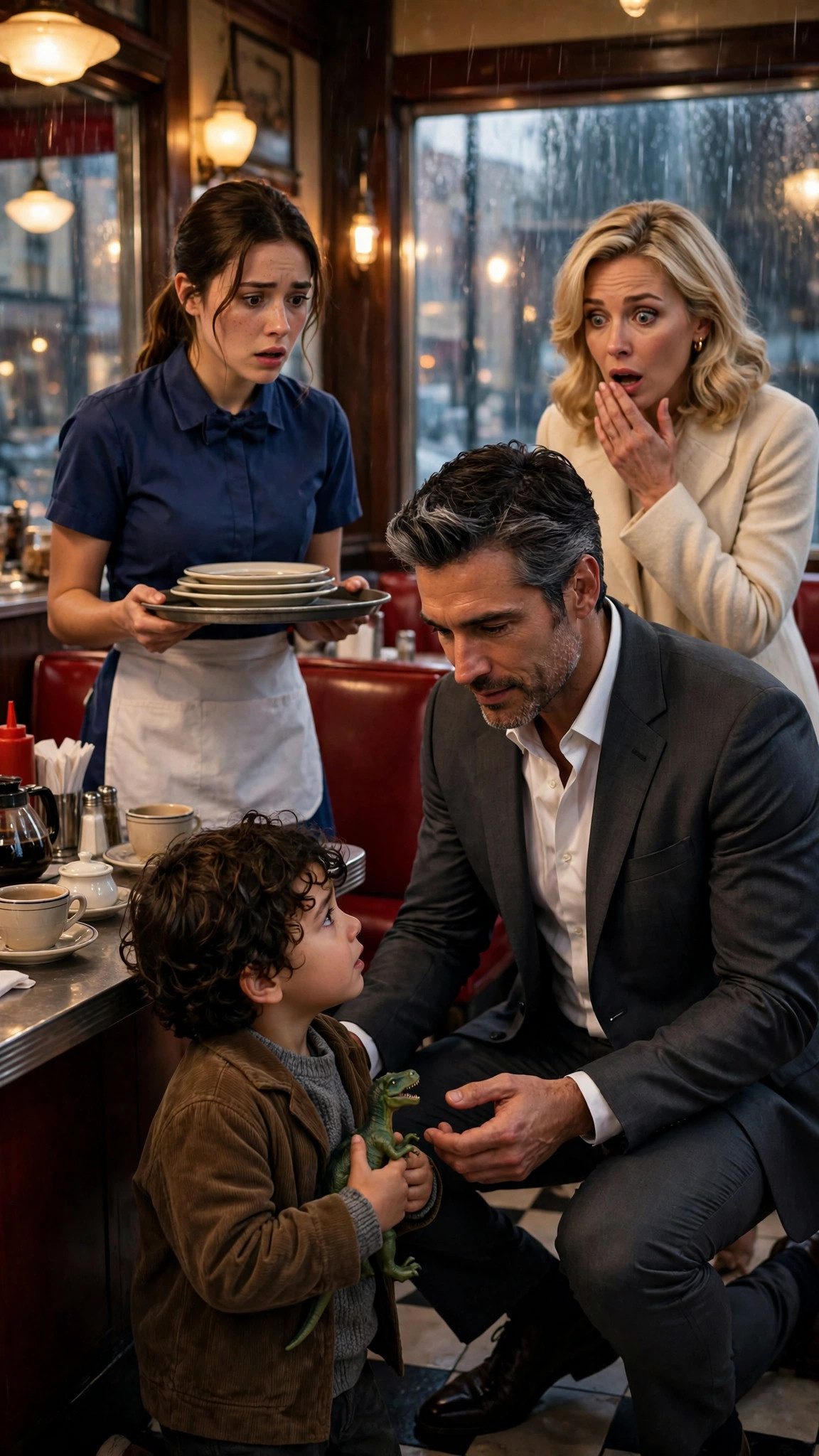
And then, on a rainy afternoon in October, the door of Rosie's Diner opened, and Matthew Vieri walked in, and my five-year-old son looked into his eyes and asked the question that destroyed everything I had built.
"Are you my daddy?"
And I knew, in that moment, that the life I had spent six years protecting was about to disappear — and that maybe, just maybe, that was not the worst thing that could happen. Maybe it was the beginning of the only thing that could save us.
Because the truth always finds a way. And it had found me in the one place I believed was safe.
It was time to stop running. It was time to go home.