My father died on a Tuesday in March, two years before the gala, in a hospital room that smelled of disinfectant and old coffee. He was sixty-one years old. He had worked the subway tunnels for thirty-one years, and his lungs had never been right after that, and his heart had been tired for a long time, and in the end it simply stopped, quietly, in the middle of the night, while my mother held his hand and I stood in the doorway because I couldn't bear to watch and couldn't bear to leave.
The morning after the funeral, my mother and I went through his things. His closet was small. A few shirts. Two pairs of work boots, both worn thin at the heels. And his navy uniform jacket, the one with the transit authority patch on the sleeve, folded neatly on the top shelf where he always kept it, even though he hadn't worn it in years.
My mother held it up, and the fabric was thin at the elbows, and there was a frayed thread hanging from the cuff — one short length of navy blue thread, coming loose from the seam.
"Your father wore this jacket the night he saved that man's life," my mother said. She didn't look at me. She was looking at the jacket, at the thread. "He never told anyone. He came home that night with his hands shaking, and he wouldn't eat, and when I asked him what happened, he only said, 'A man fell, Rosa. I pulled him back. That's all.'"
"What man?" I asked.
"I don't know," she said. "He never said his name. He said it didn't matter. A man fell, and he pulled him back, and that was all."
She cut the thread from the cuff with her little sewing scissors, and she handed it to me, and she said, "Take this, Elena. Your father is with you."
I sewed it into the lining of my apron pocket that same night, with a needle and a knot so tight it would never come loose. And I have carried it into every room I have ever worked in since — every wedding, every gala, every charity ball where I was nobody and the people around me were somebody.
My mother Rosa is a seamstress. She is fifty-eight years old, with hands that have mended a thousand hems and eyes that have gone a little soft around the edges from years of close work. After my father died, she took in sewing from the neighbors — hems and buttons and the occasional wedding dress — and she kept our little apartment in Queens going, and she never once complained, not even when the winter was cold and the rent went up and the medicine for her knees cost more than we had.
"Your father would be proud of you," she told me on the morning of the gala, standing in our kitchen in her housecoat, watching me tie my apron. "You work hard. You don't lie. You don't steal. That's worth more than all the diamonds in Manhattan."
"I just carry trays, Mama," I said.
"You carry yourself," she said. "That's harder."
I kissed her cheek and caught the bus to Manhattan, and I told myself what I always told myself on the way to a big job: keep your head down, keep your hands steady, don't look anyone important in the eye unless they speak to you first, and never, ever make a scene.
Sterling Events had sent twelve of us to the Plaza Grand that night. The job was the engagement party of Bianca Romano and Dante Moretti — the wedding of the year, the papers said, the merger of two of the most powerful families in New York. We were told to arrive at three, to wear our black uniforms with white aprons, to keep our hair tied back, to wear no perfume and no jewelry, and to remember that we were invisible.
"You're not guests," the supervisor, a sharp-eyed woman named Mrs. Delaney, told us in the service corridor, her voice low and hard. "You're furniture that moves. You don't speak unless spoken to. You don't look at the guests. You don't eat the food. And if Miss Romano says jump, you ask how high on the way up. Do you understand?"
We all nodded. We understood. Girls like us always understand.
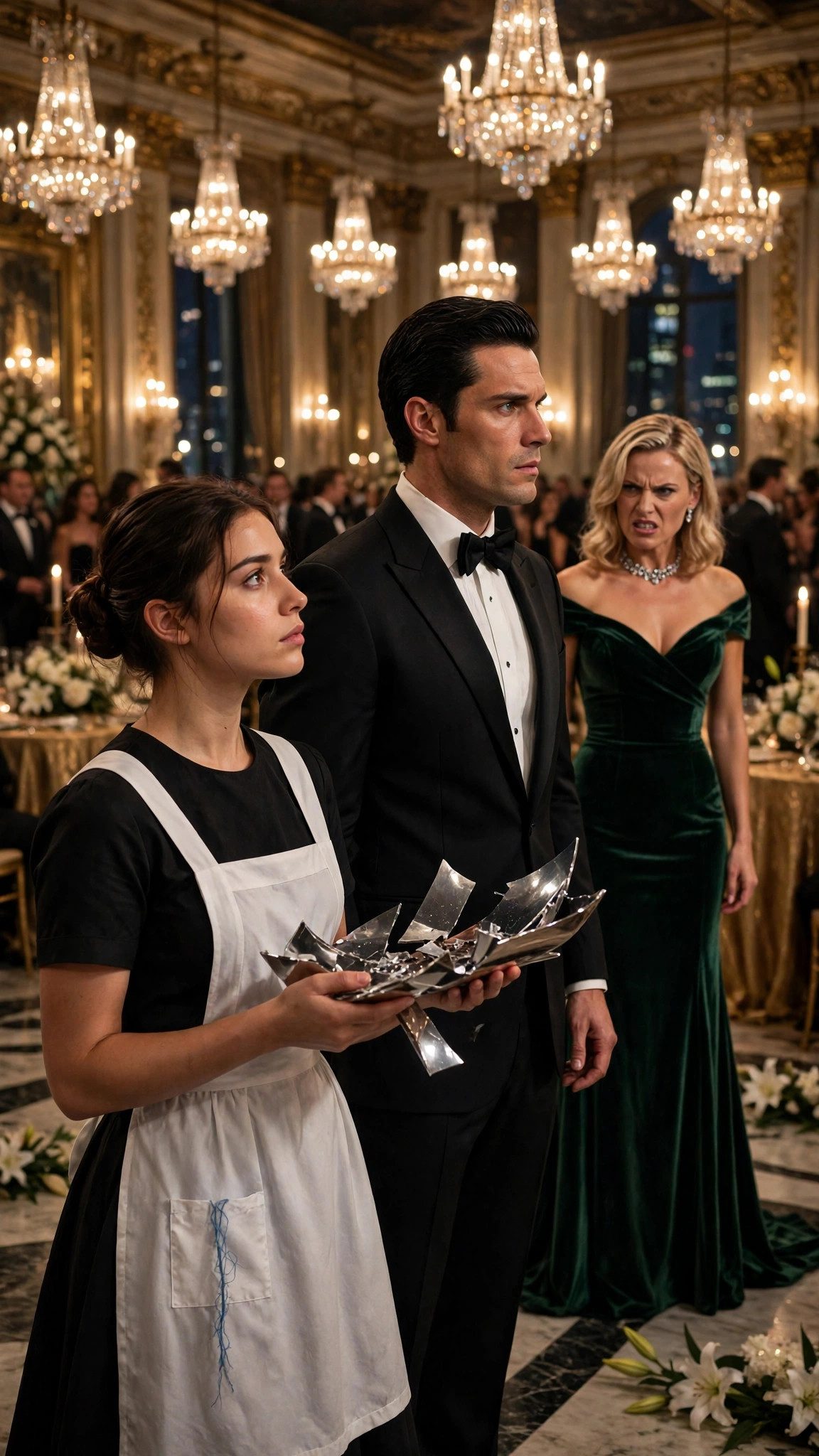
The ballroom was the most beautiful room I had ever been in. Chandeliers hung in rows, each one bigger than the last, throwing light across marble floors polished to a shine so bright you could see your own reflection in them. White lilies stood in tall vases on every table. The head table was draped in gold cloth, and the chairs were gold, and the plates were gold-rimmed, and everything glittered, and I thought, standing there in the service doorway with my tray in my hands, that I had never felt so small in my life.
I worked the room for three hours before anything went wrong. I carried trays of champagne. I refilled water glasses. I cleared plates. I smiled at people who didn't look at me. I did my job the way my father taught me to do every job: quietly, carefully, like it mattered, because it did.
And then, at half past seven, Mrs. Delaney sent me down the back hallway to fetch a fresh case of champagne from the service pantry, and that was when I found Bianca Romano in the hallway.
She was not alone. She was standing close to a man I had never seen before — a tall man in a waiter's uniform that didn't fit him quite right, with a hard face and eyes that kept moving toward the ballroom doors. Bianca was holding an envelope. She pressed it into the man's hand, and she said something I couldn't quite hear, and then she saw me standing at the end of the hallway with an empty tray in my hands, and her face went cold.
"What are you doing here?" she said.
"Fetching champagne, miss," I said. My voice came out steady, which surprised me, because my heart was beating very fast. "Mrs. Delaney sent me."
Bianca walked toward me slowly, her emerald gown whispering against the floor, and she stopped so close to me that I could smell her perfume — something expensive and sharp, like crushed flowers and ice.
"You didn't see anything," she said. Her voice was low and sweet and absolutely certain. "Do you understand me? You didn't see anything, and you didn't hear anything, and if you ever breathe a word about this hallway to anyone — anyone — I will make sure you never work in this city again. Not at a gala. Not at a wedding. Not at a diner. Nowhere. Do you understand?"
I understood. I understood perfectly. Women like Bianca Romano didn't make threats they couldn't carry out.
"Yes, miss," I said.
"Good girl," she said, and she smiled, and she turned and walked back toward the ballroom, her gown sweeping the floor behind her, and the man in the waiter's uniform was gone, vanished down the service stairs like he had never been there at all.
I stood in the hallway for a long time after she left, holding my empty tray, thinking about the envelope and the man and the way Bianca's hands had shaken, just slightly, when she pressed it into his hand. I thought about telling Mrs. Delaney. I thought about telling someone. But I needed this job, and my mother needed her medicine, and girls like me don't accuse women like Bianca Romano of anything, ever, unless they want to lose everything.
So I fetched the champagne. I went back to the ballroom. I did my job. I carried trays and refilled glasses and smiled at people who didn't look at me, and I told myself that the hallway had never happened, and that the envelope didn't matter, and that Bianca Romano was none of my business.
I was wrong about that, too. The hallway mattered more than anything else that happened that night — more than the heel, more than the glass, more than the wedding being called off in front of three hundred people — because the hallway was where it all began, and because three weeks later, when Dante Moretti asked me if I was the one who found Bianca in the hallway, I finally understood that he had known about it all along, and that he had been waiting for someone to tell him the truth.
But that night, I knew none of that. That night, I was just a girl with a blue thread in her apron pocket, carrying a tray through a ballroom full of chandeliers, trying very hard to be invisible.
It didn't work. I was never invisible to Dante Moretti. Not for a single second. I just didn't know it yet.
I had not always worked for Sterling Events. I started when I was twenty-two, fresh out of a waitressing job at a diner in Queens that had closed when the owner retired, and I had no references and no experience with galas, and Mrs. Delaney had looked at me the way a woman looks at a stray dog — half pity, half suspicion — and said, "We will try you for one night. One mistake, and you are gone."
My first night was a charity ball at a hotel downtown, and I was so nervous that I dropped a spoon during the soup course, and the sound of it hitting the floor felt like a gunshot. An older waitress named Gloria — sixty years old, with grey hair in a tight bun and hands that had carried a thousand trays — caught my arm before I could panic, and she whispered, "Pick it up, honey. Smile. Nobody saw. The rich don't see us, and that is our power and our curse. They don't see us, so they don't watch us. And because they don't watch us, we see everything."
Gloria became my friend after that. She taught me everything: how to carry a tray with one hand and pour with the other, how to disappear into a corner when the guests started arguing, how to smile with your mouth while your eyes stayed somewhere else entirely. She had worked galas for thirty years, and she had seen everything — proposals and breakups, deals made over dessert, men crying in hallways, women slapping their husbands behind potted plants — and she had never told a soul, because that was the rule, the first rule, the only rule that mattered: what happens in the ballroom stays in the ballroom.
"The girls who talk," Gloria told me once, over coffee in a service pantry, "are the girls who don't work again. The girls who keep their mouths shut work forever. Remember that, Elena. Your silence is your paycheck."
I remembered it. I kept my silence for four years. I kept it through a hundred galas and a hundred weddings and a hundred nights of carrying trays for people who never learned my name. I kept it the night I found Bianca Romano in the hallway with a man in a waiter's uniform and an envelope full of secrets. I kept it because Gloria was right — my silence was my paycheck, and my paycheck was my mother's medicine and our rent and the food on our table.
But there was one thing Gloria didn't know, one thing I had never told anyone at the agency: why I sewed a blue thread into my apron pocket, and where it came from. That was mine. That was my father's. And I kept it the way Gloria taught me to keep everything that mattered — quietly, and close.
My father used to come home from the night shift and sit at our kitchen table with his thermos, and he would tell me about the people he saw on the platforms — the musicians with their battered cases, the tired nurses coming off the night shift, the kids going to school with their backpacks half open — and he always said the same thing: "Elena, the city is full of people nobody sees. You see them. That's your job in this world."
I thought about his words every night I worked a gala. I thought about them the night a bride cried in the pantry of a hotel downtown — a beautiful girl in a white dress, twenty-four years old, hiding behind the dessert trays twenty minutes before her own wedding, crying because her mother had just told her she was making a mistake. I didn't say anything. I just handed her a glass of water and a clean napkin, and I stood in the doorway so no one would come in, and I waited with her until she was ready. She looked at me afterward, with her makeup fixed and her dress straightened, and she said, "Thank you. Nobody else even noticed I was gone."
"Nobody notices us," I said. "But we notice them."
That was the job, as far as I was concerned. Not the trays. Not the champagne. The noticing. Gloria taught me the trays. My father taught me the noticing.
Gloria taught me other things, too. She taught me how to handle a drunk groomsman who grabs your wrist — you smile, you step back, you say, "Congratulations, sir, let me get you some water," and you never, ever make a scene, because a scene is what he wants and a scene is what will get you fired. She taught me how to handle a guest who snaps her fingers at you like you are a dog — you walk over, you smile, you say, "Yes, ma'am, right away," and you remember her face, and you never forget it, because people who snap their fingers at waitresses will snap their fingers at anyone, and one day they will snap at the wrong person.
"Watch them, Elena," Gloria told me once, over coffee in a service pantry, her voice low and her eyes sharp. "The rich think we are furniture. Furniture doesn't have eyes. Furniture doesn't remember. But you remember everything, honey. You remember who was kind and who was cruel, and you keep it all in here." She tapped her temple. "Because one day, it matters. One day, somebody asks, and you are the only one who knows."
I didn't understand what she meant, not then. I was twenty-two years old, and I thought she was just talking — the way old waitresses talk, the way people talk when they have seen too much and said too little. But I remembered her words. I kept them in the same place I kept my father's thread — close, and quiet, and where nobody could see them.
And three weeks before the gala, in the hallway of the Plaza Grand, when Bianca Romano pressed an envelope into a stranger's hand and told me I had seen nothing, I understood Gloria at last. I understood that my silence was my paycheck, and that my memory was the one thing nobody could take from me, and that one day — one day — somebody was going to ask me what I had seen.
That day came sooner than I expected. It came in a ballroom full of chandeliers, with a broken tray at my feet and three hundred people watching, when Dante Moretti looked at me and said, "You're the same one who found Bianca in the hallway, aren't you?"
And I knew, in that moment, that Gloria had been right all along. One day, somebody asks. And you are the only one who knows.