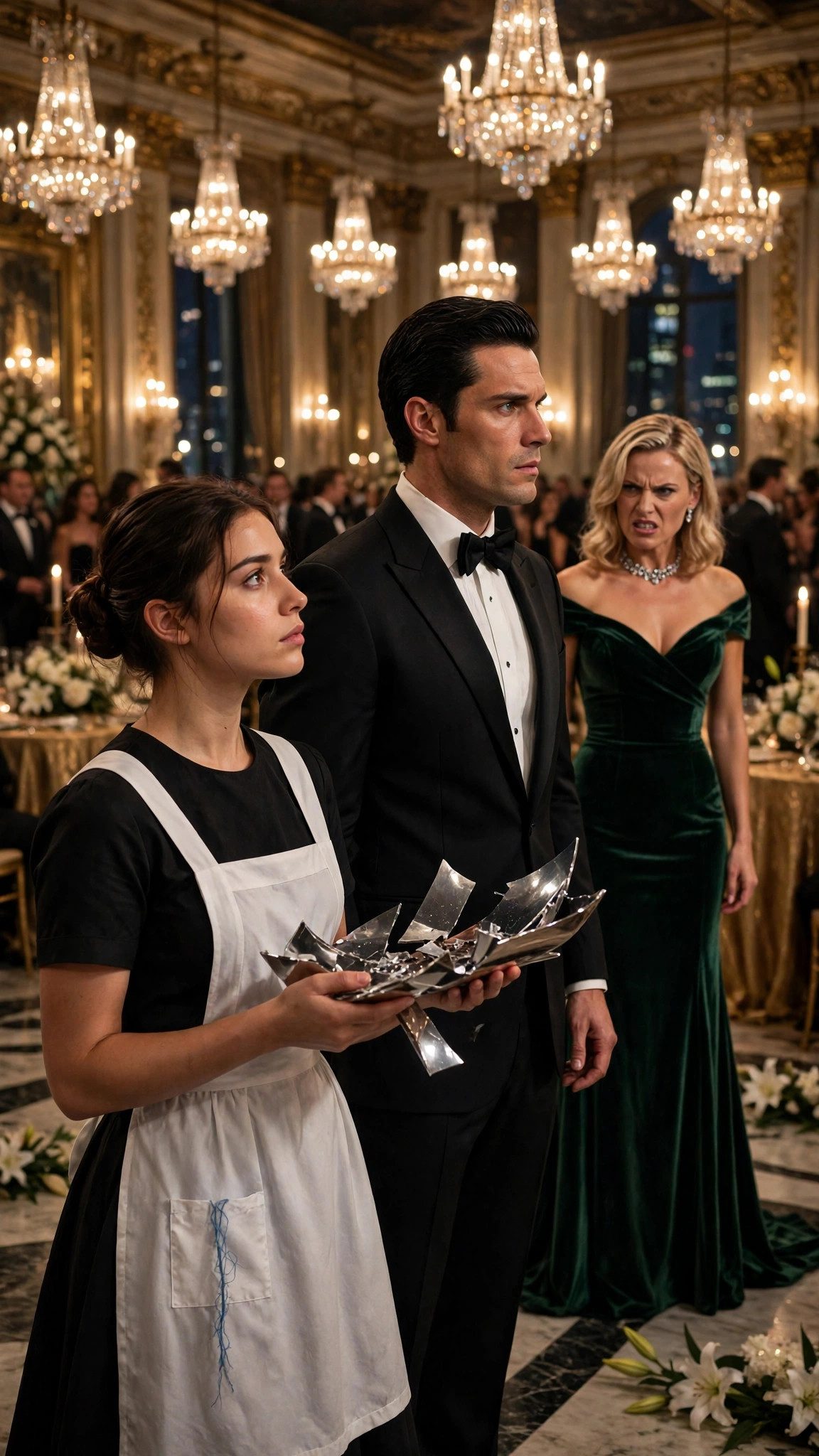
The FBI agent's name was Daniel Reyes, and he was the calmest man I had ever met.
He was forty years old, with short dark hair going grey at the temples, a plain dark suit, and a voice so even and patient that it made you want to tell him everything, even the things you had promised yourself you would never tell anyone. He met me in a small room in a federal building downtown, with a tape recorder on the table and a cup of water in front of me, and he said, "Miss Elena, take your time. Start at the beginning. Tell me everything you remember, in your own words."
So I told him. I told him about the hallway, and the man in the waiter's uniform, and the envelope, and Bianca's shaking hands, and her threat — "I will make sure you never work in this city again." I told him about the platter, and the tiny black lens, and the way Bianca's fingers had brushed the rim, checking it, making sure it was on. I told him about the gala, and the heel, and the glass, and the wedding being called off in front of three hundred people. I told him everything, slowly and carefully, in my own words, and Agent Reyes listened without interrupting, and when I finished, he turned off the tape recorder and said, "Thank you, Miss Elena. You have been very brave. And very helpful."
"Will it be enough?" I asked. "To stop him?"
"It will be a start," he said. "But I need more than a hallway and a camera. I need the man who tried to kill Mr. Moretti six years ago. I need the man who paid him. And I need proof that connects them."
Dante found the proof. Or rather, Sal found it, the way Sal always found things — quietly, patiently, by asking the right questions of the right people and waiting for the answers to come to him.
The killer from Astoria had a name. His name was Frank DeLuca, and he had been a small-time enforcer for the Romano family for twenty years, and he had died three years ago in a car accident on the highway outside the city — an accident that Sal had always thought looked a little too convenient, a little too clean, for a man who had known too much.
But Frank DeLuca had kept a notebook. A small black notebook, the kind you buy at a drugstore, filled with dates and names and amounts in a cramped, careful hand. And when he died, the notebook had gone to his sister, a woman named Angela who lived in New Jersey and ran a flower shop and wanted nothing to do with her brother's life or his death, but who had kept the notebook in a drawer for three years because she couldn't bring herself to throw it away.
Sal went to New Jersey. He sat in Angela's flower shop, among the lilies and the roses, and he told her about a maintenance man named Thomas who had saved a stranger on a platform in Astoria six years ago, and about a girl named Elena who had lost her job for telling the truth, and about a mafia boss who had spent six years looking for the man who saved his life.
And Angela DeLuca opened the drawer, and she took out the notebook, and she handed it to Sal, and she said, "My brother was not a good man. But he wrote everything down. He said, if anything ever happened to him, someone should know."
The notebook had it all. November 14th, six years ago. Astoria station. Target: Dante Moretti. Payment: fifty thousand dollars. Paid by: V.R. — Vittorio Romano. And a note, in Frank's cramped handwriting, at the bottom of the page: "The subway man got in the way. I couldn't finish it. V.R. was furious. He said next time, no witnesses."
There were other pages, too. Other jobs. Other payments. Six years of Vittorio Romano buying his way toward the Moretti empire — bribing captains, planting men, paying for information, building the army that Bianca had been carrying in an envelope in the hallway of the Plaza Grand.
And there was one more thing. Tucked into the back of the notebook, folded into quarters, was a photograph — old, creased, a little faded. It showed a young man standing on a subway platform in a navy uniform, smiling at the camera, a thermos in his hand. On the back, in Frank's handwriting, were the words: "The witness. Thomas. Astoria. Do not touch him — V.R. says he is useful alive. He knows my face."
My father. Frank DeLuca had taken a photograph of my father — the man who had stopped him from killing Dante — and Vittorio Romano had ordered him not to touch him, because a living witness was more useful than a dead one. My father had lived for four more years after that night, never knowing that a photograph of him was folded into a killer's notebook, never knowing that his life had been spared by a man who wanted to use him.
I cried when Sal showed me the photograph. I cried in Dante's office, sitting in the same chair where Bianca had sat, holding the creased, faded picture of my father in his navy uniform, smiling at a camera he never knew was there, and Dante sat across from me and didn't say anything, and Sal stood by the door and didn't say anything, and for a long time the only sound in the room was my crying and the hum of the city below us.
"He kept you safe," Dante said finally, very quietly. "Vittorio could have had him killed a dozen times. He didn't. Because your father was the only man alive who could identify Frank DeLuca, and Vittorio needed Frank alive, and Frank needed your father alive to prove that he had been there, that he had done the job, that he had earned his money. Your father lived because he was evidence. And now that evidence is going to put Vittorio Romano in prison for the rest of his life."
Agent Reyes moved fast after that. He had the notebook. He had the photograph. He had Eddie Krol's testimony about the camera and the hallway and the list. He had my testimony. He had Bianca's confession — because Bianca, to her credit, when the FBI came to her door, told them everything, in her own words, without a lawyer, without a deal, because she was tired of being afraid of her father and because she wanted, for once in her life, to do the right thing.
They arrested Vittorio Romano on a Thursday morning, at his house in Long Island, in front of his lawyers and his bodyguards and his wife, who stood in the doorway in her dressing gown and watched them put handcuffs on the man she had been married to for forty years, and who did not cry, and did not speak, and did not move.
The charges were long. Attempted murder. Conspiracy. Racketeering. Bribery. Six years of crimes, laid out in Frank DeLuca's notebook, confirmed by Eddie Krol, confirmed by Bianca, confirmed by me.
Vittorio Romano was sixty-eight years old. He would die in prison. Everyone knew it, including him. He didn't fight the charges. He didn't make a speech. He just looked at Dante, as the agents led him past, and he said, "Your father would have done the same thing, boy. Don't pretend you're better than me."
Dante looked at him, and his face was calm, and his voice was steady, and he said, "My father never tried to kill a man on a subway platform. My father never used his daughter as a weapon. And my father never made a maid afraid to tell the truth. So yes, Mr. Romano. I am better than you."
That night, Dante came to my apartment in Queens. Not with guards. Not with a driver. Just him, standing in our little hallway in his dark coat, holding a small paper bag, looking nervous in a way I had never seen him nervous before — not in the ballroom, not in his office, not anywhere.
"Your mother is asleep?" he asked.
"She's in the kitchen," I said. "She's making tea. She makes tea when she's nervous, and she's been nervous since the FBI came to the door."
Dante nodded. He held out the paper bag. Inside it was a photograph — the photograph from Frank DeLuca's notebook, my father on the platform in his navy uniform, smiling, a thermos in his hand. Agent Reyes had made a copy for me, at Dante's request, and Dante had it framed in a simple wooden frame, the kind you buy at a drugstore, the kind my father would have liked.
"I thought you should have it," Dante said. "He saved my life, Elena. The least I can do is make sure his daughter never forgets his face."
I took the frame in both hands, and I looked at my father's face, and I cried again — but this time I wasn't crying because I was sad. I was crying because for the first time in two years, since the day he died in that hospital room, I felt like my father was still with me. Not gone. Not lost. Still here, in this little apartment in Queens, in a photograph, in a blue thread sewn into my apron pocket, in the man standing in my hallway who owed him his life and knew it.
"Thank you," I whispered.
"No," Dante said. "Thank you."
And then he did something I will never forget, for as long as I live. He reached out, very slowly, very gently, and he touched the blue thread sewn into the pocket of my apron — the thread I was still wearing, even at home, even after everything — and he said, "Your father pulled me back from the edge, Elena. Six years ago, on a platform in Astoria, he put his hand on my arm and he pulled me back. I've been looking for him ever since. And now I've found his daughter. And I am not going to let her go."
I didn't know what he meant. Not yet. But I would find out soon enough — under the chandeliers, where it all began, where a blue thread had caught the light and changed everything.
The trial took three weeks, and I testified on the second day.
I had never been in a courtroom before. I had seen them on television, of course — the wood paneling, the flags, the judge in the black robe, the lawyers in their dark suits — but nothing on television had prepared me for how small the room felt, or how quiet it was, or how every eye in the place seemed to be on me when I walked down the aisle to the witness stand and raised my right hand and swore to tell the truth.
The prosecutor was a woman named Ms. Okafor, with a calm voice and a patient way about her, and she asked me simple questions, one at a time, and she let me answer in my own words, and she never rushed me, not once.
"Miss Elena," she said, "can you tell the court what you saw in the hallway of the Plaza Grand on the night of the engagement party?"
So I told them. I told them about the man in the waiter's uniform that didn't fit him quite right. I told them about the envelope. I told them about Bianca's shaking hands, and her threat, and the way she had looked at me — not angry, but frightened. I told them about the platter, and the tiny black lens, and the way Bianca's fingers had brushed the rim, checking it. I told them everything, slowly and carefully, in my own words, and the courtroom was so quiet you could have heard a pin drop on the wooden floor.
Then Vittorio Romano's lawyer stood up. He was a tall man with silver hair and a suit that cost more than my mother's apartment, and he smiled at me the way a cat smiles at a bird, and he said, "Miss Elena, isn't it true that you are now in a romantic relationship with Mr. Moretti?"
The courtroom murmured. The judge banged his gavel. Ms. Okafor stood up and objected, and the judge sustained the objection, and the lawyer sat down, but the damage was done — the suggestion was out there now, hanging in the air, that I was not a witness but a girlfriend, not a truth-teller but a woman with something to gain.
I looked at the lawyer, and I looked at Vittorio Romano sitting at the defense table, watching me with cold, flat eyes, and I thought about my father, and about the blue thread, and about the night he pulled a stranger back from the edge of a platform, and I said, in a voice that was steadier than I felt, "I am telling the truth, sir. Whether or not Mr. Moretti and I are friends has nothing to do with what I saw in that hallway. I saw what I saw. And I will not lie about it, not for you, not for anyone."
The courtroom went quiet again. And in that quiet, I saw the jury — twelve ordinary people, men and women, old and young — and I saw them looking at me, and I saw something in their faces that gave me hope. They believed me. I could tell. They believed me because I was telling the truth, and the truth, when you say it plainly and without fear, has a sound to it — a clear, simple sound — that a lie can never imitate.
Bianca testified the next day. She wore a simple grey dress, no diamonds, no makeup, her blonde hair pulled back in a plain ponytail, and she looked smaller than I had ever seen her — not the queen of the ballroom, but a woman who had spent her whole life doing what her father told her and had finally decided to stop.
She told them everything. The camera. The hallway. The list. The money. The plan to take the docks. The night at Astoria, six years ago, when her father had paid a man to push Dante Moretti onto the tracks. She told them in a voice that shook, and she cried twice, and she apologized once — not to the court, but to me, looking straight at me across the room, saying, "I'm sorry, Elena. I was cruel to you because I was afraid. That is not an excuse. But it is the truth."
The verdict came on a Friday afternoon. Guilty, on all counts. Attempted murder. Conspiracy. Racketeering. Bribery. The judge sentenced Vittorio Romano to life in prison, without the possibility of parole, and as the officers led him away, he looked back at Dante, sitting in the gallery, and he said nothing at all. There was nothing left to say.
After the trial, the Romano captains scattered. Some of them came to Dante, asking for protection, asking for work, asking for a place in the new order. Dante took the ones who were willing to work clean, and he turned away the ones who weren't, and the ones he turned away went to other families, or disappeared, the way men in our world sometimes do.
Eddie Krol got eight years, for testifying. He wrote Dante a letter from prison, once, thanking him for not having him killed — which, Eddie said, was what most men in Dante's position would have done. Dante never answered the letter. He didn't need to. The fact that Eddie was alive, in prison, telling the truth, was answer enough.
And Bianca — Bianca went to the women's shelter in Brooklyn, and she served her two hundred hours, and she kept going after that, long after the hours were done, because she had found something there she had never found in a ballroom full of chandeliers: a reason to get up in the morning that had nothing to do with her father.