The clock on the dashboard said 1:12 in the morning when Roman Moretti turned his SUV into the driveway of the house on Lake Drive, and the first thing he noticed was the dark.
Every light in the house was out. Not the porch light. Not the lamp in the front hall that Aaron always left burning for him, no matter how late he came home. Not the soft amber glow from the nursery window on the second floor, the one she kept on all night because she was afraid of the dark in a room full of tiny sounds.
Roman cut the engine and sat there for a moment with his hands on the wheel, listening to the rain tick against the windshield. His head was still full of the restaurant — the clink of glasses, Laya's laugh, the low throb of the music at the Drake — and for one stupid, drunken second he told himself that Aaron had simply gone to sleep early. That she had finally given up waiting for him and gone to bed like a normal wife, and that in the morning she would be cold and quiet and he would buy her something expensive and it would all be fine again.
Then he saw the front door standing open two inches, rain blowing in across the mat, and the cold went through him like a blade.
He was out of the car before he had finished thinking about it, taking the porch steps three at a time, his coat flapping, his shoes loud on the wet stone. He pushed the door wide and the hallway was dark and empty and wrong in a way he could feel in his teeth.
"Aaron?" His voice sounded strange in his own ears. Too loud. Too fast. "Aaron!"
No answer. The house gave him nothing back but the ticking of the grandfather clock in the hall and the low hum of the refrigerator in the kitchen.
He went up the stairs two at a time, his hand sliding along the banister, and when he reached the nursery door he already knew. He knew the way a man knows when the ground has dropped out from under him, the way a man knows when the thing he has been most afraid of has finally happened, not because anyone told him but because the air itself has changed.
The nursery was empty.
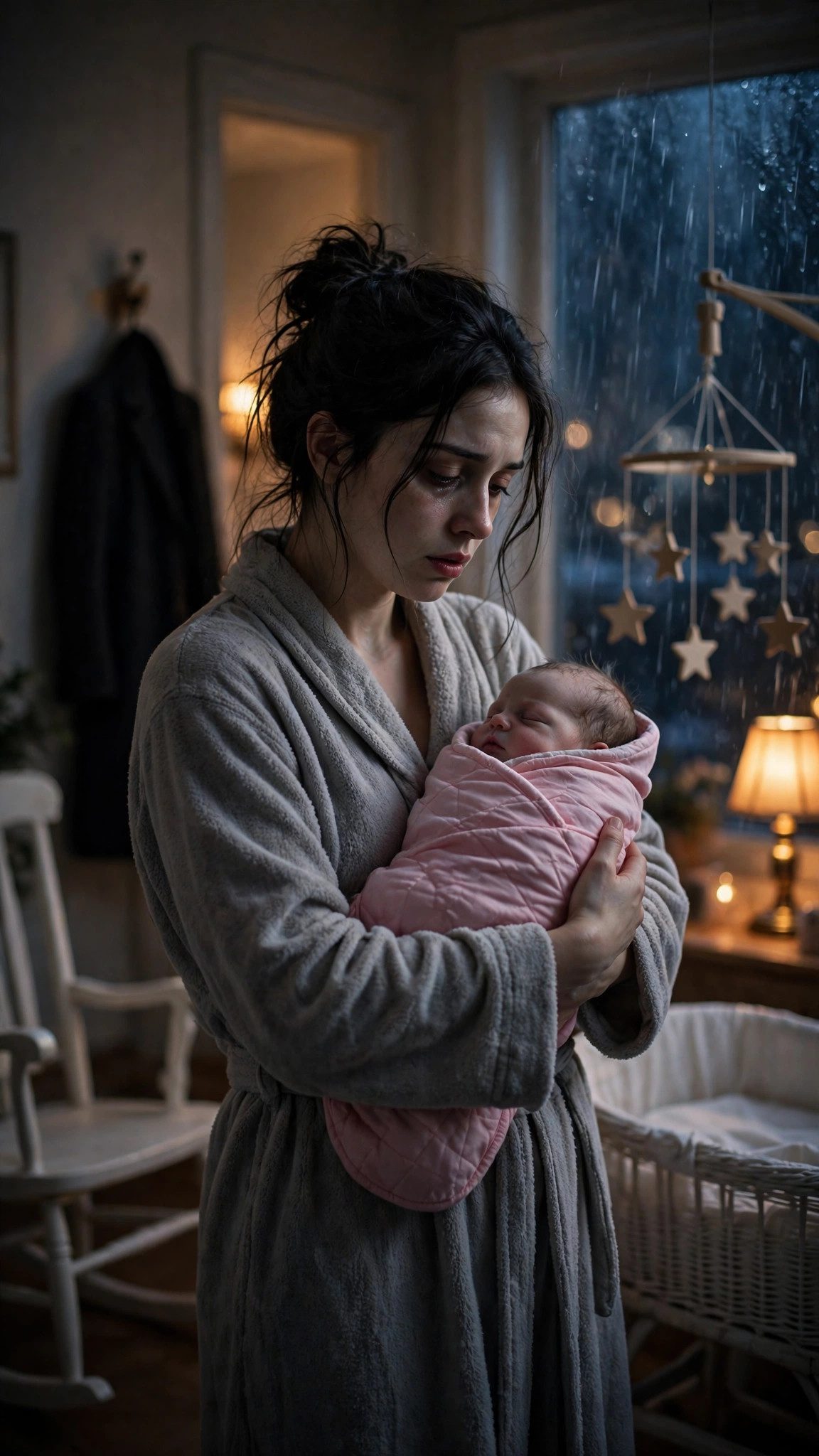
The bassinet was empty. The white rocking chair sat still in the corner, the pink sleep sack folded neatly over its arm. The mobile he had hung above the bassinet before Sophie was born — the little wooden stars and moons he had spent an hour assembling with the instructions spread across the floor — turned slowly in the draft from the open window, and the stars knocked together with a soft, hollow sound that made his chest hurt.
On the changing table, her phone lay face down. Beside it, a single sheet of paper, folded in half. His name was written on it in Aaron's handwriting. Not "Roman." Not "my love." Just his name, in the neat, careful letters she used when she was trying very hard not to cry.
He did not open it yet. He stood in the doorway of the empty nursery with rain dripping off his coat onto the rug, and he looked at the place where his daughter had slept that morning, and the place where his wife had stood that evening watching him button his coat, and he understood, all at once and with perfect clarity, that he had broken the only promise that had ever mattered.
"I'll be back before nine," he had said.
It was 1:12 in the morning. He had not come back before nine. And now they were gone.
Six days earlier, he had held his daughter for the first time.
Sophie Moretti had come into the world at St. Mary's Hospital in Milwaukee on a cold Tuesday morning in November, four pounds and eleven ounces of furious, red-faced life, and the nurse had placed her in Aaron's arms and Aaron had laughed through her tears and said, "She has your eyes," and Roman had stood there in his suit with his tie loosened and his hands shaking, and for one shining minute he had not been the most feared mafia boss in Milwaukee. He had been a father. Just a father, looking at his daughter, wondering how anything so small could already own him completely.
The drive home from the hospital had been slow and careful, Roman driving ten miles under the speed limit while Aaron sat in the back seat with the car seat, one hand resting on the tiny bundle, checking her breathing every thirty seconds. He had carried the car seat up the front steps himself, refusing to let any of his men touch it, and he had set it down in the middle of the nursery and looked around at the room they had spent three months preparing — the white crib, the rocking chair, the dresser full of tiny clothes folded with impossible neatness — and he had thought, this is my life now. This is what all of it was for.
That first night, he had sat in the rocking chair until three in the morning, holding Sophie against his chest while she slept, listening to the small, snuffling sounds she made, and he had made a promise to himself. He would be a different man for her. A better man. The kind of father who was there.
He had kept that promise for exactly five days.
On the sixth day, Laya Crane called.
Laya had been calling for months. She called in the morning, when Aaron was in the shower. She called in the afternoon, when Roman was supposed to be at the docks. She called at night, when the house was quiet and Aaron was asleep with one hand on the bassinet, and Roman would step out onto the terrace with his phone pressed to his ear and his voice low, and tell himself that it was only business. That she was an old family friend. That the dinners and the parties and the photographs were nothing.
He had told Aaron that story so many times that he had almost started to believe it himself.
But Aaron had stopped believing it a long time ago. He could see it in her eyes now, in the way she watched him when he came home late, in the way she went quiet when Laya's name appeared in the society pages. She knew. She had always known. She had just been waiting for him to choose them, and he had kept choosing wrong.
On the sixth evening, he had stood in the nursery doorway buttoning his expensive black coat, and Aaron had stood in front of him in her robe, her hair pulled back in a messy bun, her face pale with exhaustion, and she had said, "You said you'd stay tonight."
"It's just dinner," he had said, and he had not even looked at her.
"You said that yesterday."
"I won't be long."
She had glanced at his phone, lying face down on the dresser, the screen tilted away from her the way it always was now. A familiar habit. One she had spent months pretending not to notice.
"It's Laya's birthday, isn't it?"
His hands had stopped. Just for a second. He remembered that second now, standing in the empty nursery, and it felt like the longest second of his life.
"Yes," he had said.
"Laya Crane." She had said the name the way a woman says the name of a wound. "The woman everyone in your world knows about but nobody dares call your mistress."
"She appears beside you at parties. She smiles in photographs. And somehow she always needs your attention." Aaron's voice had been quiet. Not angry. Worse than angry. Tired. "For months you told me she was simply an old family friend. I've stopped believing that."
"You're leaving me six days after I gave birth," she had said, "to celebrate another woman's birthday."
"Aaron, don't start."
"Then say it out loud."
His jaw had tightened. He remembered the way her hand had rested on the doorframe, the way her fingers had curled against the wood, as if she were holding herself upright by force of will alone.
"I promised her I'd be there," he had said.
She had stared at him. "You promised me, too."
For a moment, he had looked toward the bassinet. Sophie was sleeping peacefully, one tiny fist curled against her cheek, and in that moment Roman had felt something crack open inside his chest — something small and terrible, like ice breaking on a lake in spring.
Then he had picked up his car keys.
"I'll be back before nine," he had said.
He had not argued. He had not cried. He had not begged. He had simply stepped aside and said, "Go, Roman."
He had hesitated. For one brief second, he had almost changed his mind. Then he had walked away, and the front door had closed behind him, and his SUV had disappeared into the November rain, and Aaron had been alone again.
Alone with a six-day-old baby. Alone with a body still healing from childbirth. Alone with the exhaustion that made her eyes burn and her hands shake and the whole world tilt sideways every time she stood up too fast.
At 8:42 that evening, Sophie drank half her bottle. Aaron wrote it down in the little notebook the nurse had given her, the way she wrote down everything — every feeding, every diaper, every degree of the nursery temperature, kept at exactly seventy-two degrees, just as the nurse had instructed. No loose blankets. Nothing in the bassinet. Every detail mattered to her, because Sophie was everything.
At 9:03, she texted him. Sophie's awake. Are you coming home? Delivered. Unread.
At 9:31, she called. Voicemail.
At 9:48, she tried again. Nothing.
By 10:07, she had stopped watching the clock. She stood in the kitchen rinsing Sophie's bottle while the baby slept in her bassinet nearby, and her whole body ached, and her eyes burned from exhaustion, and somewhere across Milwaukee her husband was celebrating another woman's birthday while she struggled with their newborn alone.
Then her phone vibrated. Unknown number. A voicemail.
She almost ignored it. She was so tired that the phone felt heavy in her hand, and for a moment she thought about letting it go, about finishing the bottle and going to bed and pretending the world did not exist. But when the transcription appeared on the screen, she stopped breathing.
The message mentioned Roman. And Laya.
She turned off the faucet and read it again. The words were short, and the voice that had left them was a woman's voice, low and hurried, the voice of someone who did not want to be overheard.
"Mrs. Moretti, I work at the Drake. I shouldn't be calling you, but I thought you should know. Your husband just stood up in front of the whole room and raised a glass to Laya Crane. He called her the future Mrs. Moretti. He said the papers are already drawn up. I'm sorry. I thought you should hear it from someone before you hear it from everyone."
Something about those words made her stomach twist. Not the betrayal itself — she had known about the betrayal for months, in the way a wife always knows, in the tilt of a phone screen and the smell of another woman's perfume on a coat. It was the phrase. The future Mrs. Moretti. The papers are already drawn up.
He was not just cheating on her. He was replacing her.
She looked toward the nursery. At the tiny pink sleep sack. At the white rocking chair. At the mobile she had hung before Sophie was born, the little wooden stars turning slowly in the warm air. She had imagined Roman standing beside her here, holding their daughter, smiling as they watched her sleep. Instead, she was waiting for a man who could not even answer his phone.
She picked up Sophie and held her gently against her chest. The baby stirred, then settled, her warm weight fitting perfectly into the curve of Aaron's arm, and Aaron kissed her forehead and whispered, "I'm here, sweetheart."
And for the first time since becoming a mother, she understood something that hurt more than Roman's betrayal. She could not make him choose them. But she could decide what Sophie and she deserved.
She looked down at the voicemail again. Then she opened her contacts and found a number she had not called in months. Her finger hovered over the screen.
Because leaving an ordinary husband was one thing. Leaving Roman Moretti, a mafia boss with men watching every road out of Milwaukee, was something else entirely. And if she was going to disappear with their daughter, she could not afford a single mistake.
She pressed call.
Two rings. Then a voice she had not heard in three years, rough with sleep and then suddenly, sharply awake.
"Aaron? It's two in the morning. What's wrong?"
"Ethan," she whispered, and her voice broke on his name. "I need you to help me disappear."
There was a silence on the other end of the line. Then her brother said, very quietly, "Tell me where you are. Don't pack a suitcase. Don't take anything with his name on it. I'll tell you exactly what to do."
She did what he told her. She dressed Sophie in the warmest sleeper she owned and wrapped her in the gray blanket her own mother had knitted before she died. She packed one diaper bag — diapers, formula, two changes of clothes, the little notebook with the feeding times, Sophie's birth certificate folded inside a plastic bag. She left her phone on the changing table. She left her wedding ring on the nightstand. She left a single sheet of paper, folded in half, with his name on it, and on the inside, four words she had been carrying for months.
You promised me, too.
Then she carried her daughter out into the November rain, and she did not look back.
Roman stood in the doorway of the empty nursery, holding the folded paper in his shaking hands, and read those four words. The mobile turned. The stars knocked together. And the most feared mafia boss in Milwaukee, a man who could make grown men tremble with a single look, sank slowly to his knees on the nursery rug and understood, for the first time in his life, what it felt like to lose everything.