It took six months for the dust to settle.
Vittorio Romano went to prison, and the Romano family — what was left of it — scattered. Some of the captains came to Dante, asking for protection, asking for work, asking for a place in the new order. Some of them went to other families. Some of them simply disappeared, the way men in our world sometimes do, quietly, without a sound, without a trace.
Bianca testified at her father's trial, and she told the truth, all of it, in her own words, without a deal, without a lawyer holding her hand. The judge gave her probation and two hundred hours of community service, and she served every hour of it at a women's shelter in Brooklyn, serving meals to women who had less than she did, learning, for the first time in her life, what it felt like to be useful instead of decorative. She wrote me a letter, once, on plain white paper, in a careful hand. It said: "I am sorry. I was cruel to you because I was afraid, and that is not an excuse, but it is the truth. I hope you are happy. You deserve to be." I kept the letter. I never wrote back. Some things don't need an answer.
Dante did what he had promised himself he would do, in the ballroom, in front of three hundred people, on the night he called off the wedding: he freed himself from the prison where he wasn't allowed to defend anything but a man's ego. He went to the council — the old men in dark rooms who had arranged his engagement, who had cared about docks and shipping routes and the balance of power — and he told them that the Moretti family was going legitimate. The docks would stay, but they would be clean. The shipping routes would stay, but they would be legal. The money would be made in daylight, not in the dark, and any man who didn't like it was free to leave.
Half of them left. The other half stayed, because they were tired, too — tired of the fear, tired of the blood, tired of raising their sons to be afraid. Sal stayed. Sal had been waiting thirty years for a boss brave enough to say the words out loud.
And me? I got my job back. Mrs. Delaney called me herself, three weeks after the trial, and her voice was different — warmer, almost shy — and she said, "Elena, I'm sorry. I was wrong to let you go. The agency would be honored to have you back, at double your old pay, with a supervisor's position if you want it."
I said thank you, and I said I would think about it, and I hung up the phone, and I sat at our kitchen table in Queens, and I thought about it for a long time.
I didn't go back to Sterling Events. Not because I was angry — I wasn't, not really, not anymore — but because I had spent my whole life carrying trays for other people's happiness, and I wanted, for once, to carry something for my own.
Dante helped me open a small café in Queens, three blocks from our apartment, with a blue awning and a bell over the door and a photograph of my father on the wall behind the counter — the photograph from Frank DeLuca's notebook, my father on the platform in his navy uniform, smiling, a thermos in his hand. My mother does the baking. I do the coffee. And on the wall by the door, in a small wooden frame, there is a single length of frayed blue thread, sewn onto a piece of white linen, with a little brass plaque underneath it that says: "For Thomas, who pulled a stranger back from the edge."
The café is called The Blue Thread. People come from all over the neighborhood, and some of them come from Manhattan, too, and they sit at the little tables by the window, and they drink coffee, and they talk, and sometimes a man in a dark coat comes in and sits at the table in the corner, and he orders black coffee, and he watches me work, and he smiles the way a man smiles when he is exactly where he wants to be.
That man is Dante Moretti. He comes every morning at seven, before the café opens, and he helps me carry in the milk crates, and he wipes down the tables, and he tells me about his day — about the docks, about the council, about the men who stayed and the men who left — and I tell him about mine, and we talk the way two people talk when they have all the time in the world and nowhere else they would rather be.
It took him four months to ask me to marry him. Four months of mornings at the café, four months of carrying milk crates and wiping tables, four months of learning who I was when I wasn't wearing a uniform and who he was when he wasn't wearing a tuxedo. Four months of my mother watching us from the kitchen with a smile on her face and a wooden spoon in her hand, pretending not to listen.
He asked me on a Tuesday evening, in the café, after closing, with the chairs stacked on the tables and the smell of coffee still in the air. He didn't kneel — he said later that kneeling felt wrong, that he had spent his whole life with people kneeling to him, and he didn't want me to be one of them. He just stood in front of me, in his dark sweater, holding a small box, looking nervous in the way only Dante Moretti can look nervous — like a storm deciding whether to break — and he said, "Elena. I have spent six years looking for the man who saved my life. I found his daughter instead. And she saved me, too — not from a train, but from a life I didn't want, from a wedding that was a business transaction, from a prison where I wasn't allowed to defend anything but a man's ego. Will you marry me?"
I said yes. I said yes before he had even finished the sentence, and I cried, and he laughed, and my mother came out of the kitchen with flour on her hands and tears in her eyes, and she hugged us both, and she said, "Your father would be so proud. Both of your fathers would be proud."
The ring was simple. A thin gold band, with a single small diamond — not a choker, not a chandelier, not a display of wealth, just a ring, chosen by a man who had finally learned the difference between price and value.
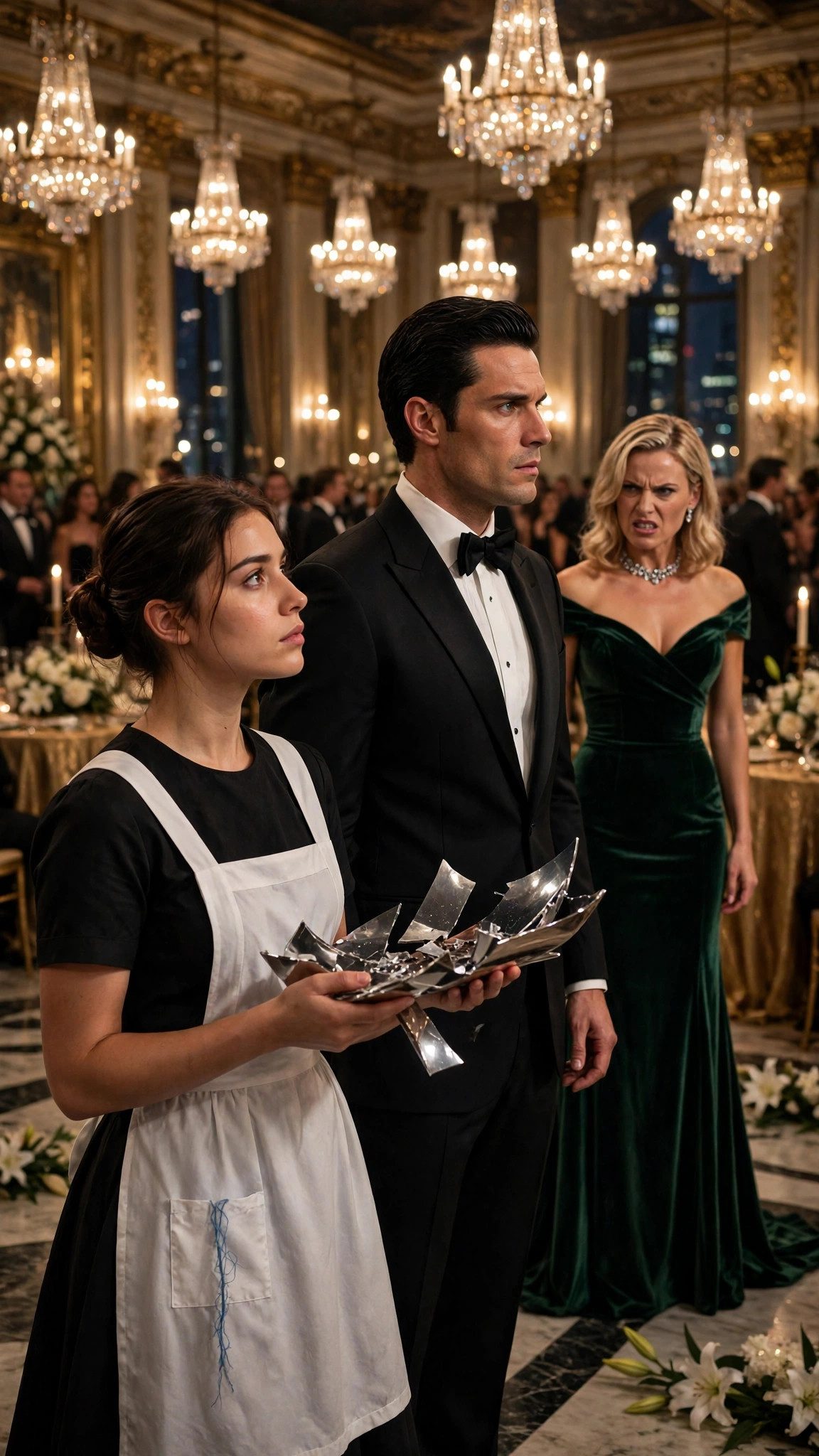
We were married six weeks later, in a small ceremony, under the chandeliers of the Plaza Grand — the same ballroom, the same chandeliers, the same marble floors where it had all begun. There were not three hundred guests this time. There were forty. My mother, in a blue dress she had made herself. Sal Greco, standing at Dante's side, crying openly and not caring who saw it. Agent Reyes, in a plain dark suit, sitting in the back row with a smile on his face. Mrs. Delaney, who had come to apologize in person. And Bianca — yes, Bianca, who had written to ask if she could come, and who sat quietly in the last row, in a simple grey dress with no diamonds at all, and who cried when I walked down the aisle, and who left before the reception, slipping out the side door, because she knew that some rooms belong to other people's happiness.
My dress was simple, too. White, with long sleeves, and a veil my mother had sewn by hand. And sewn into the hem, where nobody could see it — where only I would know it was there — was a short length of frayed blue thread, the exact navy blue of my father's old uniform, the thread that had started everything, the thread that had caught the light under the chandeliers and led a man who had been searching for six years straight to me.
Dante saw it. Of course he saw it. He notices everything. When we danced our first dance, under the chandeliers, in the middle of the ballroom where he had once stepped between me and Bianca Romano, he leaned close to my ear and whispered, "I see the thread."
"I know," I whispered back. "It's the same one. It's always been the same one."
He held me tighter, and the music played, and the chandeliers threw light across the marble floor, and I thought about my father, standing on a platform in Astoria, stepping between a killer and a stranger, and I thought about the night he saved a man's life, and about the night that man saved mine, and about the blue thread that had tied it all together — a father, a daughter, a boss, a maid, a platform, a ballroom, a thread.
Some people say that love is a grand thing, a dramatic thing, a thing of ballrooms and diamonds and three hundred guests. But I know better now. Love is a small thing. Love is a hand on your arm, pulling you back from the edge. Love is a man stepping between you and a raised heel. Love is a thread, frayed and blue, sewn into an apron pocket, carried into every room you ever walk into, because it is the only piece of someone you loved that you can still hold.
My name is Elena Moretti now. I am twenty-seven years old. I am plain, with dark brown hair I wear in a low bun, warm brown eyes, no makeup, and a blue thread sewn into the hem of my wedding dress. I own a small café in Queens called The Blue Thread. My husband comes every morning at seven to help me carry in the milk crates. My mother does the baking. My father's photograph hangs on the wall behind the counter.
And sometimes, on quiet evenings, when the café is closed and the chairs are stacked on the tables and the smell of coffee is still in the air, Dante and I sit at the table by the window, and we hold hands, and we talk about the future — about the children we want, about the life we are building, about the family we are going to be — and I think about a platform in Astoria, and a ballroom full of chandeliers, and a man who said, "Not here. Not on my platform," and I think about how the most dangerous thing about Dante Moretti was never that he was a mafia boss.
The most dangerous thing about Dante Moretti was that he was a good man, hiding inside a feared one, waiting for someone to see him.
And I saw him. Under the chandeliers. Beneath the blue thread.
The café's first month was the happiest month of my life.
We opened on a Tuesday in June, with a blue awning and a bell over the door and a photograph of my father on the wall behind the counter, and by nine o'clock on the first morning there was a line out the door — neighbors from the building, mothers from the school down the street, old men from the corner who had lived in Queens for fifty years and had never had a decent cup of coffee in their lives.
My mother did the baking — croissants and muffins and a lemon cake that became famous within a week, so famous that people started calling ahead to reserve a slice — and I did the coffee, and Dante came every morning at seven to help me carry in the milk crates, and by the end of the first week, we had regulars. Mrs. Alvarez from the third floor, who took her coffee black and her muffin warm. Mr. Chen from the laundromat, who did the crossword at the table by the window. A little girl named Sofia, seven years old, with dark curls and a gap in her front teeth, who came in every afternoon after school and drew pictures at the corner table — pictures of the café, pictures of my mother, pictures of the blue thread in its little wooden frame on the wall by the door.
"What's that?" Sofia asked me one day, pointing at the frame.
"It's a thread," I said. "A blue thread. It belonged to my father."
"Why is it on the wall?" she asked.
"Because it reminds me," I said, "that small things can hold big stories. And that a single thread can tie a whole life together."
Sofia nodded, very seriously, the way seven-year-olds do when they understand something perfectly, and she went back to her drawing, and I went back to the coffee, and I thought about how strange and wonderful it was that a frayed piece of blue thread from a subway uniform had led me here — to a café in Queens, to a husband who carried milk crates, to a mother who baked lemon cake, to a little girl who drew pictures at the corner table.
One year later, on our first anniversary, Dante took me back to the Plaza Grand.
The ballroom was empty. No guests. No quartet. No chandeliers blazing — just the late afternoon light coming through the tall windows, and the marble floor, and the head table, bare and quiet, and the two of us, standing in the middle of it all, holding hands.
He had arranged it with the manager. He had asked for one hour, alone, in the room where it all began. And when we walked in, he took my hand, and he led me to the center of the floor, and he put his arms around me, and we danced — slowly, without music, just the sound of our shoes on the marble and the hum of the chandeliers above us.
"Do you remember?" he asked, his voice soft against my hair. "Do you remember the night you stood here, holding a broken tray, with three hundred people watching?"
"I remember," I said.
"And do you remember what I said to you?" he asked. "In the ballroom. After Bianca left. After the wedding was called off."
"You asked me my name," I said.
"And then I asked you about your father," he said. "And you didn't answer me. You couldn't. Because you didn't know yet — none of us knew yet — what that question meant."
"I know now," I said.
"So do I," he said. "It meant that your father saved my life, and that you saved me from a life I didn't want, and that a blue thread tied us together six years before we ever met. It meant that some things are not accidents, Elena. Some things are threads. And if you follow them far enough, they lead you home."
We danced until the light faded, and the chandeliers came on, one by one, throwing their light across the marble floor, and I thought about the night it all began — the heel, the glass, the wedding being called off in front of three hundred people — and I thought about how frightened I had been, standing there with a broken tray in my hands, and how I had never imagined, not in my wildest dreams, that the most humiliating night of my life would turn out to be the best night of my life, too.
And I thought about the future — about the children we want, about the life we are building, about the family we are going to be. One day, when we have a daughter, I will tell her about a thread. I will tell her about a platform in Astoria, and a ballroom full of chandeliers, and a man who said, "Not here. Not on my platform." I will tell her that her grandfather was a maintenance man who saved a stranger's life, and that the stranger became her father, and that a single blue thread tied it all together.
And I will tell her the most important thing my father ever taught me, the thing he told me at our kitchen table in Queens, on a night long ago, when I was just a girl and he was just a man coming home from the night shift with grease under his fingernails: "Elena, the city is full of people nobody sees. You see them. That's your job in this world."
I see them. I see them every day, in my little café in Queens, with its blue awning and its bell over the door. I see the tired mothers and the old men and the little girls who draw pictures at the corner table. I see them, and I serve them coffee, and I remember that being seen — truly seen, the way Dante saw me under the chandeliers — is the greatest gift one person can give another.
The End.
THE END