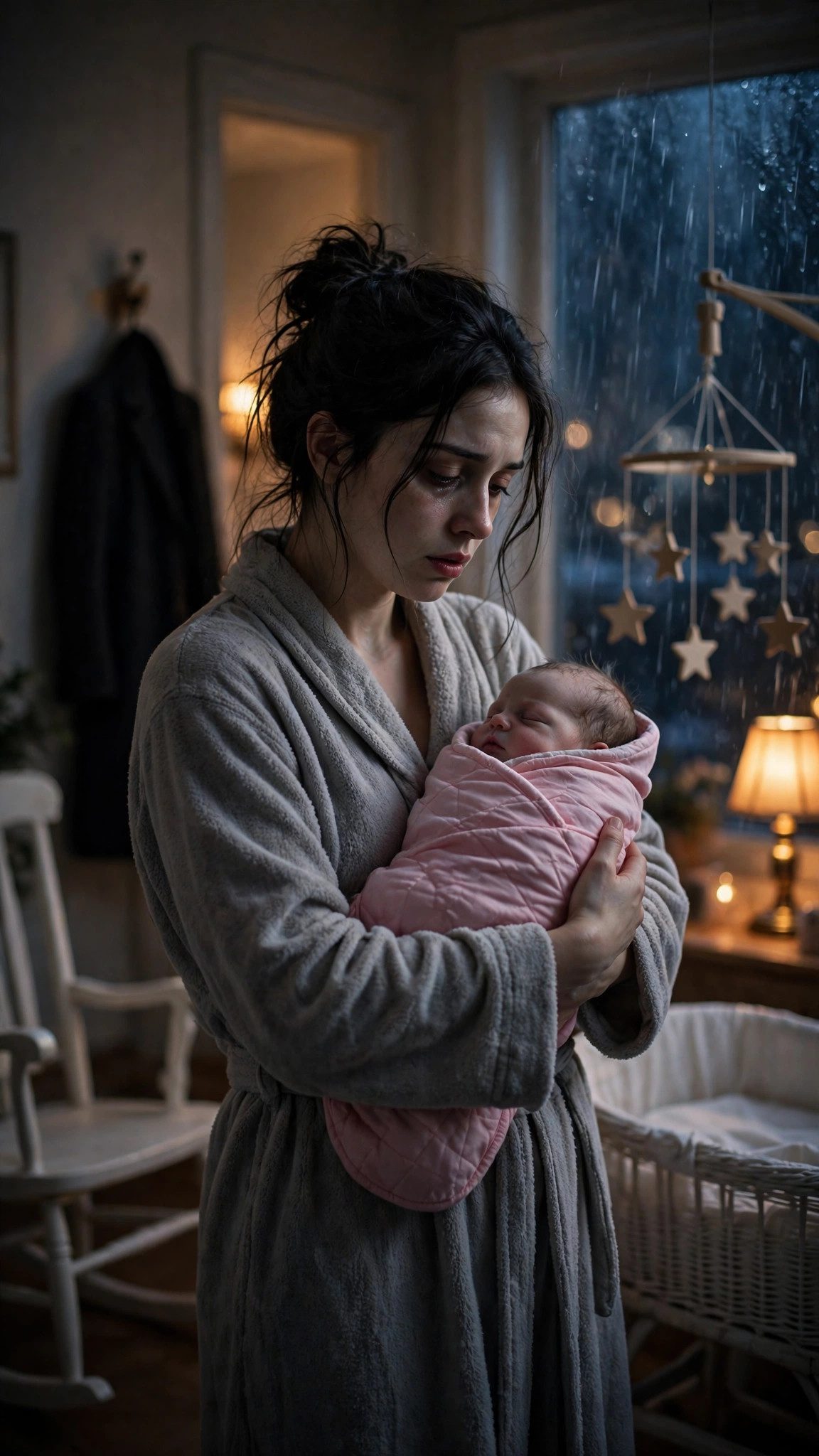
The night had started like every other night in the house on Lake Drive. That was the strangest part, when Aaron thought about it later. Nothing had felt different. The rain had been falling since late afternoon, soft and steady against the windows. The radiators had ticked as they warmed the rooms. Sophie had slept in her bassinet in the nursery, kept at exactly seventy-two degrees, and Aaron had moved through the evening the way she moved through every evening — quietly, carefully, like a woman walking through a house made of glass.
She had fed Sophie at six. She had changed her diaper and dressed her in the pink sleeper with the tiny rabbits on the feet, the one her mother had bought before she died, the one Aaron had saved for a special night without knowing what the special night would be. She had rocked her until her eyelids grew heavy, and then she had laid her down in the bassinet and stood watching her breathe, the way new mothers do, counting the rise and fall of that small chest until her own breathing slowed to match it.
At seven, she had gone downstairs and made herself a cup of tea she did not drink. She had stood at the kitchen window and watched the rain darken the street, and she had thought about calling her brother. Not to leave. Not yet. Just to hear his voice. Just to hear someone say her name like it mattered.
She had not called. She had told herself she was being dramatic. She had told herself Roman would come home, that he had promised, that a promise meant something.
At 8:42, Sophie woke and drank half her bottle. Aaron wrote it down in the little notebook the nurse had given her, in the same neat handwriting she used for everything. 8:42 p.m. Half bottle. 2 oz. She had been keeping records since the day they brought Sophie home from the hospital, because the nurse had told her to, and because keeping records made her feel like she had some control over a life that had become unrecognizable.
At 9:03, she texted him. Sophie's awake. Are you coming home? She watched the word Delivered appear beneath the message, and then she watched the minutes crawl by, and the word never changed to Read. She set the phone down on the kitchen counter and picked up Sophie's bottle and began rinsing it in the sink, because her hands needed something to do, because if her hands stopped moving she might start screaming.
At 9:31, she called. The phone rang four times. Then Roman's voicemail, his voice smooth and distant, the way it sounded on every recording: "You've reached Roman Moretti. Leave a message." She hung up without leaving one. What would she have said? Come home? Please? I need you? She had said all of those things a hundred times, in a hundred different ways, and none of them had worked.
At 9:48, she tried again. Nothing. Not even a ring this time. Straight to voicemail, as if the phone were off, or as if he had seen her name on the screen and pressed the button to silence it.
By 10:07, she had stopped watching the clock. She stood in the kitchen rinsing Sophie's bottle while the baby slept nearby in her bassinet, and her whole body ached, and her eyes burned from exhaustion, and somewhere across Milwaukee her husband was celebrating another woman's birthday while she struggled with their newborn alone.
She thought about the first time she had seen Laya Crane, standing beside Roman near the bar at that fundraiser, her hand resting lightly on his forearm. She thought about the cashmere blanket at the baby shower, and the smell of Laya's perfume on it, and the way she had washed it twice and still could not get the smell out. She thought about the nights Roman had come home smelling of restaurants and expensive wine, and the mornings he had left before she woke, and the way he had stopped asking about her patients, and the way his eyes went somewhere else when she talked about the future.
She thought about all of it, and then she stopped thinking about it, because her phone vibrated in her hand.
Unknown number. A voicemail.
She almost ignored it. She was so tired that the phone felt heavy, and for a moment she thought about letting it go, about finishing the bottle and going to bed and pretending the world did not exist. But something — some instinct, some small voice that had been whispering to her for months — told her to look.
When the transcription appeared on the screen, she stopped breathing.
"Mrs. Moretti, I work at the Drake. I shouldn't be calling you, but I thought you should know. Your husband just stood up in front of the whole room and raised a glass to Laya Crane. He called her the future Mrs. Moretti. He said the papers are already drawn up. I'm sorry. I thought you should hear it from someone before you hear it from everyone."
She read it again. And again. The words did not change. The future Mrs. Moretti. The papers are already drawn up.
She turned off the faucet. The kitchen went quiet except for the ticking of the radiators and the soft, even sound of Sophie breathing in the next room. Aaron stood there with her hands dripping water onto the floor, and she felt something inside her go very still and very cold, the way a lake goes still just before it freezes.
He was not just cheating on her. He was replacing her. He had already decided. The divorce papers were drawn up, and he was toasting his future wife in a restaurant across the city while his wife and his six-day-old daughter waited at home in the dark.
She looked toward the nursery. At the tiny pink sleep sack, folded neatly over the arm of the rocking chair. At the white rocking chair, still as a held breath. At the mobile she had hung before Sophie was born, the little wooden stars turning slowly in the warm air. She had imagined Roman standing beside her here, holding their daughter, smiling as they watched her sleep. She had imagined a hundred small, ordinary moments like that — the first bath, the first laugh, the first word — and now she understood that she had been imagining a life with a man who did not exist anymore.
She picked up Sophie and held her gently against her chest. The baby stirred, then settled, her warm weight fitting perfectly into the curve of Aaron's arm, and Aaron kissed her forehead and whispered, "I'm here, sweetheart."
And for the first time since becoming a mother, she understood something that hurt more than Roman's betrayal. She could not make him choose them. But she could decide what Sophie and she deserved.
She looked down at the voicemail again. Then she opened her contacts and found a number she had not called in months. Her finger hovered over the screen.
Ethan Sullivan. Her brother. The one person in the world who had warned her, and who had never once said "I told you so," even when he had every right to.
Because leaving an ordinary husband was one thing. Leaving Roman Moretti, a mafia boss with men watching every road out of Milwaukee, was something else entirely. And if she was going to disappear with their daughter, she could not afford a single mistake.
She pressed call.
Two rings. Then a voice she had not heard in three years, rough with sleep and then suddenly, sharply awake.
"Aaron? It's two in the morning. What's wrong?"
"Ethan," she whispered, and her voice broke on his name. "I need you to help me disappear."
There was a silence on the other end of the line. She could hear him breathing. She could hear a woman's voice in the background, asking who it was, and Ethan saying, "It's my sister," in a tone she had never heard him use before — a tone that was all at once afraid and furious and fiercely, completely certain.
"Tell me what happened," he said.
So she told him. She told him about Laya's birthday. About the promise to be home before nine. About the texts and the calls and the voicemail. About the future Mrs. Moretti and the papers already drawn up. She told him in a voice that shook and then steadied, because saying it out loud made it real, and making it real made it something she could finally do something about.
When she finished, Ethan was quiet for a long moment. Then he said, "Listen to me very carefully, Aaron. I'm going to tell you exactly what to do, and you're going to do exactly what I say. Do you understand?"
"Yes."
"First. Don't pack a suitcase. A woman with a suitcase is a woman who is leaving, and Roman's men will see her. Pack one diaper bag. Diapers, formula, two changes of clothes for Sophie, and nothing else. Put the birth certificate in a plastic bag inside the diaper bag. Take cash from the kitchen drawer — there's a coffee tin on the top shelf with emergency money in it. How much is in there?"
Aaron opened the cupboard with one hand, still holding Sophie against her chest with the other. The coffee tin was there, exactly where Ethan had put it three years ago, on the night he had helped her move into this house and told her, "Every woman needs money nobody else knows about. Don't argue with me. Just keep it full." Inside were forty-seven hundred dollars in twenties, folded neatly and held together with a rubber band.
"Forty-seven hundred," she whispered.
"Good. That's enough. Take it all. Leave your phone on the changing table. Leave your wedding ring on the nightstand. Leave your credit cards in your purse. Roman can track all of those. Do you have the old car? The blue Honda?"
"Yes. It's in the garage. I haven't driven it in months."
"Good. Roman's men watch the black SUV. They don't watch the Honda. Take the Honda. Drive north on Highway 41, not the interstate. The interstate has cameras. Take the back roads through West Bend and Fond du Lac. Don't stop for gas until you're past Oshkosh. Don't use your cards. Don't call anyone else. I'll meet you at the cabin on Lake Mendota. Do you remember how to get there?"
"The cabin," she said. "Dad's cabin."
"Yes. Dad's cabin. The one nobody knows about except us. Drive straight there. Don't stop. If you see headlights behind you for more than ten minutes, pull into a gas station and call me from the pay phone. Do you understand?"
"Yes," she said. "Ethan —"
"Aaron. Listen. You are not running away. You are protecting your daughter. There is a difference, and you need to remember it when it gets hard. And it will get hard. But you can do this. You are stronger than you think you are. Now go."
She did what he told her. She dressed Sophie in the warmest sleeper she owned and wrapped her in the gray blanket her own mother had knitted before she died, the one with the tiny uneven stitches that Aaron had always loved because they proved a real person had made it with real hands. She packed one diaper bag — diapers, formula, two changes of clothes, the little notebook with the feeding times, Sophie's birth certificate folded inside a plastic bag. She took the cash from the coffee tin and put it in the inside pocket of her coat. She left her phone on the changing table. She left her wedding ring on the nightstand. She left a single sheet of paper, folded in half, with his name on it, and on the inside, four words she had been carrying for months.
You promised me, too.
Then she carried her daughter out into the November rain, and she did not look back.
The Honda started on the third try, coughing and shuddering like an old animal waking from a long sleep. Aaron sat in the driver's seat with Sophie in her car seat behind her, and she looked at the house on Lake Drive one last time — at the dark windows, at the porch light that was out, at the nursery window where the amber glow should have been — and she put the car in gear and drove away, north, into the rain, toward the only person in the world who had ever told her the truth about the man she married.
She drove for two hours through the dark, through towns with names she had never paid attention to before — West Bend, Fond du Lac, Oshkosh — and the rain never stopped, and Sophie slept the whole way, and Aaron cried twice, silently, without taking her hands off the wheel. Once when she passed the sign for Milwaukee and understood that she was really leaving. And once when she realized that she was not afraid anymore. She was free. Or as free as a woman with a six-day-old baby and forty-seven hundred dollars in her coat pocket could be, driving north in the rain, away from the most feared mafia boss in Milwaukee, toward a cabin on a lake she had not seen since she was a little girl.
When she finally turned down the gravel road to her father's cabin, the headlights caught Ethan standing on the porch in the rain, holding a flashlight, and the sight of him — her big brother, in an old flannel shirt, with his hair wet and his face white with worry — broke something open inside her, and she got out of the car and walked into his arms, and for the first time in months, she let someone else hold her up.
Inside the cabin, it was warm. A fire was already burning in the stone fireplace, and there were blankets on the couch, and a bassinet — an old wicker one, borrowed from a neighbor, Ethan said — set up beside the wood stove. Claire, Ethan's wife, a quiet woman with kind eyes and flour on her hands from the bread she had been baking when the phone rang, took Sophie without a word and held her against her shoulder, humming softly, while Ethan made Aaron sit down and put a mug of tea in her hands.
"Drink," he said. "Then sleep. You're safe here, Aaron. Nobody knows about this place. Dad bought it under a different name, remember? It's not in any record Roman's men can find."
Aaron drank the tea. It was too hot, and it burned her tongue, and she did not care, because the heat meant she was alive, and alive meant she could still fight. She looked around the cabin — at the low wooden beams, at the fishing rods leaning in the corner, at the photograph of her father on the mantel, smiling in a flannel shirt with a trout in his hands — and she thought about the house on Lake Drive, with its marble floors and its chandeliers and its empty nursery, and she understood something with sudden, startling clarity.
The house on Lake Drive had never been a home. It had been a beautiful cage, and she had decorated it herself, and she had called it love. But this cabin — this small, drafty, ordinary cabin with its wood smoke and its borrowed bassinet — this felt like the first real home she had known since she was a little girl.
She fell asleep on the couch with Sophie in the wicker bassinet beside her, and for the first time in six days, she slept without dreaming of empty rooms.