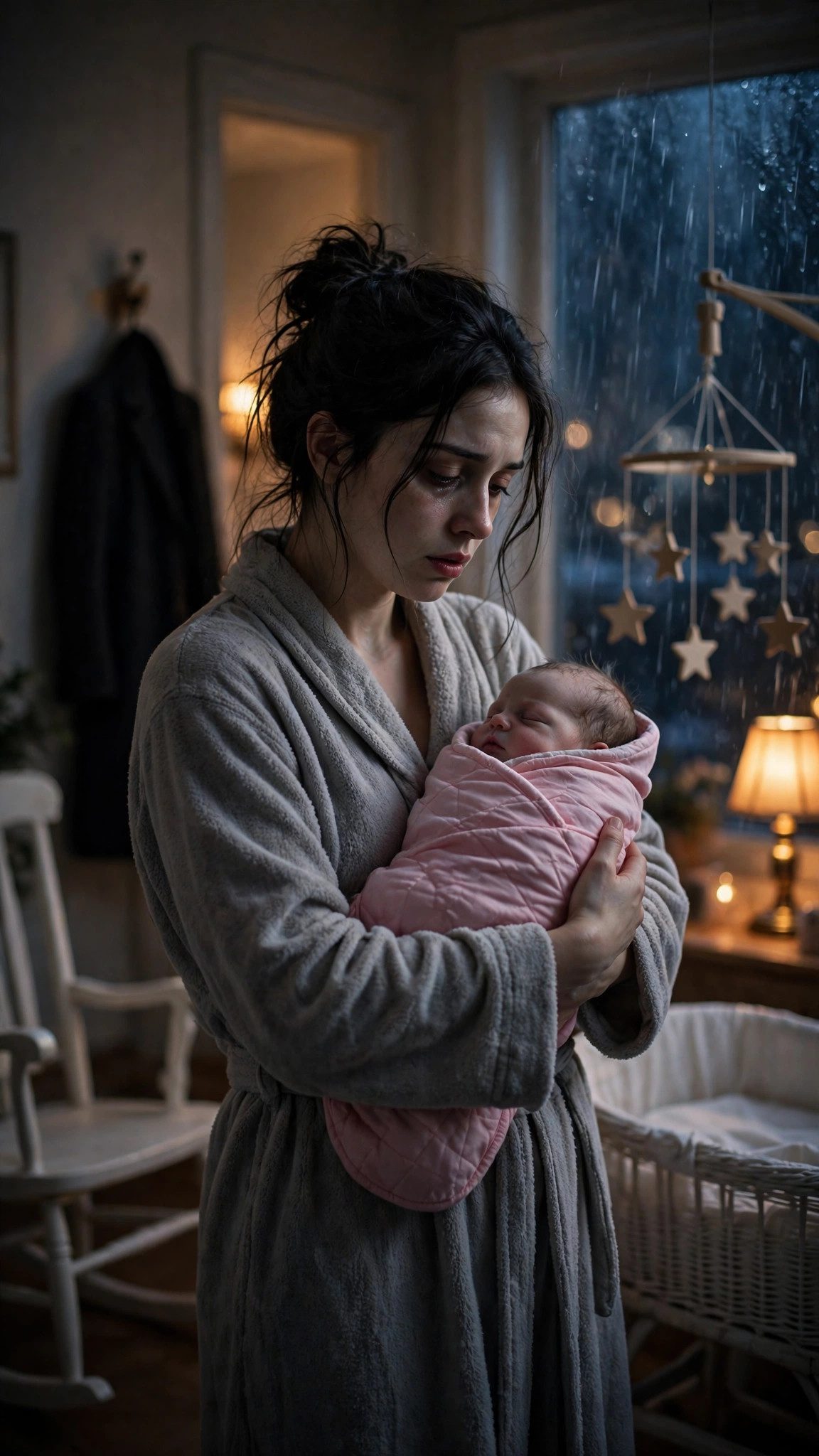
Aaron Sullivan had met Roman Moretti on a night when she had not wanted to be anywhere at all.
It had been a charity gala at the Milwaukee Art Museum, one of those glittering fundraisers where the city's richest people paid a thousand dollars a plate to eat tiny portions of food and congratulate themselves for caring about children. Aaron had been there because the children's hospital where she worked as a pediatric nurse had sent her as a representative, and she had spent the first hour standing near the dessert table in a borrowed black dress, holding a glass of champagne she did not drink, wondering how soon she could leave without being rude.
Roman had found her there, staring at a chocolate fountain like it had personally offended her.
"You look like you'd rather be anywhere else," he had said.
She had turned, ready with a polite smile, and then she had actually looked at him, and the polite smile had died on her face. He was tall, dark-haired, gray-eyed, wearing a black suit that fit him like it had been sewn onto him by someone who loved him, and he was looking at her the way no man had ever looked at her before — not like she was a decoration, and not like she was a problem to be solved, but like she was the only interesting thing in a room full of boring people.
"I'd rather be at the hospital," she had said, because she had never been good at lying. "There's a little boy there who had his tonsils out this morning, and he asked me to read him the same story three times, and I promised I'd come back tomorrow and read it a fourth."
"Then why are you here?"
"Because someone has to tell these people what the money actually does. It buys cribs. It buys medicine. It buys the little plastic dinosaurs they give the kids after surgery so they stop crying."
He had laughed then, a real laugh, surprised out of him, and something in Aaron's chest had shifted, the way a door shifts when someone opens it for the first time in years.
"I like you," he had said. "What's your name?"
"Aaron Sullivan. I'm a nurse. I don't belong here."
"You belong wherever you decide to belong," he had said, and he had offered her his arm, and she had taken it, and they had walked out onto the terrace above the lake, and he had asked her about the hospital, and about the little boy with the tonsils, and about the plastic dinosaurs, and he had listened — really listened, the way almost no one in his world ever listened — for two hours, until the gala ended and the lights went down and the lake went black beyond the glass.
He had asked for her number. She had given it to him, against her better judgment, because her brother Ethan had warned her about men like Roman Moretti a hundred times, and she had ignored every single warning.
Ethan had been right to warn her. That was the worst part. Ethan had been right about everything.
Her brother had sat her down the week after the gala, in his cramped apartment above a law office in Madison, and he had laid it out for her the way a lawyer lays out a case, calmly and without raising his voice.
"Roman Moretti runs this city, Aaron. Not the mayor. Not the police chief. Him. His family owns the docks, the warehouses, the trucking routes, half the restaurants on the east side. His father built that empire with his bare hands, and Roman inherited it when he was twenty-six, and he has held it ever since with a grip that doesn't loosen. Men who cross him disappear. Not metaphorically. Actually."
"He's kind to me," Aaron had said.
"He's kind to everyone, right up until the moment he isn't," Ethan had said. "That's how men like him work. The kindness is real. The danger is also real. They live in the same house. And if you marry him, you will live in that house too, and so will your children."
"I love him."
"I know you do," Ethan had said, and he had looked so tired, so much older than his twenty-eight years. "That's what scares me. Because love doesn't protect you from a man like that. It just makes you stay longer."
She had married Roman anyway. Of course she had. She had been twenty-four years old and in love, and Roman had asked her in the garden of the house on Lake Drive on a June evening, down on one knee with a ring that caught the last light of the day, and he had said, "I don't know how to be the man you deserve. But I want to spend the rest of my life learning." And she had believed him, because in that moment, he had believed it too.
The wedding had been small, by Moretti standards. Fifty guests instead of five hundred. No photographers from the society pages. Roman had insisted on that, because Aaron had asked him to, and he had stood at the altar in a black suit and watched her walk down the aisle in a simple white dress, and he had cried — actually cried, in front of his men, in front of everyone — and afterward, his consigliere, an old man named Salvatore Voss, had clapped him on the shoulder and said, "She's good for you, boss. Don't ruin it."
For two years, he didn't ruin it. Or at least, he didn't ruin it in any way Aaron could see.
They built a life. She kept working at the hospital three days a week, because Roman had promised her she could keep her job, and he had kept that promise, even though his mother had raised her eyebrows and his men had muttered that a Moretti wife did not work for wages. He came home for dinner most nights. He learned the names of her patients. He sat with her on the terrace in the summer and talked about the future — about children, about a house full of noise, about growing old together in a city that had never been kind to either of them.
And then, in the third year, Laya Crane appeared.
Aaron remembered the first time she saw her. It was at a fundraiser, another glittering room full of glittering people, and Laya had been standing beside Roman near the bar, laughing at something he had said, her hand resting lightly on his forearm, her blonde hair catching the light. She was beautiful in the sharp, polished way of a woman who has spent her life being looked at — red dress, diamond earrings, a smile that never quite reached her eyes.
"An old family friend," Roman had said, when Aaron asked. "Her father did business with my father. I've known her since we were kids."
But Aaron had watched the way Laya looked at Roman, and she had watched the way Roman looked back, and she had known, in the way a wife always knows, that "old family friend" was a story, and that the real story was something else entirely.
After that night, Laya was everywhere. At the parties. In the photographs. At the restaurant openings and the charity dinners and the boxing matches Roman attended with his men. She appeared beside him like a shadow that had learned to wear red, and she smiled for the cameras, and she always, always needed his attention.
Roman told Aaron not to worry. He told her she was imagining things. He told her Laya was nothing, that she was simply a friend of the family, that Aaron was the only woman he had ever loved.
And Aaron, because she loved him, because she wanted to believe him, because the alternative was unthinkable, pretended to believe him.
She pretended for months. She pretended through the late-night phone calls and the tilted phone screens and the smell of unfamiliar perfume on his coat. She pretended through the dinners he missed and the weekends he spent "at the docks" and the way he stopped touching her in the mornings, the way he stopped asking about her patients, the way his eyes went somewhere else when she talked about the future.
She pretended right up until the night she found out she was pregnant.
She had taken the test in the bathroom of the hospital where she worked, sitting on the cold tile floor with her back against the door, staring at the two pink lines until they blurred. Then she had driven home in a daze, and she had waited for Roman in the kitchen, and when he came through the door at nine o'clock, she had held up the test and said, "We're going to have a baby."
He had stared at it for a long moment. Then he had dropped his briefcase on the floor and pulled her into his arms and lifted her off the ground, laughing, and he had said, "A baby. We're having a baby." And for one shining evening, it had felt like the beginning again. Like the gala. Like the terrace above the lake. Like the man who had listened to her talk about plastic dinosaurs for two hours.
The pregnancy had been hard. Morning sickness that lasted until noon. Swollen ankles. Nights when she could not sleep because the baby was kicking and her back was aching and her mind was racing. But Roman had been there, at first. He had rubbed her feet. He had gone out at midnight for ice cream and pickles. He had read the baby books she left on the nightstand, underlining passages about swaddling and sleep schedules with a pen, the way he underlined passages in business contracts.
And then, in the seventh month, Laya had come back from a trip to New York, and the phone calls had started again, and the dinners had started again, and Roman had started coming home later and later, and Aaron had stopped asking where he had been, because she already knew the answer, and knowing the answer did not change anything.
She had told herself it would be different after the baby came. That once Sophie was here, once Roman held his daughter, he would remember who he was. He would remember the promise he had made in the rocking chair on that first night, the promise to be a different man.
For five days, he had kept it. He had sat in the nursery and held Sophie against his chest and looked at her like she was a miracle. He had changed diapers with the grim concentration of a man defusing a bomb. He had warmed bottles at three in the morning and paced the hallway with his daughter in his arms, humming tunelessly, until she fell asleep.
And on the sixth day, Laya Crane had called, and he had stood in the nursery doorway buttoning his expensive black coat, and Aaron had said, "You said you'd stay tonight," and he had said, "It's just dinner," and he had walked out the door, and she had understood, finally and completely, that she had been waiting for a man who was never coming home.
Not the man she had married on a June evening in the garden. That man was gone. And the man who had replaced him was a stranger who promised to be back before nine and did not come.
There had been one afternoon, in the eighth month of her pregnancy, when Aaron had almost told someone the truth.
It had been her baby shower, held in the hospital cafeteria because Aaron had refused to let Roman rent out a restaurant. "It's not a society event," she had said. "It's my friends eating cake." Her colleagues from the pediatric ward had decorated the room with pink streamers and a banner that read "Welcome, Baby Sophie," and there had been a cake shaped like a bassinet, and a game where everyone had to guess the baby's birth weight, and for two hours Aaron had felt almost normal. Almost happy.
Then Laya Crane had walked in.
She had not been invited. Aaron was certain of that, because she had written the guest list herself, in her careful handwriting, on a piece of paper she still had in her kitchen drawer. But there Laya was, in a cream-colored dress that probably cost more than Aaron's monthly salary, carrying a gift bag tied with a silver ribbon, smiling like she belonged there.
"I heard about the shower," she had said, holding out the bag. "I wanted to bring something for the baby. Roman told me how excited you both are."
Inside the bag was a tiny cashmere blanket, soft as a cloud, in the palest shade of pink. It was beautiful. It was also, Aaron realized with a sick twist in her stomach, the most expensive thing anyone had brought. More expensive than the crib sheets from her best friend. More expensive than the hand-knitted booties from the head nurse, who had stayed up three nights making them.
"Thank you," Aaron had said, because her mother had raised her to be polite even when her heart was breaking. "That's very kind."
Laya had smiled, and her eyes had flicked, just for a second, toward Aaron's swollen belly. "You're glowing," she had said. "Pregnancy suits you. Roman says you're handling it so well."
Roman says. As if they talked about her. As if Aaron were a subject of conversation between her husband and another woman, discussed over dinners she was not invited to.
After Laya left, Aaron's best friend, a nurse named Priya who had worked beside her for four years, had found her in the supply room, sitting on a stool with her hands folded in her lap, staring at the cashmere blanket.
"Talk to me," Priya had said.
"There's nothing to talk about," Aaron had said.
"There is. I've watched you for months, Aaron. You come to work exhausted. You flinch every time your phone rings. You stopped wearing your wedding ring to your shifts because you said it pinches, but it never pinched before. So talk to me."
Aaron had looked at her friend — at the kind, tired face of a woman who had held her hand through twelve-hour shifts and bad days and worse nights — and she had almost said it. She had almost said, "My husband is in love with another woman, and I'm pregnant, and I don't know what to do." The words had risen in her throat like water, and for a moment she had thought she might drown in them.
Instead, she had said, "I'm just tired. The baby keeps me up. That's all."
Priya had looked at her for a long moment. Then she had said, very quietly, "Okay. But when you're ready to tell the truth, I'm here. And Aaron — whatever it is, you don't have to carry it alone."
Aaron had nodded. She had folded the cashmere blanket and put it in the gift bag and carried it home, and that night she had washed it twice, because it smelled faintly of Laya's perfume, and she could not bear the thought of her daughter sleeping wrapped in something that smelled like the other woman.
She had never told Priya the truth. She had never told anyone. She had carried it alone, the way she carried everything, until the night of the voicemail, when she finally understood that carrying it alone was not strength. It was just loneliness with better posture.