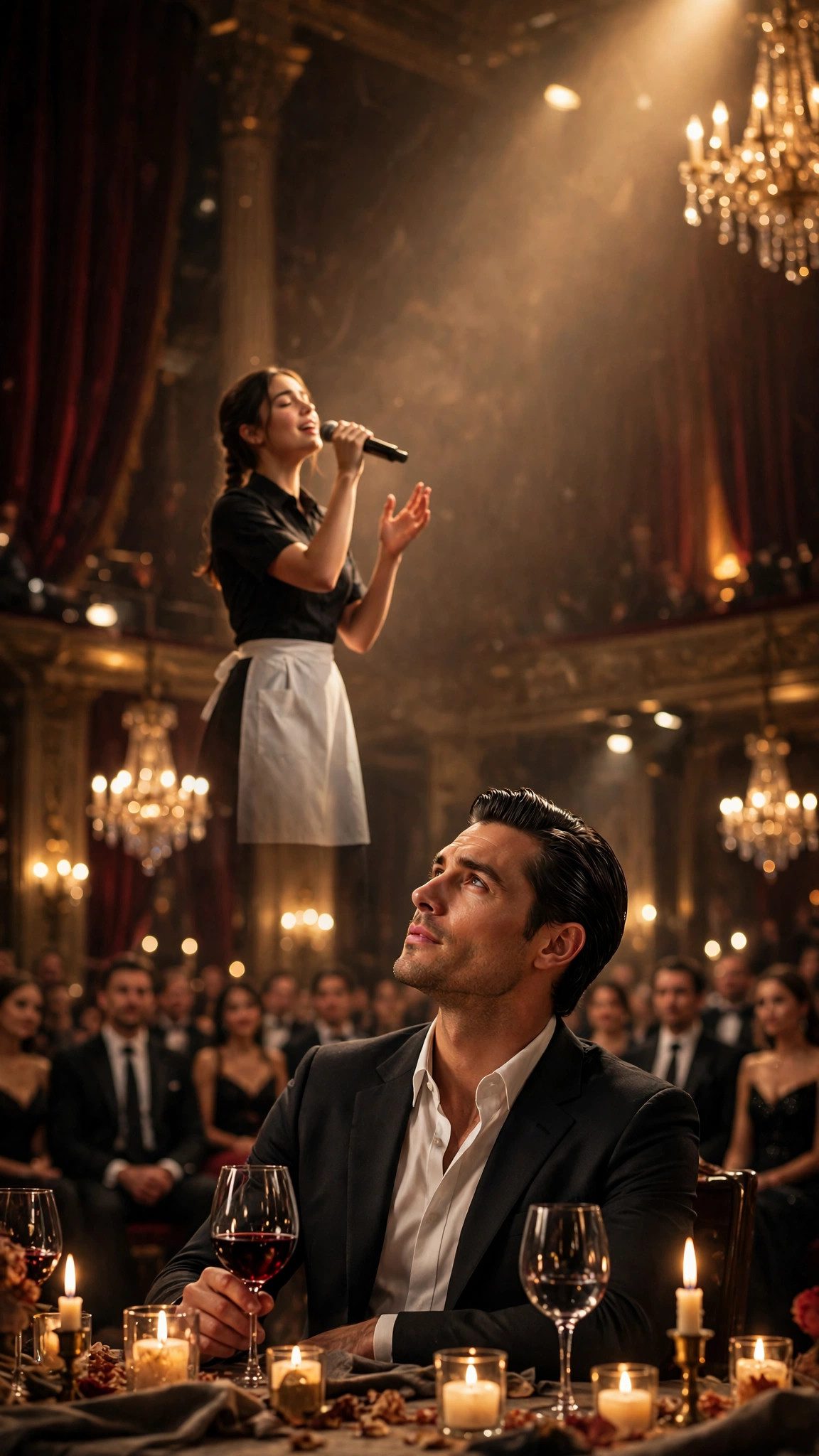
The concert hall held two hundred people in black tie and diamonds, and every one of them was laughing at me.
I stood on the small stage at the front of the Moretti Foundation gala with a borrowed microphone in my hand and a tray still balanced on my forearm, because no one had told the waitress she was allowed to put the tray down. The chandeliers burned above us like frozen fire. The men in their tuxedos and the women in their gowns had turned in their chairs to look at me, and their laughter rolled across the room in waves, the easy laughter of people who have never once been afraid of being the joke.
And in the center of it all, at the head table, sat Alessandro Moretti, the King of New York, laughing harder than any of them.
He was thirty-eight years old, tall even sitting down, with dark hair combed back from a face that newspapers called handsome and his enemies called carved from stone. He wore a black suit that must have cost more than a year of my rent, and a white shirt, and no tie, the collar open at his throat like a man who had decided the rules of the room did not apply to him. His eyes were cold and dark, the kind of eyes that made waiters stammer and grown men lower their voices, and they were fixed on me with something I could not name. Amusement. Curiosity. Hunger, maybe, though not the kind I had learned to fear.
"If you can sing the aria," he said, and his voice carried across the hall without any effort at all, the way a king's voice does, "I will marry you on the spot."
The laughter swelled. Someone near the back shouted, "Do it, girl! Marry the king!" A woman in emeralds pressed a hand to her mouth and giggled behind her fingers. The string quartet in the corner had stopped playing. The waiters along the wall had gone still, trays frozen in the air, watching the show like everyone else.
I should have been terrified. Five years ago, terror would have swallowed me whole. Five years ago, I had been a nineteen-year-old girl in Naples who believed love was enough, and then three men with guns had taught me what the world did to girls who believed that.
But I was not nineteen anymore. I was twenty-four, and I had a five-year-old son asleep in a two-room apartment in Queens, and I had spent five years running from men who thought they owned me, and something in me had gone very still and very quiet, the way the air goes still just before a storm breaks.
I looked at Alessandro Moretti, and I smiled.
"If that is the truth," I said, and my voice did not shake, "then I will thank you for proving that the name you swore you had buried was never buried at all."
The laughter died.
It died so fast that the silence rang in my ears like a struck bell. Two hundred faces turned from me to him, and I watched the smile drain out of Alessandro Moretti's face, watched his dark eyes narrow, watched his hand tighten around his wine glass until I thought the stem would snap. Because everyone in New York knew the story. Everyone knew about Caterina Voss, the beautiful fiancee who had died in a car crash three years ago on the West Side Highway, and everyone knew that Alessandro Moretti had stood at her funeral and sworn, before God and his whole family, that her name was buried with her and he would never marry, never love, never give his heart to anyone again.
And I, a waitress in a black uniform with a tray on my arm, had just said it out loud in front of two hundred people.
"Sing," he said. His voice had gone low and rough, and it was not a dare anymore. It was a command. "Sing the aria, and we will see whose name is buried."
I set the tray down on the edge of the stage. I took the microphone in both hands. I closed my eyes, and I thought of my mother.
My mother had been Sofia Marchetti, a soprano with a voice like cut glass and honey, and when I was a little girl she used to sing me to sleep with the hardest aria in all of opera, Mozart's Queen of the Night, "Der Hölle Rache kocht in meinem Herzen," the revenge aria, the one with the high F's that only a handful of women in the world can sing cleanly, the one that sounds like a woman tearing her own heart out of her chest and throwing it at the feet of the gods. My father had been Antonio Marchetti, a violinist with the Naples orchestra, and he used to say that my mother did not sing the aria, she survived it, and that one day I would too.
My father died when I was twelve. My mother died when I was seventeen. I had not sung the aria in public since the day they buried her.
I opened my mouth, and I sang.
The first notes came out low and dark, a mother's fury, a queen's curse, and the hall went so quiet I could hear the ice settling in someone's glass. Then the melody climbed, and my voice climbed with it, up through the coloratura runs, through the staccato daggers of sound, up to the high F's that rang off the chandeliers like struck crystal, each one clean and true and bright enough to hurt. I sang of hell's vengeance boiling in my heart. I sang of a mother who would rather see her daughter dead than disobedient. I sang five years of running, five years of fear, five years of being a girl with no name and no home, and I poured all of it into Mozart's notes until the aria was not a performance anymore but a confession.
When the last note died, the hall was silent for one whole breath. Two breaths. Three.
And then two hundred people rose to their feet at once, and the applause came down like thunder.
I stood on the stage with the microphone shaking in my hand and tears running down my face, and I looked at Alessandro Moretti, and he was standing too, and he was not laughing anymore. He was looking at me the way a man looks at something he has searched for all his life and finally found, and I knew, with a certainty that settled in my bones like cold water, that my five years of running were over.
I had waited for this moment for five years. I just had not known it would look like this.
My name is Elena Marchetti Bellini, and this is the story of how I ran away from one mafia family and straight into the arms of the King of New York.
I was nineteen years old when I married Matteo Bellini in a small church in Naples, and I was young and in love, and I did not know that love could be a death sentence.
Matteo was twenty-one, tall and dark and laughing, the grandson of Don Salvatore Bellini, and he had courted me for a year with flowers and poetry and promises whispered on the steps of the opera house where my mother used to sing. He told me his family was in shipping. He told me his grandfather was a respected businessman. He told me he would take care of me forever. And I believed him, because I was nineteen and my mother had just died and I was so lonely that a kind word felt like shelter.
I found out the truth six months after the wedding, on a Tuesday night in November, when three men with guns took me from the street outside our apartment and put a black hood over my head and drove me to a warehouse by the docks. They did not hurt me. That was the worst part. They were polite, almost gentle, and they told me, very clearly, that I was a weakness. That Matteo's enemies would use me to get to him. That a boss's wife who could be taken off the street was a liability, and that the family had decided I needed to understand my place.
They let me go after four hours. Matteo was waiting at home, white-faced and shaking, and he held me and cried and swore he had not known, swore he would protect me, swore it would never happen again. But I saw the truth in his eyes. He had known. Maybe not the details, but he had known what his family was, and he had married me anyway, and brought me into a house where I was nothing but a soft spot in his armor.
He gave me a name. An heir. But he could not give me love, or even a single minute to call him his own, because every minute belonged to the family, to his grandfather, to the business, to the men with guns who decided who lived and who died in Naples.
So I ran.
I ran when Gabriel was six months old, with a bag of baby clothes and three hundred euros and my mother's old score of The Magic Flute pressed flat in the bottom of the suitcase. I took a train to Rome, a plane to New York, and I never looked back. For five years, I have been a ghost. A waitress. A mother. A woman with no past and no future, only the next shift and the next rent payment and the next morning when my son asks me about his father.
Gabriel is five now. He has Matteo's dark hair and my mother's green eyes, and he is the smartest, bravest, most stubborn little boy in all of Queens. When he asks about his father, I tell him that he simply has no father. No long explanations. No false stories. Just the truth as I have chosen to tell it: some questions do not have answers, and some men do not deserve to be called father.
I work at Lumière, the most elegant restaurant in Manhattan, where the chandeliers are real crystal and the wine list is thicker than a novel and the customers are the kind of people who have never once worried about the rent. I wear a black uniform and a white apron and I carry trays and I smile, and I am invisible. That is the point. Invisible women do not get found.
Or so I thought.
One evening in October, six weeks before the gala, I was carrying a tray of drinks to a table by the window when my foot caught on the edge of the carpet and the tray tipped. A glass of red wine slid off the silver and poured straight down the front of a white shirt, a beautiful white shirt, on a man in a black suit who was sitting alone at the best table in the house, reading a letter by candlelight.
I panicked. Of course I panicked. I grabbed a napkin and tried to wipe the wine from his shirt, apologizing in a rush of Italian and English, and then his hand closed around my wrist like a steel band, and I froze.
At first, it reminded me of my husband. The cold, dark eyes. The stillness. The sense that this man could tear me apart with one word and never lose a night of sleep over it. My whole body went rigid, and my breath stopped in my chest, and I waited for the shouting, for the cruelty, for the punishment.
But when I looked into his eyes, my body stopped trembling.
There was deep sympathy in them. Not pity. Sympathy, the kind that comes from a man who knows what it is to lose something and carry it anyway. He looked at me for a long moment, his fingers still around my wrist, and I felt something I had not felt in five years. I felt seen.
"Do you know who I am?" he asked, very quietly.
"No," I whispered. "Should I?"
The corner of his mouth lifted, just barely, and he let go of my wrist. "Most people in this city would say yes. My name is Alessandro Moretti."
I had heard the name, of course. Everyone in New York had heard the name. Alessandro Moretti, the King of New York, the head of the Moretti family, the man who owned half the docks and all of the fear in this city. But I had never seen him before, and standing there with a wine-stained napkin in my hand, I understood why people whispered his name the way they did.
"I'm sorry about your shirt," I said. "I'll pay for the cleaning. I'll pay for the shirt."
"Keep the napkin," he said. "And your name?"
"Elena," I said. It was the first time in five years I had given my real name to a stranger, and I did not know why I did it. "Elena Marchetti."
He repeated it slowly, as if tasting it. "Marchetti. Your father was a violinist, wasn't he? Antonio Marchetti, of the Naples orchestra."
My heart stopped. "How do you know that?"
"Because my mother knew your mother," he said. "Sofia Marchetti sang at my parents' wedding forty years ago. My mother has never forgotten it. She says your mother's Queen of the Night was the most beautiful thing she ever heard, and she has spent forty years waiting to hear it again."
He stood up then, and he was taller than I had expected, and he looked down at me with those dark, cold eyes that were not cold at all.
"My mother is dying, Elena Marchetti," he said. "Her heart is failing. Her last wish is to hear the Queen of the Night sung live, the way your mother sang it. I have searched for five years for a woman who can sing it. Every soprano in New York has auditioned. Every one of them has failed. And tonight, a waitress spills wine on my shirt and tells me her name is Marchetti."
He took a card from his jacket and held it out to me. It was plain white, with only a name and a number.
"Come to the gala in six weeks," he said. "Sing for my mother. That is all I ask."
I took the card. I did not know then that taking it would change everything. I did not know that the man standing in front of me had spent five years searching for a voice, and that the voice belonged to me, and that the woman he had been searching for was the same woman who had spent five years running from a name she could not escape.
All of those years, he had searched for a woman who could sing the Queen of the Night's aria for his mother. And the woman standing in front of him was me. The daughter of a violinist, raised by my mother with the opera legacy. The only woman who can sing the Queen of the Night's aria from Mozart's The Magic Flute.
I went home that night to my little apartment in Queens, to my son asleep with his stuffed rabbit under one arm, and I sat by his bed and I cried for the first time in years. Because for the first time in five years, someone had said my mother's name out loud, and remembered her, and wanted her music to live again.
And I knew, even then, that I was going to sing.