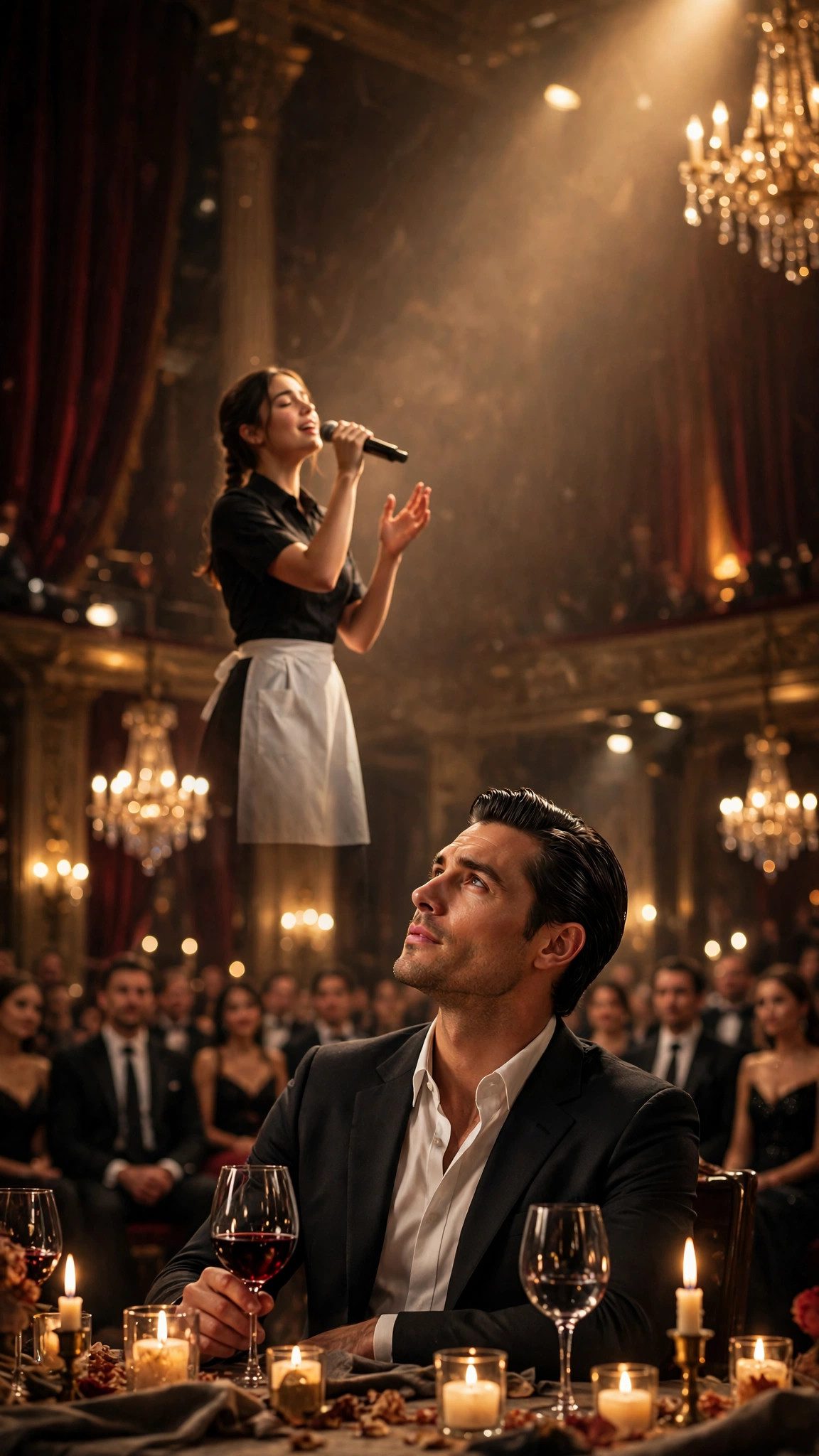
For six weeks, I carried Alessandro Moretti's card in my apron pocket like a live coal.
I told myself I would not go. I told myself every morning when I woke up in my little apartment in Queens, and every night when I came home with aching feet and a sore back from carrying trays at Lumière. I told myself that singing for the King of New York was the most dangerous thing I could do, that men like Alessandro Moretti did not ask waitresses to sing for their dying mothers out of kindness, that there was always a price, and that I had already paid every price I was willing to pay.
But every night, after Gabriel fell asleep, I stood in our tiny kitchen and I sang. I sang the Queen of the Night the way my mother taught me, quietly at first, so as not to wake the neighbors, and then louder, and louder, until the whole apartment shook with it. I sang for my mother. I sang for my father. I sang for the nineteen-year-old girl in Naples who had believed in love. And every night, the aria came back stronger, cleaner, truer, as if my voice had only been waiting for permission to live again.
Gabriel heard me once. He stood in the kitchen doorway in his pajamas, rubbing his eyes, and said, "Mamma, why are you singing the scary lady song?"
"Because the scary lady is brave," I told him. "She is angry, and she sings her anger, and nobody can stop her."
"I like it when you sing," he said. "You should sing more."
On the morning of the gala, I woke up before dawn and I could not go back to sleep. I made Gabriel his breakfast, I walked him to school, I kissed him goodbye at the gate, and then I went to Lumière and worked my shift, carrying trays and smiling, and all day long my hands shook so badly that twice I nearly dropped a glass.
The gala was at the Moretti Foundation's concert hall on the Upper East Side, a beautiful old building with marble floors and gold leaf on the ceilings and chandeliers that looked like they had been stolen from a palace. Two hundred people in black tie and diamonds. A string quartet. A champagne fountain. A stage at the front with a single microphone.
I was not supposed to be there as a guest. I was there as a waitress, hired for the evening along with twenty other girls from Lumière, to carry trays and pour champagne and be invisible. I wore my black uniform and my white apron and I kept my head down, and I told myself that was all I was there to do.
But Alessandro Moretti had other plans.
He found me in the kitchen during the first course, standing by the coffee urns with a tray of empty glasses. He was wearing a black suit with a white shirt, no tie, the collar open at his throat, and he looked at me with those dark eyes that were not cold at all, and he said, "You came."
"You gave me a card," I said. "I thought I should see what the evening was."
"The evening," he said, "is a room full of people who have forgotten how to feel anything. My mother is upstairs, in a private room, too weak to come down. She can hear the music through the speakers. She asked me to find her a voice, Elena. I found you. Will you sing for her?"
I looked at him for a long moment. I thought about my mother, dying in Naples, holding my hand and saying, "Sing, Elena. Whatever happens, sing." I thought about Gabriel, asleep in Queens with his stuffed rabbit. I thought about five years of running.
"I will sing," I said. "But not as a favor. And not as a servant. If I sing, I sing as your equal, or I do not sing at all."
Something flickered in his eyes. Respect, maybe. Or surprise. "Then sing as my equal," he said. "The whole room is waiting."
He took me by the hand and led me out of the kitchen, through the swinging doors, into the concert hall, and two hundred faces turned to look at us. The string quartet stopped playing. The waiters froze. The room went silent, and then someone near the back laughed, a sharp, nervous sound, and then another person laughed, and then the whole room was laughing, because the King of New York was holding the hand of a waitress in a black uniform, and it was the funniest thing they had seen all year.
Alessandro Moretti laughed too. He laughed in front of two hundred people, a big, easy laugh, and he turned to the room and raised his glass, and he said, in a voice that carried to every corner of the hall, "Ladies and gentlemen, this young woman tells me she can sing the Queen of the Night. The most impossible aria in all of opera. I told her that if she can sing it, I will marry her on the spot."
The laughter swelled. Someone shouted, "Do it, girl! Marry the king!" A woman in emeralds giggled behind her fingers. The men at the head table slapped each other on the back and roared.
And I stood there with a tray still balanced on my forearm, because no one had told the waitress she was allowed to put the tray down, and I looked at this man who thought he could buy my voice with a joke, and something in me rose up, cold and clear and furious, the way it had risen up five years ago in the warehouse by the docks in Naples, when three men with guns had told me I was a weakness.
"If that is the truth," I said, and my voice did not shake, "then I will thank you for proving that the name you swore you had buried was never buried at all."
The laughter died. It died so fast that the silence rang in my ears like a struck bell. Two hundred faces turned from me to him, and I watched the smile drain out of Alessandro Moretti's face, watched his dark eyes narrow, watched his hand tighten around his wine glass until I thought the stem would snap.
Because everyone in New York knew the story. Everyone knew about Caterina Voss, the beautiful fiancee with the dark hair and the laughing eyes, who had died in a car crash three years ago on the West Side Highway, on a rainy night in March, and everyone knew that Alessandro Moretti had stood at her funeral in a black suit in the pouring rain and sworn, before God and his whole family, that her name was buried with her and he would never marry, never love, never give his heart to anyone again.
And I, a waitress in a black uniform with a tray on my arm, had just said it out loud in front of two hundred people.
For a moment, I thought he would have me thrown out. For a moment, I thought I had gone too far, that I had insulted the King of New York in his own house, and that I would pay for it. His face had gone white, and his jaw was clenched, and the whole room held its breath, waiting to see what the king would do to the girl who had dared to speak his dead fiancee's name.
Then he set his wine glass down, very carefully, on the table. He stood up. He walked to the edge of the stage, and he looked at me, and his voice, when it came, was low and rough, and it was not a dare anymore. It was a command.
"Sing," he said. "Sing the aria, and we will see whose name is buried."
I set the tray down on the edge of the stage. I took the microphone in both hands. I closed my eyes, and I thought of my mother.
I thought of Sofia Marchetti, standing in our little kitchen in Naples, teaching me to breathe from the belly, to open the throat, to let the sound come from the floor of the body. "This aria is not a song," she used to say. "It is a woman who has been pushed too far. You do not perform her. You become her."
I opened my mouth, and I became her.
The first notes came out low and dark, a mother's fury, a queen's curse, and the hall went so quiet I could hear the ice settling in someone's glass. Then the melody climbed, and my voice climbed with it, up through the coloratura runs, through the staccato daggers of sound, up to the high F's that rang off the chandeliers like struck crystal, each one clean and true and bright enough to hurt. I sang of hell's vengeance boiling in my heart. I sang of a mother who would rather see her daughter dead than disobedient. I sang five years of running, five years of fear, five years of being a girl with no name and no home, and I poured all of it into Mozart's notes until the aria was not a performance anymore but a confession.
When the last note died, the hall was silent for one whole breath. Two breaths. Three.
And then two hundred people rose to their feet at once, and the applause came down like thunder.
I stood on the stage with the microphone shaking in my hand and tears running down my face, and I looked at Alessandro Moretti, and he was standing too, and he was not laughing anymore. He was looking at me the way a man looks at something he has searched for all his life and finally found.
Upstairs, in the private room, his mother Isabella was weeping. I did not know it then, but later, one of the nurses told me: the old woman had heard the aria through the speakers, and she had closed her eyes, and she had whispered, "Sofia. My Sofia has come back to sing for me."
After the applause died down, Alessandro Moretti walked to the stage, and he took my hand, and he lifted it to his lips, and he kissed it, gently, in front of two hundred people.
"You sang," he said, very quietly, so only I could hear. "You sang, and my mother is crying upstairs, and for the first time in three years, I feel something other than anger. What is your name?"
"You already know my name," I said.
"Then tell me the rest," he said. "Tell me why a woman with a voice like that is carrying trays in my restaurant."
I looked into his dark eyes, and I saw the sympathy there, and the curiosity, and something else, something I was afraid to name. And I knew, with a certainty that settled in my bones like cold water, that my five years of running were over.
I had waited for this moment for five years. I just had not known it would look like this.
The week after the gala, my life changed in ways I had never imagined. The telephone at Lumière rang all day, every day. Opera companies wanted to know who I was. A talent agent from Los Angeles left three messages, each one more desperate than the last, offering me auditions, contracts, a recording deal. A reporter from a music magazine came to the restaurant and tried to interview me during my shift, and my manager had to ask him to leave.
I said no to all of them. I was not ready. I had spent five years being invisible, and suddenly the whole world wanted to look at me, and it frightened me more than I could say.
But Alessandro came to Lumière for lunch the following Tuesday, and he sat at his usual table by the window, and he ordered the same thing he always ordered, and when I brought his food, he said, very quietly, "You are afraid."
"Of course I am afraid," I said. "Yesterday I was a waitress. Today the whole city knows my name. What if they find out about Naples? What if they find out about Matteo?"
"Then they will find out that you are a woman who survived," he said. "And they will admire you for it. The world loves a survivor, Elena. It is the one story everyone understands."
That night, after the restaurant closed, the kitchen staff asked me to sing for them. Just a few bars, they said, just the beginning of the aria, so they could hear it up close. I stood in the middle of the kitchen, in my black uniform, with the dishwashers and the line cooks and the pastry chef gathered around me, and I sang the opening of the Queen of the Night, and when I finished, the pastry chef, a big man from Sicily with flour on his apron, had tears in his eyes, and he said, "Signorina, I have worked in kitchens for thirty years, and I have never heard anything like that. You do not belong in a kitchen. You belong on a stage."
I went home that night to Gabriel, and he was waiting up for me, sitting on the couch with his spelling book, and he said, "Mamma, Mrs. Deluca says you are famous now. Are you famous?"
"No, tesoro," I said. "I am just your mamma."
"Good," he said, and he yawned. "I like it when you are just my mamma."
But I knew, even then, that nothing would ever be just the same again. The world had heard my voice, and the world does not forget a voice like that. And somewhere in the city, in an office with dark windows, a man named Vincent Castellano was reading the same newspapers I was reading, and he was smiling, and he was making a telephone call to Naples.
The next morning, a letter arrived at my apartment, delivered by hand in a cream-colored envelope with no stamp, only my name written on the front in a careful, old-fashioned hand. Inside, on thick paper, were a few lines: "My dear Elena, Thank you for giving an old woman her music back. Will you come to tea on Thursday? There is so much I want to tell you about your mother. — Isabella Moretti."
I read the letter three times, standing in my little kitchen with Gabriel eating his toast, and I held it to my chest, and I thought about the fact that a dying woman, a stranger, a queen in her own way, had written to me by hand, and wanted to tell me about my mother, and I knew that I would go, no matter what it cost me, no matter who might be watching. Some invitations are not really invitations. They are doors. And this one was opening.