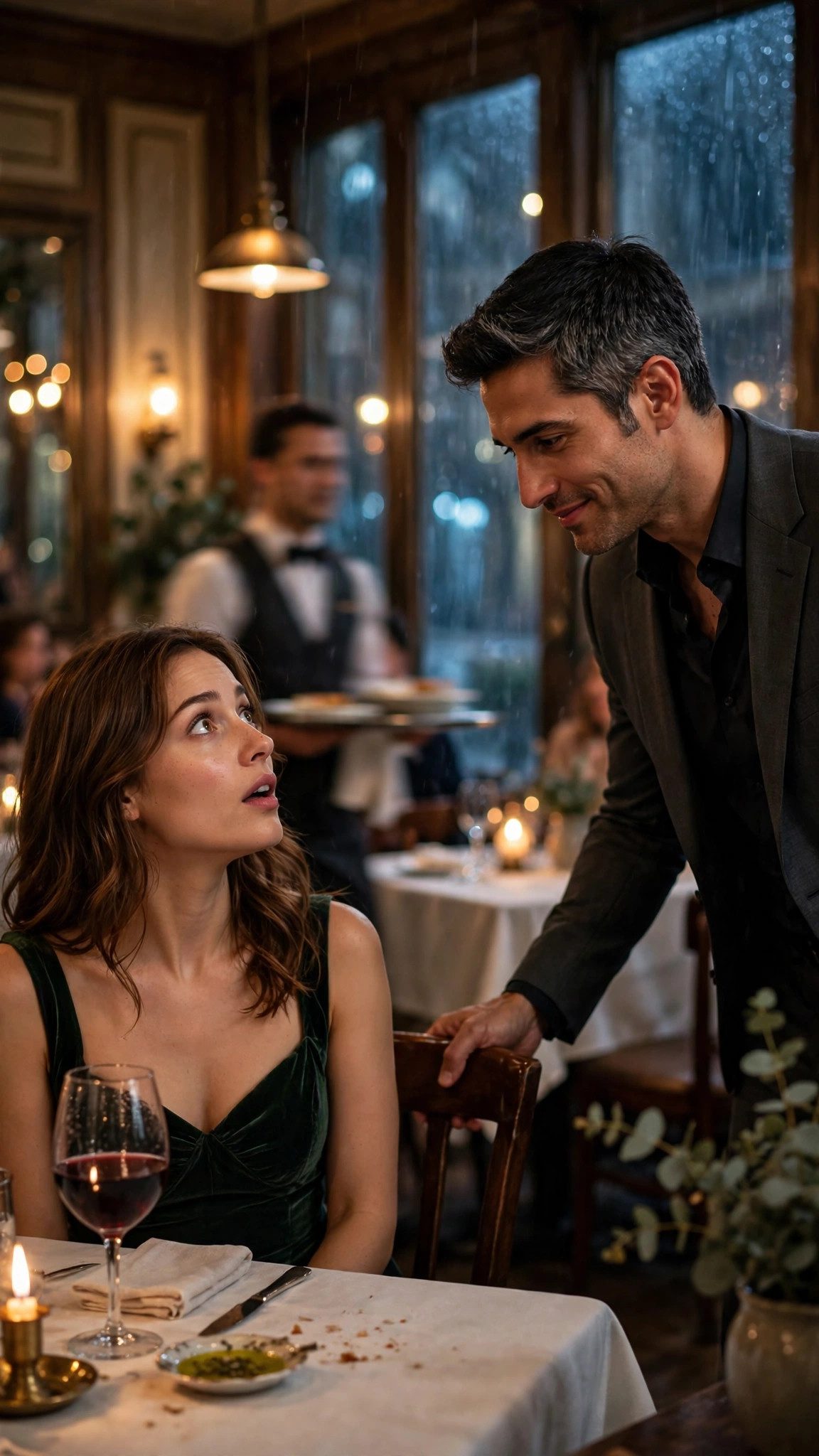
The next morning, I went to work early, before the sun was properly up, because I did not know what else to do with myself. I made coffee in the break room with hands that would not stop shaking, and I told myself I was being ridiculous, that it had been two years, that the man in the café had let me go, that Ryan was just a man who had bought me dinner. But my hands kept shaking, and when Louise Carter came in at seven with her silver knot and her iron spine, she took one look at me and closed the break room door.
"Emma," she said. "Did you have a good time last night?"
I said yes, of course. I said it too fast. I said it the way people say yes when the answer is complicated and they do not want to explain it before coffee.
She looked at me long and hard. Louise had a way of looking at people that made you feel like she could see straight through to the back of your skull. She drummed her fingers on the table, once, twice, three times, and then she said, "Emma, did he tell you his last name?"
I frowned. "No. Why?"
She stopped drumming. She leaned forward, both hands flat on the table, and her voice dropped to something low and careful, the way you speak when you are telling someone the floor is about to give way.
"Because the man you had dinner with last night is the head of the Russo family."
Wait. Was that a bad thing? I did not know what the Russo family was. I knew Rochester had families, the way every old city has families, names that showed up on hospital wings and library plaques and the sides of trucks. I knew the name Russo from the freight yard on the edge of town and from a construction company that had built half the new buildings downtown. I did not know why Louise was looking at me like that.
She looked me dead in the eyes and said, "It's the mafia boss people crossed streets to avoid."
Huh?
My hands began to shake. My knees became weak. I felt my heart drop to the floor.
It turned out the man I had just spent two hours with wasn't just some charming stranger. He was Anthony Russo. The one who controlled the gambling, freight, construction, and private security operations of the entire city of Rochester. And I had had dinner with him.
"How do you know?" I whispered. My voice sounded like it belonged to someone else.
Louise sat back in her chair. She looked older suddenly, and tired in a way I had never seen her look before. "My Frank drove trucks for Russo freight for thirty years," she said. "Thirty years, Emma. He drove their routes from Rochester to Buffalo to Syracuse, and he came home every night and he never once told me what was in those trucks, and I never once asked. But I know that family. I know that name. And I know that man."
Frank had died five years ago, of a heart attack in his sleep, and Louise had buried him in the cemetery on the hill, and Anthony's father, old Salvatore Russo, had paid for the funeral, every dollar of it, because Frank had driven for him for twenty years and that was what the family did. Louise had told me that story once, on a slow afternoon, and I had thought it was a kind story, a story about loyalty. Now I understood it was also a warning. The Russo family took care of their own. And they never forgot a debt. And they never forgot a face.
"His name was Ryan," I said, and even as I said it, I heard how foolish it sounded.
"Ryan is what he calls himself when he doesn't want you to know who he is," Louise said. "Anthony Russo. Thirty-eight years old. His father built the freight company from one truck. His grandfather came over from Sicily with nothing. And now he owns half this city, and the other half owes him money, and the police look the other way when his trucks roll through at midnight. Emma, men like that do not have dinner with girls like us by accident."
I wanted to argue. I wanted to tell her that he had been kind, that he had listened, that he had held the umbrella so I stayed dry. But my hands were shaking too hard to make a fist, let alone an argument, and all I could think about was the café in Canandaigua and the question he had asked me two years ago, and the fact that he had known my name and my number without ever asking for either.
"Louise," I said, "I think I've met him before."
She went very still. "When?"
"Two years ago. In Canandaigua. At my aunt June's. There was a café on the lake, and I overheard something, and he sat down across from me and he asked me why he shouldn't kill me."
Louise closed her eyes. For a moment, she looked every one of her seventy-four years. "And what did you say?"
"I told him the truth," I said. "I told him I was a nurse, and I had heard words, not meanings, and I was waiting for my aunt, and I would forget it all by dinner. And he looked at me for a long time, and then he said, 'Then forget it,' and he paid for my coffee and he let me walk away.
It had been a Tuesday in late August, hot and bright, the lake flat and blue outside the café windows. I had driven up to Canandaigua to visit my aunt June, who had a little house near the water and a garden full of tomatoes she was always trying to give away. We had gone to the Blue Heron Café for lunch, a place with blue-checked tablecloths and a chalkboard menu and the smell of coffee and fried fish in the air. June had gone to the counter to order, and I had stayed at our table by the window, and that was when the two men had sat down at the table next to mine.
I had not meant to listen. But they were close, and they were arguing, and one of them, a man with a scar through his eyebrow, kept saying "Tuesday" and "Pier 4" and "midnight," and the other one, a man with a gold watch and a nervous laugh, kept saying "Castellano wants it done quiet, you understand? Quiet." I had not known what any of it meant. Tuesday. Pier 4. Midnight. Castellano. They were just words, floating past me like the boats on the lake outside. But then the man with the scar had looked over, and he had seen me listening, and his face had changed, and he had stood up, and my blood had gone cold.
That was when Anthony had appeared. He had been sitting at the bar, I realized later, watching the whole thing. He had put a hand on the scarred man's shoulder and said something low, too low for me to hear, and the scarred man had sat back down, and Anthony had come to my table, and he had pulled out the chair across from me, and he had sat down, and he had looked at me with those winter-lake eyes, and he had asked me the question.
After he let me go, I sat there for a long time, my coffee going cold, my hands shaking so hard I could barely hold the cup. June came back with our sandwiches and asked me what was wrong, and I said nothing, because what could I say? A man had just asked me why he should not kill me, and then he had paid for my coffee and let me walk away, and I did not understand any of it. I drove home to Rochester that evening, and I never told my mother, and I never told June, and I folded the whole day away in the back of my mind, like a letter you never open, and I forgot it was even there."
Louise opened her eyes. "Emma. Do you understand what you are telling me? That man had every reason in the world to make you disappear that day. Men in his world do not leave witnesses walking around. He let you live because you told him the truth while you were afraid, and men like Anthony Russo do not forget a thing like that. He has been carrying your face around in his head for two years. And last night, he found you."
I went home that afternoon with my head spinning and my stomach in knots, and when I pulled into my driveway, I saw the mailbox flag was up. There was a handwritten note inside. It was postmarked the same day. It read, "Emma, I don't usually introduce myself to strangers. But I need to apologize for not introducing myself properly."
There was no signature. There did not need to be one. I knew the handwriting already, somehow, the way you know a voice you have only heard once. I stood in my driveway holding that note, and the rain had stopped, and the sun was coming out over Park Avenue, and I felt like the whole world had tilted sideways.
He was there the next day. Not at my house. At the facility.
That Sunday, I sat on my couch with the note in my lap, reading it over and over until I had memorized every word, every loop of the handwriting. "I don't usually introduce myself to strangers. But I need to apologize for not introducing myself properly." I turned it over. There was nothing on the back. No name. No number. No address. Just the words, and the postmark, and the faint smell of paper that had been carried in a pocket. I thought about calling my mother, but I knew what she would say. She would tell me to stay away from him. She would tell me to be careful. And she would be right. But I also thought about the way he had listened to me for two hours, and the way he had held the umbrella, and I thought about what Louise had said: men like him don't apologize. Not to anyone. Not ever. He had apologized to me. In his own handwriting. Whatever else he was, I had to remember that. I came in on Monday morning and Priya was waiting at the front desk with her eyes wide and her mouth open, and she pointed toward the director's office without saying a word, and there he was, standing beside Louise's desk in a charcoal suit, talking to her in a low voice, and when he saw me in the doorway, he stopped talking, and he smiled, and it was the same smile from Friday night, warm and unhurried, like we were the only two people in the building.
"Emma," Louise said, and her voice was doing something I had never heard it do before. It was shaking. "Mr. Russo called me this morning. He asked me to reach you."
I looked at him. I looked at Louise. I waited for someone to tell me what was happening.
"He said he'd like to meet you on Tuesday at five p.m.," Louise said, "at the biggest health benefits show in Rochester."
I laughed nervously. I could not help it. A health benefits show. The biggest health benefits show in Rochester. It was the kind of event where hospital administrators shook hands and insurance companies handed out pens with their logos on them. It was the last place on earth I expected to meet the most feared man in the city.
But Louise was not laughing. She was looking at me with an expression I could not read, and Anthony Russo was looking at me the way he had looked at me on Friday night, like I was the only interesting thing in the room, and I realized, slowly, that this was not a joke.
"He wanted you to think he was someone you could trust," Louise said later, when he had gone and it was just the two of us in her office with the door closed. "That is what a meeting like this means. A public place. Daylight. A hundred witnesses. He is telling you that you are safe with him."
"And the other thing?" I asked. My voice was barely a whisper.
Louise hesitated. "Your birthday is Tuesday, Emma. He knows that. I don't know how he knows that, but he knows. And I think he wanted you to think he had forgotten it, so that when you walked in, it would be a surprise."
My birthday. I had forgotten my own birthday was Tuesday. I had been so buried in budget meetings and layoff notices and the fight to save the memory-care program that the date had slipped past me entirely. And this man, this stranger, this mafia boss who had once asked me why he should not kill me, had remembered.
What was I supposed to do? Walk in on Tuesday and think I was going to have dinner with the city's most notorious mafia boss?
I went home that night and sat on my couch and stared at my phone for a long time. I thought about the café. I thought about the note in my mailbox. I thought about the way he had listened to me for two hours, and the way he had held the umbrella, and the way he had told me to text when I got home. I thought about Louise's warning, and Frank Carter driving trucks for thirty years and never asking what was in them, and the way Louise's voice had shaken when she said his name.
And then I thought about something else. Something Louise had said, almost as an afterthought, when she walked me to my car that evening.
"Emma," she had said, "men like him don't apologize. Not to anyone. Not ever. He wrote you a note, child. He apologized to you in his own handwriting. Whatever else he is, remember that."
I slept badly that night, and the next, and by Tuesday morning, my hands were numb and my stomach was a knot, and I had decided, at least five times, not to go. And then Louise came into my office at noon, closed the door, and said, "I'll cover your shift. Go."
"Louise, I can't—"
"You can," she said. "And you will. Because whatever this is, Emma, you deserve to know what it is. And because I have known that man by reputation for thirty years, and I have never once heard of him hurting a woman. Not once. Go."
So I went.