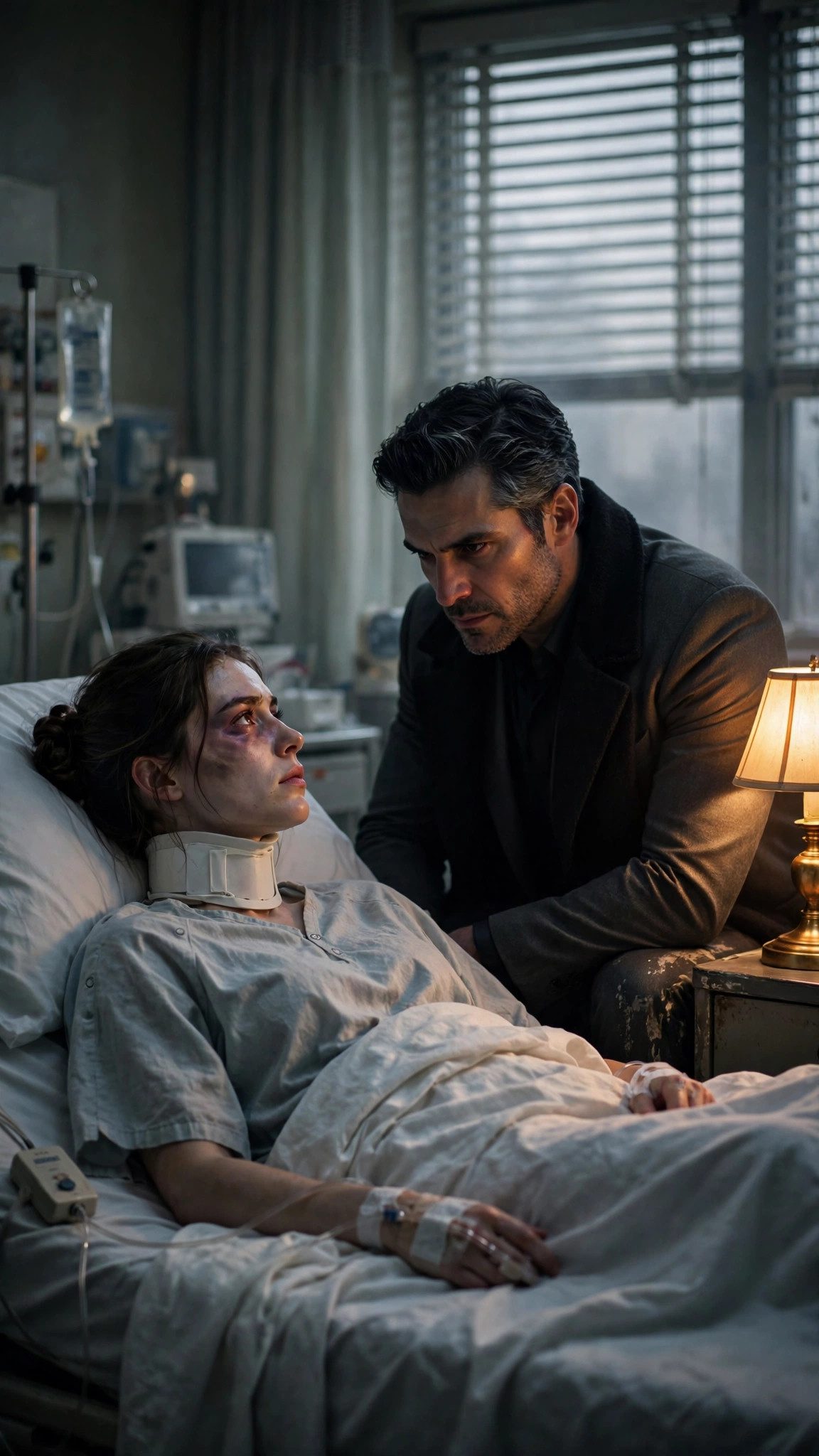
Dante Moretti did not sleep on the night after Harper was attacked.
He sat in his office on the forty-first floor with the lights off and the city burning below him, and he made phone calls. He called Tony Mercer, his driver, who had been with him for eleven years and who knew every street in Chicago the way other men knew their own names. He called his lawyers. He called the police captain who owed him a favor from a case three years ago. He called the owner of the parking garage on Wabash, and the owner of the restaurant across from the Drake, and the man who sold security cameras out of a warehouse in Cicero.
By dawn, he had the footage.
It was grainy, and it was dark, and it was raining, but it was enough. The black Lincoln had turned onto Wabash at nine thirty-one. It had waited with its lights off for eleven minutes. At nine forty-two, Harper had come around the corner, and the doors had opened, and three men had gotten out, and ninety seconds later, the car had pulled away with her bag in the back seat.
Dante watched the footage four times. On the fourth time, he saw something he had missed.
The driver had not worn gloves when he opened the door. For one second, under the streetlight, his hand was visible on the door handle. And on his wrist, there was a tattoo: a small black snake, coiled around a dagger.
Dante knew that tattoo. He had seen it once before, two years ago, on the wrist of a man named Eddie Krol, who worked for Vincent Castellano and who had once broken a longshoreman's jaw for voting the wrong way in a union election.
"Eddie Krol," Dante said to the empty office. "You stupid, stupid man."
He called Tony.
"Find Eddie Krol," he said. "Do not touch him. Do not warn him. Just find him, and tell me where he sleeps, and where he eats, and who he talks to."
Tony found him by noon. Krol ate at a diner on Cicero every night at nine o'clock, in the back booth, under a buzzing fluorescent light, and he ordered the same thing every time: a cheeseburger, black coffee, and a slice of apple pie he never finished. He sat alone, and he talked too much, and the waitress, a tired woman named Marlene who had worked the night shift for fourteen years, told Tony everything without being asked twice, because Krol had once left her a twenty-dollar tip and a bruise on her wrist in the same evening, and she had not forgotten either one.
"He brags," Marlene said, wiping the counter with a gray rag. "He comes in here and he talks about the jobs he does for Castellano, like he is some kind of soldier, and he tells everyone who will listen that he is untouchable. Last night he told me he did a job on Tuesday, and the money was good, and the woman he hit was 'just a secretary.' He laughed when he said it. He laughed."
Tony wrote it all down. He did not tell Marlene who he was, or who he worked for, but he left her a hundred dollars and the number of a lawyer, and he said, "If he ever touches you again, you call this number."
Then he drove to the parking garage on Wabash, and he talked to the attendant, a young man named Luis who had been on duty the night of the attack, and Luis remembered the black Lincoln, because it had circled the block three times before it stopped, and because the driver had kept the engine running, and because Luis had thought, at the time, that it was strange, and then he had thought no more about it, because strange cars were ordinary in Chicago, and ordinary men did not ask questions that could get them hurt.
Tony thanked him, and he drove back to the office, and he laid it all out for Dante: the diner, the waitress, the garage, the three circles around the block. And Dante listened, and his face did not change, and when Tony finished, Dante said only, "Good. Now we wait."
Then he drove to the hospital.
Harper was awake when he arrived, sitting up against the pillows with a tray of untouched toast in front of her and a crossword puzzle open on her lap. The bruise on her face had darkened overnight, purple and black around her left eye, and the collar held her neck stiff and straight, and she looked, Dante thought, like a woman who had been hit by a truck and was already annoyed about the inconvenience.
"You look terrible," he said.
"Thank you," she said. "You always know exactly what to say."
He sat down in the chair beside her bed. "I have the footage."
Her eyes sharpened. "And?"
"The car was stolen. The plates were fake. But the driver has a tattoo on his wrist. A snake around a dagger. I know the man. His name is Eddie Krol. He works for Castellano."
Harper was quiet for a moment. Then she said, "The man who crouched in front of me. The one who whispered the message. He smelled like cigarettes. Cheap cologne. And there was rainwater dripping from his jaw."
"That is Krol," Dante said. "He smokes two packs a day. He buys his cologne at a drugstore. And he has done this before. He is Castellano's messenger. When Castellano wants someone frightened, he sends Krol. When he wants someone dead, he sends someone else."
"So I should feel lucky," Harper said.
"You should feel angry," Dante said. "I do."
She set the crossword puzzle aside. "Dante. The other two men. Did you see their faces?"
"One of them is Danny Cole. He is twenty years old, and he has been arrested twice for assault, and Castellano pays his mother's rent. The other one I do not know yet. Tony is working on it."
Harper nodded slowly. Then she said something that surprised him.
"The man who whispered. Krol. He knew my name."
Dante went still. "What?"
"He said, 'Tell Moretti.' He did not say, 'Tell your boss.' He said my name first. Before the message. He said, 'Harper.' I didn't notice it at the time, because I was trying not to pass out, but he knew my name. He knew who I was. He knew I was your secretary."
"That means someone told him," Dante said.
"Yes," she said. "Someone told him my name, my schedule, and where to find me. Someone who knew I would be alone at nine forty on a Tuesday. Someone who knew I would be carrying the zoning packet."
They looked at each other, and neither of them said the name. They did not have to. There were only five people who had known.
That afternoon, the second message arrived.
It did not come in an alley. It came to the hospital. A nurse found a single red rose on the tray outside Harper's room, with no card, no note, nothing but a thorn that had been deliberately left sharp. And when the nurse called the front desk to ask who had left it, the switchboard said a man had called an hour earlier and asked for Harper Bennett's room number, and when the operator had refused to give it, the man had said, "Tell her the next message won't need a room number."
Harper did not sleep that night. She lay in the dark and listened to the machines beeping, and every time she closed her eyes, she was back in the alley. She could feel the pavement against her knees. She could feel the hands grabbing her arms. She could smell the cigarettes and the cheap cologne, and she could hear the whisper, soft and close, and she would jerk awake, gasping, with her heart pounding so hard it hurt her ribs.
At three in the morning, a nurse named Grace came in to check her blood pressure, and she saw Harper's face, and she sat down in the chair beside the bed, and she said, "You are having nightmares."
"How did you know?" Harper whispered.
"Because I have worked this ward for twelve years," Grace said, "and I know the look. You are safe here, Miss Bennett. There are guards at every door. No one is going to hurt you in this hospital."
Harper wanted to believe her. She tried to believe her. But she had believed she was safe before, too, behind Dante's reputation, behind his rules, behind the wall that had held for three years, and the wall had not held. So she lay awake until dawn, watching the gray light leak through the blinds, and she thought about the rose, and about the man who had left it, and about the fact that Castellano could reach her even here, in a hospital, behind locked doors, and she understood, finally, what the beating had really been for.
It had not been about the zoning vote. Not only that. It had been about fear. Castellano wanted her afraid. He wanted Dante afraid. He wanted them both to lie awake at night and wonder where the next message would come from, and when, and how bad it would be. Fear was Castellano's real weapon. The beating was only the delivery system.
When the sun came up, Harper made a decision. She would be afraid at night, when she could not help it, when the dark brought the alley back. But in the daylight, she would not be afraid. In the daylight, she would be angry. And she would use the anger the way she used everything else: carefully, precisely, and to its full effect.
Dante was in the hallway when the nurse told him. He did not raise his voice. He did not move quickly. He walked to the nurses' station, and he asked to see the security footage, and he stood there for ten minutes watching the tape, and what he saw made his hands curl into fists at his sides.
A man in a gray coat had walked past Harper's door at two fifteen. He had not stopped. He had not looked in. He had simply walked past, slowly, with his hands in his pockets, and the camera had caught his face for three seconds.
It was Marcus Hale.
Dante stood in the hallway for a long time after the tape ended. He thought about nine years of loyalty. He thought about the mornings Marcus had brought him coffee. He thought about the nights Marcus had checked his car for bombs, and the afternoons Marcus had stood outside his office door, and the time Marcus had carried Harper's laptop bag up three flights of stairs when the elevator broke.
Then he thought about Harper lying in a hospital bed with two cracked ribs and a fracture near her eye, and the nine years went quiet in his head, the way a room goes quiet when someone turns off the music.
He walked back into Harper's room and sat down beside her bed.
"Marcus Hale left a rose outside your door," he said.
Harper's face went pale. "He was here?"
"On the security tape. Two fifteen. He walked past your door and did not stop."
"Why would he do that?" she whispered. "Why would he come here?"
"Because he wanted you to know," Dante said. "Because the rose is Castellano's signature. He leaves a red rose for the people he is about to destroy. And Marcus wanted you to see it, because he wanted you frightened, and he wanted me frightened, and he wanted us both to understand that Castellano can reach you even here."
Harper was quiet for a long time. Then she said, "Dante, what did Castellano pay him?"
"I don't know yet," Dante said. "But I will. And when I do, I will know everything."
That evening, Tony called.
"I found Krol," he said. "He eats at a diner on Cicero every night at nine. He sits in the back booth. He orders the same thing. And he talks too much. He told the waitress last night that he did a job for Castellano and that the money was good, and that the woman he hit was 'just a secretary.'"
Dante closed his eyes. "And the other man? The third one?"
"Tommy Falco," Tony said. "He drives for Castellano sometimes. He was the one who stole the Lincoln."
"Good," Dante said. "Now listen to me carefully. I want you to do nothing. Do not touch Krol. Do not touch Falco. Do not touch Cole. I want them comfortable. I want them careless. Because on Tuesday, after the zoning vote, I am going to take all three of them, and I am going to take the man who paid them, and I am going to take the man who sold them Harper's schedule."
"And Marcus?" Tony asked.
Dante was silent for a moment. Then he said, "Marcus is mine."
He hung up, and he sat in the dark office, and he thought about the message Harper had delivered to him in the hospital, the exact words Krol had whispered in the rain.
Tell Moretti the docks are Castellano's. He pulls his bid before the zoning vote on Tuesday, or next time we don't stop at his secretary.
Dante Moretti had spent twenty years building an empire on two foundations: fear, and the absolute certainty that his people were untouchable. Castellano had attacked the second foundation. He had done it deliberately, and publicly, and cruelly, because he believed it would make Dante afraid.
It had not made Dante afraid.
It had made him certain.
On Tuesday, the zoning board would vote. Dante would win. And then, with the docks finally his, he would turn his full attention to Vincent Castellano, and to Eddie Krol, and to Marcus Hale, and he would show them all, one by one, what happened to men who used his secretary as an envelope.
He picked up his phone and called the one man in Chicago he trusted more than anyone else.
"Daniel," he said. "It is Dante Moretti. I need to talk to you about Vincent Castellano. And I need you to bring the FBI."