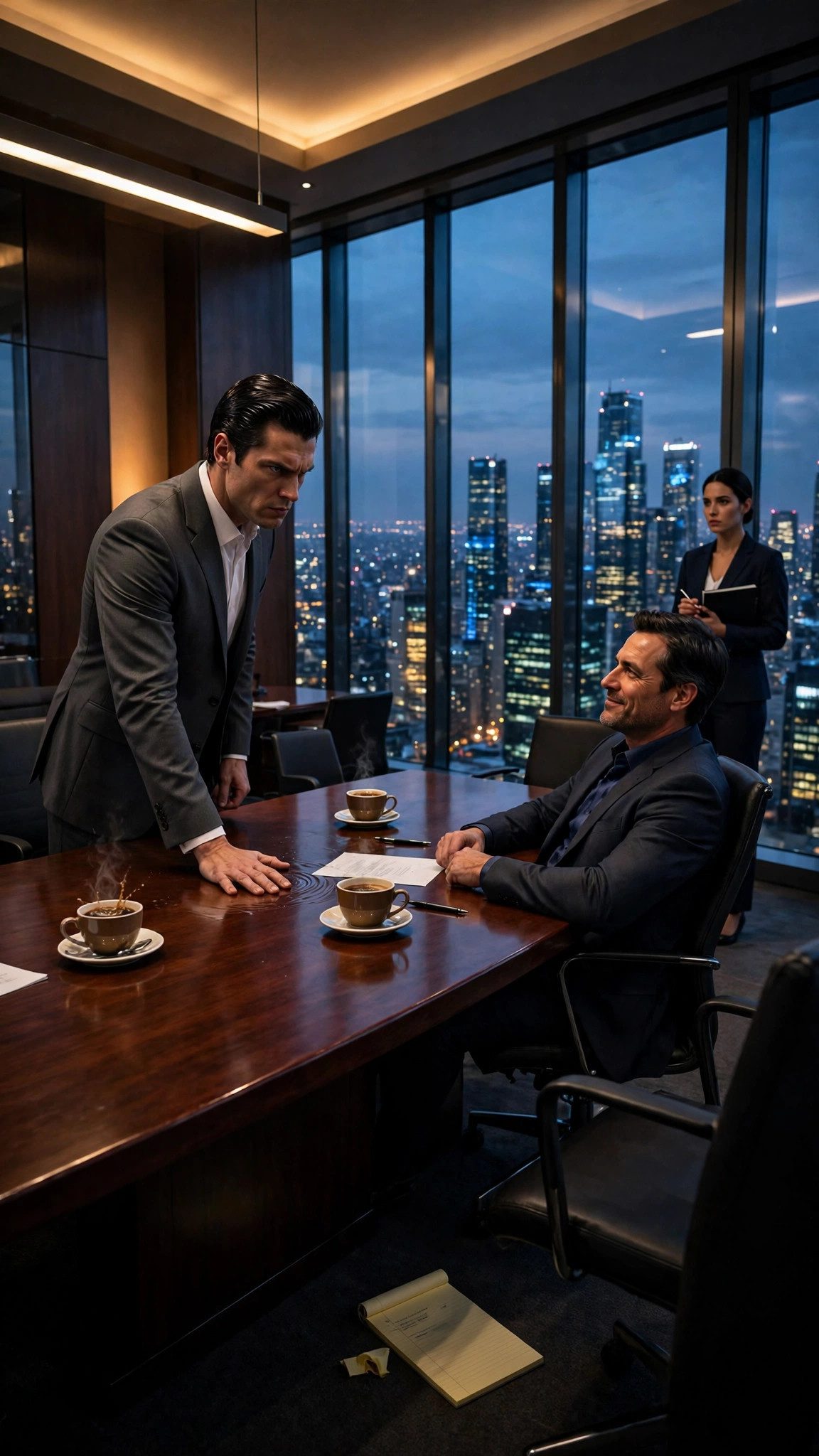
The FBI field office was not what I expected. I had imagined something from the movies — dark rooms, blinking lights, men in suits shouting into telephones. Instead it was an ordinary office building with ordinary carpet and ordinary fluorescent lights, and the people inside it looked like accountants. Agent Daniel Reyes's office was on the fifth floor, and it was small, and it was full of files, and there was a photograph of his wife and two daughters on his desk, in a frame that had a crack in one corner.
"Sit down," Reyes said. "Both of you. We have a great deal to discuss, and not much time."
He spread the files across his desk. Shipping manifests. Bank transfers. Photographs of warehouses. A list of names — men who worked for Vincent Calder, men who had been paid to look the other way, men who had been threatened into silence. And at the center of it all, a single photograph: a black car, burned and twisted, on a street I recognized from the police report I had read two years ago, late at night, when the office was empty.
"Sofia Marchetti," Reyes said quietly. "Twenty-nine years old. Killed by a car bomb on the fourteenth of March, two years ago. The bomb was planted by a man named Eddie Krol, who worked for Vincent Calder. Krol died six months later — an overdose, officially. Unofficially, he was killed because he knew too much. We have never been able to prove any of it. Until now."
He set down another file. Inside it was a bank statement, and on the bank statement was a transfer — fifty thousand dollars, from a company owned by Vincent Calder, to an account in Eddie Krol's name, dated the thirteenth of March, two years ago. The day before Sofia died.
"Where did you get this?" Adrian asked. His voice was very steady. Too steady.
"From your files," Reyes said. "From the contracts you gave me this morning. Calder hid his payments inside your own distribution network. He used your warehouses, your routes, your paperwork — and he thought you would never look closely enough to see it. He was wrong. You gave me everything, and my people found it in four hours."
Adrian looked at the bank statement for a long time. Then he looked at the photograph of the burned car. And then he did something I had never seen him do before. He put his head in his hands, and his shoulders shook, and for one moment, the most feared man in the city was simply a man grieving the woman he had loved.
I reached across the desk and took his hand. I did not care that Reyes was watching. I did not care that we were in an FBI office. I held his hand, and I did not let go, and after a moment, his breathing steadied, and he lifted his head, and his eyes were red, but his voice was clear.
"What do you need from me?" he asked.
"Everything," Reyes said. "I need you to testify. I need you to tell a grand jury what you know about Calder's operation, about the distribution routes, about the money, about the threats. I need you to stand in a courtroom and say, in front of a judge and a jury, that Vincent Calder ordered the murder of Sofia Marchetti. And I need you to understand what that means. Once you testify, there is no going back. Calder's people will know. His lawyers will know. The whole city will know. You will be a witness against one of the most dangerous men in New York. Are you prepared for that?"
Adrian looked at me. He looked at my hand in his. And then he looked back at Reyes.
"I have been silent for two years," he said. "Silence did not save Sofia. Silence did not save me. So yes. I am prepared. Tell me when, and tell me where, and I will be there."
Reyes nodded. "There is one more thing. Miss Morgan — Vincent is going to try to reach you again. He sent the lilies because he wanted Adrian to be afraid. When he learns that Adrian has gone to the FBI, he will be desperate. Desperate men do desperate things. I am putting two agents on you, around the clock, until Calder is in custody. I am also putting agents on your mother. Do you understand?"
"My mother?" I said. "She's in a hospital—"
"She's in a care facility on the east side," Reyes said, gently. "I know. My agents will be there within the hour. No one will touch her. I promise you that."
I called my mother from Reyes's office. I told her not to worry, that there were policemen watching the building, that it was only a precaution. She did not believe me — mothers never believe that kind of lie — but she said, "All right, my love. I trust you. And Tessa —" Her voice went soft. "Whatever is happening, I am proud of you. Your father would have been proud of you too."
I hung up the phone. And I cried, for the first time since the morning Vincent Calder asked his question. Not because I was afraid. Because I was proud, too. Proud of Adrian, for finally speaking. Proud of myself, for standing beside him. Proud of the life I had built out of borrowed suits and secondhand briefcases, and of the woman I had become in two years of being invisible and efficient and unbreakable.
Adrian put his arm around me. He did not say anything. He did not need to. We sat in Reyes's office, holding each other, while the FBI agents worked around us, and the files piled up on the desk, and the case against Vincent Calder grew stronger with every hour.
Three days later, at dawn, the FBI raided six warehouses, three offices, and one very expensive apartment on the river. They arrested Vincent Calder in his bedroom, in his pajamas, while his attorney shouted into a telephone and his wife stood in the hallway in her robe, crying. They arrested eleven of his men. They seized computers, bank records, shipping manifests, and enough evidence to fill a warehouse of its own.
I was not there. I was at home, with two FBI agents outside my door, waiting for the phone to ring. When it rang, it was Reyes.
"It's done," he said. "Calder is in custody. He will be charged with racketeering, smuggling, conspiracy, and the murder of Sofia Marchetti. He will never see the outside of a prison again. You are safe, Miss Morgan. Your mother is safe. Adrian is safe. It's over."
I hung up the phone. I sat on my couch. And I thought about the morning in the conference room, and the question, and the hand slamming against the table, and the forty-million-dollar deal that had died in a single second.
It was over. Vincent Calder was in prison. Sofia Marchetti would finally have justice. And Adrian Vescari — the most feared man in the city, the man who had been silent for two years — had finally spoken, and the law had listened.
Two weeks later, Adrian testified before a grand jury. I waited for him in the hallway of the courthouse, sitting on a wooden bench with my notebook in my lap, watching lawyers and clerks and policemen walk past. I had been a secretary for two years. I was good at waiting. But this was the longest wait of my life.
When the doors finally opened, Adrian came out with Reyes beside him, and his suit was immaculate, and his face was calm, and his hands were steady. He looked at me, and he smiled — the small, tired, true smile I had come to know — and he said, "It's done. I told them everything. Every threat. Every payment. Every lie. The grand jury voted to indict. Calder will stand trial."
"How do you feel?" I asked.
"Free," he said. "For the first time in two years, I feel free."
That afternoon, we drove together to the cemetery where Sofia was buried. I had never been there. Adrian had gone alone, every fourteenth of the month, for two years, and he had never told anyone. He parked the car, and we walked together between the rows of headstones, and the autumn leaves were falling, and the air smelled like rain.
Sofia's grave was simple. A gray stone, with her name and two dates, and a small vase that held fresh white lilies — Adrian had brought them every month, without fail, for two years.
He stood in front of the stone for a long time. He did not speak. Then, very quietly, he said, "Sofia. I loved you. I will always love you. But I cannot live in the past anymore. I have met someone who makes me want to live in the future. Her name is Tessa. She is kind, and brave, and she is standing right here beside me. I wanted you to meet her."
He turned to me. "Tessa," he said. "This is Sofia."
I stepped forward. I put my hand on the cold stone. And I said, very quietly, "Hello, Sofia. Thank you for loving him first. Thank you for teaching him how. I promise you — I will take care of him. I will love him the way you did. And I will never let him be alone again."
Adrian took my hand. We stood there together, in the falling leaves, in front of the grave of the woman he had loved and lost, and I felt something shift inside me — not jealousy, not fear, but gratitude. Gratitude for a woman I had never met, who had loved this man before me, and who had left behind a space in his heart that I was now being asked to fill.
On the drive back to the city, Adrian was quiet. Then, as we crossed the bridge over the river, he said, "My uncle Salvatore told me something, the night Sofia died. He said that a man with nothing to lose is a man who has already lost everything. I didn't understand him then. I understand him now. I lost Sofia. And then I lost two years of my life, trying to lose nothing else. But you taught me something, Tessa. You taught me that the only way to stop losing is to start living again."
He reached across the car and took my hand. "Thank you," he said. "For staying. For being brave. For not running when Vincent sent the lilies. For holding my hand in Reyes's office when I couldn't hold it together myself. Thank you."
I squeezed his hand. "You're welcome," I said. "Now drive. We have a company to rebuild."
Six months later, Vincent Calder stood trial. I was there, in the courtroom, sitting in the front row with my mother beside me, watching the man who had ordered Sofia's murder and sent me white lilies listen to the evidence against him. The bank transfer. The shipping manifests. The testimony of his own men, who had turned against him one by one when Reyes showed them the files. And Adrian's testimony — calm, clear, devastating — delivered in a voice that never rose above a conversational tone, the way Adrian always spoke when he was saying something that mattered.
The jury took four hours to reach a verdict. Guilty on all counts. Racketeering. Smuggling. Conspiracy. And the murder of Sofia Marchetti.
The judge sentenced Vincent Calder to life in prison, without the possibility of parole. As the bailiffs led him away, he turned and looked at Adrian — one last look, full of hatred and disbelief, as if he still could not understand how the quietest man in the room had brought him down.
Adrian did not look back. He stood up, took my hand, and walked out of the courtroom into the sunlight, where the whole city was waiting, and where the rest of our lives were about to begin.
But I knew, even then, that it was not really over. Because a man like Adrian Vescari does not spend two years being silent and then simply go back to being ordinary. He had to decide what kind of man he was going to be, now that the silence was broken. He had to decide what Vescari Holdings was going to be, now that the deal was dead and the empire was his to rebuild.
And he had to decide what I was going to be — not his secretary, not his weakness, not the woman he had hidden behind three feet of distance for two years, but something else entirely.
I did not have to wait long to find out. Because the next morning, Adrian Vescari called a meeting of his entire company — every employee, from the dockworkers to the executives, all two hundred of them — and he stood in front of them in the lobby of the building, and he told them the truth.
He told them about Sofia. He told them about Vincent Calder. He told them about the FBI, and the arrests, and the case. And then he told them something no one in that room had ever expected to hear from the head of the Vescari family.
"From this day forward," he said, "Vescari Holdings will be a legitimate company. No more shadows. No more deals in the dark. No more men who are afraid to come to work in the morning. We will pay our taxes. We will follow the law. We will be a company that a good person can be proud to work for. And if any man in this room disagrees, he is free to leave, with my thanks and my respect, and no hard feelings."
No one left. Not one person. Two hundred men and women stood in the lobby of Vescari Holdings and applauded — not politely, not the way people applaud at a business meeting, but the way people applaud when they have been waiting a very long time to hear something true.
And I stood in the back of the room, in my dark suit, with my notebook and my pen, and I cried. Because I knew, standing there, that Adrian Vescari had finally done the bravest thing he had ever done.
He had stopped being afraid. And he had started being free.