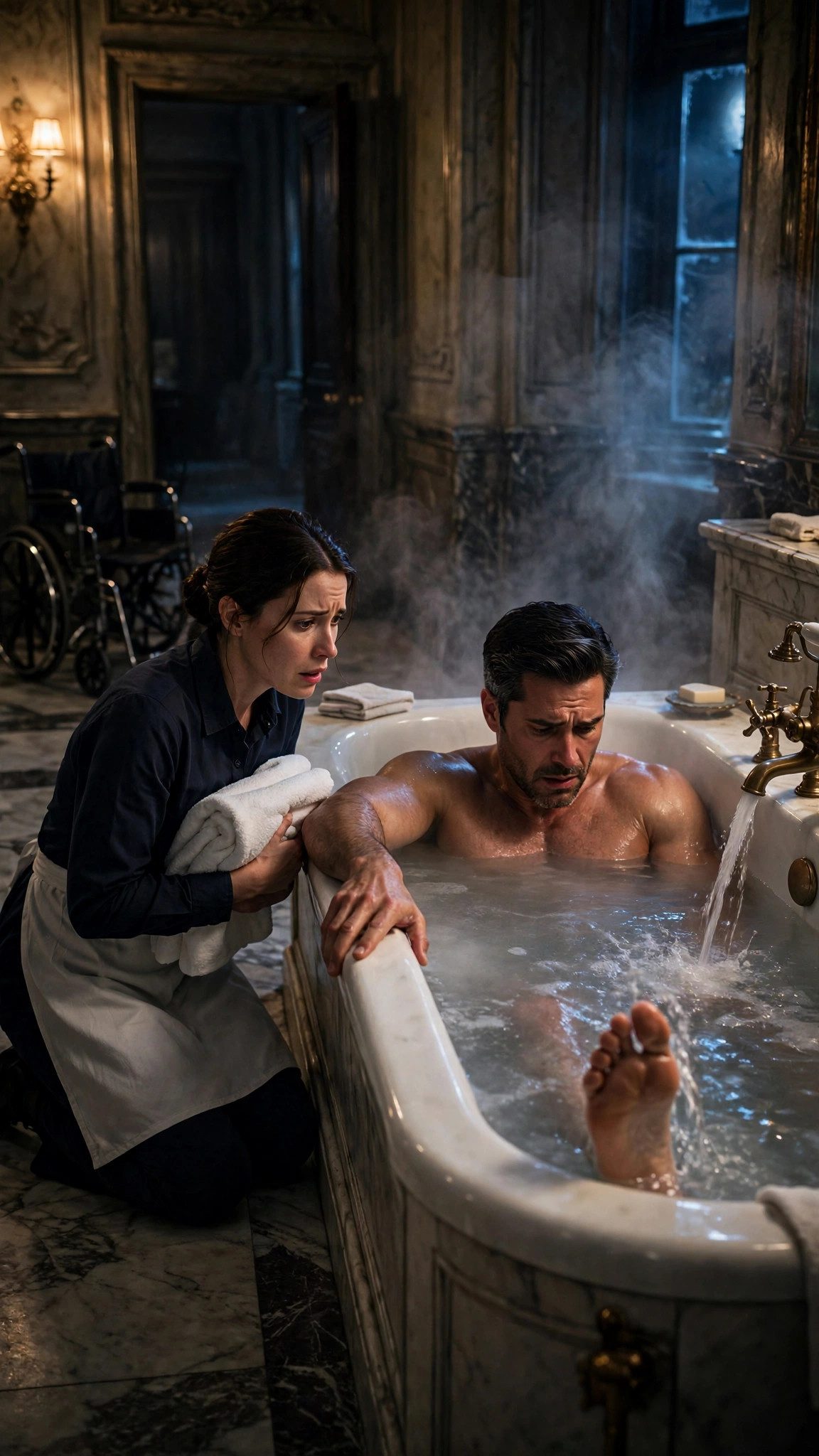
It happened on a Thursday night, three weeks after Martha had started drawing the bath.
She had stayed late. Miss Delaney had gone home with a headache, Rosa had left after dinner, and Tony had driven to the airport to pick up a shipment of parts for the Meridian Terminal — a job that would keep him out until midnight. Martha was in the kitchen, wiping down the counters for the third time, because she had learned that a house this big always gave a woman a reason to stay if she wanted one.
At eleven-forty, she heard the front door open downstairs.
She froze, the cloth in her hand. Tony was not due back until midnight. Miss Delaney had gone home. Cole Bennett was supposed to be on duty, but Cole had not come in at all that day — he had called in the morning, his voice thick, and said he was sick, and no one had questioned it, because Cole called in sick the way other men called in dead.
Footsteps crossed the hall below. Slow. Careful. Not Tony's heavy tread. Not Delaney's quick click. These footsteps were trying not to be heard.
Martha put the cloth down. She took the kitchen thermometer from her apron pocket — the only thing in her hands that could pass for a weapon — and she moved to the foot of the stairs, keeping to the shadows the way she had learned to move in hospital corridors at night, when patients were sleeping and every sound mattered.
The footsteps went up. Past the second floor. To the third.
Martha followed. Her heart beat so hard she was certain the whole house could hear it. At the top of the stairs, she saw the door to Maxwell's bedroom standing open a crack, and a thin line of light from the hall falling across the floor inside.
She pushed the door open.
A man stood beside Maxwell's bed. He was broad and dark, with a shaved head and a tattoo crawling up the side of his neck, and he was holding a pillow in both hands. Maxwell lay in the bed, his eyes open, his face white, his arms braced against the mattress as if he were trying to push himself upright — and failing, because his legs would not help him and the man was already leaning over him.
Martha did not think. Thinking was for later. She did what nurses do when a patient is in danger: she made noise.
She screamed. Not a polite scream. A full, raw, hospital-corridor scream, the kind that brings orderlies running from three wards away.
The man with the pillow jerked around. His eyes found her. For a second, Martha saw the calculation in them — the pillow, the bed, the woman in the doorway — and then he dropped the pillow and came at her.
She threw the thermometer at his face. It missed. She grabbed the heavy ceramic vase from the hall table and swung it with both hands. It caught him on the shoulder and shattered against the wall. He swore and grabbed her wrist, and his grip was strong, and for a terrible moment Martha thought about Walter Abernathy and about the chart and about how she had spent two years believing her life was over, and she thought, not this time, not this man, not tonight.
She bit his hand. Hard. He yelled and let go. She ran down the stairs, screaming, and hit the panic button by the front door — a small red button she had noticed on her first day and never asked about — and the alarm went off like a air-raid siren, filling the whole house with sound.
The man came down the stairs behind her. He was fast, but Martha was faster, because fear is faster than anything, and she was already at the front door, pulling it open, when headlights swept across the driveway and Tony Ferraro's car screeched to a stop.
Tony came out of the car with a tire iron in his hand. The man in the hall saw him, turned, and ran for the back door. Tony chased him through the kitchen, across the garden, to the low wall at the back of the property. Martha heard shouting, and a crash, and then silence. Tony came back alone, breathing hard, the tire iron still in his hand.
"He went over the wall," Tony said. "I got his jacket." He held it up. A black windbreaker, torn at the shoulder. In the pocket was a phone.
Martha was shaking. She sat down on the bottom step of the stairs and put her head between her knees, the way she had once told panicking patients to do.
"Upstairs," she managed to say. "Mr. Rourke. Check him."
Tony went up. Martha followed, her legs unsteady. Maxwell sat on the edge of his bed, his hands gripping the mattress, his chest heaving. His eyes found her face, and the fear in them was gone, replaced by something harder and colder.
"Are you hurt?" he asked.
"No," Martha said. "Are you?"
"No." He looked at the pillow on the floor. "He was going to smother me. A man in a wheelchair, in his own bed, in the middle of the night. It would have looked like a heart attack. Or a stroke. Or a man who simply stopped breathing in his sleep."
Tony came back into the room, holding the phone. "I know this man," he said. "Eddie Krol. He does jobs for Victor. He was on the docks the night you were shot, Mr. Rourke. I saw him there, but I could never prove it."
Maxwell took the phone. He turned it over in his hand. "Whose number is in it?"
Tony scrolled. "Victor's. Three calls this week. The last one was an hour ago."
Silence filled the bedroom. Outside, the alarm was still ringing, and somewhere in the distance, a dog was barking.
Martha did what her training told her to do before anything else: she checked her patient. She knelt beside the bed and ran her hands over Maxwell's shoulders and arms, looking for injuries, for bruises, for any sign that the man had hurt him before she screamed. His breathing was fast but steady. His pulse, when she pressed two fingers to his wrist, was strong.
"Can you feel your legs?" she asked quietly. "Right now. Can you feel them?"
Maxwell closed his eyes and concentrated. "My right foot," he said after a moment. "I can feel the sheet against it. And my left thigh — pressure, where the blanket is." He opened his eyes. "He did not hurt me. He did not have time."
"Good," Martha said. "That is good. Fear makes the nerves go quiet sometimes, after a shock. I wanted to be sure the feeling was still there."
"It is still there," Maxwell said. "And it is not going anywhere. Not now. Not ever again."
Martha stood up and stepped back, and her hands were shaking again, but only a little, and only where no one could see them.
"That is enough," Maxwell said quietly. "No more hiding. No more waiting. We go to the law."
Martha looked at him. "The law? The police closed the file in six weeks."
"Not the police," Maxwell said. "The FBI. There is an agent who has been watching the Rourke docks for two years. Daniel Reyes. He came to see me in the hospital, fourteen months ago, and he told me that if I ever wanted to take my family legitimate, he would help me do it. I told him to leave. I was wrong."
He looked at Martha. "You will have to tell him what you saw. All of it. The bath. The foot. The notebook. Everything."
Martha nodded. Her hands had stopped shaking. "I will tell him. I have been writing it all down."
Tony looked at the two of them — the man in the wheelchair on the edge of the bed, and the cleaning woman standing in the doorway with a torn apron and blood on her knuckle where she had bitten a hitman's hand — and he shook his head slowly.
"Fourteen months," he said. "Fourteen months, and the whole thing changes because a maid checked the bathwater."
"She is not a maid," Maxwell said. "She is a nurse. And she is the reason I am still alive."
The next morning, Martha came downstairs to find Miss Delaney standing in the hall with the police on the telephone, her face gray, her hands shaking as she tried to explain that yes, there had been an intruder, and no, nothing had been stolen, and yes, Mr. Rourke was unharmed, and no, she did not know who the man was.
When she hung up, she turned to Martha, and her voice was sharp with fear. "You were here last night. You saw him. The police will want to talk to you."
"Then I will talk to them," Martha said.
"Do you understand what you are involved in?" Miss Delaney asked. "This is not a cleaning job anymore, Miss Kovak. A man came into this house last night to kill Mr. Rourke. If you stay, you are in danger too."
Martha thought about it. She thought about the two years of cleaning rooms, and the hearing, and the chart, and the night nurse who could not remember. She thought about the blue notebook in her bag, and the map of a man's legs, and the toe that moved on command.
"I understand," she said. "I am staying."
Miss Delaney looked at her for a long moment. Then she did something Martha had never seen her do. She reached out and took Martha's hand, and her grip was strong and warm.
"My sister was in Harborview," she said again, quietly. "After her hip. The nurses there were kind to her. I have watched you in this house for three weeks, Miss Kovak. You clean well. You ask no questions. And last night, when a man came to kill Mr. Rourke, you screamed loud enough to wake the dead, and you bit his hand, and you did not run." She let go of Martha's hand. "Whatever you are doing on that third floor, I do not need to know. But if you need anything — anything at all — you come to me."
That afternoon, while Tony was out with the car and the house was quiet, Maxwell asked Martha to come to the study. He sat in his wheelchair by the window, the way he always did, but his face was different — harder, more focused, the face of a man who had stopped pretending and started planning.
"I need to tell you about the council," he said. "There are five men. My uncle Victor. Three captains who have been with the family for twenty years. And me. Fourteen months ago, I told them I was shutting down the illegal side. Victor laughed. The captains said nothing. Two of them came to see me in the hospital, and they told me, privately, that they agreed with me — that the family was rotting from the inside, that Castellano owned too much of us. The third captain, Sal Ferrante, said nothing at all, and I have not trusted him since."
"Where do they stand now?" Martha asked.
"Two with me, one with Victor, one waiting to see who wins." Maxwell looked out the window. "When Reyes arrests Victor, the captains will have to choose. If they choose me, the family goes legitimate, and I can keep the docks and the trucking and the warehouses without the blood on them. If they choose Victor, the family splits, and there will be a war, and men will die." He turned to look at her. "I am telling you this because you are in it now, Martha. You were in it the moment you checked the water. If anything happens to me, you need to know who to trust. Tony. Delaney. The two captains — Marco Bellini and Frank DeLuca. No one else. Not Cole. Not Sal. Not anyone who comes to the door after dark."
Martha wrote the names in her notebook. Tony Ferraro. Agnes Delaney. Marco Bellini. Frank DeLuca. She underlined them twice.
"And what about me?" she asked. "What do I do now?"
"You do what you have been doing," Maxwell said. "You draw the bath. You test the water. You write it down. And you keep that notebook somewhere no one can find it, because that notebook is the only record in this house that tells the truth."
That evening, Martha took the blue notebook home with her for the first time. She did not leave it in the staff room, or in her canvas bag, or anywhere in Rourke House. She carried it in her coat pocket, against her chest, all the way to Pawtucket, and she put it in the drawer of her kitchen table, under a stack of old magazines, where no one would think to look for it. Then she sat at the table and wrote down everything that had happened since the night of the attack, in order, in handwriting so clear and careful that no one would ever be able to call it a lie.
Eleven-forty. Front door. Footsteps to the third floor. Man with a pillow. Eddie Krol. Phone with Victor's number. Three calls this week. Last call one hour before.
She underlined the last line twice. Then she wrote the names of the people she could trust, and she underlined those twice, too.
Tony Ferraro. Agnes Delaney. Marco Bellini. Frank DeLuca.
Then she turned the page, and she wrote a new heading at the top, in the same clear handwriting.
Rehabilitation plan, week four. Right big toe: moves on command. Right ankle: moves on command, small range. Right knee: bends with assistance. Left leg: pressure only. Standing: not yet. Walking: not yet.
But soon, she thought. Soon.
That night, Martha did not go home. She stayed in the small staff room on the second floor, with the door locked and the lights off, listening to the house settle around her. The blue notebook was safe in her kitchen drawer in Pawtucket, where no one in Rourke House could find it. She lay on the narrow bed and stared at the ceiling, and she thought about the names she had written in it, and the numbers, and the map of a man's legs, and she thought about how strange it was that a notebook full of bath temperatures had become the most important thing in her life.
Down the hall, behind a locked door, Maxwell Rourke lay in his bed and stared at the ceiling, and for the first time in fourteen months, he was not afraid of the dark. He was angry. And anger, Martha knew from six years in rehabilitation, was the first thing that came back when a man decided he was going to live.