At 8:42 P.M., I signed the papers to withdraw life support from my eight-year-old son while my husband, Chicago's most feared mafia boss, celebrated his anniversary with my friend in Zurich.
My name is Claire Vale. I am thirty-three years old, and my heart barely comprehends the words I am writing. But I have to write them, because if I do not write them, they will stay inside me, and I am afraid of what they will do to me if they stay.
Noah was eight years old. He was a boy who once told me that his favorite question in school was asking who his hero was, and if he could connect the dots of the stars to draw a rocket on the ceiling. He said it the way only an eight-year-old can say it, like the stars were a puzzle someone had left out for him on purpose, and all he had to do was draw the lines.
He was a boy who was in an emergency state, and to him, his father was his hero just because he always came back. Marcus Vale, one of Chicago's most feared mafia bosses, was the man my son worshipped, because every time he returned, he brought something for him: a sword, a magnet, a small Swiss army knife from his pocket. Noah kept them all in a wooden box under his bed, and he could tell you the story of every single one.
In the last twenty-four hours, a rare neurological disorder killed him. The doctors called it acute fulminant encephalopathy, a storm in the brain that no medicine could stop. He was fighting, but he could not breathe. He was only kept alive by a ventilator, a machine doing the work his body had forgotten how to do.
Noah was dying fast. The doctor repeated it twice, gently, the way doctors do when they are telling you something that will break your life in half and they have no softer way to say it. And the law needed a consenting parent's signature to withdraw life support.
Under any other circumstances, it would have been one signature from his father. But Marcus was nowhere to be found.
He was in Zurich, having a candlelight dinner to mark another year of his marriage. Not with me. With Rebecca. The nanny who stole his heart.
The pediatrician had called twice and sent six messages. Marcus's driver, Frank DeLuca, who had been working for the family for years, had seen with his own eyes who Marcus had left with. He had driven me to the hospital himself that morning, and when the nurses would not let him past the doors, he had stood at the nurse's station and told the nurse, in his thick Italian accent, to call the police, or he would take care of it himself. But there was nothing for the police to do. There was no crime. There was only a father who was not there, and a mother who was.
It was a decision I had never imagined in my wildest dreams, and it was worth my own life.
At 8:42 P.M., I took the pen, looked at Noah's face one more time, held his chest, and signed it.
I signed because Noah begged me not to let him suffocate. He could not speak anymore by then, not with the tube in his throat, but his eyes were open, and they were afraid, and he squeezed my hand twice, the way we had always done it, two squeezes for yes, and I understood. He was asking me to let him go. He was asking me not to make him fight a fight he had already lost.
I signed because his father was not there to hold his broken promise. Marcus had made a promise that no harm would come to his son, and he had failed to keep it. He had promised Noah, on the night of his seventh birthday, with his hand on the boy's head, that nothing in this world would ever hurt him while his father was alive to stop it. And then he had gone to Zurich, and he had not answered his phone, and the promise had broken like a glass dropped on a tile floor.
After Noah passed away, I did not scream. I did not throw anything. I sat beside his bed for a long time, holding his hand, which was still warm, and then, slowly, it was not warm anymore, and I knew that the warmth had gone somewhere I could not follow.
I went home in Frank's car. He did not speak. He did not ask me anything. He only opened the door for me and waited until I was inside, and then he sat in the car outside the house all night, because that is what Frank does. He stays.
I cleaned Noah's room. I took out his belongings, and I put his drawings on a table near his bed. I packed his uniform, his shoes, his backpack, and the photograph of them at Duca's, Marcus still holding Noah's small hand in his apron, the two of them laughing over a plate of pasta. I also placed two photographs in the bedroom where my husband kept his handkerchief: one taken on the day Noah was born, in the maternity ward of the hospital, my best friend holding my hand while I held him for the first time; and the other taken during our trip to the zoo a month before his death, Noah pointing at the elephants with his whole arm stretched out, as if he could touch them from across the fence.
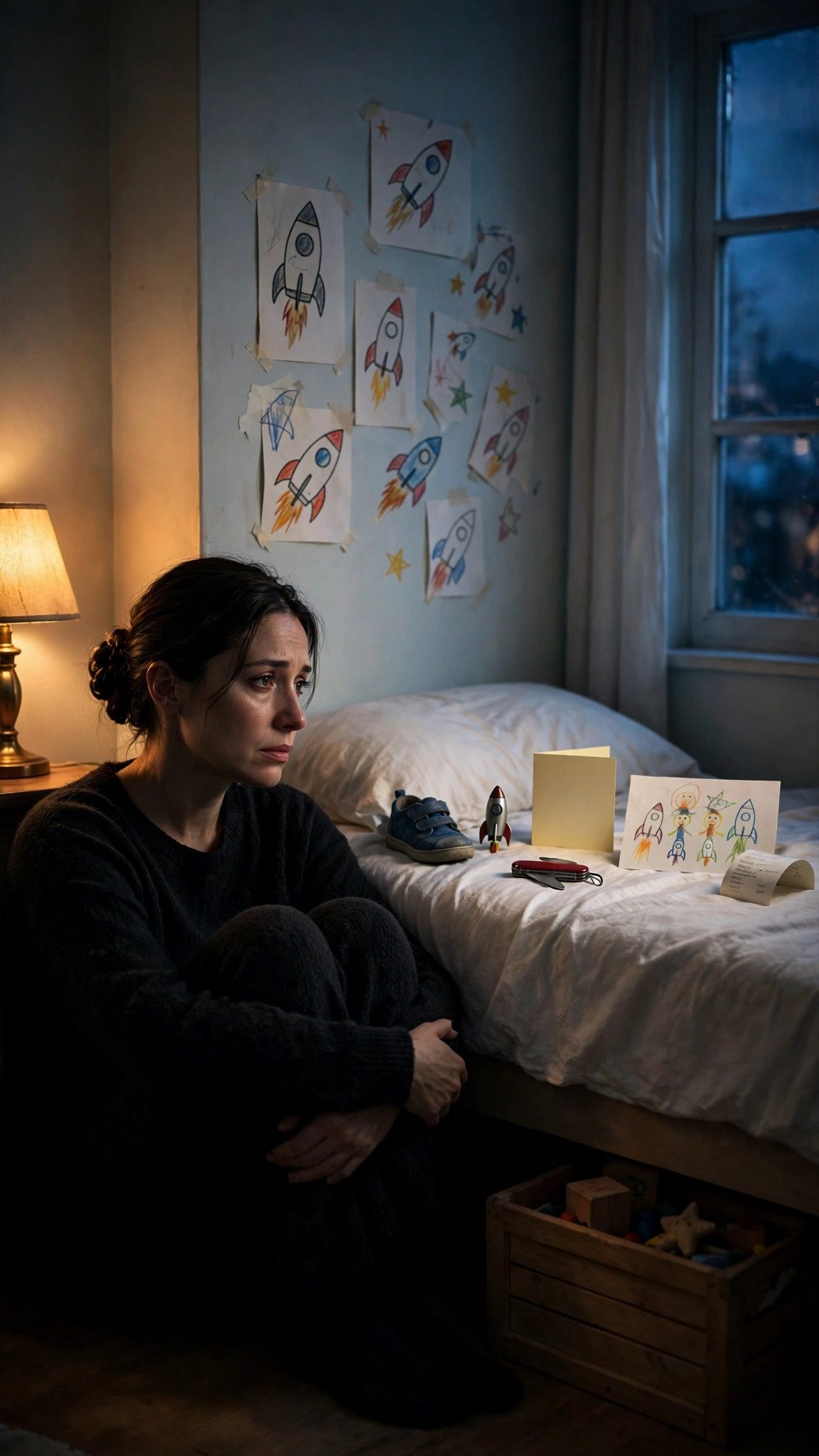
I did not leave in panic. I did not change the locks. I did not write him an angry note. I placed six items on the bed.
A child's shoe. A small magnet. A Swiss army knife. A birthday card. A crude drawing of the four of us as rocket ships. And a receipt from a Zurich restaurant dated the day Noah died, showing Marcus and Rebecca's dinner for two: 3,680 Swiss francs.
For years, I had carried the weight of a possibility. From that night onwards, I carried a different weight: the need to protect my son's dignity, so that his life would not have been spent in vain.
I took his hand one last time and whispered: "Mommy's here." "Mommy's here." "Thank you for being brave."
After Noah died, I didn't cry. And for a long time after that, I didn't sleep. My only solace was to leave flowers on his grave on Sundays, white lilies, because he had once said they looked like stars that had fallen down to live in the grass.
When Marcus finally appeared at home at 10 a.m., fourteen hours after Noah's death, I sat in the corner of Noah's bedroom on the floor. I didn't move. I didn't speak.
He was wearing a wrinkled suit and he smelled of jet fuel. He assured me that he had flown back from Chicago, that he had come as fast as he could, that he was sorry. But when he saw what was on the bed, he stopped.
The six items.
He exploded. "Where is Noah?!" His voice boomed through the entire house. I hadn't seen Marcus in a state like that in a long time. His cold, pallid expression shifted into something I had only seen briefly, the expression of a man from one of the bloodiest crime families in Illinois, a man who had built an empire on the promise that no one touched what was his.
He grabbed the receipt in his hand and crumpled it into a ball, letting out a low scream. He saw the accident had happened before he got home. He couldn't find his child, yet he looked for conflict instead of comfort. All he wanted was to join the war.
Marcus Vale was a criminal, a criminal empire protected by armed men. A husband who was obsessed with one thing: maintaining his authority as an authority over everything and everyone he protected. But he had no authority to stop the people he loved from leaving him. And the wealthiest person was still a man, and he was the accomplice in our stealing of the clock.
I paced toward the door and walked through it.
"What about Noah?" he repeated.
I twisted a small smile and whispered. "I can forgive a husband who no longer loves me. I don't know how to live with a father who would never come home. And I will always remember Noah, who thought his hero would never come, but he never did."
Then I walked out of the house, and I did not look back, because if I had looked back, I would have stayed, and staying would have meant forgiving something that had not yet earned forgiveness.
The nurse who had been with us all day, a young woman named Sofia with dark hair and kind eyes, came and stood beside me. She did not say anything at first. She only put her hand on my shoulder, and we stood there together, looking at Noah, and after a while she said, very quietly, "He was a brave boy. I have seen a lot of brave children in this ward, Mrs. Vale, but your son was one of the bravest. He never cried when we changed his lines. He asked us questions about the machines. He wanted to know how everything worked."
"He wanted to know how everything worked," I repeated, and my voice sounded far away, like it belonged to someone else. "That was Noah. He wanted to know how the stars worked, and how the rockets worked, and how the ventilator worked. He was eight years old, and he thought that if he understood how something worked, it could not hurt him."
Sofia nodded. "The doctor will come and talk to you about what happens next. The paperwork. The arrangements. You do not have to decide anything tonight. Take your time. There is no hurry. He is at peace now."
I nodded, but I did not move. I could not move. My legs would not work. My hands were still holding Noah's hand, and I could not make them let go, because letting go felt like the last thing, the final thing, and once I let go, there would be nothing left to hold onto.
Frank came into the room then. He had been standing in the doorway for hours, his cap in his hands, his head bowed, and now he came and stood on the other side of the bed, and he looked down at Noah, and his big shoulders shook, once, twice, and then he was still again.
"Mrs. Vale," he said, very gently. "The car is outside. Whenever you are ready. There is no hurry. I will wait all night, if you need me to."
"Thank you, Frank," I whispered. "Thank you for staying."
"I will always stay, Mrs. Vale," he said. "That is my job. That is what I do. I stay."
I do not know how long I sat there. It could have been an hour. It could have been three. Time had stopped meaning anything. The clock on the wall said 11:47, and then it said 12:15, and then it said 1:03, and each time I looked at it, I was surprised, because I had not felt the minutes passing. I had only felt the stillness, and the weight of Noah's hand in mine, growing cooler, and the sound of my own breathing, in and out, in and out, the only breathing left in the room.
Finally, Sofia came back with a blanket, and she put it around my shoulders, and she said, "Mrs. Vale. You need to go home. You need to rest. You have been through something no mother should ever have to go through, and you need to take care of yourself now. Noah would want that. He would want his mommy to be all right."
I looked at her, and I wanted to tell her that I would never be all right again, that the word "all right" had stopped meaning anything the moment I signed those papers, but I did not say it. I only nodded, and I stood up, slowly, like an old woman, and I kissed Noah's forehead one last time, and I whispered, "Goodnight, my rocket boy. Mommy loves you. Mommy will always love you. Fly to the stars now. Draw your rocket on the ceiling. I will look up at it every night, and I will think of you."
Then I walked out of the room, and Frank walked beside me, and we went down in the elevator, and out through the lobby, and into the cold night air, and I stood on the sidewalk for a moment, looking up at the hospital, at the window of Noah's room, at the light still burning there, and I thought about how strange it was that the world was still going on, that cars were still driving past, that people were still walking their dogs, that the city was still alive, when my son was dead.
Frank opened the car door for me. I got in. He drove me home in silence, through the empty streets, past the lake, past the houses with their lights off, past the world that did not know what had happened, and did not care, because the world never stops for one mother's grief.
When we got to the house, Frank walked me to the door. He did not come inside. He only said, "Mrs. Vale. If you need anything, anything at all, you call me. Day or night. I mean it."
"I know, Frank," I said. "Thank you."
I went inside, and the house was dark, and quiet, and so empty that the silence felt like a physical thing, pressing against my ears. I walked through the living room, past the photographs on the wall, past Noah's shoes by the door, past the drawing of the rocket taped to the refrigerator, and I went upstairs, to Noah's room, and I sat down on the floor in the corner, with my back against the wall and my knees pulled up to my chest, and I stayed there all night, listening to the silence, and thinking about the six items I was going to place on the bed in the morning, and about the man in Zurich, and about the promise that had been broken, and about the boy who had once believed, with his whole heart, that his father was his hero just because he always came back.
That was the night my marriage ended. But it was not the night my story ended. It was the night it began.