I met Marcus Vale on a rainy night in October, at a charity gala for the children's hospital where I worked as a nurse. I was twenty-four years old, and I had spent the whole evening refilling water glasses and smiling at donors who could not remember my name. I was not supposed to be in the ballroom. I was supposed to be in the back, where the staff ate standing up.
He found me on the terrace, hiding from the noise with a glass of champagne I had not asked for and did not want. He was wearing a black suit that fit him like it had been sewn onto him, and he had the kind of stillness that made the whole terrace feel quieter just because he was standing in it.
"You look like you would rather be anywhere else," he said.
"So do you," I said, because I was twenty-four and tired and I had not yet learned to be afraid of men like Marcus Vale.
He laughed. It was a short laugh, surprised, like he had not laughed in a long time and had forgotten how it felt. "My name is Marcus," he said. "I own half the shipping on the lake and none of the patience for galas."
"I'm Claire," I said. "I own one pair of good shoes and none of the patience for donors."
We talked for an hour. He asked me about the hospital, about the children, about why I had become a nurse. I told him about my mother, who had died when I was sixteen, and about the night nurse who had held my hand in the hallway while the doctors worked on her, and how I had decided that night that I wanted to be the person standing in the hallway holding someone else's hand.
He listened the way almost no one had ever listened to me. He did not look at his phone. He did not look over my shoulder. He looked at me, and when I finished, he said, "My mother died when I was twelve. My father told me that grief was a luxury men like us could not afford. He was wrong. He was wrong about almost everything, but he was most wrong about that."
I did not know then who he was. I knew his name from the newspapers, of course. Everyone in Chicago knew the name Vale. But the man on the terrace did not look like a headline. He looked like a man who had been lonely for a very long time and had just remembered what it felt like not to be.
He asked if he could drive me home. I said yes, because I was twenty-four and tired and brave in the way only young people are brave. Frank DeLuca was already waiting at the curb, a big man with kind eyes and a driver's cap, and he opened the door for me like I was someone important.
On the way home, Marcus told me about his family. Not the business. Never the business, not then. He told me about his sister, who had died young. He told me about the house on the lake where he had grown up. He told me that he had never brought a woman home to his mother, because his mother had standards, and he had never met a woman who could survive them.
"Would I survive them?" I asked, and immediately wished I had not.
He looked at me for a long moment. "I think you would surprise her," he said.
We were married eleven months later, in a small church with white lilies and forty guests. His mother, Elena Vale, cried through the whole ceremony and then told me afterward, with her hand on my cheek, that I was the first good thing her son had ever chosen for himself.
Noah was born two years later, on a hot July night, in the maternity ward of the hospital where I worked. My best friend, Grace, held my hand while I held him for the first time, and I remember thinking that he was so small, and so perfect, and so impossibly alive, that the whole world had narrowed down to the weight of him in my arms.
Marcus came into the room an hour later, still in his suit, still smelling of the office, and when the nurse put Noah in his arms, he went very still. He looked down at his son for a long time, and then he looked up at me, and his eyes were wet.
"I promise you," he said, very quietly, so only I could hear it. "I promise you, Claire. No harm will ever come to this boy while I am alive to stop it. That is my oath. On my mother's grave, on my own life, I swear it."
I believed him. Of course I believed him. He was Marcus Vale, and when Marcus Vale made a promise, the whole city knew it was a promise that would be kept, because Marcus Vale did not break his word. That was the one thing everyone said about him, even his enemies: his word was iron.
For seven years, he kept it in the only way he knew how. He came back. Every time he left, he came back, and every time he came back, he brought something for Noah.
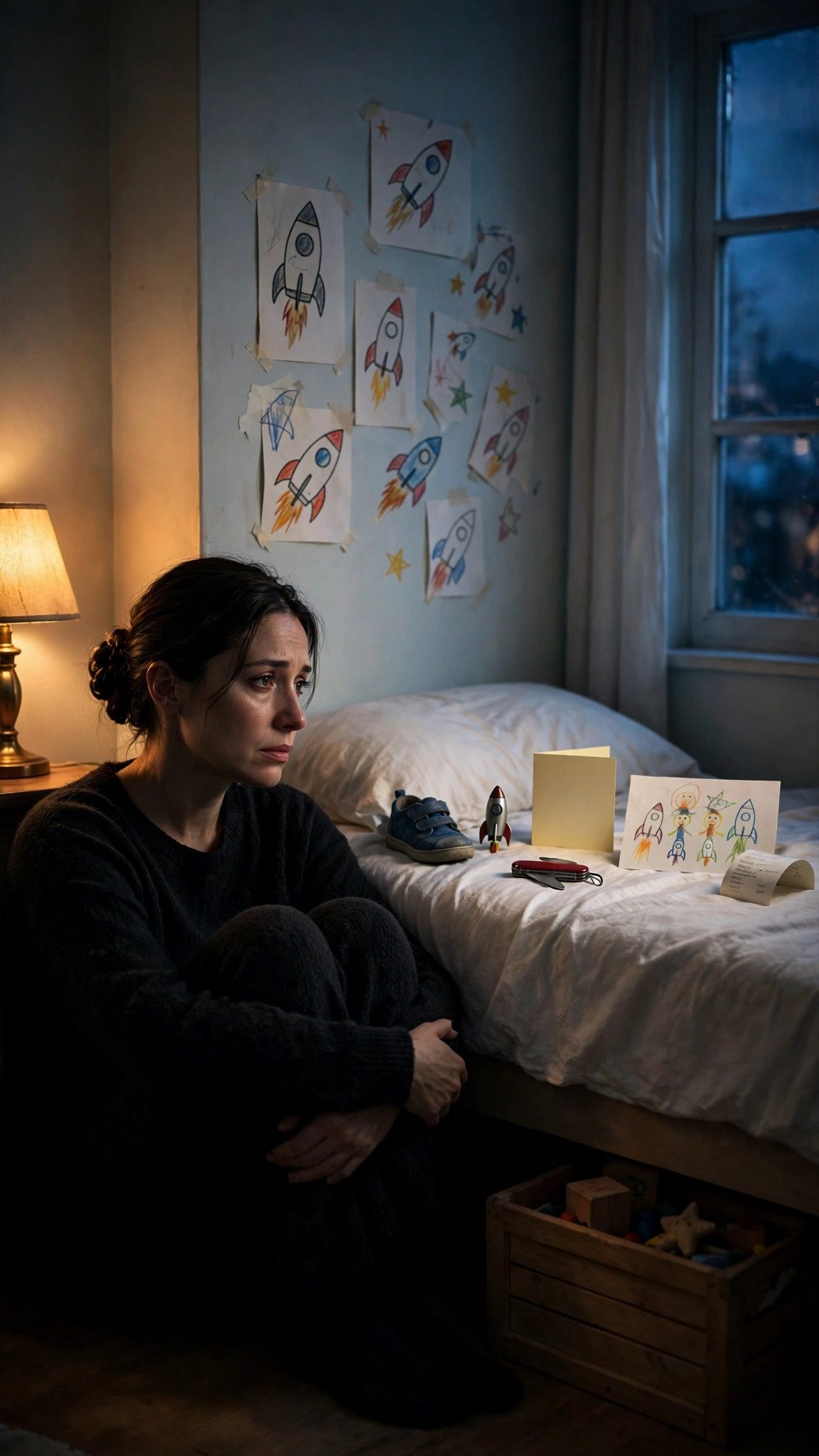
A wooden sword from a market in Florence, because Noah had decided that week that he wanted to be a knight. A magnet shaped like a rocket, because Noah had drawn rockets all over his schoolbooks. A small Swiss army knife from his pocket, because Noah had asked him, very seriously, what a man carried in his pockets, and Marcus had decided that his son should know.
Noah kept them all in a wooden box under his bed, and he could tell you the story of every single one. "Daddy brought this from Italy," he would say, holding up the sword. "Daddy brought this from the lake," he would say, holding up the magnet. "Daddy says a man always carries a knife, because a man is always ready." He said it with such pride, such complete faith, that I never had the heart to tell him that his father was not a traveling salesman, that the trips were not business trips, that the men who called our house at midnight were not clients.
I told myself it did not matter. I told myself that the money was clean enough, that the house was safe, that Noah would never need to know what his father did in the rooms with the doors closed. I told myself that love was enough, and that Marcus's love for his son was real, and that real love would be enough to keep us all safe.
Elena Vale became the mother I had lost when I was sixteen. She came to the house every Sunday for dinner, and she taught me how to make her sauce, the one that took six hours and a whole afternoon of stirring, and she told me stories about Marcus as a little boy, about how he had once brought home a wounded bird and kept it in a shoebox under his bed until it could fly again, and about how his father had been furious, and how Marcus had not cared, because the bird needed him.
"He has always been like that," she told me once, while we were washing dishes together. "He finds something broken, and he has to fix it. A bird. A business. A woman on a terrace at a gala who looks like she would rather be anywhere else. He cannot help himself. It is who he is."
"Is it a good thing?" I asked.
"It is a good thing and a dangerous thing," she said. "A man who fixes broken things is a good man. But a man who thinks he can fix everything is a man who will break himself trying. Watch him, Claire. Love him. But do not let him carry the whole world on his back. Make him put some of it down."
I tried. In the early years, I tried. We had Sunday dinners, and quiet evenings, and mornings when Marcus would make coffee and bring it to me in bed, and for a while, it felt like an ordinary life, like the life I had always wanted. Noah's first birthday was in our backyard, with a cake shaped like a rocket, and Marcus had hired a man to dress up as an astronaut, and Noah had been so excited that he had not stopped talking about it for a week.
But even then, there were signs. The phone calls at midnight. The men in suits who came to the house and went into Marcus's study with the door closed. The way Marcus would sometimes come home with blood on his cuff, and tell me he had cut himself shaving, and I would pretend to believe him, because believing him was easier than asking.
I told myself it was the price of the life we had. The big house. The safe streets. The money that meant Noah would never want for anything. I told myself that every family had its secrets, and that ours were no worse than anyone else's.
I was wrong. But I did not know it yet. I would not know it until the night I sat on the floor of Noah's bedroom, in the corner, with my back against the wall, and understood that the price had been too high, and that I had been paying it for years without ever seeing the bill.
Rebecca came into our lives when Noah was five. I had gone back to work part-time at the hospital, three days a week, and we needed someone at the house in the afternoons. She was twenty-six, warm, funny, good with children in the way that cannot be taught. Noah adored her within a week. She taught him card tricks. She made his lunches in the shape of animals. She read to him at night when I was on a late shift, doing the voices, all of them, even the dragon.
I liked her. I trusted her. I invited her to Sunday dinners. I told her things I did not tell anyone else, about how lonely the big house could feel, about how Marcus was gone so much, about how sometimes I lay awake at night and listened for his key in the door, and how the sound of it was the only thing that let me sleep.
I did not see it happening. That is the part I have to live with. I did not see the way Marcus started coming home later, or the way he started taking calls in his study with the door closed, or the way Rebecca started wearing the perfume I had bought for myself, or the way the two of them started finishing each other's sentences at the dinner table.
Or maybe I did see it, and I chose not to see it, because seeing it would have meant doing something about it, and doing something about it would have meant admitting that the promise was already broken, and I was not ready to admit that yet.
Noah saw it before I did. Children always see it first. One night, when he was seven, he asked me, very quietly, while I was tucking him in, "Mommy, why does Daddy smile at Rebecca the way he smiles at you?"
I did not have an answer. I kissed his forehead and told him that Daddy smiled at lots of people, and that it did not mean anything, and he nodded, but I could see in his eyes that he did not believe me. He was seven years old, and he already knew the difference between a smile that meant something and a smile that meant nothing, and he knew that his father's smile for Rebecca meant something.
That night, after Noah was asleep, I stood in the doorway of his room for a long time, watching him breathe, watching the rocket drawings on his wall, watching the wooden box under his bed where he kept the sword and the magnet and the little knife. And I thought about the promise Marcus had made in the maternity ward, with Noah in his arms, and I thought about how a promise is only as strong as the man who makes it, and how the man who made that promise was starting to come home later and later, and how one day he might not come home at all.
I remember the night Noah was born as if it were yesterday, and as if it were a hundred years ago, both at once. The maternity ward was quiet, except for the soft beeping of the monitors, and Grace was holding my hand, and the nurse was saying, "Push, Claire, push," and then suddenly there he was, small and red and furious at the world, and the nurse put him on my chest, and he stopped crying, just like that, as if he had been waiting his whole short life to hear my heartbeat.
Marcus came in an hour later, and the nurse put Noah in his arms, and I watched my husband, the most feared man in Chicago, go completely still, and completely soft, all at once. He held his son like he was holding the whole world, and he whispered, "Hello, Noah. I am your father. I will always come back for you. Always."
That was the promise. That was the beginning of everything. And I believed it, with my whole heart, because in that moment, in that quiet room, with my best friend holding my hand and my son in his father's arms, it felt like the truest thing in the world.
I went to bed that night and lay awake until three in the morning, listening for his key in the door. It came at half past three. I heard his shoes in the hallway. I heard him pause outside Noah's room. I heard him go into his study and close the door. I did not get up. I did not say anything. I lay there in the dark, and I told myself that tomorrow I would ask him. Tomorrow I would say it out loud. Tomorrow I would make him choose.
Tomorrow never came. Not the way I meant it. Because three weeks later, Noah got sick, and everything else stopped mattering, and the question of who Marcus smiled at became the smallest thing in the world, and then it became the biggest thing in the world, because when my son needed his father most, his father was in Zurich, having a candlelight dinner to mark another year of his marriage.
Not with me. With Rebecca.