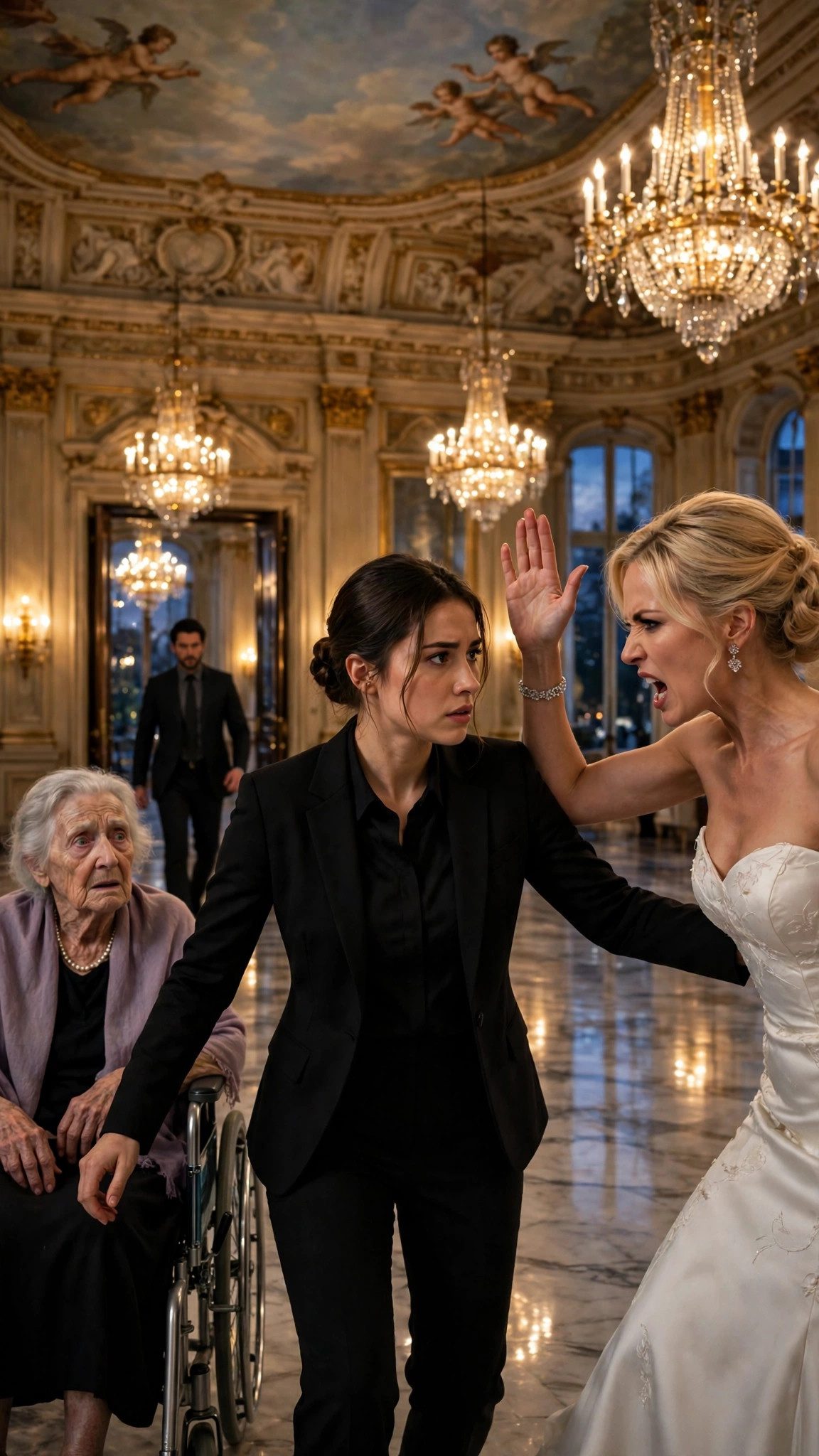
The morning of the engagement party began with screaming.
I was in the kitchen at six o'clock, checking the delivery of white roses, when I heard it from upstairs, a high, sharp sound that cut through the whole house like a knife. I ran up the back stairs two at a time, my apron still on, my hands still smelling of roses, and I found Vivian Calder standing in the middle of her suite in a silk robe, her blonde hair wild around her face, her jewelry box open and empty on the dressing table.
"My ring!" she screamed. "My diamond ring is gone! Someone stole my ring!"
The suite filled up fast. Rosa Delgado came in with her cleaning cart. Paulie Romano, Julian's head of security, came in with two of his men. The wedding planner came in with her clipboard. And then Julian came in, tall and dark and quiet, and the room went silent, because everyone in that room knew that Julian Cross did not raise his voice, and that when he was quiet, that was when you should be afraid.
"Explain," he said to Vivian.
"My engagement ring," she said, and her voice shook, and tears ran down her face, and for a moment, for one terrible moment, I almost believed her. "The diamond. Four carats. It was in my jewelry box last night, and now it is gone. Someone came into my room while I was sleeping and stole it."
Julian looked at Paulie. "Search the hotel," he said. "Every room. Every locker. Every bag. No one leaves until we find it."
Paulie nodded, and his men went out, and the search began. They searched the housekeepers' lockers first. They searched the cooks' bags. They searched the gardeners' shed. They searched my little office, pulling open drawers, looking under papers, while I stood in the doorway with my hands folded in front of me, the way I had been taught to stand when important guests arrived.
And then they came to my locker.
It was in the staff corridor on the ground floor, a narrow metal locker with my name written on a piece of tape on the door. Emma Hart. Inside there was my spare uniform, my raincoat, a pair of flat shoes, and a small wooden box where I kept my mother's birthday present, a silver bracelet my father had bought for her twenty years ago, wrapped in tissue paper.
Paulie opened the locker, and he reached into the wooden box, and he pulled out something that glittered in the fluorescent light, and he held it up, and the whole corridor went silent.
It was Vivian's diamond ring.
"There," Vivian said, and her voice was suddenly calm, suddenly sweet, suddenly sure. "There it is. In her box. So that is how you got your diamond ring, Emma. You stole it from me. You are in another box now. There was already a diamond there. In your locker. Everyone saw it. Ask anyone. Ask the security men. They found it in your box."
I stared at the ring in Paulie's hand, and I could not speak. I had never touched that ring. I had never even been inside Vivian's suite, not once, not in the three weeks she had lived at the hotel. I had never opened that wooden box except to put my mother's bracelet in it, months ago. And now the diamond was there, sitting on top of the tissue paper, shining like a lie.
"I did not take it," I said. My voice sounded strange to my own ears, thin and far away. "I have never touched that ring. I have never been in her room."
"Then how did it get into your locker?" Paulie asked. He was not unkind. He was a good man, Paulie, loyal and careful, but he was looking at the ring in his hand, and he was looking at me, and I could see the doubt in his face, because the evidence was in his hand, and evidence does not lie, even when people do.
"I do not know," I said. "I do not know how it got there. But I did not put it there."
Julian came down the corridor then, and he stood in front of my locker, and he looked at the ring, and he looked at me, and his gray eyes did not give anything away. He took the ring from Paulie, and he turned it over in his fingers, and he looked at Vivian, who was standing behind him with her arms crossed, and he said nothing for a long time.
"Lock her in the office," he said at last, to Paulie. "Until we sort this out. No one talks to her. No one leaves the hotel."
Paulie took my arm, gently, the way a man takes a woman's arm when he does not want to hurt her but has his orders, and he led me to my little office off the kitchen, and he closed the door, and I heard the lock click, and I sat down at my desk, and I put my head in my hands, and I cried for the first time in years.
I cried because my mother was going to hear about this, and my father was going to hear about this, and the whole staff was going to hear about this, and no one was going to believe me, because the ring had been found in my locker, in my box, and that was all anyone needed to know.
I cried because the party was that night, and the ballroom was full of white roses, and the champagne was on ice, and the string quartet was tuning their instruments, and none of it mattered anymore, because I was a thief now, in everyone's eyes, and thieves do not run hotels.
And I cried because Julian Cross had looked at me the way he had looked at the house that first day, like he was trying to decide whether something was worth saving, and I did not know what he had decided.
I sat in my office for three hours. Three hours is a long time to sit alone with your thoughts. I thought about my mother, climbing the stairs with her bucket. I thought about my father, pruning roses nobody paid him to prune. I thought about the night I was six years old, sitting on a flour sack in the kitchen, watching the cooks move like dancers, thinking this was the most beautiful place in the world. I thought about the promise I had made to my mother that morning in March, that the house was not going anywhere, that I would not let it.
And then, in the middle of the afternoon, the door opened, and Rosa Delgado came in with a tray of tea, and she closed the door behind her, and she sat down across from me, and she said, "Eat something, child. You will need your strength tonight."
"Rosa," I said, "did you hear what happened?"
"I heard," she said. "The whole hotel heard. And I do not believe a word of it."
"You do not believe it?" I whispered. "But the ring was in my locker. They found it in my box."
"Emma," Rosa said, and she leaned across the desk, and her old eyes were sharp and clear, "I have cleaned this hotel for fifty years. I know every locker and every drawer and every hiding place in this building. And I know that a girl who has not taken a day off in three years does not steal a diamond ring and hide it in a box with her mother's bracelet. Someone put it there. Someone who wanted you gone."
"Who?" I asked. "Who would do that?"
Rosa looked at the door, and she lowered her voice, and she said, "The same person who sent your mother's cleaning cart back to storage. The same person who told the cooks their food was too heavy. The same person who wants the painted ceiling covered with white fabric. The same person who is going to stand in our ballroom tonight and smile for the cameras."
"Vivian," I said.
"Vivian," Rosa agreed. "But you cannot prove it. And she knows it. And Julian knows it too, I think. He is not a stupid man, Emma. He is watching. He is waiting. He is doing what he always does. He is being quiet, and he is letting the truth come to him."
"But the party is tonight," I said. "What am I supposed to do tonight?"
"You are supposed to do your job," Rosa said. "You are supposed to stand in the doorway of the ballroom and make sure everything is perfect, the way you always do. And you are supposed to keep your head up. Because the only way a lie wins is if the truth hides."
She left then, and I sat alone again, and I wiped my face, and I fixed my hair, and I put on my black manager's suit, and I went back to work, because Rosa was right. The party was that night, and the ballroom was full of white roses, and the champagne was on ice, and someone had to make sure everything was perfect.
That evening, before the guests arrived, I went to the library to read to Eleanor, the way I did every evening. She was sitting by the window in her wheelchair, looking out at the river, and her silver hair was loose around her shoulders, and she looked smaller than usual, and older, and more fragile.
"Emma," she said, when I sat down beside her. "You are crying."
"I am fine, Grandmother," I said, and I tried to smile, but my voice broke. "I am fine."
"You are not fine," she said. "Someone hurt you. I can see it in your face."
I did not tell her about the ring. I did not want to worry her. But Eleanor Cross was eighty-one years old, and she had lived through more trouble than I could imagine, and she looked at me with her sharp blue eyes, and she said, "Tell me, Emma. Tell me everything."
So I told her. I told her about the ring, and the locker, and the search, and the way Julian had looked at me. And Eleanor listened, and her hands gripped the armrests of her wheelchair, and her face went pale, and then red, and then pale again.
"I saw her," she whispered. "This morning. I saw her in the corridor. I was in my wheelchair, and she did not see me, because she never sees me, because to her I am just an old woman in a chair. She was carrying something in her hand. Something shiny. And she went into the staff corridor. And she came out with empty hands."
My heart stopped. "Grandmother," I said slowly, "are you telling me you saw Vivian put the ring in my locker?"
Eleanor nodded, and her eyes filled with tears, and she said, "I saw her, Emma. I saw her. But my mind…" She touched her forehead with one thin hand. "My mind goes foggy sometimes. I forget things. I forget names. I forget what day it is. And when I tried to tell Paulie this afternoon, I could not remember the words. I could not remember which corridor. I could not remember what time. And he patted my hand and told me not to worry, and he walked away."
"Grandmother," I said, and I took her hands in mine, and they were cold, so cold. "You have to tell Julian. You have to tell him what you saw."
"I will try," she whispered. "Tonight, at the party, I will try. I will stand up, and I will tell everyone. I am not afraid of her, Emma. I am eighty-one years old. What can she do to me?"
I did not know then that Vivian Calder could do something terrible to an eighty-one-year-old woman. I did not know that she could raise her hand in a ballroom full of people and try to hit her. I did not know that I would step between them, and that I would end up on the marble floor, and that Julian Cross would walk in at that exact moment, and that everything would change.
But Eleanor knew. I think she knew. Because when I left the library that evening, she called after me, in a voice that was clear and strong and not foggy at all.
"Emma," she said. "Do not look away. Whatever happens tonight, do not look away."
And I promised her I would not. I promised her, and I went down to the ballroom, and I stood in the doorway, and I watched the guests arrive in their black limousines, one after another, and I watched Vivian Calder come down the stairs in a white dress with her diamond ring back on her finger, shining like a lie, and I watched Julian Cross walk in behind her, tall and dark and quiet, and I thought about what Rosa had said.
The only way a lie wins is if the truth hides.
I left the library and walked down the long hallway toward the ballroom, and my shoes made no sound on the carpet, and the house was quiet around me in the way it only gets quiet right before a party, when all the work is done and the guests have not yet arrived and the whole building seems to be holding its breath. I stopped at the top of the stairs and looked down at the lobby, at the marble floor shining like ice, at the white roses on every table, at the candles waiting to be lit, and I thought about all the weddings and all the parties this house had seen in a hundred and forty years. I thought about the presidents who had slept here and the movie stars who had married here, and I thought about my mother, who had cleaned these floors since she was nineteen, and my father, who had planted every rose in the garden with his own strong hands. I thought about the promise I had made that morning in March, that the house was not going anywhere, that I would not let it. And I straightened my shoulders, and I smoothed my black suit, and I walked down the stairs to stand in the doorway of the ballroom, the way I always did, because whatever Vivian Calder had planned for that night, she was going to have to do it in front of me, in my house, under my painted ceiling, and I was not going to hide.
That night, the truth did not hide. That night, the truth stood up in a wheelchair, in front of three hundred people, and it spoke. And the lie raised its hand to hit it. And I stepped between them. And the rest, as they say, is history.