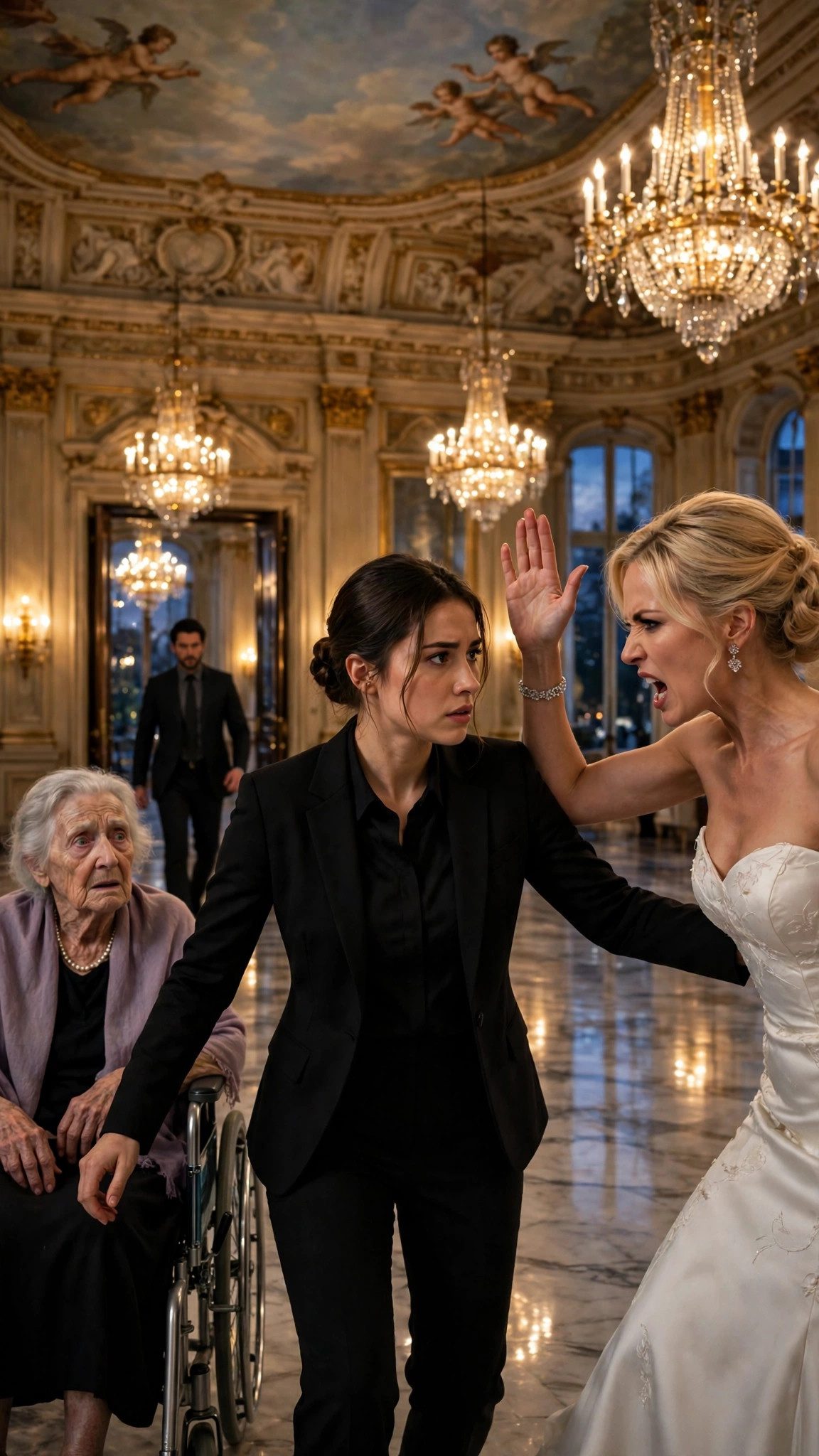
The morning after the engagement party, The Whitmore House was quiet in a way I had never heard it quiet before.
The ballroom was empty, the white roses wilting on the tables, the champagne glasses still standing where the guests had left them, half full and flat. The string quartet had gone home. The black limousines had gone home. The three hundred richest people in New York had gone home, and they had taken the story of the slap with them, and by morning it would be all over the city, and there was nothing I could do about it.
I stood in the doorway of the ballroom with an ice pack on my cheek, and Rosa Delgado stood beside me, and neither of us said anything for a long time.
"Your cheek is going to bruise," Rosa said at last. "Put the ice back on it."
"It is fine," I said, but I put the ice back on it, because Rosa was right, and because my cheek was throbbing, and because I was too tired to argue.
"It is not fine," Rosa said. "A woman hit you in front of three hundred people, and now the whole city knows it, and you are standing here pretending it is fine. You are allowed to be angry, Emma."
"I am not angry," I said. "I am… I do not know what I am. I keep thinking about Eleanor. About what she said. About what she saw."
"Then go to her," Rosa said. "She is in the library. She has been asking for you since she woke up."
I went to the library, and Eleanor was sitting by the window in her wheelchair, looking out at the river, and her silver hair was loose around her shoulders, and she looked smaller than she had looked the night before, and older, and more fragile. But when she saw me, her eyes lit up, clear and sharp, and she held out her thin hand to me.
"Emma," she said. "Come here, child. Sit with me."
I sat beside her, and I took her hand, and it was cold, so cold, and she looked at me for a long moment, and she said, "Tell me what happened last night. Tell me everything, from the beginning. My mind goes foggy, and I need to hear it in order, so I can hold onto it."
So I told her. I told her about the party, and the ballroom, and the moment she had stood up in her wheelchair and pointed at Vivian and said, "I saw what you did." I told her about Vivian's hand in the air, and the way I had stepped between them, and the sound of the slap, and the marble floor, and Julian walking in.
Eleanor listened, and her face went pale, and then red, and then pale again, and when I finished, she nodded slowly, and she said, "Good. Good. I remember now. I remember all of it. I remember the corridor. I remember the shiny thing in her hand. I remember the way she looked when she came out with empty hands, like a cat that has eaten a bird."
"Grandmother," I said, "Julian needs to hear this. Not from me. From you. You are the only witness."
"I know," she said. "And I will tell him. But Emma, you must understand something. My grandson is torn. He is torn between his ring and his family. The ring is not just a ring. It is a promise he made to the Calder family, and the Calder family is powerful, and the promise was made for a reason. If he breaks it, there will be consequences. There will be men who come to this hotel, and they will not be kind."
"What reason?" I asked. "What promise?"
Eleanor looked at the door, and she lowered her voice, and she said, "The Calder family owes money to bad men. Very bad men. Marcus Calder borrowed from Vincent Castellano, and he cannot pay it back, and the only way out was to marry his daughter to my grandson. Vivian was supposed to marry Julian, and Julian's money was supposed to pay the debt, and Castellano was supposed to go away. That was the arrangement. That was the deal."
I stared at her. "And Julian knew?"
"Julian knew some of it," she said. "He knew the Calders were in trouble. He did not know how much trouble. He did not know about Castellano. He thought he was saving a family. He thought he was doing a good thing. That is the kind of man my grandson is, Emma. He tries to save people. Even people who do not deserve to be saved."
Before I could answer, the library door opened, and Julian Cross walked in, tall and dark and quiet, and he stopped in the doorway, and he looked at his grandmother, and he looked at me, and his gray eyes did not give anything away.
"Grandmother," he said. "I need to talk to you. Alone."
I stood up to leave, but Eleanor held my hand tighter, and she said, "No. Emma stays. She is part of this now. She was there. She took the slap that was meant for me. She stays."
Julian looked at me for a long moment, and then he nodded, and he sat down across from us, and he said, "Tell me what you saw, Grandmother. Tell me everything. Slowly. From the beginning."
And Eleanor told him. She told him about the corridor, and the shiny thing in Vivian's hand, and the way Vivian had gone into the staff corridor and come out with empty hands. She told him about the morning, and the time, and the dress Vivian had been wearing. She told him in pieces, the way old people tell stories, stopping and starting, forgetting a detail and then remembering it, but the core of it was clear, and it was true, and I could see Julian listening, really listening, the way he had listened to me that first day in the garden, when I told him why the house was still standing.
When she finished, Julian was quiet for a long time. He sat with his hands folded in front of him, and he looked out the window at the river, and I could see the war going on behind his eyes. His ring, and his family. His promise, and the truth. The woman he was supposed to marry, and the woman who had taken a slap for his grandmother.
"Paulie," he said at last, without turning around. "Come in."
Paulie Romano came in from the hallway, where he had been standing guard, and Julian said, "The hotel has cameras in the corridors. I had them installed when I bought the place. I want the footage from the staff corridor, yesterday morning, between eleven and noon. Bring it to me. Now."
Paulie nodded and went out, and the library went quiet again, and Eleanor closed her eyes, and I sat holding her hand, and Julian sat looking out the window, and none of us said anything, because there was nothing to say until Paulie came back.
He came back in twenty minutes, with a laptop under his arm, and he set it on the table, and he opened it, and he pressed play, and we all watched.
The footage was grainy and black and white, and the time stamp in the corner said 11:42 a.m., and the staff corridor was empty, and then Vivian Calder walked into the frame, in a white dress, with her blonde hair loose around her shoulders, and she was carrying something in her right hand, something small and shiny, and she stopped in front of my locker, and she looked up and down the corridor, and she opened the locker, and she put the shiny thing inside the wooden box, and she closed the locker, and she walked away, and she never looked back.
The room was silent. The laptop screen went dark. Paulie closed it gently, and he stood with his hands behind his back, and he waited.
Julian stood up. He walked to the window, and he stood there for a long time, looking out at the river, and his shoulders were straight, and his hands were at his sides, and I could see, from the way he was standing, that something inside him had just broken, and something else had just been decided.
"Thank you, Paulie," he said, without turning around. "Thank you, Grandmother. Thank you, Emma. I need to think. I need to be alone. Please, both of you, go and rest. I will handle this."
I wanted to stay. I wanted to tell him that I was sorry, that I had not meant for any of this to happen, that I had only been trying to protect his grandmother. But Rosa had taught me that when a man like Julian Cross says he needs to be alone, you leave him alone. So I wheeled Eleanor back to her room, and I helped her into bed, and I sat with her until she fell asleep, and then I went down to the kitchen, because there was work to do, and the hotel did not stop, even when the world was falling apart.
But the world was not done falling apart. Not yet.
That afternoon, Vivian Calder came to the kitchen. She came in her white dress, with her blonde hair perfect and her makeup perfect and her diamond ring back on her finger, shining like a lie, and she stood in the doorway, and she looked at my mother, who was wiping down a table with her bucket beside her, and she said, in a voice loud enough for the whole kitchen to hear, "You. The old woman with the bad knees. You are fired. Pack your things and get out of my hotel."
My mother froze, her rag in her hand, and the whole kitchen went silent, and I came around the counter so fast I knocked over a stack of plates, and I stood between Vivian and my mother, and I said, "No. You do not get to do that. She has worked here for twenty-three years. You do not get to fire her."
"She works for me now," Vivian said, and her blue eyes were cold, and her smile was the smile of a cat with a bird. "This hotel belongs to my fiance. And my fiance belongs to me. And you, Emma, you are cleaning the house from now on. You are not the manager anymore. You are a maid. A maid who steals diamonds. Do you understand?"
"I understand," I said, and my voice was shaking, but I did not move, and I did not look away. "I understand that you planted that ring in my locker. I understand that Eleanor saw you do it. I understand that Paulie has the footage. And I understand that you are afraid, Vivian, because you know what happens when Julian sees the truth."
Vivian's face went white, and then red, and her hand rose, and for a moment I thought she was going to hit me, right there in the kitchen, in front of my mother and the whole staff. But then the kitchen door opened, and Julian Cross walked in, and Vivian's hand came down slowly, and she turned to him with a smile, a bright, sweet, lying smile.
"Darling," she said. "I was just telling the staff about the changes we are making. The old housekeeper is too slow. We need someone younger."
Julian looked at her. He looked at my mother, standing with her rag in her hand, her knees shaking. He looked at me, standing between them, my cheek still bruised from the night before. And he said, in a voice so low and so quiet that the whole kitchen had to lean in to hear him, "Vivian. My office. Now."
She went. She had no choice. She went, and the kitchen door closed behind them, and the whole staff stood in silence, and my mother sat down at the table, and she put her head in her hands, and she cried, quietly, the way mothers cry when they are afraid for their children.
I sat beside her, and I held her hand, and I said, "It is going to be all right, Mama. I promise. It is going to be all right."
But I did not know if it was true. I did not know what Julian was going to decide. I did not know if his ring was stronger than his family, or if his family was stronger than his ring. I only knew that I had stood between Vivian and the two women I loved most in the world, first Eleanor and then my mother, and that I would do it again, a hundred times, no matter what it cost me.
That night, I could not sleep. I lay in my bed in the little room above the kitchen, listening to the house settle around me, listening to the river in the distance, listening to my own heart beating too fast. And at two in the morning, I got up, and I went down to the library, because I needed to think, and the library was the quietest place in the house.
And that was when I heard it. A voice, low and urgent, coming from Julian's office, through the half-open door. Vivian's voice.
"You cannot do this to me," she was saying. "My father owes Castellano four million dollars. If you break this engagement, Castellano will come for my family. He will come for all of us. He wants the docks, Julian. He has always wanted the docks. And if you do not marry me, he will take them another way."
I froze in the hallway, my hand on the library door, my heart pounding so hard I was sure they could hear it.
Four million dollars. Vincent Castellano. The docks.
That was the night I understood that this was not just about a ring, or a slap, or an engagement party. This was about the Hudson River itself. And the man who controlled the docks controlled everything.
And I was standing in the middle of it, a hotel manager with a bruised cheek and a mother with bad knees, between a billionaire's ring and his family, with nowhere to run.