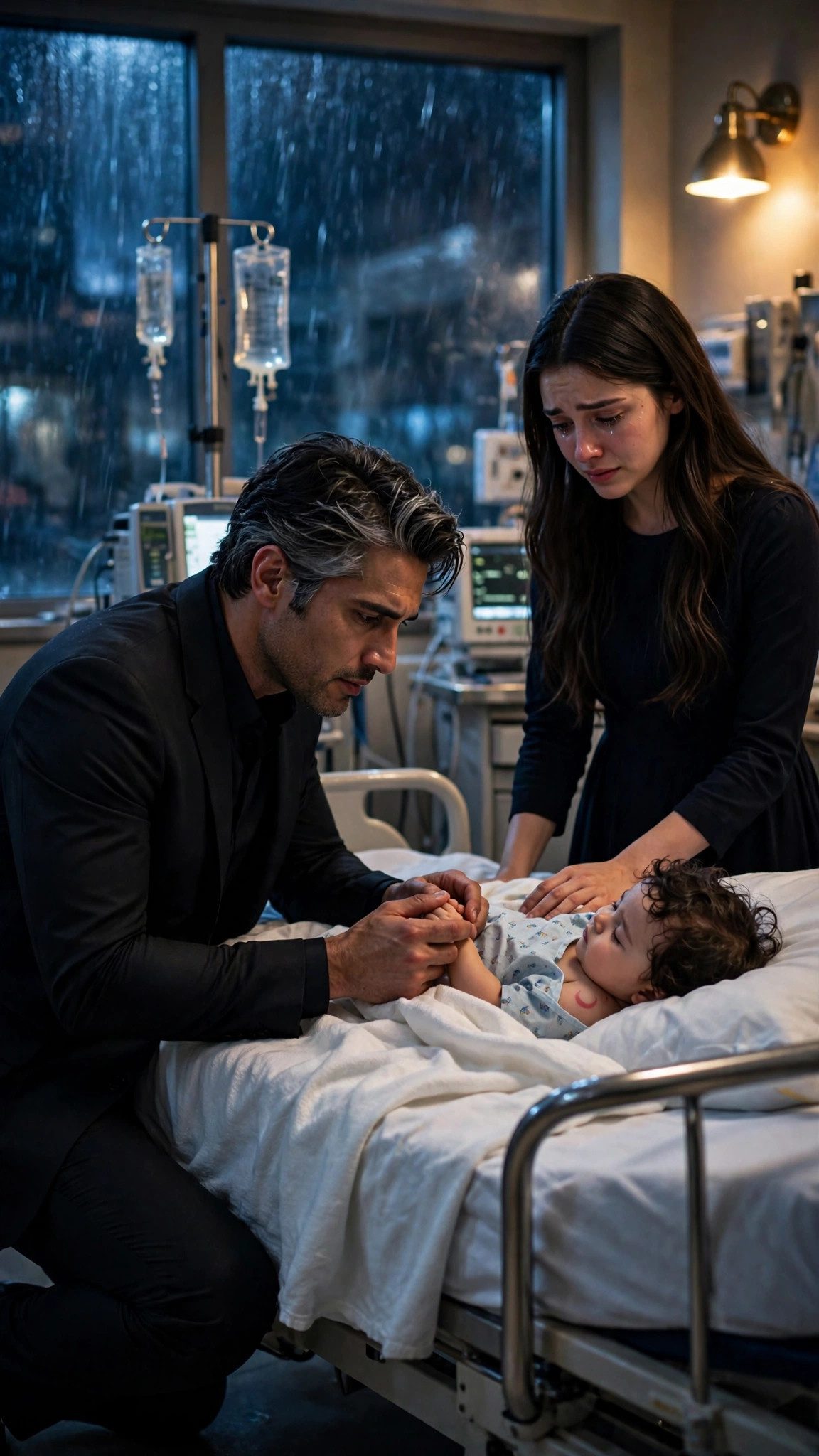
Castellano's last move came at dawn.
Agent Reyes called Dante at five in the morning, his voice tight and urgent. "Mr. Russo, Castellano is gone. He left his house an hour ago with two men and a bag full of cash. We think he's heading for the airfield outside Worcester — the same one Marcus told us about. He's going to run, and if he runs, we lose him. I need you at the courthouse in one hour. I need you to sign the statement. I need you to testify."
Dante was already dressed and out the door before I could ask what was happening. He kissed Noah's forehead, and he kissed my cheek, very quickly, like a man who was afraid he might not come back, and he said, "Stay here. Lock the doors. Don't open them for anyone but Reyes or me."
Then he was gone, and the house was quiet, and Rosa made breakfast, and Mrs. Darrow came over with more shortbread, and Noah played on the rug, and I sat by the window and watched the street, and I waited.
At noon, Reyes called. "We got him," he said. "Castellano tried to board a private plane at Worcester. The marshals were waiting. He's in custody. Marcus Hale is testifying right now, in front of a grand jury. Tommy Falco is testifying. Eddie Krol is testifying. Danny Cole is testifying. Mr. Russo is testifying. It's over, Miss Cole. It's really over."
I cried then. I sat by the window with the phone in my hand, and I cried, because fourteen months of fear were finally coming out of me all at once, and Rosa came and put her arms around me, and Mrs. Darrow patted my hand, and Noah crawled over and patted my knee, and for the first time since the night Noah was born, I felt safe.
Dante came home that evening, exhausted, with his tie loosened and his hair falling into his eyes, and he picked Noah up and held him high in the air, and Noah laughed, and Dante laughed, and Rosa cried, and Mrs. Darrow cried, and I cried, and the whole house was full of tears and laughter at the same time.
"It's done," Dante said. "Castellano is finished. The grand jury indicted him on forty-seven counts — racketeering, conspiracy, attempted kidnapping, murder. Marcus testified for six hours. Tommy testified for four. Krol and Cole testified for three. And I testified for two. When I finished, the prosecutor shook my hand and said, 'Mr. Russo, you just did more for this city than any man I've ever met.'"
"What happens now?" I asked.
"Now the trials begin," Dante said. "Marcus gets eight years, for testifying. Tommy gets eight years. Krol gets twenty-five years on a plea. Cole gets fifteen. And Castellano — Castellano gets life without parole. He will die in prison, Mariah. He will never come near us again."
He set Noah down, and he took my hands, and he looked at me the way he had looked at me in the hospital waiting room, like a man who had just found something he thought he had lost forever.
"And there's something else," he said. "Something I need to tell you. Today, in the courthouse, after I testified, Agent Reyes took me aside, and he said, 'Mr. Russo, you have a choice to make. You can keep running the family the way your father did, and the way Castellano did, and sooner or later, someone else will come for your son. Or you can do what you've been talking about for years. You can go legitimate. All the way. No more routes. No more docks. No more gambling. Just a real business, with real books.' And I told him, 'Agent Reyes, I made that choice the night my son got sick in a hospital waiting room. I'm going legitimate. I'm shutting it all down. And I'm going to do it with the law on my side, not against me.'"
He paused, and he took a deep breath, and I could see how much this cost him, how much he was giving up, and how much he was gaining.
"Reyes is going to help me," Dante said. "He's going to help me unwind the businesses, legally, cleanly, so that no one can ever use them against us again. It's going to take a year. Maybe two. But at the end of it, the Russo family will be a shipping company and a property company, and nothing else. And my son will grow up in a house where the only thing his father does is work hard and come home for dinner."
"That's a good choice," I said quietly.
"It's the only choice," Dante said. "Because I have a son now. And a son changes everything."
That night, after Noah was asleep, Dante and I sat in the study, and he showed me the papers. The plan to legitimize the businesses. The sale of the gambling interests. The transfer of the docks to a real shipping company. The foundation he wanted to start, in his father's name, to fund schools and libraries in the North End. And at the bottom of the last page, in his own handwriting, he had written a name.
"The Mariah Cole Foundation," I read aloud. "For children who need a safe place to learn."
"I want you to run it," Dante said. "Not as my employee. As my partner. You were a teacher, Mariah. You know what children need. You know what it means to keep a child safe. I want you to build something that outlasts all of us. Something good. Something that has nothing to do with guns or money or fear."
I looked at him, and I looked at the papers, and I thought about my mother's bookstore, and about the children I had taught, and about Noah sleeping upstairs, and I said, "Yes. I'll do it. But on one condition."
"Anything," Dante said.
"You let me reopen Cole's Books," I said. "Not as a foundation office. As a bookstore. A real one, with a bell over the door and shelves all the way to the ceiling, where children can come and do their homework behind the counter, the way I did. My mother would have wanted that."
Dante smiled. "Done," he said. "The coffee shop that's there now — I own the building, Mariah. I bought it six months ago, when I found out where you used to live. I was going to turn it back into a bookstore, but I didn't know if you'd ever come home. Now you're home. So we'll do it together."
I stared at him. "You bought my mother's bookstore?"
"I bought the building," Dante said. "I couldn't buy the memories. Those are yours. But the building is yours now, too, if you want it."
I cried again. I seemed to be doing a lot of that lately. But these were good tears, the kind that come when something broken finally starts to heal.
"Thank you," I whispered.
"Don't thank me," Dante said. "Thank Mrs. Darrow. She's the one who told me where the bookstore was. She's the one who told me to buy the building. She's the one who told me that one day, you'd come home."
The next morning, Agent Reyes came to the house with a stack of papers for me to sign. A statement, about Marcus Hale, about the envelope, about the fourteen months. My part of the case. I signed every page, and when I finished, Reyes looked at me and said, "Miss Cole, you are a very brave woman. Most people in your position would have run. You didn't. You stayed, and you kept your son safe, and because of you, Vincent Castellano is going to die in prison. That's not a small thing."
"It's not bravery," I said. "It's motherhood."
Reyes smiled. "Same thing, in my experience."
After he left, Dante took me and Noah to see the bookstore. The coffee shop was still there, with its bright lights and its chrome counters, but Dante had already spoken to the owners, and they were moving out at the end of the month, and the space would be mine. I stood in the middle of the empty room, holding Noah, and I could see it the way it used to be: the shelves, the bell over the door, my mother behind the counter, recommending novels to old ladies and arguing about poetry with the fishermen.
"It's going to be beautiful," I said.
"It already is," Dante said. "Because you're here."
That evening, we had dinner together, all of us — Dante, Rosa, Mrs. Darrow, Noah, and me — and Rosa made her famous sauce, and Mrs. Darrow told stories about Harold, and Noah threw spaghetti on the floor, and Dante laughed, and I thought about how far we had come. Fourteen months ago, I had been alone in a nine-hundred-dollar apartment, afraid of my own shadow. Tonight, I was sitting at a table full of family, eating dinner, planning a bookstore and a foundation, while the man who had tried to destroy us sat in a federal cell, waiting for a trial he could not win.
The law had done what the law was supposed to do. It had protected the innocent. It had punished the guilty. And it had given my son a future.
The trials began in January. Marcus Hale was the first to be sentenced: eight years in a federal prison, in exchange for his testimony. He stood in the courtroom in a gray suit, thinner than I remembered, and he looked at Dante, and he said, "I am sorry." Dante did not answer him. He did not need to. Some apologies come too late to matter.
Tommy Falco was next: eight years. He cried when the sentence was read, and his wife, a small woman with two little girls, sat in the back of the courtroom and held their hands, and I thought about how many lives Castellano had ruined, not just ours, and I felt something I had not expected to feel. Pity. Not for Tommy, who had sold us out for five thousand dollars a month. But for his wife and his daughters, who had done nothing wrong, and who would grow up visiting their father in prison.
Eddie Krol got twenty-five years on a plea. Danny Cole got fifteen. Both of them testified, and both of them told the jury everything: the payments, the routes, the plans, the night they came through our back door. When Krol was asked why he had done it, he said, "Because Castellano told me to, and no one says no to Castellano." And when the prosecutor asked him if he was sorry, he looked down at his hands and said, "I am sorry I got caught."
Castellano's trial lasted three weeks. I did not go. Dante did not want me there, and I did not want to be there. But Agent Reyes called us every evening with updates, and Rosa and Mrs. Darrow and I sat in the living room and listened, and Noah played on the rug, and the world kept turning.
On the last day, the jury came back after only four hours. Guilty on all forty-seven counts. Life without parole. When the sentence was read, Castellano stood up and looked around the courtroom, and his eyes found Dante, and he said, "You think you've won, Russo. But there will always be another Castellano. There will always be someone."
And Dante stood up, and he looked back at him, and he said, "Then there will always be someone like me, too. Someone who stands up. Someone who says no. Someone who chooses his family over his fear."
That was the end of it. That was the end of Vincent Castellano.
The week after the sentencing, Dante held a press conference. Not in a courthouse, and not in an office, but in the community center in the North End, in front of teachers and shopkeepers and fishermen and mothers with children on their laps. He stood at a podium, in a suit that was not quite as expensive as the ones he used to wear, and he told them the truth. All of it. About his father. About Castellano. About the routes and the docks and the gambling. And about what he was going to do next.
"The Russo family is going legitimate," he said. "All the way. No more shadows. No more secrets. We are going to be a shipping company, and a property company, and nothing else. And we are going to start a foundation, in my father's name, to fund schools and libraries in this neighborhood, because this neighborhood gave my family everything, and it is time we gave something back."
The room was quiet for a moment. Then someone started clapping. Then everyone was clapping. And Rosa was crying. And I was crying. And Noah, sitting on my lap, clapped too, because everyone else was clapping, and he thought it was a game.
After the press conference, a reporter came up to me and asked, "Miss Cole, what is your role in all of this?" And before I could answer, Dante put his arm around me and said, "She is the reason any of this is happening. She is the mother of my son. She is the bravest person I have ever met. And she is going to run the foundation."
The reporter wrote it all down. The next day, it was in the newspaper. "Mafia Boss Goes Legitimate, Credits Schoolteacher and Son." Mrs. Darrow cut the article out and framed it, and she hung it in her hallway, next to Harold's photograph, and she said, "Harold would have loved this. He always said Dante was a good boy, underneath it all."
The foundation's first event was a reading day at the Boston Public Library, in the same ballroom where Dante and I had first danced. We filled the room with children from schools all over the city, and I read them stories, and Dante handed out books, and Noah sat on the floor in the middle of it all, turning the pages of a picture book upside down and laughing. A photographer from the newspaper took a picture of us — Dante holding Noah, me reading to a circle of children — and that photograph ran on the front page the next morning, under the headline: "A New Chapter for the Russo Family." Rosa cut that one out, too, and she put it on the refrigerator, next to Noah's drawings, where it still hangs today.
But there was still one thing left to do. One thing that had nothing to do with the law, and everything to do with us.