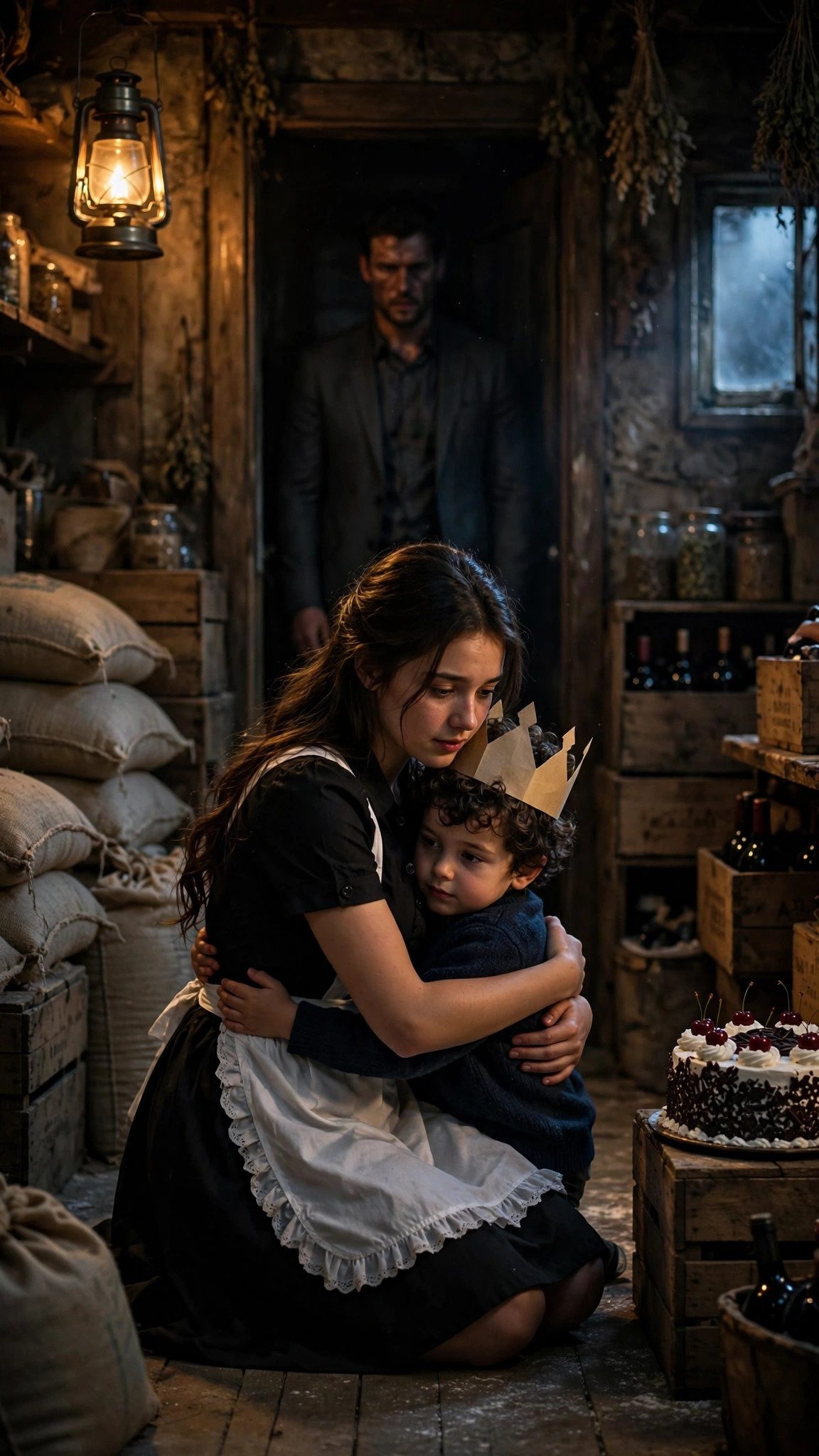
I was twenty-one years old when Kian Moretti found out who I really was.
It happened the way terrible things always happen in that world: quietly, in a back room, because of a piece of paper.
A supplier's invoice had been filed wrong, and I was carrying a stack of old delivery records down to the basement archive, and one of the folders slipped from my arms and scattered across the floor. I knelt to gather the papers, and a man I did not know — a thin man in a gray suit, with a lawyer's careful hands — picked up a page and read the name at the top.
"Aurora Bellini," he said, almost to himself. "Salvatore Bellini's daughter."
I froze. I had been so careful. For three years I had been Aurora Bell, and nobody had asked, and nobody had looked twice, and now a stranger in a gray suit had said my real name out loud in the basement of Bellarosa, and the air went out of the room.
"She works here?" the man asked the manager, who had come running at the sound of the falling folders.
"She is a maid," the manager said quickly. "She cleans. She bakes on Sundays. She is nobody."
But I was not nobody. I was Salvatore Bellini's daughter, and in the world Kian Moretti lived in, that meant something. It meant my father had once controlled the Brooklyn docks. It meant my father had once been Kian's father's rival, and then his enemy, and then his ghost. It meant that the girl who ate lunch with Kian's son every day at one o'clock was the daughter of a dead man whose name still made old soldiers reach for their guns.
By that evening, Kian knew.
He came to the kitchen after closing, when I was wiping down the counters and the room smelled of lemon and bleach. He stood in the doorway for a long time, watching me work, and I knew from the set of his shoulders that something had changed. The man who had thanked me for a paper airplane was gone. In his place stood the man criminals in New York were afraid to name too loudly.
"You lied to me," he said. His voice was flat, and that was worse than shouting.
"I told you my name was Aurora Bell," I said. "That is true. Bell is my mother's name. Elena Bell, before she married my father."
"Your father was Salvatore Bellini," he said. "He ordered the hit on my uncle's warehouse in 2011. He put three of my men in the hospital. He tried to take the docks my family has held for forty years."
"I was nine years old in 2011," I said. "I was learning to bake Black Forest cake in my mother's kitchen. I did not order anything."
"And yet you came here," he said. "To my building. To my restaurant. To my son."
"I came here because I needed a job," I said, and my voice was shaking now, and I hated that it was shaking. "I came here because Regina was trying to marry me to a man who smelled of cigars. I came here because your kitchen smelled like my mother's kitchen. I did not come here to spy on you. I did not come here to hurt your son. I love your son."
The word hung in the air between us. Love. I had said it out loud, and I could not take it back, and I did not want to take it back.
Kian looked at me for a long moment, and I saw the war in his face — the boss who had survived by trusting no one, and the father who had watched his son laugh for the first time in a year because of me.
"You are dismissed," he said finally. "Effective immediately. You will collect your wages from the manager in the morning. You will not come back to this building. You will not speak to my son again."
It was like being struck. I stood there with a cloth in my hand, and the kitchen tilted, and I thought about the small table by the kitchen door, and the lunches at one o'clock, and the paper airplane, and Zayn asking me if heaven had cake.
"Please," I said. "Please, let me say goodbye to him. Just one minute. He will not understand—"
"He will understand that people leave," Kian said, and his voice was colder than I had ever heard it. "That is a lesson every child in this life learns. Better he learns it now, from a maid, than later, from a bullet."
He turned and walked out, and I stood alone in the kitchen with the smell of lemon and bleach, and I understood that I had lost everything in the space of a single evening.
I did not go back the next morning. I sent Maria to collect my wages, and I stayed in the small room I rented above a laundromat on a street Regina did not know, and I waited for the phone to ring, and it did not ring.
Zayn would be asking for me. I knew that. He would ask at lunch, at one o'clock, at the small table by the kitchen door, and someone would tell him that Aurora was gone, and he would not understand, because he was three years old, and people do not explain betrayal to three-year-olds. They just say "she left," and the child learns that love leaves.
I thought about going back. I stood outside Bellarosa twice, in the rain, in my old coat, watching the lights in the windows. Once I saw Zayn's small face pressed against the glass of the upstairs apartment, looking out at the street, and I had to bite my own hand to keep from calling out to him.
But Kian had been clear. I was dismissed. I was not to come back. I was not to speak to his son again.
What I did not know — what I would not learn until the storage room, months later, when Kian put his phone into his son's hands — was that Kian had typed apologies to me in the dark, night after night, and never sent them.
"I'm sorry I hurt you already."
"I'm sorry, honey. I'm sorry. I'm sorry."
He had written them the way a man writes a letter he will never mail: honestly, and too late. He had learned the truth within a week of dismissing me — that my father had died owing Kian's family nothing, that the warehouse fire in 2011 had been Castellano's work, not my father's, that I was exactly what I had always seemed to be: a girl who baked cake and loved his son.
He had learned it, and he had been too proud to undo what he had done, and too afraid to admit that he had been wrong, and so he typed apologies into his phone at two in the morning, and deleted nothing, and sent nothing, and let the silence grow between us like a wall.
I, meanwhile, was learning how to survive on nothing.
The room above the laundromat was small and cold, and the radiator clanged all night, and the smell of detergent came up through the floorboards no matter how many times I opened the window. I paid the rent with the last of my wages from Bellarosa, and I counted the money every night, the way Regina used to count her cards, and I understood for the first time how quickly money disappears when there is no more coming in.
I looked for work. I walked to every restaurant on every street I could reach on foot, and I asked for a maid's job, or a dishwasher's job, or anything at all, and every time I heard the same answer: we are not hiring, come back next month, leave your name. I left my name — Aurora Bell — and nobody called.
Maria came to see me on the third day. She brought bread from the restaurant, and a jar of soup, and news that made my chest ache.
"He is not eating," she said, sitting on the edge of my narrow bed. "Zayn. He pushes his plate away. He asks for you at lunch, at one o'clock, at the small table, and when you do not come, he goes upstairs and sits by the window."
"Is he all right?" I asked, and my voice sounded strange to my own ears, thin and far away.
"He is quiet," Maria said. "He was quiet before you came, and now he is quiet again. Mrs. Kowalski says he has stopped talking to everyone. He only says one thing, over and over. 'Where is Aurora?'"
I pressed my hands over my face. "Kian told me not to come back. He told me not to speak to his son again."
"I know," Maria said gently. "But a child does not understand orders, Aurora. A child understands only that the person who sang to him is gone."
After Maria left, I sat on the bed for a long time, and then I did something I had never done before: I wrote a letter.
"Dear Zayn," I wrote, in my careful handwriting, on a piece of paper torn from a notebook. "I am sorry I had to go away. It was not because of anything you did. You are the best boy in the world, and I love you very much, and I think about you every day at one o'clock."
I wrote three more letters that week, and I never sent any of them. I kept them in the drawer beside my bed, folded neatly, like the recipe card in my uniform pocket. They were promises I could not keep, written to a child I could not reach.
On the tenth day, I stood outside Bellarosa in the rain. I told myself I was only walking past, that I was only going to the store, that I had no reason to stop. But I stopped, under the awning across the street, and I watched the lights in the windows, and I saw a small face pressed against the glass of the upstairs apartment — Zayn, looking out at the street, looking for someone.
I bit my own hand to keep from calling out to him. I turned around and walked away, and the rain soaked through my coat, and I cried the whole way home, not because I was cold, but because I had finally understood what Kian had done.
He had not just dismissed a maid. He had taken a mother away from a child who had already lost one mother, and he had done it because of a name — a name I had not chosen, a name that belonged to a dead man, a name that had nothing to do with the girl who sang lullabies and baked Black Forest cake.
That night, I wrote another letter I would never send. "Dear Kian," I wrote. "You told me people leave, and that it is a lesson every child learns. But you were wrong. Children should not have to learn that lesson from the people who love them. They should learn that love stays."
I folded the letter and put it in the drawer with the others, and I lay down on the narrow bed, and I listened to the radiator clang, and I thought about the small table by the kitchen door, and the lunches at one o'clock, and the paper airplane, and I wondered how long a person could live on memories alone.
I took my mother's recipe card out of my pocket and read it by the light from the streetlamp outside the window. The ink was faded, and the corners were soft from being folded and unfolded a thousand times, but her handwriting was still clear: "Black Forest cake. Cherries. Chocolate. Cream. Kirsch, if you can get it, and if you cannot, cherry juice and a prayer."
My mother used to say that a recipe was a kind of map — it could not take you home, but it could remind you what home tasted like. I held the card against my chest and closed my eyes, and for a moment I could smell her kitchen again, and hear her humming, and feel her hand on my shoulder, guiding the spoon.
"You will be all right, my love," she used to say, when I burned the cake, or dropped the bowl, or cried over something small. "Cakes can be baked again. People cannot. Remember which one matters."
I remembered. I put the card back in my pocket, and I fell asleep with my hand over it, and I dreamed of a kitchen full of light, and a little boy with chocolate on his face, asking me to stay.
The answer, I would learn, was twenty days. Twenty days, and then a birthday, and a cake, and a storage room, and a little boy who refused to move.
For twenty days, I hid from Regina. She had found my first room, and I had moved. She had found my second room, and I had moved again. She was relentless, because fifty thousand dollars was a great deal of money to a woman who had lost everything at the card tables, and Tony Falco did not wait patiently.
On the twentieth day, I learned that Zayn was turning four, and that there would be a party at Bellarosa, and that his father would be there, and that the whole restaurant would be full of people who loved that little boy.
I baked a Black Forest cake at three in the morning, in the kitchen of a woman named Mrs. Alvarez, who let me use her oven and asked no questions. I wrapped it carefully. I put on my old black maid's uniform, because it was the only good dress I owned. And I walked to Bellarosa, telling myself I would leave the cake at the door and go.
I did not leave it at the door. I went inside. I could not help it. I needed to see him, just once, on his birthday, to know that he was all right.
That was how I ended up in the storage room, with Tony's men on one side and my stepmother's voice on the other, and a four-year-old boy stepping between us with his arms spread wide.
That was how I learned that the man who had dismissed me had been sorry all along, and had never once said it out loud.