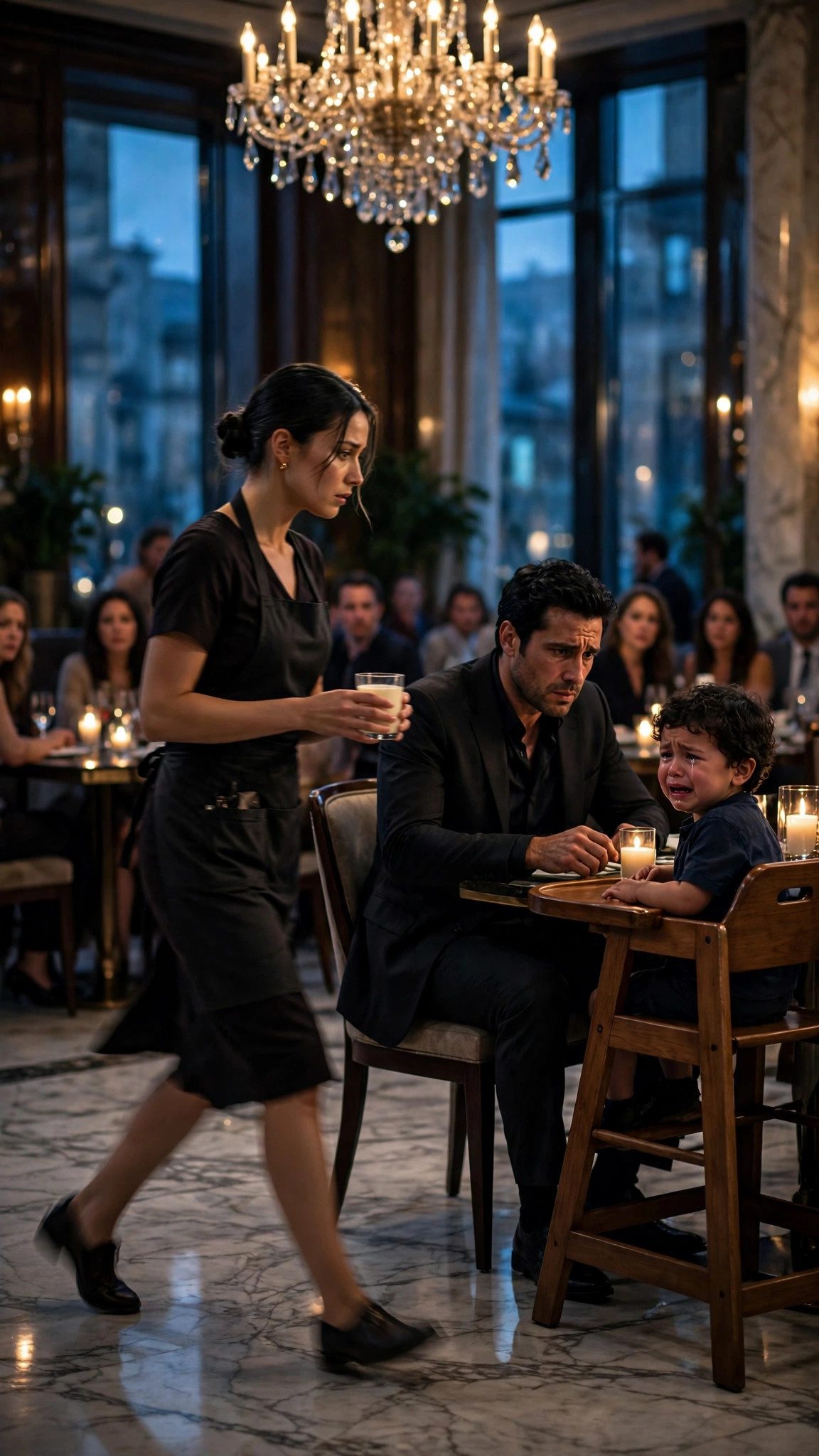
The morning after the attack, the house on Willow Lane felt like a different place. The broken door had been replaced. The plaster from the ceiling had been swept up. The books were back on the shelf, though not in the right order — Leo had insisted on arranging them himself, by size, and then by color, and then by size again.
Dante was in the hospital, his shoulder bandaged, grumbling at the nurses and demanding to be released. The doctors said he would need two weeks of rest. Dante said he would need two days. The nurses, wisely, did not argue with either of them.
Rico had not slept. He sat in the kitchen at dawn with a cup of coffee gone cold, staring at the garden through the window, while Leo ate his toast — triangles, always triangles — at the small table.
Agent Daniel Reyes arrived at eight o'clock, carrying a leather folder and a calm, professional manner that made the whole house feel steadier just by being in it.
"Mr. Moretti," he said, shaking Rico's hand. "Miss Bennett. Thank you both for agreeing to talk to me this morning."
"We want Castellano behind bars," Rico said. "Whatever you need from us, you have it."
Reyes nodded. He opened the folder. Inside were photographs, bank records, phone logs — a paper trail that stretched back six months, to the night Elena died.
"Sal Ferraro has been very cooperative," Reyes said. "He was arrested at JFK with fifty thousand dollars in cash and a one-way ticket to Miami. He has confessed to leaking Mrs. Moretti's route to Castellano's men on the night of the drive-by. He has also confessed to leaving the garden door unlocked last night, and to telling Castellano that Leo had started speaking again — that the boy was, in his words, 'becoming a problem.'"
"A problem," Rico repeated, his voice flat. "My three-year-old son was a problem."
"To Castellano, yes," Reyes said. "Castellano believed that as long as Leo could not speak, he was safe — a child who couldn't testify, couldn't identify anyone, couldn't tell anyone what he had seen. But Leo was getting better. He was starting to talk. And Castellano was afraid that one day, Leo would remember something. A face. A car. A voice from that night."
"What did Leo see that night?" I asked quietly. "He was asleep. He was two and a half."
Reyes looked at me. "He was asleep in his bed, yes. But he woke up when the shots were fired outside — the house is on the same street as Atlantic Avenue, Miss Bennett. He woke up and went to the window. He saw the black sedan. He saw the driver. He has never been able to say it, because he stopped speaking. But last night, after the attack, he told Mr. Moretti something."
Rico nodded slowly. "This morning, at breakfast, Leo pointed at the photograph in the newspaper — the one of Castellano being led into the courthouse — and he said, 'Bad man.' Then he pointed at the window and said, 'Car.' Two words. But he remembered. He remembered the car."
My throat went tight. A two-and-a-half-year-old boy, woken by gunfire, looking out a window at the car that had killed his mother — and carrying that memory in silence for six months, because he had no words for it.
"He's very brave," I said.
"He's his mother's son," Rico said.
Reyes continued. "Sal has agreed to testify against Castellano in exchange for a reduced sentence. Eight years. He will also testify about the money — the payments from Castellano's shell companies, the ledger that Sal kept in his mother's house, the phone calls. With Sal's testimony, and with Eddie Krol's confession — Krol has already told us everything, in exchange for twenty-five years instead of life — we have enough to charge Vincent Castellano with conspiracy to commit murder, racketeering, and the murder of Elena Moretti."
"Life," Rico said. It wasn't a question.
"Life without parole," Reyes confirmed. "If the jury convicts. And with this evidence, they will."
Rico was quiet for a long moment. Then he said, "Agent Reyes, I need you to understand something. For ten years, I have run my family's businesses the way my father ran them. Some of it was legal. Some of it was not. I told myself it was necessary. I told myself it was the only way to keep my family safe. Elena knew. She never approved, but she loved me anyway. And she died because of it."
He set his coffee cup down. "That ends now. I am handing you everything. My ledgers. My accounts. The names of every man who has ever moved money for me outside the law. I will testify. I will cooperate. I will dismantle the illegal side of my family's businesses, piece by piece, and I will make them legitimate — all of them. The restaurants. The construction. The freight. All of it, clean."
Reyes studied him carefully. "Mr. Moretti, that is a significant decision. It will take years. It will cost you a great deal of money. And it will make you enemies."
"I already have enemies," Rico said. "And the money doesn't matter. What matters is that my son grows up in a house where the doors are locked because we choose to lock them, not because we are afraid of who might come through them. What matters is that Leo never has to learn the name 'the Butcher.' What matters is that Elena did not die for nothing."
Reyes closed his folder. "Then we will work together," he said. "And Mr. Moretti — for what it is worth, I have been doing this job for fifteen years, and I have never seen a man walk away from an empire to save his son. It is a rare thing."
"It is not rare," Rico said quietly. "It is what a father does."
The trial took four months. In that time, the house on Willow Lane changed in ways I could feel in my bones.
Sal Ferraro testified for three days. He cried on the stand. He told the jury about the fifty thousand dollars, about the phone calls, about the night he had watched Elena Moretti's car stop at a red light on Atlantic Avenue and done nothing. He was sentenced to eight years. He wrote Rico a letter from prison, apologizing. Rico read it once, folded it, and put it in a drawer. He never answered it. Some things, he said, you forgive by letting go, not by writing back.
Eddie Krol testified for two days and got twenty-five years. He never once looked at Leo.
Vincent Castellano sat through the whole trial in a grey suit, his face blank, his hands folded. He did not testify. He did not show emotion. When the jury came back with a verdict of guilty on all counts, he stood up slowly, and he looked across the courtroom at Rico, and he said one thing: "Your father would be ashamed of you."
Rico looked back at him and said, "My father would be proud of me. My wife would be proud of me. And my son will be proud of me. That is all that matters."
Castellano was sentenced to life in prison without the possibility of parole. He was sixty-one years old. He would die in prison.
On the day of the sentencing, Rico came home and found Leo and me in the garden. Leo was digging with his plastic spoon. I was reading. The lemon tree was in bloom.
"It's over," Rico said. He sat down on the blanket beside us, and he took off his suit jacket, and he rolled up his sleeves, and for the first time in six months, he looked like a man who had put down something heavy.
"Is it really over?" I asked.
"Castellano is gone. Sal is gone. Krol is gone. The illegal businesses are being dismantled. Agent Reyes says the family will be clean within two years." He looked at Leo, digging in the dirt. "My son is safe. My house is safe. And I have you to thank for that."
"You have Leo to thank," I said. "He's the one who remembered. He's the one who said 'Daddy.' He's the one who fought."
Rico shook his head. "He fought because you taught him how to breathe. Because you sat on the floor with him and didn't try to fix him. Because you understood him." He paused. "Clara, I need to ask you something, and I need you to think about it before you answer."
"All right," I said.
"When you came to this house, you came as Leo's companion. A job. Three times your pay. A room if you wanted it. That was the arrangement. But it isn't an arrangement anymore. You are not an employee. You are family. You are the person my son runs to when he is scared. You are the person my mother asks for by name. You are the person I —" He stopped. He looked down at his hands. "You are the person I look for when I come home."
My heart was beating too fast. One, two, three, four. In. One, two, three, four, five, six. Out.
"Rico," I said.
"I'm not asking you to marry me," he said quickly. "Not yet. Not like this. I'm asking you to stay. Not as an employee. As someone who belongs here. As someone who is part of this family. Will you stay, Clara? Will you stay and let us be a family?"
Leo looked up from his digging. He held out a worm, the way he always did, like it was a treasure. "Clara," he said. "Worm."
I took the worm. I looked at Rico. I looked at Leo. I looked at the lemon tree and the garden wall and the house that had once been full of grief and was now, slowly, becoming full of something else.
"Yes," I said. "I'll stay."
Rico closed his eyes. His shoulders dropped, like a man setting down something he had carried for a very long time.
"Good," he said. "Good. Then we can start."
"Start what?" I asked.
"Starting over," he said. "All of us. Together."
The trial began on a grey Monday in September. I had never been inside a courtroom before. I had seen them on television, but television had not prepared me for the smell of old wood and floor polish, or for the way the room went silent when the judge walked in, or for the way Vincent Castellano sat at the defense table in a grey suit, his hands folded, his face completely blank — as if the whole proceeding were a minor inconvenience, as if a woman had not died and a little boy had not lost his mother.
Agent Reyes had prepared me. "Just tell the truth," he had said. "Tell it the way you told it to me. Slowly. One breath at a time."
When they called my name, I walked to the witness stand with my hands steady and my heart hammering, and I took the oath, and I sat down, and the prosecutor — a woman named Alvarez, with kind eyes and a voice like a schoolteacher's — asked me to tell the jury what had happened on the night of the attack.
So I told them. About the click of the back door. About the footsteps on the stairs. About the lock holding, and the door splintering, and the lamp, and the bookshelf, and Leo running down the stairs shouting "Daddy." I told them about Dante bleeding on the kitchen floor. I told them about the man in the black jacket saying Castellano's name.
When I finished, the defense attorney stood up. He was a thin man with a thin smile, and he asked me, very politely, whether I was certain about what I had heard. Whether a frightened waitress in the dark could really be sure of a name spoken through a door.
"Yes," I said. "I am certain. He said Castellano. I will never forget that name. It is the name of the man who killed Leo's mother."
The attorney asked me whether I had any training in security. Whether I had any reason to be in that house at all. Whether I was, perhaps, exaggerating my role to impress the jury.
I looked at him, and I thought about the nights on the bathroom floor, and the breathing, and Dr. Patel saying, "Panic is not weakness." And I said, "Sir, I am a waitress from Queens. I have no training in security. I was in that house because a three-year-old boy asked me to stay. And I am not exaggerating anything. I wish I were. I wish none of it had happened at all."
The jury was silent. One of the jurors — an older woman with grey hair — was crying.
After I stepped down, Rico was waiting in the hallway. He took my hand. He didn't say anything. He just held it, and we stood there together until my breathing slowed.
Two weeks later, I went to see Rosa. I took the bus to Flushing, the way I always had, and I walked into the care home with a bag of lemon cake from the bakery on the corner, and Rosa was sitting by the window in the common room, looking out at the garden.
"Clara," she said, when she saw me. Her eyes were clear that day. "You look different. You look happy."
"I am happy, Nonna," I said. I sat down beside her and took her hand. "I have so much to tell you."
And I told her everything. About Leo. About the milk. About the attack. About the trial. About Rico, and the garden, and the lemon tree, and the way he had asked me to stay — not as an employee, but as family.
Rosa listened without interrupting, the way she always had. When I finished, she was quiet for a long time. Then she squeezed my hand, hard, with the strength she still had in it.
"Your mother," she said, "used to say that love is not something you find. It is something you build, one small kindness at a time. A glass of milk. A breath counted in the dark. A hand held. That is how you build it. And Clara —" she looked at me, her eyes shining. "You built it. You built a family out of warm milk and steady hands. Your mother would be so proud of you."
"I'm going to marry him, Nonna," I said. "Rico. I haven't said yes yet — he hasn't asked yet, not properly — but when he does, I'm going to say yes."
Rosa laughed, a sound like a girl's laugh, bright and sudden. "Then I had better live to see it," she said. "I am eighty years old, Clara. I have earned the right to dance at my granddaughter's wedding."
"You will," I said. "I promise. You will dance, and Leo will dance with you, and it will be the best day of all our lives."
She patted my hand. "Go on, then," she said. "Go and build your family. And Clara — bring me a piece of the wedding cake. Lemon, if they have it. Your mother always loved lemon cake."