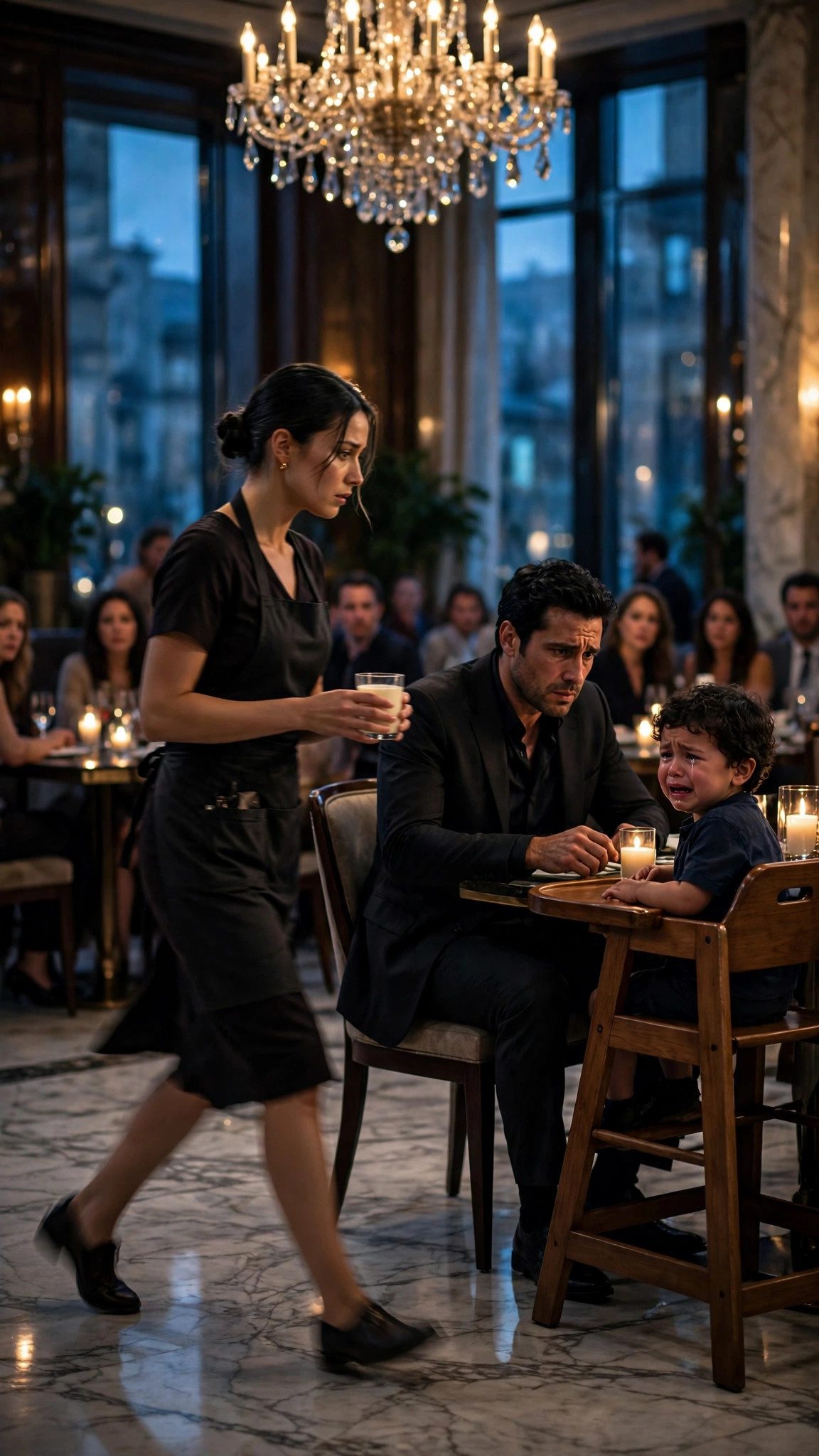
The wedding was in the garden, under the lemon tree, on a Saturday afternoon in September, one year after the night I had carried a glass of warm milk across a restaurant floor.
It was not a large wedding. Rico had wanted it small. Isabella had wanted it small. I had wanted it small. Fifty people, maybe. Family. Friends. Sarah, who cried through the entire ceremony and then claimed it was allergies. Dante, who stood at the back in a suit that barely fit his shoulders, his arm still stiff from the bullet, beaming like a man at his own daughter's wedding. Dr. Patel, who had flown in from Elmhurst and who told me, as she hugged me, "You did the work, Clara. You answered the alarm. I am so proud of you."
Rosa was there, too. My grandmother, eighty years old now, in a wheelchair with a blanket over her knees, her memory clearer that day than it had been in months. She held my hand before the ceremony and said, "Your mother would be so proud of you, Clara. She would look at you and say, 'That is my girl. That is my brave girl.'"
I wore a simple white dress, not a ball gown, not a princess dress. A simple white dress, and a pair of flat shoes that didn't squeak, and a small bouquet of white lilies that Isabella had arranged herself.
Rico wore a dark suit. Not Brioni. Not armor. Just a dark suit, and a tie that Leo had picked out — bright blue, with small anchors on it, because Leo loved boats and had insisted.
Leo was the ring bearer. He was four years old now, tall for his age, his hair neatly combed, his little suit fitting him perfectly. He walked down the garden path carrying the rings on a velvet pillow, very slowly, very carefully, his tongue sticking out of the corner of his mouth in concentration, and when he reached us, he held the pillow up high and said, very clearly, so that everyone in the garden could hear him:
"Daddy, the rings!"
Everyone laughed. Everyone cried. Rico picked him up and held him against his chest, and Leo wrapped his arms around his father's neck, and I stood there in my simple white dress and thought about a little boy who had once hidden under a kitchen table and screamed at the whole world, and who now walked down a garden path carrying rings and speaking in full sentences.
The ceremony was short. The officiant was an old friend of Isabella's, a kind man with a soft voice. He talked about love, and about second chances, and about families that are built not by blood but by choice.
When it was time for the vows, Rico took my hands in his. His hands were warm. They were steady. Mine were steady, too.
"Clara Bennett," he said, "a year ago, you walked across a restaurant floor carrying a glass of milk, and you asked a frightened little boy to breathe with you. You did not know who I was. You did not know what I was. You only knew that a child was scared, and you went to him. That is the bravest thing I have ever seen anyone do."
He paused. The garden was silent except for the bees in the lemon tree.
"I spent ten years building a name that frightened people," he said. "I thought the name would keep my family safe. I was wrong. The name kept my family alone. Elena knew that. She tried to tell me. I didn't listen. And then I lost her, and I almost lost my son, and I thought I would spend the rest of my life behind that name, alone in a house full of photographs."
He squeezed my hands. "And then you came. With warm milk and one sugar cube. And you taught my son to breathe. And you taught me that a man does not protect his family by being feared. He protects them by being present. By being honest. By being brave enough to be seen."
He looked at Leo, who was sitting on Dante's shoulders now, watching us with wide eyes.
"Clara," he said, "I love you. I love the way you breathe with my son. I love the way you laugh at my terrible jokes. I love the way you stood in a doorway with a lamp in your hands and refused to let a bad man take my boy. I love you, and I am asking you — in front of everyone we love — to be my wife. Not because I need you. Because I choose you. Every day. For the rest of my life."
I was crying by then. I didn't try to stop.
"Yes," I said. "Yes. A thousand times, yes."
Then it was my turn. I took a deep breath — one, two, three, four, in; one, two, three, four, five, six, out — and I said the vows I had written the night before, sitting on my fire escape with a cup of tea, looking out at the city that had once felt so big and so lonely.
"Rico," I said, "a year ago, I was a waitress from Queens who was afraid of everything. Afraid of losing my job. Afraid of losing my apartment. Afraid of my own heart. I had panic attacks in bathrooms and counted my breaths on cold floors, and I thought that was just how my life would be."
I looked at Leo, and at Isabella, and at Rosa, and at all the faces in the garden.
"And then I met a little boy who was more afraid than I was. And I realized that my fear had taught me something. It had taught me what terror looks like. It had taught me how to sit with it. How to breathe through it. How to hold someone's hand and say, 'I'm here. You're safe. Breathe with me.'"
I squeezed Rico's hands. "You asked me once who I was. Do you remember? In the restaurant. You said, 'Who are you?' And I said, 'My name is Clara Bennett. I work here.' But that wasn't the whole answer. The whole answer is this: I am the girl who knows what fear looks like. I am the girl who brings milk. I am the girl who stays. And I will stay. With you. With Leo. With this family. For as long as you will have me."
Rico leaned forward and kissed me, gently, in front of everyone, and Leo cheered so loudly that the birds in the lemon tree scattered, and Dante shouted, "Finally!" and Sarah threw flower petals into the air, and Isabella dabbed at her eyes with a handkerchief, and Rosa clapped her hands together and laughed like a girl.
After the ceremony, we ate in the garden. Pasta, of course. Leo ate two whole bowls, and he pointed at the parmesan and said, "More," and everyone laughed, because that was Leo's word — the first word he had said in the garden, a year ago, when he asked for more story.
Later, when the sun was going down and the string lights in the lemon tree came on, Leo came to find me. He tugged on my dress.
"Clara?" he said.
"Yes, sweetheart?"
He looked up at me with his father's dark eyes and his mother's smile, and he said, very carefully, the way he said things that mattered:
"Are you my mama now?"
The whole garden went quiet. Rico, who was standing nearby with a glass of wine, went very still. Isabella stopped talking mid-sentence. Dante stopped eating.
I knelt down so I was at Leo's level. I put my hands on his small shoulders. I looked into his eyes.
"Leo," I said, "your mama was Elena. She was beautiful and brave, and she loved you more than anything in the world. She will always be your mama. No one can ever take her place."
He nodded, his eyes filling with tears. "I miss her."
"I know, sweetheart. I miss my mama, too. Every day. And you know what? Missing someone doesn't mean they're gone. It means they mattered. It means they loved you, and you loved them, and that love doesn't go away just because someone isn't here anymore."
Leo thought about that for a moment. Then he said, "Can I call you Mama Clara?"
My throat went so tight I could barely speak. "Yes," I whispered. "Yes, you can call me Mama Clara. I would like that very much."
He threw his arms around my neck, and I held him, and I felt Rico's hand on my shoulder, and Isabella's hand on my other shoulder, and I thought about Elena, and about my mother, and about Rosa, and about all the women who had loved and lost and kept going, and I thought about how love doesn't end. It just changes shape. It becomes a glass of warm milk. It becomes a breath counted in a dark room. It becomes a little boy asking for more story.
One year later, on a warm evening in September, I sat in the garden with Leo — five years old now, chattering, laughing, telling me a story about a worm he had found that was, in his words, "the biggest worm in the whole world" — and Rico came out of the house with two glasses of wine, and he sat down beside me, and he put his arm around me, and we watched our son dig in the dirt with his plastic spoon.
"Clara," Rico said.
"Yes?" I said.
"Do you remember the night I asked you who you were?"
"I remember," I said. "You had your hand inside your jacket. I thought you were going to shoot me."
"I was reaching for my wallet," he said, laughing. "I was going to tip you. A hundred dollars, for the milk. And then you knelt down beside my son, and you breathed with him, and I forgot about the wallet entirely."
"Good," I said. "The milk was free."
He kissed the top of my head. "You know what the men call me now?"
"The Butcher of Brooklyn?" I asked.
"No," he said. "Not anymore. The other day, one of my drivers — a new one, he doesn't know the old stories — he asked Dante what they call me. And Dante said, 'We call him Rico. He's Leo's father. He's Clara's husband. That's enough.'"
I leaned against him. The lemon tree smelled sharp and sweet. The string lights glowed. Leo held up a worm, triumphant.
"Mama Clara!" he shouted. "Look! The biggest worm!"
"I see it, sweetheart," I called back. "That's a very fine worm."
Rico laughed, and I laughed, and Leo laughed, and the house on Willow Lane — the house that had once been full of grief and silence and locked doors — was full of laughter instead.
And that night, when Leo was asleep in his bed, and Rico was asleep beside me, I lay awake for a little while, listening to them breathe. One, two, three, four. In. One, two, three, four, five, six. Out.
I thought about the girl I had been a year ago: a waitress from Queens, standing near the kitchen doors, holding a tray she had forgotten about, watching a little boy scream.
I thought about the night the Butcher of Brooklyn had asked me who I was.
And I thought about the answer I had finally found.
My name is Clara Bennett Moretti. I am a wife. I am a mother. I am the girl who brings the milk. I am the girl who stays.
And I am home.
The morning Leo started school, he woke up before dawn and came into our room in his pajamas, holding his new backpack like it was made of gold.
"Mama Clara," he whispered, climbing onto the bed between us. "What if nobody likes me? What if the teacher is mean? What if I get scared?"
Rico opened one eye. "Then you breathe," he said, his voice still thick with sleep. "One, two, three, four. In. One, two, three, four, five, six. Out. Just like Mama Clara taught you."
"And if that doesn't work?" Leo asked.
"Then you find the kindest person in the room," I said, "and you sit next to them. And you ask them their name. And you share your crayons. That's how you make a friend."
Leo thought about that. "Can I take the milk?" he asked. "Warm milk. One sugar. In my thermos?"
"You can take the milk," I said. "And if anyone asks why, you tell them your mama makes it, and it's the best milk in the world."
He grinned, and he ran to get dressed, and Rico and I lay there for a moment, listening to him crash around his bedroom, and Rico said, "He's going to be all right, you know. Our boy. He's going to be all right."
"I know," I said. "Because he's not doing it alone."
That autumn, Rico did something I had not expected. He took the money from the sale of one of the old freight warehouses — money that had once been dirty, money that was now clean — and he started a foundation. The Elena Moretti Foundation, for children who have lost a parent to violence. It paid for therapy. It paid for school. It paid for warm milk and quiet rooms and people trained to sit on the floor and breathe with a frightened child.
"We can't bring her back," Rico said, at the foundation's first small ceremony, standing in front of a room full of social workers and teachers and parents. "But we can make sure that no child has to grieve alone the way my son did. That is what Elena would have wanted. That is what she deserves."
Leo, who was sitting in the front row with Isabella, raised his hand. "My mama started it," he said, very loudly, to the whole room. "My mama Elena. And my Mama Clara helps. And my daddy helps. And we all help together."
The room laughed, and then it applauded, and Leo stood up and bowed, the way he had practiced, and I cried, and Rico cried, and Isabella cried, and even Dante — sitting at the back with his arms crossed — wiped his eyes and pretended it was allergies.
On the way home that night, Leo fell asleep in the back seat, his head against the window, his backpack on his lap. Rico drove. I sat beside him. The city slid past the windows, golden and dark by turns.
"Clara," Rico said quietly, so as not to wake Leo.
"Yes?" I said.
"Thank you," he said. "For the milk. For the breathing. For staying. For all of it."
I took his hand. It was warm. It was steady. Mine was steady, too.
"Always," I said. "I'm not going anywhere."
And I meant it. Every word.
The End.
THE END