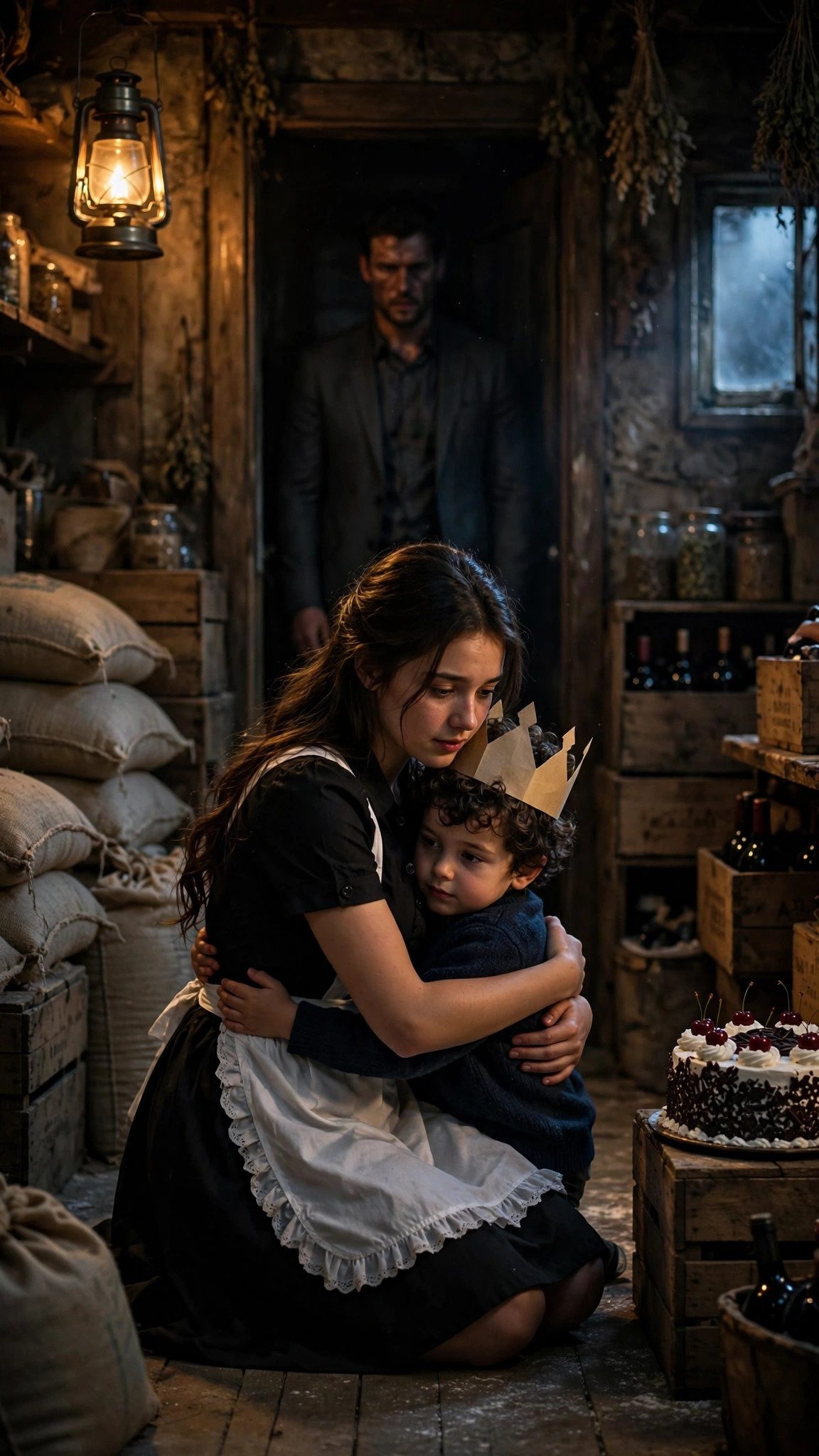
The wedding was in the garden behind Bellarosa, on a Sunday in June, one year after Zayn's fourth birthday.
It was not a large wedding. Kian had offered me anything — a cathedral, a hotel ballroom, a thousand guests — and I had said no to all of it. I wanted the garden. I wanted the string lights in the trees. I wanted the long table with the white cloth. I wanted Mrs. Alvarez's granddaughter to scatter rose petals, and old Vince to stand at the grill in his chef's whites, and Maria to cry in the front row.
I wanted the people who had been there when I was nobody.
I wore a simple white dress, and I carried lilies, and Zayn walked me down the aisle in his small dark suit, holding my hand with the seriousness of a boy performing the most important job of his life.
"Are you nervous, Mommy?" he whispered, halfway down the path.
"A little," I whispered back.
"Don't be nervous," he said. "Daddy is waiting. And I am right here. Nobody will take you away."
He was five years old, and he had kept his promise. Nobody had taken me away.
Kian was waiting at the end of the aisle, tall and broad-shouldered, in a dark suit with no tie, because I had told him he looked better without one. His eyes were on me, and they were not the eyes of a man criminals were afraid to name too loudly. They were the eyes of a man who had typed apologies into his phone at two in the morning and had finally learned to say them out loud.
When I reached him, he took my hands, and the minister began to speak, and I heard almost none of it, because I was looking at Kian's face, and at Zayn standing beside us with the rings on a small velvet pillow, and at the garden full of people who loved us, and I was thinking about how strange life was — that a girl who had been priced at fifty thousand dollars could end up standing in a garden, priceless, holding the hands of the man she loved.
"Do you, Kian Moretti, take Aurora Bellini to be your wife?" the minister asked.
"I do," Kian said, and his voice was steady, and it was certain, and it was the voice of a man who had finally learned to say what he meant.
"Do you, Aurora Bellini, take Kian Moretti to be your husband?"
"I do," I said.
Zayn tugged at my dress. "Now kiss," he announced, loudly, to the whole garden. "That is the rule. Now you kiss."
So we kissed, and the garden erupted, and old Vince rang a bell from the kitchen door, and Mrs. Alvarez threw rose petals with both hands, and Maria cried even harder, and Zayn danced in a circle around us, shouting, "They kissed! They kissed! Now she is really my mommy!"
Later, at the long table with the white cloth, we cut the cake. It was a Black Forest cake, of course. My mother's recipe. Cherries, chocolate, cream, and a prayer. Kian cut the first slice and fed it to me, and I fed the second slice to him, and Zayn demanded the biggest slice of all, and got it, because it was his house, and his garden, and his family.
"I have something for you," Kian said, after the cake, when the string lights were coming on in the trees and the evening was turning gold. He reached into his jacket pocket and took out his phone, and he held it out to me.
I looked at the screen. It was the message, the one he had shown Zayn in the storage room, the one he had typed a hundred times and never sent.
"I'm sorry I hurt you already."
"I'm sorry, honey. I'm sorry. I'm sorry."
Only now there was a new line beneath it, typed that morning, in the same hand.
"I love you. I have loved you since the day you knelt down in my kitchen and asked my son if heaven had cake. I was too afraid to say it then. I am saying it now. I love you, Aurora Moretti. Will you stay?"
I looked up at him, and the garden was gold, and the string lights were bright, and Zayn was asleep on a blanket under the table with chocolate on his face, and I thought about the girl I had been: eighteen years old, in a borrowed uniform, lying about her name, hiding from a stepmother who wanted to sell her.
That girl had walked into Bellarosa looking for a job, and she had found a kitchen that smelled like her mother's kitchen, and a little boy who asked her to stay, and a man who was too proud to say he was sorry until it was almost too late.
"Yes," I said. "I will stay. I will always stay."
He took the phone back, and he pressed send, and the message went out into the world, finally, after all that time — not as a draft, not as a secret, but as a promise, kept.
That night, after the guests had gone and the lights were off and the garden was quiet, I stood in the kitchen at Bellarosa with my husband, and we washed the cake plates together, the way ordinary people do, and Zayn slept upstairs in his bed, and the building was quiet, and the city was quiet, and for the first time in my life, I was not afraid.
I was Aurora Moretti. I was a wife. I was a mother — not by blood, not by law, but by choice, which is the strongest kind of mother there is. I was the girl who baked the Black Forest cake. I was the girl in the black uniform who had learned that a uniform with pockets could hold a recipe, and a pencil, and a future.
Kian dried the last plate and set it on the shelf, and he put his arms around me from behind, and he rested his chin on the top of my head, and he said, very quietly, "I should have saved you sooner."
"You did save me," I said. "You saved me the day you thanked me for a paper airplane. You saved me the day you ordered my cake for your son's birthday. You saved me the day you walked into that storage room and told the world I was under your protection. You have been saving me all along. You just did not know it yet."
He was quiet for a moment, and then he said, "Then let me say it properly, now that I know how. Aurora, I love you. I am sorry I hurt you. And I will spend the rest of my life making sure no one ever tries to take you away again."
The year between the trial and the wedding was the year I finally learned what a normal life could feel like.
Kian kept his promise to the FBI. He handed over the ledgers, and he sat in rooms with lawyers and accountants for months, untangling forty years of his family's business, and at the end of it, Bellarosa was a restaurant — just a restaurant, with clean books and clean taxes — and the shipping company was a shipping company, and the warehouses were warehouses, and nothing in his life happened in a back room anymore.
"It is strange," he said to me one night, sitting at the kitchen table with a stack of paperwork, "to sign my own name to things. For twenty years, other people signed for me. Now I sign, and it is my name, and my responsibility, and it feels —" He paused, searching for the word. "It feels honest. I had forgotten what honest felt like."
I opened my own bakery that year. A small shop, two doors down from Bellarosa, in the space that had been closed for years. Kian bought the building — of course he bought the building, he owned everything on the street — and he handed me the keys and said, "It is yours. The rent is one dollar a year. Do not argue."
I named it Elena's, after my mother. The sign was painted by hand, in dark green letters, and on the first day, I baked twelve Black Forest cakes, and they sold out by noon, and Mrs. Alvarez came and cried into her apron, and old Vince declared that my mother's recipe was "the best cake in Brooklyn, and I have eaten cake in six countries."
Zayn started school that September. He was five years old, and he wore a backpack that was almost as big as he was, and on the first day, he held my hand all the way to the gate, and then he let go, and he walked in by himself, and he turned around once and waved, and I stood on the sidewalk and cried, because he was growing up, and because he was not afraid.
Kian proposed on a Tuesday night, in the kitchen at Bellarosa, after closing. There were no flowers, no ring box, no grand gesture — just the two of us, in the quiet kitchen, with the smell of lemon and bleach, the same kitchen where he had dismissed me two years before.
"I have been thinking about how to do this," he said, standing in the doorway, the way he had stood that night, only this time his hands were not in his pockets, and his face was not closed. "I thought about a restaurant. I thought about a ring in a glass of champagne. I thought about asking your permission first, the way a proper man would."
"And?" I said, wiping down the counter, my heart beating so hard I was certain he could hear it.
"And then I remembered that you are not a proper woman, and I am not a proper man, and the best moments of our life have happened in this kitchen, in the dark, when no one was watching." He came closer, and he took the cloth out of my hand, and he knelt down — Kian Moretti, the man criminals were afraid to name too loudly, kneeling on the kitchen floor in his dark suit — and he said, "Aurora Bellini, will you marry me? Not because anyone owes anyone anything. Not because of a debt, or a deal, or a bloodline. Because I love you, and my son loves you, and this kitchen is where I first understood that."
Behind the door, I heard a small giggle. Zayn was hiding in the hallway, peeking through the crack, and he could not contain himself any longer.
"Say yes!" he shouted, bursting into the kitchen. "Say yes, Mommy! Say yes!"
"Yes," I said, laughing, crying, kneeling down beside Kian on the kitchen floor. "Yes, yes, yes."
Kian slid the ring onto my finger — a simple gold band, with a small blue stone, the color of my mother's ring, the one Regina had sold. He had found it, somehow, through a pawn shop in Queens, through three years of searching, and he had bought it back, and he had kept it in his pocket for months, waiting for the right night.
"I should have saved you sooner," he said, and I told him what I have told him a hundred times since: he saved me the day he thanked me for a paper airplane.
The wedding preparations took three months. Maria helped me choose the dress — a simple white dress, with lace at the sleeves, nothing like the gowns Regina had once shown me in magazines, all beads and drama and price tags. This one was quiet. This one was mine.
The fitting took place in a small shop in Brooklyn, with a seamstress who pinned and tucked and told me to stand still, and Maria sat in the corner crying happy tears, and Zayn sat on the floor playing with a toy car, and every few minutes he would look up and announce, "Mommy looks like a princess," as if it were a fact he had verified himself.
Kian chose his own suit, of course — dark, simple, no tie, because I had told him he looked better without one. He tried it on once, in the apartment upstairs, and Zayn insisted on trying his on at the same time, and they stood side by side in front of the mirror, father and son, both in dark suits, both straightening their jackets with the same gesture, and I stood in the doorway and thought: this is what a family looks like.
We rehearsed the walk down the aisle three times in the garden, with Zayn carrying the velvet pillow and dropping the rings twice, and on the third try he carried them perfectly, all the way to the end of the path, and he bowed, very seriously, like a small knight presenting a sword, and old Vince applauded from the kitchen door, and Maria cried again, and I knew — I knew — that the day would be perfect, because the people I loved were already practicing loving me. Maria helped me choose the dress. Mrs. Alvarez made the veil. Old Vince insisted on cooking the entire reception dinner himself, and refused to let anyone help him, and threatened to quit if anyone touched his stove. Zayn appointed himself the official ring bearer, and practiced walking down the aisle for weeks, carrying the velvet pillow with enormous seriousness, and dropping the rings twice, and declaring that the third time would be perfect.
It was perfect. All of it was perfect — the garden, the string lights, the long table, the Black Forest cake, the little boy in his dark suit with the crooked paper crown he refused to take off, because it was his crown, and he was the king of the day.
Outside, the city hummed, and the restaurant slept, and upstairs a little boy dreamed of race cars and paper crowns and a mother who had stayed.
The girl he should have saved had saved herself — with a cake, and a uniform with pockets, and a little boy who refused to move.
And the man who had been too afraid to say he was sorry had finally said it, out loud, in a garden full of light, where everyone could hear.
That was the end of the story. And it was the beginning of everything else.
The End.
THE END