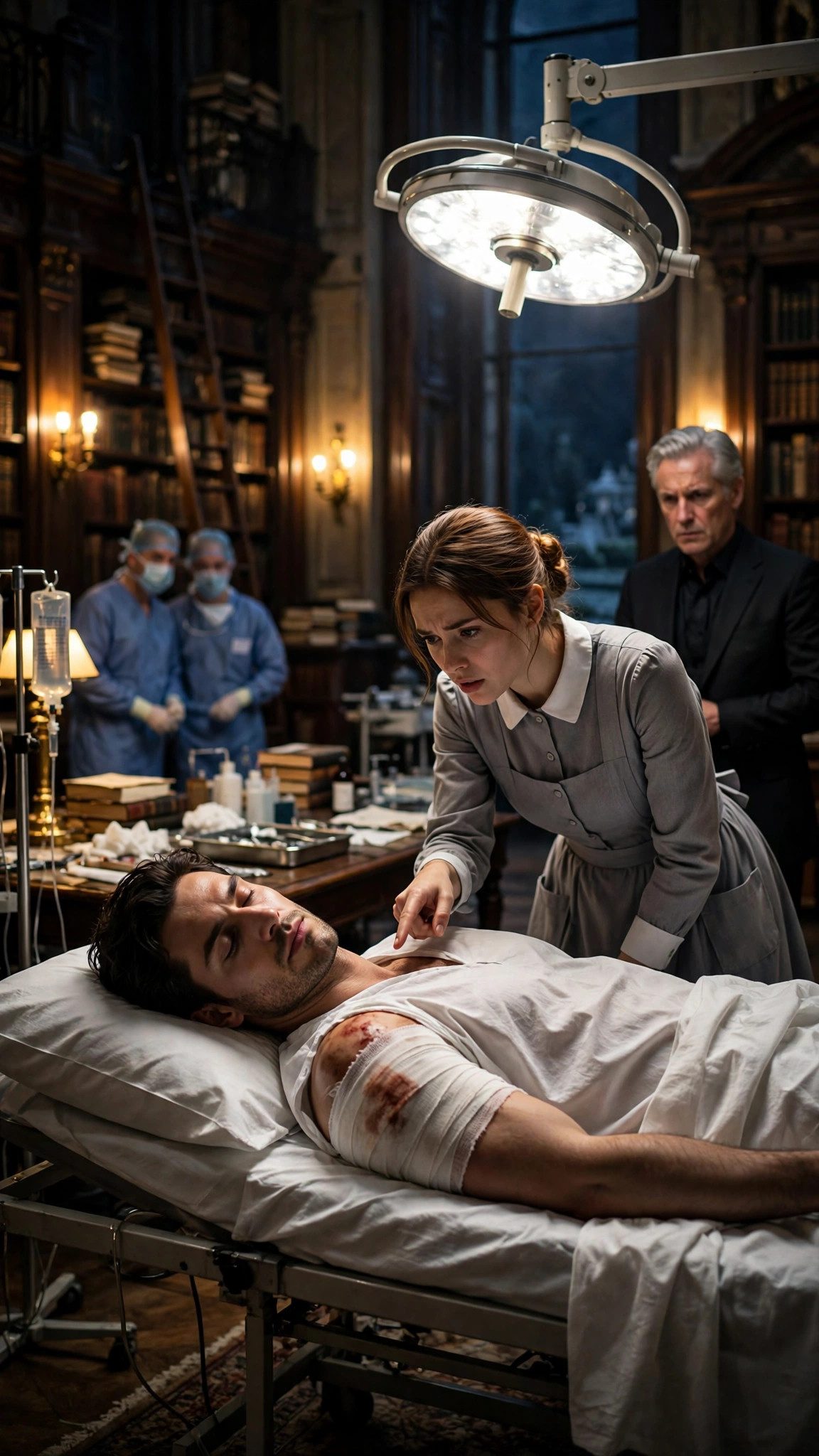
The night I was hired, Mrs. Delgado walked me through the mansion with a flashlight and a list, and she told me the rules of the house the way a priest tells a new girl the rules of a convent.
"These are the rooms you clean," she said, pointing at each door as we passed it. "The library. The dining room. The front hall. The ground-floor bathrooms. The kitchen, last. You do not go upstairs. You do not open closed doors. You do not answer the telephone. If a man speaks to you, you say 'Yes, sir' and you keep working. If a man looks at you, you look at the floor. Do you understand?"
"Yes, ma'am," I said.
She stopped at the library door and turned the flashlight on me, and in that narrow beam I saw something in her face that I had not seen before: not suspicion, but worry. The worry of a woman who had watched young girls come into this house and had seen what happened to the ones who did not learn the rules fast enough.
"Listen to me, Mara," she said. "Mr. Vale is a fair man. He pays on time. He does not raise his voice to the staff. But this house is not a hotel. The men who come here at night are not guests. They are the family. And the family has enemies. The less you know about the family, the safer you are. The less the family knows about you, the safer you are. Keep your head down and your mouth shut, and in a year you will have enough saved to find a better life. Do you understand?"
"Yes, ma'am," I said again. And I meant it. I had no better life to go to. I had an apartment with a radiator that screamed in the winter and a landlord who taped notices to my door and a bank balance that went down every week no matter how little I ate. The mansion paid fourteen dollars an hour at night, and that was more than the diner had ever paid me, and it was enough.
The first month, I learned the house by touch. The library's oak shelves were always dusty, because the men who used the library never sat still long enough for the dust to settle. The dining room's long table seated twenty-four, and after the Tuesday dinners there were always cigar ashes on the carpet and wine rings on the wood, and I learned to get the rings out with a paste of baking soda and lemon, the way my mother had taught me to get stains out of canvas.
The kitchen was Mrs. Delgado's kingdom. She ruled it with a wooden spoon and a sharp tongue, and she taught me how she liked things done: the copper pots hung in order of size, the knives sharpened every Sunday, the floor mopped twice, once with soap and once with clean water, because a kitchen floor should be clean enough to eat off, and in her kitchen, sometimes men did.
"Who are all these men?" I asked her one night, when we were folding linen in the laundry room and the house was quiet.
"They are the family," she said, and she did not look up from the sheet she was folding.
"But Mr. Vale's family — I never see a wife. I never see children."
"Mr. Vale has no wife," Mrs. Delgado said. "He has a mother in Florida who calls every Sunday, and a father who is dead, and an uncle who comes to dinner on Tuesdays, and men who would die for him. That is his family."
"And Victor Hale?" I asked. "He's his uncle?"
"His uncle by marriage," she said. "His father's best friend. Twenty years he has been at that table. When the old Mr. Vale died, Victor taught the young Mr. Vale everything. The docks. The warehouses. The men. Everything."
She folded the sheet with a snap and laid it on the pile.
"Victor Hale wanted the business for himself," she said, very quietly, so quietly I almost did not hear her over the hum of the dryer. "Everyone in this house knows it. No one in this house says it. The old man left it to his son, and Victor smiled, and Victor stayed, and Victor has been smiling for eight years. A man who smiles that long is either a saint or a snake, and I have never met a saint in this house."
I did not ask her anything else that night.
The second month, I learned Daniel Cross.
Daniel was the head of security, and he was the only man in the house who seemed to notice the staff at all. He would stand in the hallway outside the study with his arms crossed, and when I passed with my bucket, he would step aside, and once, when the bucket was heavy and I stumbled on the stair runner, he caught my elbow before I fell.
"Careful," he said. It was the first word he had ever spoken to me.
"Thank you, sir," I said.
He let go of my elbow and went back to watching the hallway. But after that, he nodded at me when we passed. A small nod. A human nod. In a house full of men who looked through me, Daniel Cross was the one man who seemed to see that I was a person.
I learned, from the cook's assistant, a girl named Tina who worked days and talked too much, that Daniel had been with Adrian since they were both nineteen, that he had taken a knife for Adrian once outside a warehouse in Locust Point, and that he had a sister in Virginia who did not know what he did for a living.
"He sends her money every month," Tina whispered, while we peeled potatoes. "She thinks he works in shipping. He does, in a way."
The third month, I learned about the docks.
The Vale family owned warehouses along the harbor, and trucks, and a shipping company with a name I saw on the sides of containers whenever I walked to the bus stop. But underneath the shipping company, there was something else, something the men talked about in low voices behind closed doors: protection, and routes, and a man named Vincent Castellano who wanted the Baltimore docks and had wanted them for years.
"Castellano is from New York," Tina told me. "He's old and he's mean and he thinks Baltimore belongs to him. Mr. Vale's father kept him out. Mr. Vale keeps him out. But Castellano keeps trying."
"What does he try?" I asked.
Tina looked around the kitchen, even though we were alone.
"He tries everything," she said. "He tried to buy the warehouses. He tried to scare the truck drivers. He tried to get the city to take the docks away. Last year, someone shot at one of our trucks on the highway, and Daniel said it was Castellano's men, and Mr. Vale did not go out for three days, and when he came back, two of Castellano's men were in the hospital, and nobody talked about it."
I thought about that for a long time. I thought about how strange it was to work in a house where men got shot at and nobody called the police, where the boss was a man the whole city feared, and where the most dangerous thing in the building was not a gun but a secret.
And I thought about my mother.
My mother had been a seamstress for the marine trade. She sewed industrial canvas on a machine as big as a table, in a workshop on the docks that smelled of salt and oil and hot thread. She repaired boat covers and cargo tarps and sailcloth, and she could look at a piece of fabric and tell you where it was made, what it was made of, and how long it would last.
She taught me everything she knew, because she had no one else to teach. I sat beside her machine from the time I was six, and she would hold up a swatch and say, "Feel this, Mara. This is cotton duck. This is waxed canvas. This is polyester. They look the same to a fool. They are not the same."
And she taught me about thread.
"Thread is the soul of the work," she would say. "A bad seam fails at the thread. A good seam holds because the thread is right. And there is one cord you must never confuse with anything else."
She held up a piece of black cord, thick and rough, braided in a diamond pattern, bristling with tiny fibers.
"This is marine cord," she said. "Diamond braid. They coat the older stock with chemicals to keep it from rotting in salt water. It burns skin. It poisons a wound. If you ever see it where it does not belong, you run, because someone put it there on purpose."
"Why would someone put it where it does not belong?" I asked. I was nine, and I did not understand that people put poison in places on purpose.
"Because people are cruel, and clever, and patient," my mother said. "And because a slow poison is harder to prove than a fast one."
She died in March, in the same hospital where I had been born, of a cancer that had been growing inside her for a year while she told me it was only a cough. She left me the apartment, and the sewing machine, and the gold earrings her own mother had given her on her wedding day.
The earrings were small, plain gold hoops, and they were worth perhaps two hundred dollars at a pawnshop. I had stood outside the pawnshop on Eastern Avenue twice since she died, holding the little velvet box in my pocket, and twice I had turned around and gone home, because selling them would have been like selling the sound of her voice.
So I kept them in the box, and I kept the box in my sock drawer, and I went to work at the mansion every night, and I cleaned, and I listened, and I pretended I had not heard anything, because that was what servants did in that house.
But I heard things anyway.
I heard Adrian Vale's voice through the study door, low and calm, the voice of a man who never needed to shout because everyone in the room was already afraid of him. I heard him say Castellano's name the way other men said the word "cancer." I heard him tell Daniel Cross to double the guards at Warehouse Nine, and to check every truck, and to find out who had been asking questions about the docks.
I heard Victor Hale in the dining room on a Tuesday night, saying to another man, "Adrian is young. He is stubborn. He does not listen to advice the way his father did," and the other man saying, "The boy will learn," and Victor saying, "Or he will not, and then someone else will have to lead."
I heard the cook say that Mr. Vale had not eaten in two days, and Mrs. Delgado say that he was working too hard, and Tina say that she had seen him standing at the library window at three in the morning, looking out at the harbor, like a man waiting for something to come out of the dark.
And then, on a Tuesday afternoon, someone shot him outside Warehouse Nine.
I was asleep when it happened. I woke to my phone buzzing, and it was Tina, and she was crying, and she said, "They shot Mr. Vale. They shot him outside the warehouse. He's alive, but he's hurt, and the house is going crazy."
I went to work that night, and the mansion was a different place. The gates were closed. The guards were doubled. Daniel Cross stood in the front hall with a gun on his hip, and his face was white, and when I walked past him, he did not nod. He did not see me at all.
Mrs. Delgado was in the kitchen, and her hands were shaking when she poured the coffee.
"The bullet grazed his shoulder," she said. "That is what they say. It grazed his shoulder and shattered the window behind him. He will recover. The doctor says he will recover."
But he did not recover.
For a week, he seemed to. The wound was cleaned and stitched. The antibiotics were started. He sat up in bed and ate soup and argued with Daniel about the warehouse schedules, and Mrs. Delgado said, "See? He is strong. He is his father's son."
And then the fever came back. And the wound turned red, and then dark, and then black at the edges, and the skin around it swelled until his shoulder looked like it belonged to a much larger man, and the smell began.
I knew the smell was wrong before I knew why. I had cleaned enough in my life to know the difference between a wound that was healing and a wound that was dying. A healing wound smelled like blood and medicine. This one smelled like something else underneath the medicine, something sharp and bitter, something chemical, something that did not belong in a human body.
Dr. Pierce came every day, and every day he shook his head, and every day he said the same word: "Infection." And every day they brought in another specialist, and the specialists stood around the bed in the library and looked at the wound and looked at each other, and none of them could explain why a grazed shoulder was killing a healthy man.
On the eleventh day, Adrian stopped waking up.
On the twelfth day, they brought in the surgical lights, and the instruments, and eighteen surgeons, and they turned the library into an operating room, and Mrs. Delgado told me to stand near the wall with a yellow trash bag and not speak to anyone, and I did what she told me, because I was a maid, and maids did what they were told.
But I was also my mother's daughter. And my mother had taught me to look at the twist.
When Dr. Pierce pointed at the used bandages and told me to clean them up, I walked toward the bed, and the bitter smell hit me, and I looked down at the open wound, and I saw the black knots buried in the swollen tissue, and I knew.
I knew what the thread was. I knew where it came from. I knew what it did to a wound. And I knew, with a certainty that went down to my bones, that it had not gotten there by accident.
Someone had put poison inside Adrian Vale's shoulder. Someone had buried it there twelve days ago, when the wound was first treated, and then stood back and waited for the fever to finish what the bullet had started.
And the only person in that room who could see it was the maid with the trash bag.
I did not think about my job. I did not think about the FINAL NOTICE on my door, or the thirty-eight dollars in my bank account, or the gold earrings in my sock drawer.
I thought about my mother, sitting beside her sewing machine, holding up a piece of black cord, saying, "If you ever see it where it does not belong, you run, because someone put it there on purpose."
I did not run. I pointed. And I spoke.