At 11:07 P.M., my six-year-old daughter died, and her father was three thousand miles away on a yacht off the coast of Monaco with another woman.
I know the time exactly because I watched the clock above the operating room doors for two hours and thirty-eight minutes, and because the nurse who came out to find me looked at her watch before she said the words, and because afterward, when the doctor asked me to sign the papers, the form already had the time printed on it in neat black type: 23:07. Eleven oh seven. The minute my daughter stopped being alive and started being a memory.
Her name was Lily Moreland. She was six years old. She had brown curls that would not stay in a braid no matter how many times I tried, and a gap between her front teeth, and a teddy bear with one eye that she had carried everywhere since she was two. That afternoon she had worn a butterfly hair clip, blue and silver, because butterflies were her favorite thing in the world that week. The week before it had been dolphins. The week before that, it had been the moon.
I had spent the whole day telling her that her daddy was coming.
That was the lie I told her seven times. Or rather, that was the lie I told her while she asked for him seven times. I have counted them since, over and over, the way you count the steps between your bed and the door in the dark, the way you count anything when counting is the only thing left that makes sense. Seven times my daughter asked for her father while she was dying. Seven times I promised him to her. Seven times he did not come.
The first time was in the car, right after the truck hit us. We were driving home from her ballet class, and it had started to rain, the kind of thin October rain that makes the roads shine like glass. The truck came across the center line all at once, its headlights suddenly filling my window, and then the world turned sideways. Our car spun twice. The airbags exploded. Glass shattered around us, a sound like a thousand windows breaking at the same time, and then there was a silence so complete it felt like the whole city had stopped breathing.
When I came back to myself, I heard her crying. A small, frightened sound from the back seat.
"Mommy?"
I turned toward her. Blood was running down her forehead in a thin red line, bright against her pale skin. Her butterfly clip had come loose and was hanging by one wing in her hair.
"Where's Daddy?"
That was the first time. She was bleeding and frightened and upside down in her car seat, and the first person she wanted was her father. Not me. Not the doctors. Her daddy. Because to a six-year-old, her daddy is the person who fixes everything. He is the biggest, strongest person in the world, and if he is there, nothing bad can stay bad for long.
"He's coming, baby," I said. "Daddy's coming."
I grabbed my phone and called him from the ambulance. No answer. I tried again. Nothing. On my fifth attempt, he finally sent a message.
"In a meeting."
I replied immediately. Lily's been in an accident. Call me now.
He didn't respond.
At the hospital, the doctors rushed Lily into the emergency department, and I ran beside the gurney holding her hand, and she squeezed my fingers so hard it hurt, and she looked up at me with those big brown eyes, the same eyes as her father, and she asked me the second time.
"Is Daddy coming?"
"Yes, sweetheart," I said. I hated how easily the lie came out. It slid off my tongue like it had been waiting there all along. "Daddy's coming."
Twenty minutes later, she asked again. The third time. They had her on a bed in the trauma bay by then, and there were people everywhere, nurses and doctors moving fast and talking in low, urgent voices, and monitors beeping, and someone was cutting away her little pink leotard, the one with the sparkles on it, and she looked past all of them, past all the strangers in scrubs, and found my face.
"Where's Daddy, Mommy?"
"He's on his way," I said. Another lie. "He's on his way, baby. Just hold on."
An hour later, her voice became weaker. The doctors had found internal bleeding, and they were preparing to take her into surgery, and a nurse was explaining the consent form to me, and I was signing it with a hand that shook so badly I could barely hold the pen, and Lily tugged at my sleeve with the last of her strength.
"Mommy?"
"I'm here, sweetheart."
"Does Daddy know I'm hurt?"
That was the fourth time. I turned my face away so she wouldn't see me cry.
"Yes, baby."
She looked confused. Her brow furrowed, the same way it did when she was trying to work out a puzzle.
"Then why is he taking so long?"
That was the fifth time, and I couldn't answer her. What was I supposed to say? That her father was on a yacht in Monaco with a woman named Sabrina, drinking champagne while his daughter bled? That he had read my message and chosen not to answer? That the most powerful man in Chicago, the man who owned private jets and controlled shipping companies and luxury properties and a criminal empire protected by armed men, could not be bothered to come home?
I kissed her forehead and told her that Daddy loved her more than anything in the world, and that he was trying to get to her, and that she had to be brave, just a little bit longer.
As they prepared to take her away, she tugged my sleeve again. Her hand was so small. Her fingers were so cold.
"Mommy?"
"I'm here, sweetheart."
"Don't let Daddy be sad."
I stared at her. "Why would Daddy be sad?"
Her eyes filled with tears. "Because I ruined his trip."
Something inside me broke. Not cracked. Broke, all the way through, the way a window breaks when a stone goes through it, all at once and beyond repair. My six-year-old daughter, lying on a gurney with internal bleeding, was worried that she had ruined her father's vacation. She was worried about his feelings. She was dying, and she was worried about him.
"No, Lily," I said, and I kissed her forehead, and I tasted salt, and I didn't know if it was her tears or mine. "You didn't ruin anything."
She swallowed. Her voice was barely a whisper now.
"Daddy still loves me the most, right?"
That was the sixth time. The sixth time she asked for him, in one way or another. I nodded, and I hated myself for having to reassure her, for having to promise her a love that should have been obvious, that should have been proven by his presence instead of my words.
"Yes, sweetheart. Daddy loves you the most."
Damian finally called back two hours and thirty-eight minutes later. I was standing outside the operating room, staring at the doors, willing them to open, willing someone to come out and tell me she was going to be all right.
"What happened?"
I closed my eyes. "Our daughter is in surgery."
His voice sharpened. "I'm coming home."
"Where are you?"
Silence.
"Damian."
"Monaco."
I closed my eyes. "With Sabrina?"
He didn't answer. I hung up.
Lily never woke up after surgery. At 11:07 P.M., my little girl died. And her father wasn't there.
That was the seventh time she asked for him. I know, because I was there when they wheeled her out of the operating room and into recovery, and the nurse let me sit with her for a few minutes, and I held her hand, and I leaned close to her ear, and I whispered, "Daddy's on his way, baby. He's almost here." And her lips moved, just barely, and I thought I heard her say, "Tell Daddy I waited."
Tell Daddy I waited.
She waited for him. She waited through the crash and the ambulance and the emergency room and the surgery, and she waited while I lied to her, and she waited until there was nothing left to wait with. And he never came.
The following morning, Damian returned to our mansion. But I'd already left.
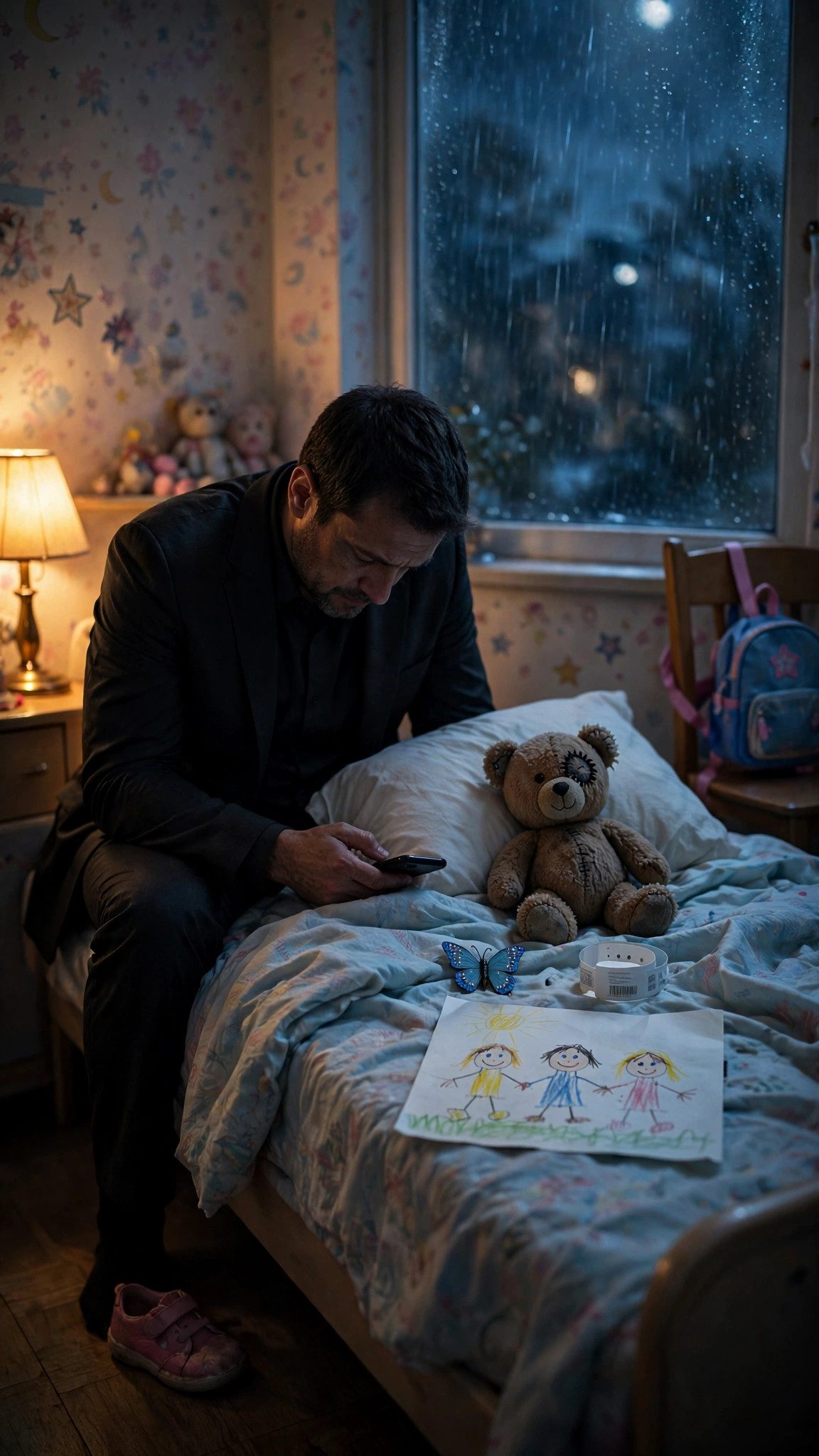
He walked upstairs and opened Lily's bedroom door. Her backpack still hung from the chair. One little shoe lay beneath the bed. Her one-eyed teddy bear rested against the pillow. On the bed, I'd left four things. The butterfly hair clip she'd worn during the accident. Her hospital bracelet. A family drawing she'd made the week before. And my phone.
In the drawing, Lily and I stood together holding hands. Damian stood farther away.
He picked up the phone. One recording was waiting. He pressed play. Our daughter's tiny voice filled the room.
"Does Daddy know I'm hurt?"
Then my voice. "Yes."
A pause.
"Then why is he taking so long?"
The recording ended. Beneath the phone, I'd written: "I lied to our daughter until the very end, telling her you were coming. She died believing her father was trying to get home."
Damian sat on the edge of Lily's bed. He didn't call his guards. He didn't order anyone to find me. He just stared at the empty space where our daughter should have been.
Near noon, the housekeeper finally entered. "Mr. Moreland?"
Damian didn't look up. "Did Claire leave alone?"
"Yes, sir."
"What did she take?"
"Just one suitcase."
He nodded slowly. Then asked the question he'd been afraid to ask.
"Did Lily ask about me?"
The housekeeper couldn't answer. But the phone lying beside him already had.
And Damian had only heard one of the seven times our little girl asked why her daddy hadn't come.
I was already gone by then. I had taken the first train out of Chicago with one suitcase and my daughter's butterfly clip in my pocket, and I did not look back at the mansion, and I did not look back at the life I had lived there for nine years, because there was nothing left in that house for me except an empty bedroom and a man who had chosen a yacht in Monaco over his dying child.
I did not know where I was going. I only knew I was never going back.
That was what I believed, standing on that train platform in the gray morning light, with the wind coming off the lake and my coat buttoned up to my chin and my daughter's voice still echoing in my ears. Seven times. She asked for him seven times. And I had lied to her seven times, because the truth would have killed her faster than the bleeding did.
I thought I was done with Damian Moreland forever. I thought the story of us had ended at 11:07 P.M. in a hospital corridor, under a clock that would never stop ticking in my head.
I was wrong. The story was only beginning. But I didn't know that yet. All I knew, as the train pulled out of the station and Chicago slid away behind me, was that my daughter was gone, my husband had failed her, and I had six years of her life to carry alone, in one suitcase, with a butterfly clip in my pocket and a recording on a phone I had left behind for a man who deserved to hear it a thousand times, until the words were carved into him so deep he could never forget them.
Does Daddy know I'm hurt?
Then why is he taking so long?
Seven times. She asked for him seven times.
And this is the story of what happened after the seventh time.
The train carried me north along the lake, past towns I had never stopped in, past houses with lights coming on in their windows, past ordinary lives going on as if the world had not ended the night before. I pressed my forehead against the cold glass and watched the water slide by, gray and endless, and I thought about the last ordinary day. The day before the accident. Lily had come home from school with a spelling test, and she had gotten nine out of ten, and she had been furious about the one word she missed, a word I could not even remember now. Butterfly. No, that was not it. She had spelled butterfly correctly. It was something else, something small and forgettable, and she had practiced it twenty times at the kitchen table while I made dinner, her tongue caught between her teeth the way it always was when she concentrated.
I would have given anything to remember that word.
At the Evanston station, my sister Sarah was waiting on the platform in a coat that was too thin for the wind, her arms wrapped around herself, her face pale. She had driven down from her house the moment I called her from the hospital, and the nurses had let her sit with me in the family room while the surgeons worked, and she had held my hand through all of it, through the waiting and the silence and the doctor's quiet voice. She did not ask me any questions on the platform. She just took my suitcase with one hand and put her other arm around my shoulders, and she walked me to her car, and she drove me to her house, and she put me in the guest room, and she brought me tea I did not drink, and she sat on the edge of the bed until I fell asleep.
I slept for fourteen hours. When I woke up, it was dark again, and Sarah was still there, in the chair by the window, watching over me the way I had once watched over Lily when she had a fever. I thought about the butterfly clip in my pocket. I took it out and held it in my palm, and the blue wings caught the light from the hallway, and for a moment it looked almost alive, almost ready to fly away.
"Sarah," I whispered. "She asked for him seven times."
"I know," Sarah said. "You told me."
"I lied to her seven times."
"You loved her," Sarah said. "That is not the same thing."
I closed my hand around the clip. Outside the window, the first snow of the season had started to fall, thin white flakes drifting down through the dark, settling on the bare branches of the maple tree in Sarah's yard. Lily had loved the first snow. Every year she pressed her face to the window and watched it come down, and she always said the same thing, that the sky was shaking out its pillows. I would never hear her say it again.
"I'm never going back," I told Sarah.
She nodded. "Then you stay here. As long as you need."
I believed her. I believed that I could stay in that small guest room forever, with the snow falling outside and my daughter's clip in my hand, and that the world would simply leave me alone. I believed that Damian Moreland would stay in his mansion with his guilt and his mistress and his empire, and that I would never have to see his face again.
I was wrong about that, too. But on that first night, in my sister's guest room, with the snow coming down and my daughter gone, I did not know it yet. All I knew was that the worst thing that could ever happen had already happened, and I was still alive, and I did not understand why.