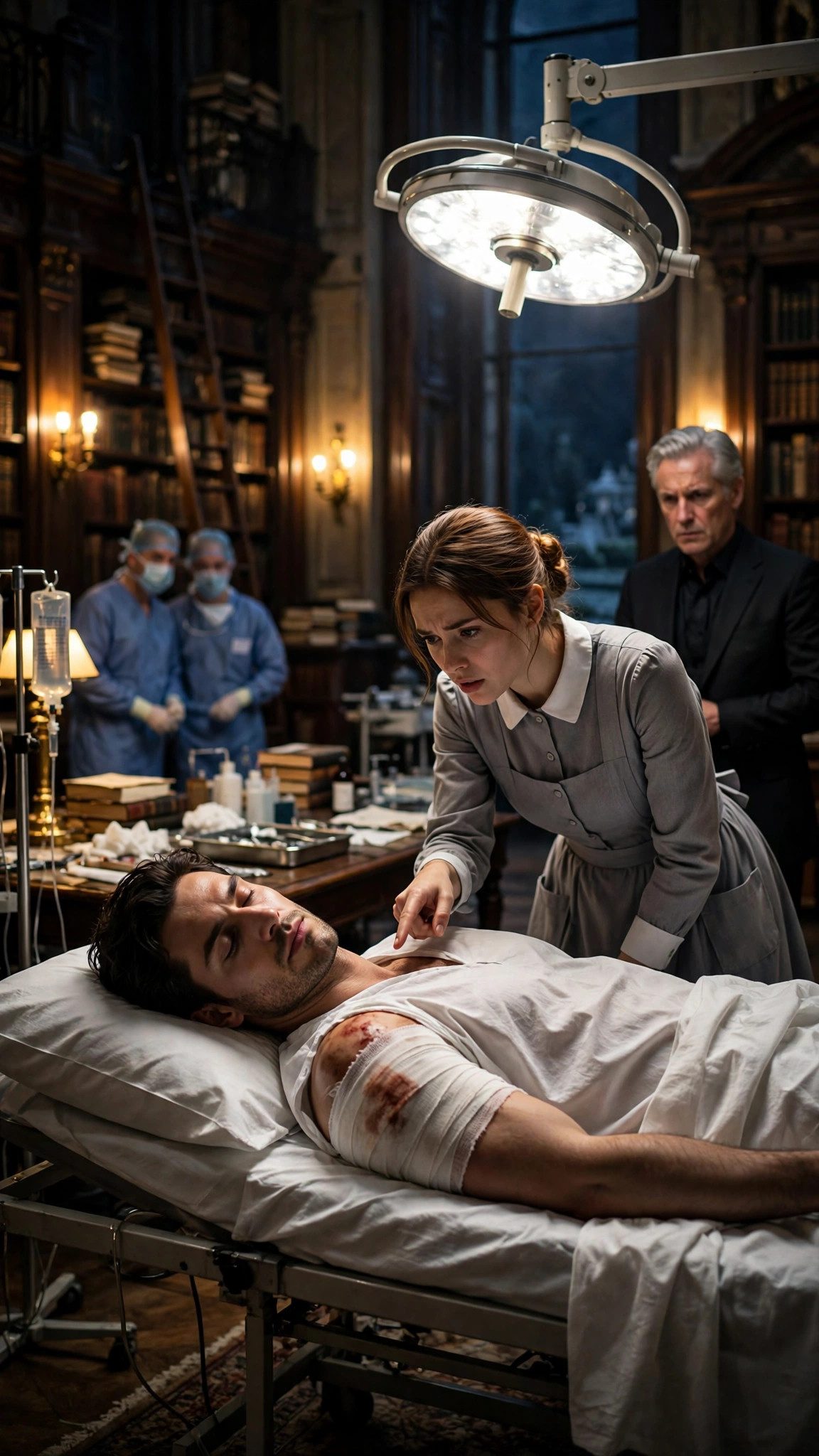
The FBI came on a Friday morning, in three black cars, and they parked in the curved driveway like they owned it, and Daniel Cross opened the front door himself, and he said, "He's in the study," and the men in suits walked past the marble floors and the high ceilings without looking at any of it, because they had seen houses like this before.
The man in charge was Agent Daniel Reyes. He was forty-five, with gray at his temples and a suit that fit him like a man who had worn suits for twenty years, and he carried a leather folder under his arm, and he shook Adrian's left hand like they were old friends, which, in a way, they were.
"You called me," Reyes said. "That's new."
"I called you because I have something you want," Adrian said. He was sitting in the study now, behind his father's desk, in a chair that had belonged to the old man, and he looked tired but steady, and his shoulder was healing, and his voice was strong.
"I have a surgeon who will testify that Vincent Castellano paid him two hundred and fifty thousand dollars to plant poison in my shoulder. I have a hitman who will testify that my uncle paid him five thousand dollars to finish the job. I have a bag of poison and a tray of cord and a wire transfer from a shell company called Bellini Holdings. And I have something else."
He opened a drawer in the desk, and he took out a ledger, a thick black book with pages full of numbers in his father's handwriting, and then another ledger, and another, and he laid them on the desk in a neat row.
"My father's ledgers," he said. "And mine. Twenty years of routes, and warehouses, and payments, and names. Every dollar Castellano ever moved through Baltimore. Every man he ever paid. Every warehouse he ever used. It is all here."
Agent Reyes looked at the ledgers for a long moment. Then he looked at Adrian.
"You know what happens if I take these," he said. "You know what it means for you."
"I know," Adrian said. "It means I am finished. It means the family is finished. It means everything my father built, and everything I built, comes apart. And it means Castellano goes to prison for the rest of his life, and my uncle goes with him, and the docks stay in Baltimore, where they belong."
He leaned back in the chair, and he winced a little, because his shoulder still hurt, and Daniel stepped forward, but Adrian waved him back.
"I have spent eight years being the man my father was," Adrian said. "A man who kept the docks by force. A man who paid men to be afraid of him. A man who had enemies in every shadow. And I almost died because of it, not once, but twice, and the second time, the only reason I am alive is a maid who knew what a piece of thread was."
He looked at Reyes.
"I am done being that man. I want to be the man who ships cargo and pays his taxes and goes home at night and does not need guards at his door. And if the price of that is these ledgers, and a trial, and whatever comes after, then I will pay it."
Agent Reyes picked up the top ledger and opened it. He read a page. He closed it. He put it back on the desk.
"Then we have a deal," he said. "You give me Castellano, and you give me Victor Hale, and you give me the ledgers, and I will make sure the United States Attorney knows that you came to us, and that you cooperated, and that you saved your own life by telling the truth."
He stood up, and he held out his hand, and Adrian shook it with his left hand, and the two men looked at each other, and I thought, from where I was standing in the hallway with my bucket, that it looked like the end of a war.
Victor Hale was arrested that same afternoon, at his house, in front of his wife and his neighbors. He did not resist. He smiled, the way he always smiled, and he said to the agents, "There must be some mistake," and the agents said, "No mistake, Mr. Hale," and they put handcuffs on him, and they took him away.
Dr. Pierce was arrested the same day, at his clinic. He cried when they put the handcuffs on him. He told them everything. He told them about the wire transfer, and the shell company, and Victor's instructions, and the cord, and the chemical coating, and he told them that he had known it would hurt Adrian, and that he had done it anyway, because his wife was sick and his practice was failing and he needed the money.
Eddie Krol was already in custody. He told them everything too. He told them about the five thousand dollars, and the man in the black coat, and the IV bag, and the syringe, and he told them that Victor had said the maid would not know the difference.
But the maid had known. The maid had smelled it. The maid had screamed.
The trials took months. I did not go to them. I was not asked to testify. Daniel told me that my statement had been taken, and that it was enough, and that the cord and the bag and the syringe spoke for themselves.
But I heard about the trials from Tina, and from Mrs. Delgado, and from the newspapers that the cook left on the kitchen table.
Victor Hale testified against Vincent Castellano. He told the court everything: the two years of secret meetings, the money, the plan to take over the Baltimore operation, the cord, the hitman, all of it. He testified for three days, and at the end of it, he was sentenced to eight years in federal prison, because he had cooperated, and because the judge believed that he had been used by a bigger man.
Vincent Castellano was sentenced to life in prison, without the possibility of parole, for racketeering, and conspiracy to commit murder, and attempted murder, and a list of other charges so long that the newspaper needed two pages to print them all.
Dr. Pierce was sentenced to five years, and he lost his medical license, and his wife left him, and the last I heard, he was working in a warehouse in Norfolk, packing boxes, which seemed to me like a kind of justice, because he had spent his life cutting people open, and now he spent his days taping boxes shut.
And Adrian Vale?
Adrian Vale gave the FBI everything. He gave them the ledgers. He gave them the routes. He gave them the names. And in return, the United States Attorney agreed that Adrian would not be prosecuted for the crimes of the past, on the condition that he dismantle the criminal side of the Vale organization completely, and that he cooperate fully, and that he never go back.
So he did. He closed the warehouses that moved things they should not have moved. He fired the men who carried guns. He sold the trucks that ran at night without papers. He kept the shipping company, and the legitimate freight business, and the docks, and he ran them the way his father had run them in the beginning, before the kingdom grew too big and too dark: honestly, and openly, and in the daylight.
The mansion changed too. The guards went away, one by one. The cameras came down. The study door stayed open. The library became a library again, with books on the shelves and a reading desk by the window, and Adrian sat there in the afternoons, reading, with his right arm in a sling, doing his physical therapy exercises, lifting a small weight up and down, up and down, rebuilding the strength in a shoulder that had almost been cut off.
And I changed too.
Adrian kept his promise. I kept my job. But the job became something else. He raised my pay. He paid my rent for three months, until I told him to stop, because I did not want charity, and he laughed, and he said, "It is not charity, Mara. It is back pay. You saved my life twice. I owe you more than rent."
He asked me to run the house. Not just to clean it, but to manage it: the staff, the schedules, the kitchen, the budget. Mrs. Delgado was retiring, and she recommended me, and she said, "She sees what other people miss. That is the only qualification that matters in a house like this."
So I became the housekeeper of the Vale mansion. I wore a gray uniform, but it was a better one, and I carried keys instead of a trash bag, and the staff called me "Miss Bennett" instead of "girl," and Tina said I walked differently now, with my shoulders back, like a woman who knew she belonged somewhere.
And Adrian and I talked.
We talked in the library, in the afternoons, when he was doing his exercises and I was bringing him tea. We talked about my mother, and the sewing machine, and the docks. We talked about his father, and the old days, and the kingdom he had inherited and the kingdom he was trying to build now, a smaller kingdom, an honest one.
He told me about the night he was shot, and how he had known, even then, that it was not a random attack, that someone inside had told the shooter where he would be. He told me about Victor, and how he had trusted him for twenty years, and how the betrayal had hurt more than the bullet.
And I told him about the FINAL NOTICE, and the thirty-eight dollars, and the pawnshop on Eastern Avenue, and the gold earrings I would not sell.
One afternoon, he reached into his desk drawer, and he took out a small velvet box, and he opened it, and inside were my mother's gold earrings.
I stared at them. "How did you —"
"I didn't buy them," he said quickly. "You never sold them. I know that. Mrs. Delgado told me. I had a pair made. An exact copy, from a photograph. Because I wanted you to have a pair you could wear every day, without worrying about losing the ones your mother gave you. Those stay in the box, safe. These are for wearing."
He held the box out to me. I took it with shaking hands. The earrings were small, plain gold hoops, exactly like my mother's, and they caught the afternoon light from the library window, and they shone.
"Thank you," I whispered.
"Don't thank me," he said. "Thank your mother. She taught you to see. And because you saw, I am alive. And because I am alive, I get to build something better. And I want you to help me build it."
He looked at me then, and his eyes were dark, and steady, and I realized that he was not looking at me the way a boss looks at a housekeeper.
He was looking at me the way a man looks at a woman he wants to know better.
And I was looking at him the way a woman looks at a man she has already saved twice, and might be willing to save a third time, if he would only let her.
"Mara," he said, very quietly. "May I take you to dinner? Not in this house. Out. Somewhere with candles, and no guards, and no one watching. Just you and me. And if you say no, I will understand, and nothing will change, and you will still be the housekeeper, and I will still be grateful. But I would like to ask."
I thought about it for exactly three seconds. Then I said, "Yes."
Before that dinner, there was one more thing Adrian had to do, and he asked me to go with him.
On a Sunday morning, we drove to the cemetery on the edge of the city, where his father was buried under a plain gray stone that said only his name and his dates, nothing more. Adrian stood in front of the grave for a long time, with his hands in his pockets, and I stood a few steps behind him, because it felt like a private moment, and I did not want to intrude.
"I told him," Adrian said at last, without turning around. "I called my mother in Florida last night, and I told her everything. About Victor. About Castellano. About the ledgers. About you. She cried. And then she said, 'Your father would be proud of you.' And I asked her how she knew that, and she said, 'Because he always said the bravest thing a man can do is tell the truth, even when it costs him everything.'"
He turned to look at me then, and his eyes were wet, and he did not try to hide it.
"My father built a kingdom," he said. "And I spent eight years trying to be him. But he built it with one truck and an honest day's work, and I was running it with guns and fear. That was never what he wanted. So I am going to build it again, the way he built it the first time. Small. Honest. In the daylight."
He took a breath, and he looked back at the gray stone.
"I also told my mother about the foundation," he said. "The one I want to start. For the families of dockworkers. For seamstresses. For people who are down to their last thirty-eight dollars and a notice on the door. I want to call it the Elena Bennett Foundation, after your mother. Because she taught you to see, and because you saw, I am alive. And I want her name to mean something in this city."
I stood there, in the cemetery, in the Sunday morning sun, and I could not speak. My mother had sewn canvas on the docks for thirty years, and no one had ever named anything after her, and now the most feared man in Baltimore wanted to put her name on a foundation.
"She would have liked that," I whispered at last.
"I know," Adrian said. "That is why I asked you first."
That evening, we went to dinner, to a small restaurant by the harbor, with candles, and no guards, and no one watching. And he asked me about my life, and I asked him about his, and we talked until the restaurant closed, and he walked me home, and he kissed my hand at my door, like a gentleman from another century, and I went inside, and I held the little velvet box with my mother's gold earrings, and I thought about how a single black thread had unraveled a kingdom, and how a new thread, a better thread, was being sewn in its place.
And that was the beginning of the rest of the story.