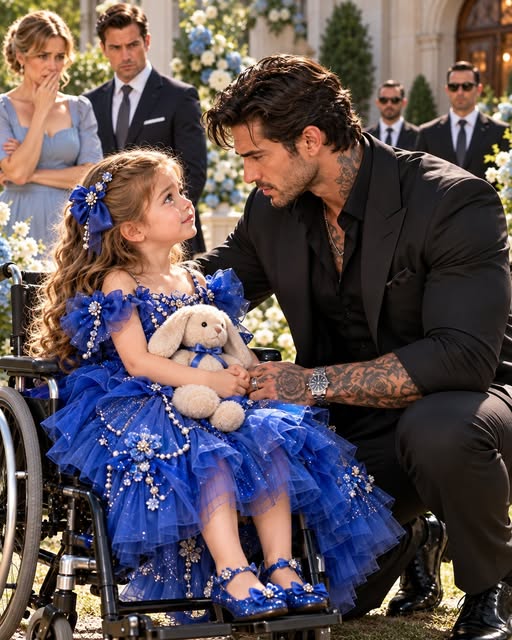
The first car door opened, and a man stepped out, and the whole courtyard went quiet in a different way. It was not the quiet of children stopping a game. It was the quiet of grown-ups holding their breath.
He was tall, and he wore a black suit, and he had dark wavy hair and a little bit of stubble on his chin, like he had forgotten to shave because he had something more important to think about. His arms had tattoos that peeked out from under his sleeves, dark shapes that curled like vines. Two other men got out of the other cars, big men in dark suits, who stood a little bit behind him, like guards in a story. I learned later that their names were Marco and Enzo. At that moment, they were just two shadows with kind eyes, which is a strange thing to say about shadows, but it is true.
Mrs. Bell stepped forward, and the director of St. Clare's came out of the house, smoothing his tie, looking both important and nervous. The director is a practical man. He likes forms and schedules and rules, and he likes placements, because a placement means a child has found a home. He shook the tall man's hand, and he said, "Mr. Moretti, welcome to St. Clare's." The name landed in my ears like a bell. Moretti. Dominic Moretti.
I had heard that name before, in whispers. Grown-ups in town whispered it when they talked about New York, about business, about a man who was feared. I did not know what "feared" meant, exactly, except that it meant people stepped aside when he walked past, and they lowered their voices, and they did not argue with him. I looked at him, and I thought, "He does look like someone people would step aside for." He had a stern face, the kind of face that does not smile easily. But his eyes, when they found me under the oak tree, were not stern. They were sad, and soft, and a little bit lost, like a person who has walked into a room and forgotten why he came, except that he knows it matters.
He walked toward me, slowly, not like a man in a hurry, but like a man who did not want to scare a small girl in a wheelchair. The two guards stayed back by the cars. The director stayed back too. Mrs. Bell stayed close, but not too close, because she wanted me to be able to speak for myself. I sat up straight. I held Mr. Bear on my lap. I counted my pearl buttons, just in case. One, two, three, four, five, six, seven.
Then he did something I did not expect. He took off his black jacket, folded it carefully, and put it on the ground. He laid it flat on the grass, among the white flowers, like a blanket. And then he knelt on it. He knelt down, right there in the courtyard, so that his face was at the same height as mine. No grown-up had ever done that for me before, not like that. Grown-ups usually bent down a little, or crouched for a second and then stood up again because their knees hurt. This man knelt, and he stayed kneeling, and he looked me right in the eyes, as if I were not a child in a wheelchair to be talked down to, but a person to be talked with.
"Hello, Lily," he said. His voice was deep, and a little bit rough, like he did not use it for gentle things very often. "I am Dominic. May I sit with you for a little while?"
I nodded. I did not trust my voice yet. He did not rush me. He looked at my drawing, which was still on my lap, and he looked at Mr. Bear, and he smiled, just a tiny smile, at the blue ribbon.
"Why are you alone out here?" he asked. His voice was quiet. "Where are your friends?"
I thought about that question. I thought about Tommy and Rosa, who were watching from the porch, and about Mrs. Bell, who was watching from the steps, and about all the banners I had waved at, and all the families who had not come back. I thought about the word "burden," and the word "normal," and the way hope had started to feel like a bruise.
"Because nobody chose me," I said. It came out braver than I felt. "Three families came, and three families went away. The last one said I was a burden, and they wanted a normal child."
I watched his face change. The stern part went away. The sad part got bigger. His jaw tightened, and his eyes went shiny, but he did not look away. He did not pretend he had not heard me. He said, "I am sorry they said that to you, Lily. That was a cruel thing to say, and it was not true."
I believed him, a little. I wanted to believe him more. So I asked him the questions I had been carrying around in my pocket, like lucky coins, waiting for someone brave enough, or honest enough, to answer them.
"Are you dangerous?" I asked.
He did not laugh. He did not get angry. He thought for a moment, which I liked, because it meant he was taking my question seriously.
"Some people would say yes," he said, honestly. "I have done hard things in my life, Lily, and I have made choices I am not proud of. But I am not dangerous to you. I would never hurt a child. I would never hurt you."
I nodded. That was a good answer. It was not a perfect answer, because perfect answers are usually lies, but it was an honest answer, and honest answers are better.
"Do you have a daughter?" I asked.
His face went very still. The courtyard seemed to hold its breath again. Mrs. Bell put her hand over her mouth. The director, who had been standing very straight, went a little bit pale.
"I did," Dominic said, very quietly. "I had a little girl. She is gone now. She died a long time ago, when she was very small, and I have carried her in my heart ever since. I never stopped missing her."
He did not tell me how she died, and I did not ask, because some stories are too sad to tell in a courtyard, and because I could see in his eyes that the sadness was still fresh, even after all those years. I thought about a man with money and power and big black cars, who had everything except a family, and who was kneeling on his own jacket in the grass to talk to a girl nobody chose. I thought, "He understands what it feels like to lose someone. He understands what it feels like to be alone."
"Would you like one?" I asked. I meant a daughter. I meant me. I was not sure if he would understand, but I hoped he would.
He looked at me, and his eyes filled with tears, and he did not try to hide them. A big, feared man, crying in front of a six-year-old girl, in a courtyard full of people, and not caring who saw. "Yes," he said. "Yes, Lily. I would like that very much. More than anything."
My heart beat very fast. It beat like a drum in a parade. I held Mr. Bear tighter. I thought about all the times I had hoped, and all the times hope had hurt, and I thought about the daisy chain Mrs. Bell had made, and the lemonade, and the toast cut into triangles. I thought about a kitchen, and a lap, and a hand that held mine because they wanted to.
And then I asked him the question that mattered most. The question I had been afraid to ask anyone, because the answer could break my heart in a way that no other answer could. Five words. Small words. Heavy words.
"Would you leave me too?"
The words hung in the golden air. The white flowers did not move. The oak tree did not move. Dominic Moretti, the feared man from New York, went pale. His mouth opened, but no sound came out. He was speechless. He looked at me, and I could see that my five words had broken something open inside him, something he had kept locked for a long time. His hands trembled, just a little. The director gasped, a small, surprised sound, like he had not expected a six-year-old to say something so direct, and so true.
Dominic did not stand up. He did not walk away. He did not pretend he had not heard me. He reached, slowly, into the inside pocket of his coat, which was still on the ground under his knees, and he pulled out a folded paper. It was thick, and official-looking, with a seal, and writing that I could not read from where I sat. He held it in his hands, and he looked at it, and then he looked at me, and he took a deep breath, like a man getting ready to tell the truth.
"Lily," he said, "this is why I came today. I did not come to look at you like you were something to choose from a catalog. I came because I heard about a brave girl in a blue dress who had been sent back three times, and I could not stop thinking about her. I talked to Mrs. Bell, and to the director, and to a lawyer, before I ever came here. I had papers prepared. These are guardianship papers. They are a promise, in writing, that if you and Mrs. Bell and the court agree, I want to be your guardian. I want to take care of you, and to be your family, not just for a visit, but for real."
He unfolded the paper a little more, and I saw that there was a second paper inside it, thinner, with handwriting on it, not typed words. "This is a letter," he said, softly. "I wrote it to my daughter, a long time ago, when I lost her. I never sent it, because there was nowhere to send it. I kept it in my pocket, because it reminded me to be a better man. I brought it today because I wanted you to know that I am not coming to you empty-handed, or empty-hearted. I am coming with a promise, and with a heart that has already loved a little girl, and that has room to love another."
Mrs. Bell was crying now, quietly, into a handkerchief. Marco and Enzo, the big guards, were looking at the ground, and one of them wiped his eyes with the back of his hand, pretending he had something in it. The director cleared his throat, twice, and said, "Mr. Moretti, this is highly unusual, but it is also highly proper. The papers are in order. The court will still need to decide, of course. There will be visits, and questions, and time."
Dominic nodded. He did not argue. He did not say, "I am Dominic Moretti, and I get what I want." He said, "Of course. Take all the time you need. I am not here to take Lily away today. I am here to ask if I may stay, and get to know her, and let her get to know me."
He turned back to me, still kneeling, still at my eye level, and he said, "Lily, I will not leave you. I cannot promise that life will always be easy, because that would be a lie, and you deserve better than lies. But I can promise this: I will not walk away because you are in a wheelchair, or because you need help, or because you are too much, or too loud, or too brave. You are not a burden. You are Lily. And if you will let me, I would like to be your family."
I did not know what to say. My throat was tight, and my eyes were wet, and Mr. Bear's ribbon was wrinkled again in my hands. I looked at Mrs. Bell, and she nodded, just a tiny nod, like she was saying, "It is okay to hope, Lily. It is okay this time."
I looked back at Dominic, and I smiled, through my tears, because that is what you do when someone says the thing you have been waiting your whole life to hear, and you are too happy and too scared to say anything else.
Dominic smiled back, a real smile this time, not a tiny one, and he stood up, slowly, because his knees were stiff from kneeling, and he picked up his jacket, and he brushed the grass off it, and he did not put it back on right away. He looked at the director, and at Mrs. Bell, and he asked, in his deep, rough, gentle voice, "May I stay for dinner? Not to take her away. Just to stay, and to share a meal, and to learn how Lily likes her toast?"
Mrs. Bell laughed, through her tears, and she said, "Mr. Moretti, you may stay for dinner, and for as many dinners as Lily wants you to stay for."
And as the golden light faded over the courtyard, and the white flowers glowed, and the three black SUVs waited quietly by the gate, I sat in my wheelchair, in my blue dress, with Mr. Bear on my lap, and I thought, "Maybe this time, the story does not end with someone leaving. Maybe this time, it begins with someone staying."
TITLE: A Feared Mafia Boss Knelt Before My Wheelchair, But My Five-Word Question Broke His Heart