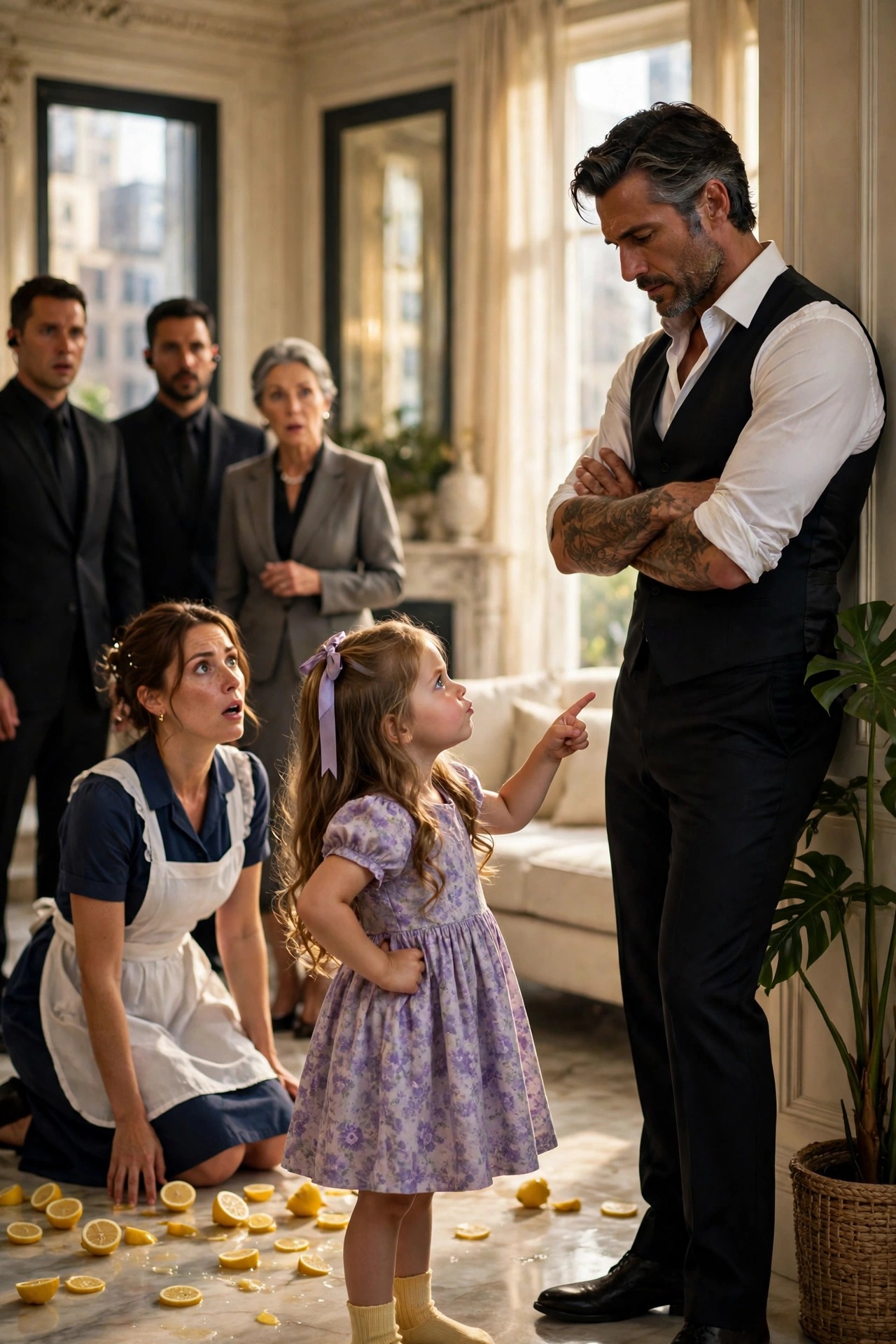
They put us in a little office at the back of the warehouse, where the paint had given up years ago and the only window was painted shut.
There was a desk with nothing on it but an old telephone that did not work. There was a chair with three legs that stood straight and one that did not. And there was my daughter, asleep and awake by turns on a pile of coats somebody had thrown into the corner, with her lavender ribbon in her fist and her yellow socks still on her feet, because even kidnappers, it turned out, did not argue with Lily about her lucky socks.
I was not brave in that room. I counted the screws in the door hinges. I listened for sirens that did not come. And I went over the one lesson Daniel had drilled into me in the happy years, back when it had only ever been a game.
"Ellie," he used to say, in restaurants and church halls, "where's your second way out?"
In the warehouse office, my second way out was a grey service door behind a stack of crates. I had seen it when they marched us in, and I memorised the path the way other women memorise prayers. Past the crates. Left at the mop sink. Do not look back.
The young guard stood outside our door. His name was Pete. He could not have been more than twenty-three, and he had the miserable look of a boy who had taken a job for the money and discovered, too late, what the job was.
Every so often he would open the door a crack — to check, I think, that we were still there, as if we might have dissolved.
On one of those checks, Lily sat up in her pile of coats, rubbed her eyes, and considered him with terrible seriousness.
"You look sad," she told him.
Pete blinked. "I'm not sad, kid."
"You are. Your mouth is doing it." She pointed at her own mouth and pulled the corners down. "Like this."
Despite everything — despite the fear sitting on my chest like a stone — I nearly laughed. That was my daughter. That was the child who had looked at the most feared man in Chicago and seen only a person breaking rules.
"I'm fine," Pete said, but his voice had gone soft at the edges.
"Are you in trouble?" Lily asked.
"No."
"Are you being naughty?"
He stared at her. Then, to my astonishment, he answered her honestly, the way everyone seemed to end up answering Lily honestly.
"Yeah," he said quietly. "Yeah, I think maybe I am."
Lily nodded, as if this confirmed something. "You can say sorry," she said. "Saying sorry is a rule. And then you have to fix it. That's the other part. Mommy, isn't that the other part?"
"That's the other part, sweetheart," I whispered.
Pete closed the door very gently. Through it, I heard him take a long breath, like a man standing at the edge of cold water.
An hour later — fear is a poor clock — the big door at the far end of the warehouse rolled up, and the whole building changed its breathing. I knew who it was before anyone spoke. Rooms did that around Vincent Marquetti.
"He's here," Pete said through the crack in our door, and I could not tell whether he meant it as a warning or a prayer.
They had left the office door open the width of a hand — carelessness, or arrogance, or Pete. From where I crouched with Lily in my arms, I could hear nearly everything in the main hall, and see a slice of it: a table. A lamp. The edge of Salvatore Ricci's coat.
And then Vincent's voice, as calm as if he were ordering coffee.
"Good evening, Sal."
"Vincent." Ricci sounded almost cheerful. "You came alone. I'm touched. I half expected the whole Chicago police department in your pockets."
"You asked for alone," Vincent said. "Alone is what I brought you."
"You brought me nothing!" Ricci's cheer cracked. "That's the point of the exercise. Your housekeeper and the little girl stay with me until you sign, and then — perhaps — everybody walks away."
Lily stirred against my shoulder. "Mommy," she murmured, "that's the mister from—"
"Shh, baby. Shh." I pressed my lips to her hair. She smelled of crayons and sleep and the faint cinnamon of a kitchen a whole world away.
In the main hall, a chair scraped. I pictured Vincent sitting down at that table, unarmed, in a room full of men who wanted him ruined, and my heart did something so painful I had to breathe through my teeth.
"Before we discuss signing," Vincent said, "I want four minutes."
Ricci laughed. "Four minutes?"
"Four minutes. Uninterrupted. It's a new custom in my house."
"This isn't your house, Vincent."
"No," Vincent agreed. "In my house, a little girl would have sent you to stand in the corner by now. And, Sal — believe me when I tell you — you would have gone."
There was a pause. I heard Pete, somewhere near our door, make a sound that might have been a swallowed laugh and might have been fear.
"Four minutes," Ricci said at last, amused the way cruel men are amused just before they stop being amused. "The clock is running, old friend. Choose your words."
"I intend to give you a choice," Vincent said. "That's what the four minutes are for. In my experience — recent experience — a choice is more powerful than a threat. So. Here is yours."
Paper slid across a table. I heard it clearly.
"These are transfer papers," Vincent said. "Routes. Warehouses. Everything you've been circling for two years. Signed. If you want them, they're yours. All you have to do is reach across this table, take them, and let the woman and the child walk out of that office unharmed."
"You expect me to believe—"
"I'm not finished. That's the first half of the choice. The second half is this: you sign nothing, you take nothing, and you walk out of here tonight with your freedom, and we never speak again."
Ricci laughed incredulously. "You offer me everything, or nothing, and call that a choice? I think the housekeeper's child has softened your brain."
"No," Vincent said. "She's sharpened it. Listen carefully, Sal, because I am only going to explain the papers once."
His voice never rose. Anger, in Vincent, was weather. Calm was architecture.
"Those papers were executed at four o'clock this afternoon," he said. "In the offices of a legitimate logistics company downtown. With their lawyers present. With my lawyers present. And with federal observers in the room, because a sale of that size, from a man with my history, invites observation — and I welcomed it."
The silence changed texture.
"The routes in those papers," Vincent went on, "are already sold. Legally. Documented. And as of this evening, under investigation — because the federal gentlemen, being thorough, are examining every hand those routes ever passed through. If you take those papers tonight, Sal, you will be the documented owner of routes that are already seized in all but name. You will have signed yourself, in your own hand, onto the front page of their file."
"You lying—"
"I have lied about many things in my life," Vincent said. "Ask anyone. But I have recently been taught that rules keep people safe. So believe this one: if you take what I'm offering, you take the blame with it. Wrapped in a bow."
I heard Ricci's chair go over. "And if I simply take you instead?"
"Then you take a man who has already given his evidence away," Vincent said, and now, at last, I heard the steel under the calm. "Hours ago, Sal. Before I ever walked in here. My man Tomas delivered a file tonight — to the police, and to a federal contact of my lawyer's. Everett's payments. Every account. Ray's work on my cameras. The market. All of it. I chose the law over my own safety net before I chose this room. There is nothing left in my head that can save you, and nothing you can do to me that buys it back."
"You'd burn your own empire down?" Ricci shouted. "For a housekeeper? For a child?"
"No," Vincent said quietly. "For the first honest thing I've done in twenty years. The empire was already burning, Sal. I just finally stopped pretending I couldn't smell the smoke."
I will remember what happened next for the rest of my life — not because it was loud, but because it was so fast.
Ricci lunged. I heard the table skid, heard men shout, heard the lamp go over in a crash of thin metal. And at exactly that moment, our office door — the door with the memorised hinges, the door I had counted screws in all night — swung open.
Pete stood there. His face was white. His hands were shaking. And in his hands was a key.
"Service door," he said to me, all in a rush. "Behind the crates. It's open. I did it. Take her and go — go, go—"
"Pete—"
"Saying sorry is a rule," he said, with a wild, terrified grin. "And then you have to fix it. Right?"
"Right," I said, and I could have kissed him. "Right."
I ran the path I had memorised. Past the crates. Lily in my arms, her ribbon streaming, her small hands locked around my neck. Left at the mop sink. Do not look back.
Daniel's voice was in my head, calm as Sunday mornings. Second way out, Ellie. There's always a second way out.
At the end of that narrow corridor, past the boilers, I found it: the fire alarm box on the wall, beside the service exit. Daniel had once pointed one out on our honeymoon and said, "Loudest friend you've got, Ellie. Never be embarrassed to use it."
I slammed my palm against it as we passed.
The warehouse exploded with sound. And sound, in a place built on secrets, is a kind of daylight. Men who had been shadows were suddenly just men — blinking, shouting, caught. Somewhere behind me Ricci was roaring, and then the night air hit my face, cold and clean, and there were headlights sweeping the yard, and sirens, finally, singing up the road.
Nico reached us first. I have never seen that immovable man run before or since. He took Lily from my arms only because my knees had stopped working, and held her as carefully as spun sugar.
"Tomas is inside," he said. "Police are in. They've got Ricci. All of them."
"What about—" I could not say his name.
Nico's face changed, and that was when I knew.
The last scuffle. That was what a policewoman called it later, at the hospital. As the officers came in, one of Ricci's men had lunged at the nearest target — at me, at the doorway, at the child who had just run through it — and Vincent, who had come unarmed, had done the simplest and most Vincent thing in the world.
He had stepped in front of us.
The wound was in his shoulder. There was blood — I will not pretend there was not — on his shirt, on my hands where I pressed them uselessly against him on the warehouse floor. But it was not the way it is in films. He did not fade. He did not drift. He looked up at me with his eyes perfectly clear and furious at his own body for misbehaving, and he said, quite distinctly:
"Elena. Stop looking like that. I'm not dying in a warehouse. It would upset Mrs. Bell."
"You idiot," I said, and I was crying and laughing at once, and Lily, whom Nico had set down, crawled straight into the small space beside him and took hold of his hand with both of hers.
"You're hurt," she informed him.
"I noticed."
"You have to be still." She patted his hand, four years old and absolutely in command. "You have to think about your choices."
Vincent's eyes went bright in a way that had nothing to do with pain. "Is this a time-out?" he asked hoarsely.
"Yes," Lily said. "Until the doctors say so."
"How long?"
She considered the ceiling. "Four minutes," she decided. "And then four more. And then four more. Until you're good."
"I'll try," Vincent said.
"Trying is okay," my daughter told the most dangerous man in Chicago, holding his hand in an ambulance while the sirens sang around us, and I watched him close his eyes — not in surrender, but the way a man rests who has been tired for twenty years. "Trying is okay, mister. You just have to keep doing it."
At the hospital, they took him away from us behind double doors, and a kind doctor with grey at her temples came out an hour later and told me what I had been begging God to hear.
"He'll recover," she said. "The shoulder will take time. He was lucky — if that's the word. He'll recover fully, Mrs. Reyes."
They arrested Ricci and his men that night, in a warehouse full of federal paperwork. They arrested Everett Cole at the airport before dawn, trying to board a plane with a bag of cash and, I was told, a look of genuine surprise — as if he had believed Vincent would protect him. That was what Everett had never understood. Vincent had stopped protecting anyone, including himself. That was the choice.
And me? I sat in a hospital corridor at three in the morning, with Lily asleep on my shoulder at last, one small hand still curled as if it were holding somebody else's, and I finally stopped lying to myself.
I did not love him because he had saved us, though he had. I loved him the way you love a house you have watched become a home — slowly, and then all at once, in a kitchen, over cold eggs, while a little girl explained the rules.
I loved Vincent Marquetti.
I sat there in that corridor, terrified and happier than I had any right to be, and I thought: Well, Daniel. Wherever you are. You taught me to find the second way out of every room I ever entered.
I never expected it to lead here.