People imagine that the truth, once it arrives, fixes everything at once, the way it does in the last ten minutes of films. It doesn't. It fixes the facts. The rest is carpentry — slow, daily, unglamorous — and you do it with your sleeves rolled up or not at all.
Alexander did the carpentry.
He began with the record. At a full meeting of the family council, with the foundation's board in attendance, he stated the whole of it into the minutes: that I had been his wife, legally and in fact, for three years; that I had been wronged in his house and in his name; that the settlement ordered for me had been stolen by the woman who replaced me, with forged documents he had been too proud and too wounded to question. He did not make me attend. He sent me the minutes instead, with the relevant page marked by a strip of paper, like a schoolboy showing his work. The gossip pages got the story within the week — they always do — and for the first time in my life, my name appeared next to his in print as something other than a rumor. Nobody. Some girl. I read the correction the way I had once read the comments, twice, standing in my own kitchen. Then I folded the paper and used it to line a drawer, because I had things to do.
The restitution money I accepted in full — pride is a luxury, and I had two children and a decade of compound interest in being wronged. The house in Evanston I sold. But the interest, ten years of it, I put to work: the Bennett Fund, administered by the very foundation whose gala had started everything, provides training grants and emergency childcare money to women in the events and hospitality trades who are starting over — after divorces, after disasters, after walking out of golden rooms with their heads high and nothing in their hands. Francesca insisted on chairing its board. "I have supervised enough beginnings badly," she said. "Let me supervise some well."
Isabella was the part I had feared most and the part that, in the event, healed fastest. She arrived at her grandmother's house for the first family dinner with her chin up and her defenses in perfect order, a small cream-suited general of eight preparing to hate us on instructions. Luna dismantled her in twenty minutes — not with kindness, with awe: Isabella could fence, Isabella had a pony, Isabella knew which fork, and Luna, who fears nothing, fears incompetence most of all and recognized a master. By dessert they had formed a government. Leo, more slowly, appointed himself her counsel as well; when a boy at her school called her mother a word he had heard at home, it was Leo who explained to the headmistress, with citations, why the boy would be apologizing — and Isabella who told me afterward, shyly, at the door, that having a brother was "acceptable."
There was one conversation we had to have before any of the rest of it could be real, and we had it on the penthouse terrace in September — I could go up there by then, through the front entrance of the building, in daylight, though I noticed my hand still reached for the service corridor out of a decade-old habit and had to be called back.
"If there had been no children," I said, "would you ever have come looking for me? Honestly. We've started billing each other for honesty; I want the full price on this one."
He was quiet for a long time. The old Alexander would have reached for a beautiful answer; I watched the new one decline to.
"No," he said. "Not because I stopped — " He stopped himself, because we had rules now. "I believed the letter because believing it was cheaper than the alternative. The alternative was that I had destroyed the best thing in my life out of cowardice and then been robbed of even the chance to apologize for it. A man can carry being betrayed. I couldn't carry being the villain and the fool in the same story. So I paid the cheaper price for ten years." He looked out at the city he owned pieces of. "You deserved to be looked for by a man who'd done the arithmetic honestly. I'm doing the arithmetic now. It's the only apology I've got that isn't just weather."
I sat with that for a while, with the wind coming off the lake the way it had the night he came home furious and started all of this. It wasn't a romantic answer. It was better than a romantic answer. It was true, all the way down, including the parts that indicted him — and I understood, standing there, that this was the actual difference between the man who let go of my hand in a ballroom and the man beside me: not that he had become perfect, but that he had stopped billing other people for his own worst moments.
"Then keep doing it," I said. "Out loud. That's the whole arrangement."
As for Alexander and me — we courted. There is no other word for the absurd, tender fact of it. The head of the Moretti family booked restaurant tables under his own name and arrived nervous. He learned my coffee order in my own kitchen and got it wrong twice. He lost at chess to his son every Saturday for four months, improved in secret with a tutor — Leo detected this within one game and prosecuted it at the dinner table like a fraud case, to the family's helpless delight — and somewhere between the chess and the coffee and the long, unflinching conversations in which neither of us was permitted to leave the room early, the thing that had died in a ballroom ten years earlier began, cautiously, to breathe again.
Not the old thing. The old thing had been built in the dark, and it died the way dark things do. This was built in daylight, by two people with their eyes open and their histories on the table like evidence — which is slower, and less romantic, and the only kind of building I will ever trust again.
In November, driving back from his mother's house with the twins asleep in the back seat, he said, without taking his eyes off the road: "I have been advised — by my mother, who charges nothing and is worth everything — that a man who wronged his wife in public has no business being forgiven in private. That the correction has to happen in the same room, at the same volume, or it isn't a correction. It's a rumor." He glanced at me then, and forty years of composure had a crack in it a mile wide. "Claire. Marry me. Again. Properly. In front of God and the quartet and every banker in Chicago."
I looked at the back seat, where his son and daughter were asleep against each other like puppies, and at the road unspooling under the headlights, and I said the thing I had waited ten years to be able to say with a whole heart:
"Yes. But Alexander — I'm walking in through the front doors."
We were married on the first Saturday of December, in the morning, in a courthouse.
The same courthouse. I chose it on purpose and he understood on sight: the gray little building where three children in suits had once been embarrassed by how little of a wedding we were having. This time the room could not hold us. Francesca sat in the front row in navy she insisted was black, holding a handkerchief she would have denied under oath. Marta cried openly from start to finish and at one point audibly instructed the clerk to speak up. Leo stood at his father's right hand in the tie he had packed for the important dinner, keeper of the rings, grave as a little judge. Luna scattered petals with the air of a girl defusing ordnance — thoroughly, and with total concentration. Isabella, in a dress the color of champagne, read a poem she had chosen herself and pretended not to cry, and her father pretended not to notice her pretending, and I have never seen two people look more alike.
And when the clerk asked if there were any declarations the couple wished to make, Alexander Moretti — who had once been unable to say one word in a kitchen — took my hands in front of all of them and said, clearly, at a volume that reached the corridor: "This is my wife. Her name is Claire. It always was."
That night was the Foundation's winter gala.
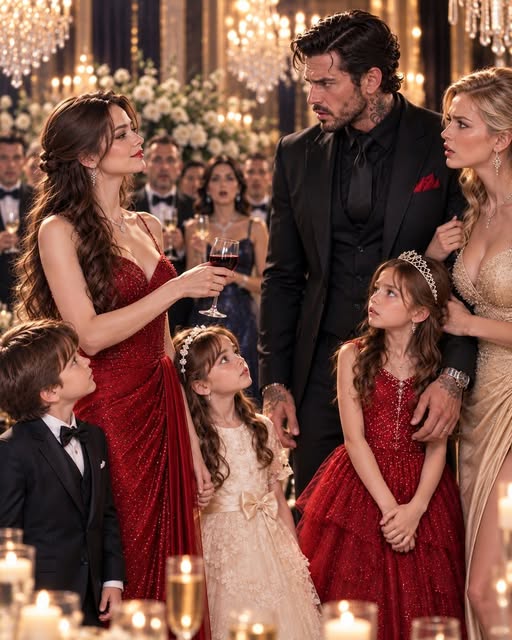
The Astor Grand. The same ballroom. I have planned four hundred events and produced that one too — some habits an army couldn't break — but this time the seating chart on the easel by the east doors carried a name in elegant calligraphy at the head table, at the right hand of the host:
C. MORETTI.
I came in through the front doors, on my husband's arm, in a dress the color of deep water, and the plain gold band rode on my finger in the open where the chandelier light could find it — no chain, no hiding, no service garage. The quartet played. The banker's widow from the old days touched my arm and called me Mrs. Moretti with the satisfied air of a woman who had always known. And halfway through the evening, a young banker — the very man, gone a little gray now, who had once leaned into a circle of laughter to tell me that getting out of a car didn't make me anyone's woman — came up to us with his glass raised in genuine, oblivious goodwill and said to Alexander: "And who is this lovely lady? You must introduce us."
I felt my husband's arm tense under my hand. I looked up at him — this is my favorite memory of that night, better even than the vows — and I watched him not hesitate. Not calculate. Not glance at the room. He looked at the man, and then he looked at me, to make sure I heard it the way I had once needed to hear it, and he said it warm and unhurried, at full ballroom volume, like a man saying the most obvious true thing in the world:
"My wife."
He turned to the head of the room then, because he had planned this too — I married a planner, it turns out; I was just never on his lists before — and with Isabella at his left and the twins at his right, my son straight as a candle and my daughter already halfway through an hors d'oeuvre, Alexander Moretti addressed the Moretti Foundation's winter gala on the subject of legacy.
"Everything I have built," he said, "will someday belong to my children. My son, Leo. My daughters, Luna and Isabella." He found me in the crowd, over the gold chairs, across the marble floor where I had once walked out alone. "All three of them. There are no footnotes in this family anymore. There is no fine print. What is ours is spoken aloud, in this room, in front of everyone — or it isn't ours at all."
Applause. Glasses. The quartet. Later he asked me to dance — in that room, on that floor, in front of all of Chicago — and I danced with my husband with my face up and my ring hand resting plain in his, and the chandeliers threw gold over us the way they had once thrown it over my worst evening, and it meant nothing now except light.
Once, three years of my life had hung on one sentence a man wouldn't say.
It took ten years, two children, a forged letter, a stolen fortune, and the truth arriving late — the way Francesca always promised it would — but in the end, Alexander Moretti said the sentence in front of everyone.
And he never stopped saying it.