I sold the Lake Forest mansion in the spring of the second year.
Eleven rooms we never used. A marble foyer with acoustics like a chapel, in which I had once told my pregnant wife to disappear from my life. The sale took eleven days — houses like that sell themselves — and I endowed the proceeds, every dollar, into the foundation's science endowment, in my father's name, with Naomi's ethics clause read aloud at the signing by her own request. Then I bought a brick house with a small garden, four streets from Naomi's apartment and six from the school, with a kitchen table big enough for science experiments and a spare room that Eli immediately annexed for what he called the Observatory and Theo called the Embassy, because diplomacy with Saturn required representation.
I visited my mother once that year, in the end. She had refused for fourteen months; then, in October, my name appeared on her list.
She looked smaller. That is the truth and it is also the whole of what the place had done to her. She did not apologize — I had made my peace with the geography of that — but at the very end of the visit, when the guard had already risen, she said, without looking at me:
"The boys. Are they… like you?"
"They're like themselves," I said. "Theo raises one eyebrow when he's about to cause trouble. Eli keeps a notebook of the sky."
For a moment, something moved in her face that might, in another woman, have become a feeling she could name. "Your father did that," she said. "The eyebrow. I had forgotten."
"I hadn't," I said gently. "That's the whole story, Mother. I hadn't."
I do not know if it was absolution, either direction. It was a fact, offered and received, and it is the last true conversation we ever had, and I have decided to let it be enough — because the alternative is to spend the rest of my life standing in that sunroom, and I have sons who need me at a kitchen table by six.
By the second autumn, I had a ritual on Tuesday mornings, and it was worth more to me than the Gold Coast towers I never bought.
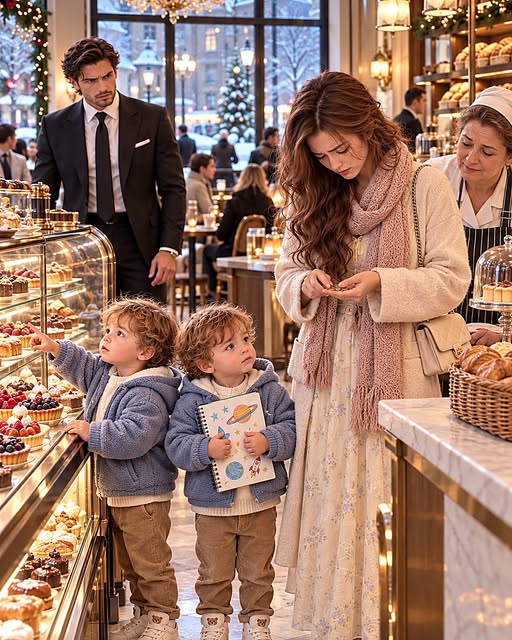
I took the boys to Frank's bakery before school. I was allowed — by then, encouraged — to do the Tuesday run, and I did it in my brick house's kitchen coat, with two backpacks and a planet notebook and the eternal mystery of Theo's left shoe, and we would come through Frank's door at seven-fifteen with the bell ringing over our heads like a small announcement to heaven.
Frank kept a jar by the register. It had not been my idea; it had been Eli's, which made it law. It was a plain glass jar with a paper label in wobbly letters: CROISSANT FUND — FOR ANYBODY WHO IS SHORT. Into it went the bakery's spare change and the customers' — fishermen, teachers, two grandmothers who treated it as a rivalry — and out of it, with great ceremony and zero paperwork, came the difference whenever anyone at that counter came up short. Frank administered it like a central bank. In two years, no one had ever been refused, and Frank had never once let anyone see him top it up himself, though the jar had a way of filling on the mornings after his nephew visited from the bank, and everyone in the neighborhood understood everything and said nothing.
I put eighty cents in it the first time. Frank looked at the coins, and then at me, with the comprehensive mistrust of our first meeting fully evolved into something else.
"Eighty cents," he said. "Specific."
"It was the exact amount," I said. "Once. For two croissants."
He nodded slowly, and put the coins in with his own hands, like a man depositing something in a vault. "Then it balances," he said. "Books are balanced. Took you long enough, son."
Theo ordered for himself that morning — two croissants, because he wanted two, and one for the road for Eli, who was home with a cold and had sent a written order by notebook — and he paid out of his own allowance jar with the solemnity of a finance minister, and counted his change twice, and put a nickel in the Fund because, he explained, "somebody might be short and it's not their fault; being short is just a day, it's not a person."
I stood in that warm bakery with my son's philosophy ringing in my ears and thought: there it is. There is the whole education my fortune couldn't buy me, delivered by a five-year-old over croissants. It took a Calloway three generations to learn it. It took Theo one childhood of being loved by Naomi Vance.
The proposal happened on a Tuesday, because of course it did. Everything that matters in my life happens on Tuesdays.
Nothing was burning. The foundation's annual report had come back clean for the second year — Naomi had framed the auditor's letter in the bakery, next to Frank's health certificate, where she said honest documents belong. Eli had lost a tooth and negotiated the tooth fairy's rate upward with a written brief. Theo had been made line leader. I was washing dishes in Naomi's kitchen after a dinner of spaghetti that Eli had graded "acceptable, with notes," and Naomi was at the table with her pencil and the program budgets, and the boys were asleep, and the rain was doing its ordinary October work against the windows.
I dried my hands. I took from my pocket a ring I had bought at a jeweler's on State Street, at the published price, from a man who did not know my name — that had mattered to me, though I could not have said why — and I put it on the table beside her pencil, the way you put down one more document among the documents of a shared life.
"Ordinary day," I said. "Nothing burning. Naomi — will you marry me? Again. Properly. At the speed of trust, which I believe we have now officially reached, as I have passed my probation on every front including the sky."
She looked at the ring for a long moment. Then she picked up her pencil — I swear to God, she picked up her pencil — and wrote something in the margin of the budget, because Naomi Vance annotates her life before she lives it.
She turned the page toward me. In her quick, slanted handwriting, under a column of figures for library grants, she had written: APPROVED. CONDITIONS AS DISCUSSED.
"Yes," she said out loud, because she knew I needed it out loud. "Yes, Preston. On one condition that is not a joke. We do not get married in a ballroom."
We were married in the school garden, in June, in front of forty people and one hundred and twelve tomato plants.
Frank catered it, and by catered I mean Frank closed the bakery for the first Saturday in its existence and produced croissants, and stood in the receiving line like a head of state, and cried without a shred of embarrassment. Martin Hayes was my best man and managed, in his toast, to say the words "as documented" only twice. Judge Reyes performed the ceremony — retired judges being the natural clergy of the Calloway restoration — and read, at Naomi's request, one paragraph of my father's foundation speech: the part about a family that takes from a city owing the city its hands back.
Eli served as ring bearer and archivist, and recorded the entire event in the battered notebook, which is now in its third volume and contains, among the planets and the star experts and the page marked DAD — APPROVED, a full meteorological log of the wedding day, temperature included. Theo served as best eyebrow. He inspected the gathering with it at full elevation, like a tiny customs officer of joy, and pronounced the proceedings satisfactory.
At the reception — sandwiches and lemonade on the school lawn, a string quartet of exactly one retired music teacher with a cello — Theo tugged my sleeve.
"Dad," he said. It had stopped being an experiment months ago; it was just my name now, and it remade me every time. "Frank says at the bakery there's a new rule. He put it on a sign."
"I know," I said. "I saw the sign."
Frank had painted it himself, in crooked gold letters on a board above the croissant case, and it said:
IN THIS BAKERY, NO CHILD SHARES A CROISSANT UNLESS HE WANTS TO. — MANAGEMENT
"But sometimes I WANT to share with Eli," Theo said, with enormous seriousness. "Is that allowed? Frank said ask you."
"Then you share because you want to," I said, "and that's the best reason in the world. That's the whole rule. Sharing because you want to is a feast. Sharing because you have to is just being short."
Theo considered this with the gravity of a judge, and then he raised one eyebrow — the left one, cocked high in amused skepticism — and my whole body went warm instead of cold, because I knew that expression, and this time I got to say the words my father said to me across a breakfast table thirty years ago, in a house that no longer belongs to us, to a boy it all belongs to now.
"There's the Calloway eyebrow," I said. "Means you're about to cause trouble."
"Good trouble?" asked Theo.
"The very best kind," I said. "The kind your mother approves in the margins."
He ran back to the lawn, to his brother, to the sandwiches — two each, and more if they wanted them, forever — and Naomi came and stood beside me with her hand in the crook of my arm, smelling of chalk dust and garden sun, my wife, again and for good.
The following autumn, the foundation held its gala in the same ballroom, under the same portrait, and this time Naomi gave the keynote.
She wore the deep green dress. She had refused a new one — "this one has seniority," she said — and she stood at the podium where my mother had stood, and she did not begin with the numbers, though the numbers were glorious: the endowment doubled, the science grants in ninety-one schools, every diverted dollar restored and published under its true name. She began with the charter.
"In trust," she said, into the same hush, in the room where that phrase had once been interrupted. "That's the whole speech, really. Everything else is catering." Four hundred people laughed — and then, as she went on, stopped laughing, in the way of people being handed something heavier than they expected. "This foundation holds other people's generosity in trust. It holds a dead man's name in trust. A city holds its children in trust. My sons were held in trust once, by people who treated trust as a drawer to lock things in. So we changed the locks. There is no drawer anymore. Every signature in this foundation now has a witness, every dollar has a name, and every letter—" she paused, and found me in the crowd, and her voice did not waver — "every letter gets answered. That's the policy. That's the whole policy. The rest is catering."
She got a standing ovation that my mother, in thirty years of galas, had never once received standing in that spot — because rooms can tell the difference between being impressed and being moved, even when the rooms are full of people who would deny it at gunpoint.
Afterward, on the steps, Eli — six now, archivist of everything — read me the entry he had made in the notebook for the evening, in his improving hand: "Mom finished the speech. The speech was started by a bad lady a long time ago and nobody finished it. Now it's finished. Also there was cake."
Out of the mouths of archivists.
The Whitmore and Gale archive came back to the family that winter, in the end — what was left of it, after the prosecutors took what they needed. Martin offered to have it destroyed. I told him no. The four letters live now in a plain box in the Observatory, on the shelf under the telescope, where Eli files his completed volumes, because my sons decided — in a ruling delivered jointly, with the eyebrow — that the letters are part of the sky records. Evidence of a long night, Theo called them, that ended. Eli labeled the box in his best handwriting: LETTERS THAT GOT ANSWERED. It is the finest piece of archival science I have ever encountered, and I have endowed a foundation.
Five years ago, I let my mother convince me that woman was ruining my future.
She was the future. She was always the future. It just took a bakery, a buried letter, and two small boys with my face to teach me how to read it.