The footage was grainy, black and white, and absolutely merciless.
Eleven minutes, recovered from a backup server the "scheduled test" hadn't touched. Paige — Vanessa's laughing friend, the bridesmaid-in-waiting — entering the locker corridor at 10:41 with her handbag held against her body like a shield. Paige at my locker. Paige's hands, quick and practiced, in my apron pocket. Paige leaving at 10:49, lighter by one string of frozen lightning, glancing once at the dead camera with the calm of a woman who had been promised it would stay dead.
Behind me in the little security room, I heard Grant make a sound I had never heard from him — not anger. Anger would have been simpler. It was the sound of a man discovering the true price of a thing he'd bought years ago without reading the receipt.
"She'll say she acted alone," Marcus said. "She'll say she was jealous, or protecting Vanessa. You know she will."
"I know," Grant said. "And Vanessa will cry, and Conrad will call it a misunderstanding between girls, and the harbor commission votes on the terminal in nineteen days." He turned to me. "Emily. If I destroy Vanessa Hale tonight, publicly, with this — her father doesn't lose. I do. He takes the terminal votes, he takes the port unions, and he does it all in the open with a grievance every family in Chicago will call legitimate. Men will die over dock contracts by Christmas. Your sister lives four blocks from the Hale warehouses."
"You're telling me she wins," I said.
"I'm telling you she survives this round." His jaw worked. "What you do with that is your choice. The door is there. I told you in the study — if you say it stops, it stops, and I'll say in front of witnesses that you were treated honorably." A muscle moved in his cheek. "But if you stay, Emily — stay knowing what this world costs. Not the diamonds. This."
I thought about the photograph of my nephews that existed now in some Hale phone. I thought about Paige's hands in my apron pocket, and Vanessa's voice saying you had to steal from me too, and about being a thing that rich people weighed. And I thought — strangely, clearly — about my father, who had lost everything he'd built to men with money and had gone on teaching in a church hall for eleven years, standing straight, because he had decided a long time before that what the world did to you was weather, and what you did next was character.
"I'm not running from a girl with cheap manners," I said. "My grandmother-figure would never forgive me."
Grant blinked. Then, for the first time since the necklace, something loosened in his face that was almost a smile. "Your grandmother-figure?"
"Eleanor. She's claimed me. It's done." I stood up. "But understand me, Grant. I stayed. I was not kept. There's a difference, and you're going to learn it."
"I am learning it," he said quietly, "at some expense."
What followed was not a romance. I want to be honest about that, the way this story has been honest about everything. What followed was a campaign. Vanessa kept her title in the newspapers — the engagement "unwound" only so far as a discreet silence — and I kept my rooms and my name slowly cleared in whispers Marcus planted like seeds: a misunderstanding, a staff error, the necklace recovered, no charges, no thief. Paige resigned from the bridal party and from Chicago, in that order. And the Whitmore Foundation charity gala — the event of the season, at the Drake Hotel, three weeks away — acquired a tradition-shaped problem.
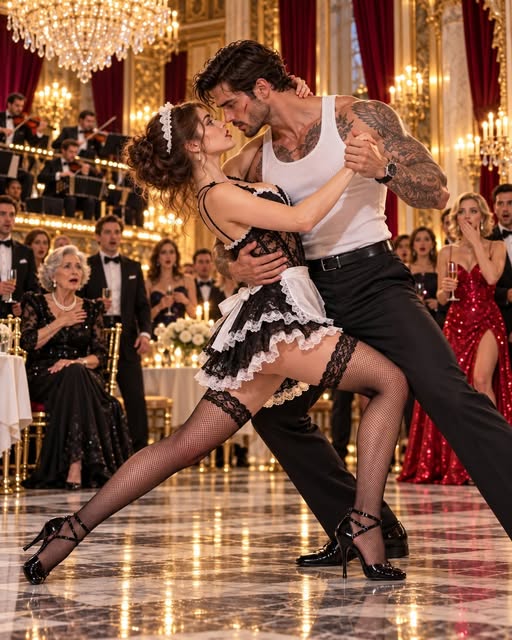
The Whitmore heir, by a custom older than the company, opened the gala by dancing a tango with his fiancée.
For forty years it had been a harmless piece of theater: three lessons, a competent waltz-with-pretensions, applause. This year, the fiancée was a woman eleven million people had watched out-dance the boss in his own ballroom, and every gossip columnist in the Midwest had already written the headline in their heads.
"You'll have to teach me," Grant said, in the ballroom, at seven in the morning, in shirtsleeves, looking like a man reporting for a sentence. "Properly. Your father's way. The club instructors taught me to perform. Nobody ever taught me to — " he searched for the word and clearly hated finding it " — listen."
So we began. Heel. Toe. Pause.
I will say this for Grant Whitmore: he did not know how to do anything halfway, including being bad at something. For two weeks we met at seven every morning, before the house woke, in the ballroom where he'd made his joke — and I watched the most feared man in Chicago submit, daily, furiously, to correction. Not to fighting the lead. To the pause. To standing perfectly still inside the music and letting the silence work. Club tango had taught him that stillness was weakness. My father's tango taught that stillness was where the trust lived.
"You're thinking about the step after this one," I told him, for the tenth time, stopping the music. "You're dancing three seconds in the future. A partner isn't a plan, Grant. She's here. Now. If you lose her balance because you're busy conquering the next bar — "
"I don't lose people," he said, too fast.
The music had stopped. The ballroom was very quiet, gold with early light.
"You lost me for one second in a hallway," I said. "With a necklace in my locker and two hundred years of your family's word on the line. I watched you weigh me." I kept my voice level, because it had taken me days to be able to. "That's why I'm still deciding about you. Not Vanessa. Not the Hales. That second."
He didn't defend himself. That was new, and we both felt it. He stood in the middle of the floor his father built, in the ruin of his choreography, and he took it like a man paying a bill he'd been avoiding.
"Then I'll spend the rest of the arrangement," he said, "unweighing."
It was during the second week — after a lesson that had ended, for the first time, with both of us laughing, breathless, at a botched turn that was entirely his fault and that he admitted was entirely his fault — that Eleanor asked me to take tea in her sitting room and closed the door.
She had a photograph album on her lap. Old pictures: the club on Halsted, the room above the bar, a young Eleanor in a dress with a wasp waist, laughing, mid-turn, in the arms of a young man with my father's smile.
"I've been deciding when to tell you this," she said. "There isn't a kind time. So: the Brooks Dance Studio. On Ashland. You know how it ended."
"Fire," I said. "I was six. An electrical fault, they said. Dad lost the building — he only leased it, the insurance was the owner's — and after that it was the church hall. He never really — " I stopped. Eight years of not saying it. "He never got it back. Any of it."
Eleanor nodded slowly. "What you don't know is who bought the lot afterward, Emily. The land, the ashes, all of it. It was bought within the month, for almost nothing, through two companies with other names. It's where Thomas built the first Whitmore Reserve distillery. It stands there still." She turned a page with a hand that trembled slightly. "Thomas didn't set that fire — I'd stake my soul on it, and I've had eighty-three years to think about what my soul is worth. But he knew whose floor had burned. He knew Daniel Brooks had refused to sell to him for six years, politely, every single time, standing in that studio doorway with his sleeves rolled up. And when the fire did Thomas's negotiating for him, Thomas bought the ground out from under your father, and he never once — not once, in thirty years — told him he was sorry. It was the thing I most hated my son for. It is the thing I have never forgiven."
The room was very still. The tea went cold between us.
"Does Grant know?" I asked at last.
"Grant knows the distillery. He doesn't know the dirt." Eleanor closed the album. "His father raised him on ledgers, not stories. But I'll tell you what I told myself the night you danced, Emily Brooks, when I watched my grandson's joke land on the daughter of the best man I ever knew: this family owes your family a debt that has nothing to do with a necklace or a promise. And debts in this family — " her eyes were wet and utterly fierce " — get paid."
I took the bus to Ashland Avenue that afternoon. I told no one. Some things a woman has to stand in front of alone before she can stand in front of them with company.
The distillery was bigger than I remembered and smaller than my grief. Four stories of brick, the Whitmore Reserve crest over the loading doors, trucks coming and going with the indifferent rhythm of a business that had never once lost sleep over the ground it stood on. I stood across the street with my hands in my coat pockets where a six-year-old's whole world used to be.
There had been a stoop. There had been a window with gold letters — BROOKS DANCE STUDIO — that my father cleaned himself every Monday because he said a man's name on glass was a promise to everyone who walked under it. There had been a floor my mother had helped him lay, board by board, the summer before I was born, and a mirror wall, and a battered upright piano, and a smell — polish, cedar, coffee, other people's effort — that I had believed, the way children believe in weather, would simply always exist.
What existed was a bottling plant with a fence around it and a security guard who watched me with the mild attention of a man deciding whether I was a problem. High on the brick side wall, above the reach of every repainting crew for thirty years, there were letters — ghost letters, soot-soft, that I could not quite read from across the street in the failing light. I crossed anyway. I stood in the shadow of that wall with my head tipped back until my neck ached, and the letters resolved, one by one, the way a face resolves in an old photograph.
BROOKS.
My father had paid a sign painter for those letters in 1983, in gold leaf, because he said a dance studio should look like it believed in itself. The fire had taken the glass, the floor, the piano, the business, and eventually — by slow inches, over eleven years of church halls and other people's borrowed rooms — the man. The gold leaf had outlasted all of it, baked into brick, forgotten by everyone except, apparently, the soot.
I put my palm flat against the cold wall of the building that had eaten my father's life, and I did not forgive it, and I did not curse it. I just stood there, a thirty-two-year-old woman in a borrowed coat, and let it be true — all of it, at once, the way the pause in a tango lets everything be true at once.
"Miss?" the guard said, not unkindly. "You can't be in the loading zone."
"I know," I said. "I used to live here. Almost. Thank you."
I rode the bus back to Lake Forest in the dark, and I did not go to the lesson the next morning. I sat by the lake until the cold drove me in, thinking about a church hall, and a man teaching tango to other people's children for eleven years with a smile that I now understood had cost him something every single day, and about the man in the ballroom at seven each morning, learning to stand still, who had been raised on the ground where my father's life burned down.
At eight, Grant knocked on my door — not the furious three raps. Two. Careful.
"My grandmother told you," he said. It wasn't a question.
"She told me."
"I had Marcus pull the property records at dawn." His face was gray. "It's true. All of it." He held out a folder — thin, old, smelling of storage. "This is everything this house has on the Ashland lot. Deeds, the shell companies, the fire report. There are no copies, Emily; that's the original file, and it's yours." He swallowed. "I can't give you back the years. I can't give you back your father. But the secrets in this family end with me. That's not a line. Come to the records room tomorrow and I'll open every drawer I own, and you can decide what I am with all of it in your hands — not the choreography."
I took the folder. It weighed almost nothing. It weighed everything.
"Lesson at seven," I said, because my voice would only hold together on ordinary words. "You're still dancing three seconds in the future."
"Seven," he said. "I'll be here. Now."