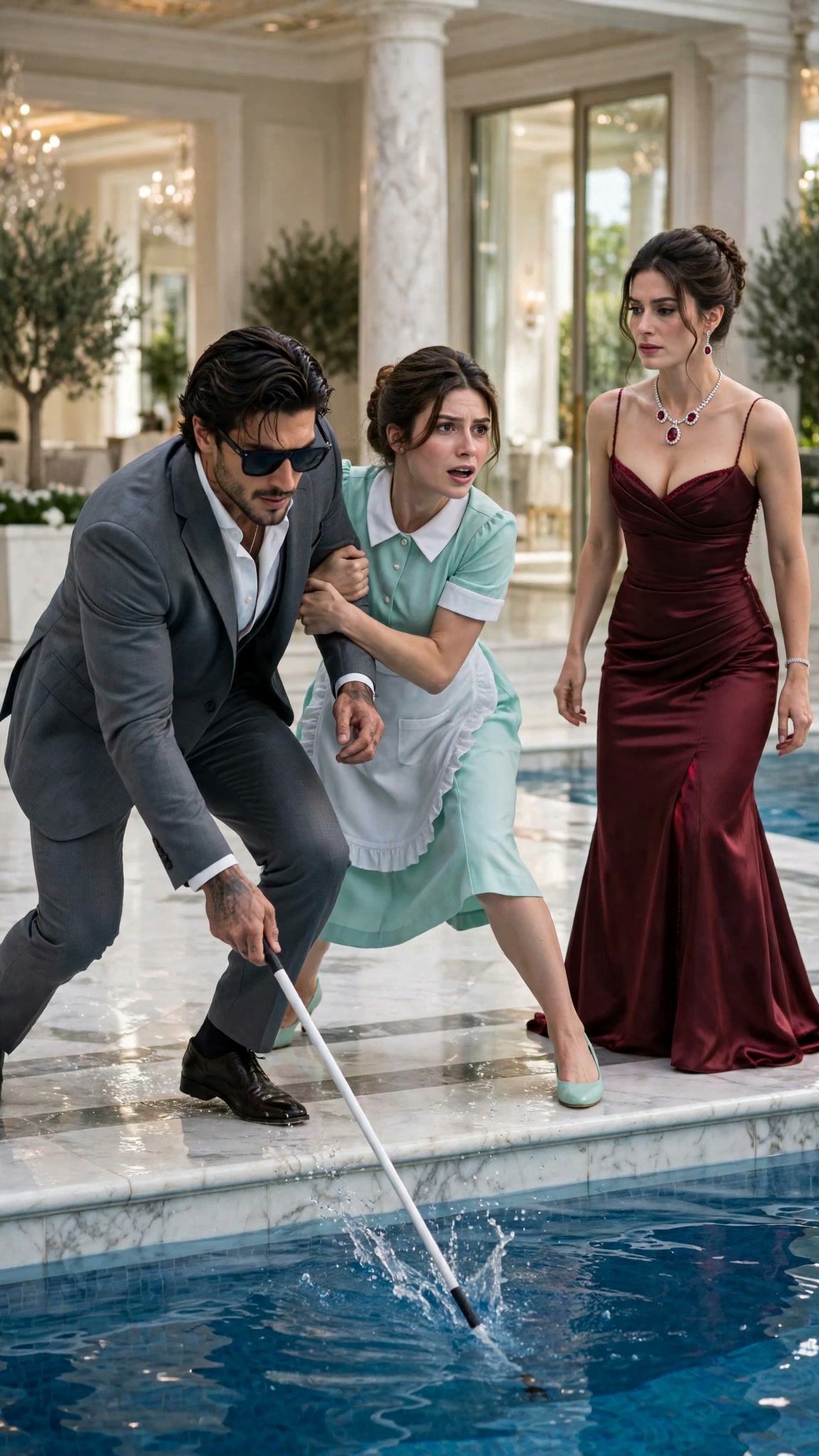
He asked her at nine the next morning, in the study, with the doors closed and Shaw outside them and the drained pool shining through the glass like an accusation neither of them had made.
"Guardianship papers," Daniel said. "Drafted last spring. Before my accident. Clara says they were your idea."
Rachel Bennett sat very still. For fourteen years she had been the calmest person in every room Daniel had ever shared with her, including rooms with judges in them, and he watched her be calm now the way you watch a surgeon be careful: as a decision, renewed second by second.
"Last April," she said, "your wife came to my office alone. She told me you had become erratic. Grandiose. That you were signing developments without reading them — you, who read the drainage clauses. She said she was frightened for you, and she asked me, as your attorney, what could be done to protect you from yourself." She folded her hands. "I told her that what she was describing had a name, and the name was a conflict of interest, and that my firm would not touch it. I told her that if she brought such a petition against my client, she would meet me across a courtroom. And then I wrote her a letter — by hand, so there would be no system copy for anyone to alter — declining, and warning her. I have kept it in my own safe for a year."
"Clara said the papers were drafted."
"They were." Rachel opened the black folder she had brought, and turned it toward him. "The audit found them last night. A full guardianship package — petition, medical affidavit template, the works — created in my firm's system eleven days after I refused her. Created under Peter Voss's credentials, from my templates, with an internal routing memo forged in my name." Her mouth was a thin, furious line. "She went home from my office, Daniel, and she went to her dinners, and she found my associate, and she had him build the weapon I wouldn't. The package sat in the system for a year like a loaded gun in a drawer — so that when she finally filed, it would look considered. Inevitable. Not what it was."
"Did you know?" he asked. "When she filed this week. Did any part of you know that thing was in your house?"
"No." She met his eyes without flinching, and fourteen years stood behind the word. "But it was in my house. I hired Voss. I promoted him. He sat behind my chair in your dining room while your life was on the table, and I brought him there." She closed the folder. "I am prepared to resign as your counsel. There is a credible appearance of conflict — the press is already building it — and my duty is to your case, not to my pride. I'll hand the files to whoever you choose, and I'll testify to all of it."
Daniel was quiet for a moment.
"You refused her when I could still see," he said. "Do you remember that spring? I was sighted, I was rich, I was in your office every month — and my wife came to you asking you to help her cage me, and you said no and put it in writing and kept the letter for a year in case I ever needed it." He shook his head slowly. "Every other professional in this story had a price, Rachel. The doctor had one. The associate had one. You had a letter. Stay. If the press wants to build something, they'll have to build it around the fact that you're the only person Clara Blackwood ever failed to buy."
Something moved in Rachel's face then that she did not permit to become an expression. She opened the folder again, to the second section, and became his lawyer once more — the fastest recovery he had ever seen her perform.
"Then here is the rest of your war," she said. "The district attorney files Monday. Clara: fraud, forgery, conspiracy — the pool makes it conspiracy to commit grievous harm, and Ethan's signed cooperation makes it airtight; her counsel is already asking about a plea. Cross: the escrow chain is federal, the agents executed a warrant at Cross Development this morning, and his board suspended him before lunch. His resort is dead, Daniel. The headland stays yours; more than yours, it stays unsellable in his lifetime." She turned a page. "And Miss Reed. The device charge is withdrawn, formally, with a written apology from the precinct that her counsel — me — negotiated word by word. The state board has agreed to reopen the review of her paramedic license. It appears the hospital administrator who pinned that medication error on her has been quietly doing the same trick for years, and your case has given three other nurses the courage to file. She's going to get her license back, Daniel. I wanted you to hear the order of battle from me."
That afternoon, the district attorney held a press conference on the courthouse steps, and Daniel attended at Rachel's instruction and against every instinct he owned — standing in the sun in a plain suit while a prosecutor he'd never met laid the whole architecture of the fraud out for the cameras in the flat, devastating language of indictments.
There was one line Rachel had fought for, and she had not told him which line it was until he heard it.
"Finally," the prosecutor said, "the charge against Miss Anna Reed, arising from a device planted in her place of work on the night of the Blackwood Foundation gala, is withdrawn in full. The investigation has established that Miss Reed was the target of a deliberate attempt to discredit a witness. The precinct has apologized to her in writing. This office adds its own."
Forty cameras swung, looking for her. She wasn't there. She was at the house, on a ladder in the library, re-shelving the law reports Voss's people had disturbed during their searches — because, as she had told Rachel that morning, her name being cleared on television was a fine thing, but the books were still in the wrong order, and only one of those problems was hers to fix.
"Thank you," he said, and meant more by it than the words could hold.
"Don't thank me yet," Rachel said. "There's still the matter of what you pay people." And she slid a final document across the desk — a contract, drafted overnight: Anna Reed, retained by the Blackwood estate as estate manager, at a salary that made Daniel raise an eyebrow, with quarters in the main house's east wing, a car, and a clause Rachel read aloud with relish: "The employee's duties expressly exclude personal attendance upon the employer outside working hours, which are to be eight to six, with Sundays the employee's own."
"She negotiated this?" Daniel asked.
"She redrafted it," Rachel said. "In my office. With a pencil. She is wasted in domestic service, Daniel, and I told her so, and she told me she intends to be wasted exactly as long as it takes her license to come home — and not one day longer."
He signed it where Rachel's tabs told him to sign.
That night, the examiner called Shaw, and Shaw came up to the study with a laptop and the expression of a man carrying something heavier than the machine.
The nine missing minutes had not been missing after all. The terrace camera fed a backup drive in the gate house — a drive Clara, for all her diligence, had never known existed, because Daniel had ordered it installed the month after his accident and told no one but Shaw. The main feed had been cut from the panel. The backup had simply gone on recording, in the dark, like its owner.
They watched it in silence. At 5:51, a gray car — registered to a Cross Development subsidiary — stopped at the service gate, and Clara herself, in daylight's first gray, let it through. At 6:02, the hooded figure crossed the yard with the bucket. At 6:07, the terrace door opened to a master keycard. And at 6:09, on the pool house camera, the figure turned — one unguarded second, reaching for the railing's release — and the hood slipped, and the face was Clara's, and on her left hand, carrying the bucket, the ring threw back its small, hard, faithless spark of light.
"She did it herself," Shaw said. "The tiles, the railing. The cane was the fixer — we found his payment in the Cross accounts, and the knife work matches his record. But the terrace was hers personally, sir. She wanted to be sure."
Daniel watched his wife cross his garden at dawn with a bucket of water, preparing the ground of his death with a housewife's thoroughness, and he waited to feel something enormous — rage, grief, vindication — and what he felt, to his own astonishment, was a kind of quiet. The last question had been the worst one. Now it was answered. There was nothing left in the dark at all.
"Give it to Rachel," he said. "All of it. And Gregory—" he closed the laptop gently, the way you close the eyes of the dead "—thank you for installing that drive."
"Sir," Shaw said, "I didn't install it. You ordered it. I just never told the house."
"Then we're even," Daniel said. "Neither did I."
Anna came to the study that evening to return the advance copy, and stood inside the door with the contract in her hand and the drained pool going gold behind her.
"The salary is too high," she said.
"It's the market rate for keeping a difficult man alive."
"The hours are too kind."
"You drafted them."
"I drafted them when I thought you'd argue." She came further into the room, step by step, the way she had once approached a table of powerful people — except that somewhere in the last week the lesson had worn off her, and now she simply walked into rooms. "Rachel says the board will likely restore my license by autumn. When it does, I'll want two days a week on the ambulances. It's in the contract because I put it there, but I'm telling you with my voice as well, because contracts aren't how people say true things."
"Two days a week," Daniel agreed. "And Sundays your own. And eight to six."
"And after six?"
He considered her, across the desk where his life had been dismantled and rebuilt in a fortnight. "After six, Miss Reed, you are a free woman in a house with an excellent library and a deplorable cook, and if the master of the house wishes to see you, he will have to learn to knock."
"Then learn carefully," Anna said, and signed her copy with the pen he held out to her, "because I intend to be extremely hard to employ and impossible to dismiss."
Rachel's last call of the day came while the ink was still wet. Dr. Fenn, she reported, had recanted in writing that morning — apparently a medical board investigator reading the trial coverage aloud in his waiting room had concentrated his mind wonderfully — and his license was suspended by evening. And the fixer, the man whose knife work had nearly severed a blind man's cane at its tip, had been arrested two states away with Clara's dawn visit to the service gate now in the prosecutor's hands. "Her lawyer hasn't seen the footage yet," Rachel said. "He will on Monday. I give her plea a week to arrive."
She left him the pen. He stood a while in the quiet study, with the two signatures drying on the contract and the whole house settling around him like a held breath released at last, and then he picked up the house phone and called down to Shaw.
"Gregory. Fill the pool."