She said yes on a Sunday, in his mother's kitchen in Brooklyn, with flour on her hands.
It had taken her three weeks to get there — three weeks of asking every hard question out loud, in daylight, the way she had sworn she always would from now on. What did his world still contain? What would be asked of her? What happened to women who stood where she would stand? Damian answered all of it the way he had answered in the car: without decoration. The old empire was being dismantled into clean companies, and dismantling made enemies. She would have security, always, and she would have honesty, always — he swore both on his mother's name, which in that family was a contract written in blood. "The one thing I will never do," he told her, "is make you small to keep you safe. I've read your file, Penelope. The world's been doing that to you for free."
So she said yes where it mattered — not in a restaurant, not with a ring produced like a magic trick — but standing in Rosa Russo's kitchen, learning to fold pasta from a seventy-year-old woman who had buried a husband the city once feared and raised a son it feared more, and who took one look at Penelope's hands in the flour and announced to the room at large, "This one has good hands. This one stays." Then she turned her fierce old eyes on her son. "You. You will deserve her. It is different from having her. Work."
They were married in November, in the little stone chapel on Staten Island where Damian's parents had married, with thirty guests, no press, and a string quartet Penelope had hired for other people's weddings a dozen times. She walked herself down the aisle — her father long gone, her mother beaming from the front pew — and Damian, who had faced down syndicates without blinking, stood at the altar with his hands visibly unsteady until the moment she put hers in them. His vows were four sentences long. Hers ended with: "You saw me. I intend to spend the rest of my life being worth looking at — and so, God help you, do you." Rosa cried. The security men stationed at the chapel doors were observed, by the florist, to be pretending they had not.
Afterward there was lunch at Rosa's house, dancing in the garden under strings of light, and Penelope Russo — who had once planned joy for a living and rationed her own — discovered what it was to be the woman in the middle of the photograph instead of the woman who made sure the photographer was fed.
Married life, it turned out, suited her ferociously. She kept her position at The Meridian two more years, because Damian understood — as no one else ever had — that her work was not a hobby to him, it was her spine. Then the foundation's board, at the gala she had rebuilt, tripled the endowment's annual giving under her informal direction, and Damian asked her — asked, again, hat figuratively in hand — to run it properly. Penelope Russo became Executive Director of the Russo Foundation, and the society pages began, slowly, to learn her name: not as an accessory to his, but in the order she preferred. Hers first. The work first. She built a scholarship program for first-generation girls and funded it, pointedly, before every other line item.
In May of the second year, the first class of Second Look scholars graduated, and Penelope attended the small ceremony in the foundation's atrium with a handkerchief already deployed, because she had learned things about herself. The valedictorian of the group — a girl from Toledo who had worked nights in a diner all four years of college and graduated with the kind of transcript that makes admissions officers weep in the good way — ended her speech by saying: "Everyone in my life told me to be grateful for any door that opened. Mrs. Russo is the first person who told me to check whether the door deserved me." The girl's mother, a home health aide with hands like Penelope's own mother's, held Penelope's face afterward in both palms like a blessing and said nothing at all, which said everything. Damian had stood at the back — he always stood at the back of her rooms, so as never to be mistaken for the point of them — and driving home he was quiet a long time before saying, "My grandfather stole coal money and called it empire. You've built more actual power in two years than he did in forty, and you've done it entirely by handing it away. I am taking notes, Mrs. Russo." She slept that night with her head on his shoulder and her whole life arranged around her like furniture she had chosen herself, piece by piece, in her own name.
It was a good life. It was, in every way she measured, a healed one.
Which is why she almost missed the shadow when it crossed the doorway, that September morning, in cream cardstock.
The envelope came with the foundation's mail: an invitation, engraved, gold-edged, from the Wexford Alumni Association. The university's centennial gala. Black tie. The St. Regis ballroom. And on the second line of the host committee — she read it three times, with her coffee cooling forgotten in her hand — the name of the evening's presenting sponsor and keynote donor, printed in the same gold ink as her own name on the guest line: Farnsworth Capital. Keynote: Bradley Farnsworth.
Damian found her at the window with the invitation still in her hand.
"Wexford," he said, reading over her shoulder. "Your university. You never go to these."
"No," she said.
"Why not?"
She had told him about Bradley, of course — the whole truth, the terrace, the lemonade glasses, the rain — one night in their first year, when she had decided that the man she married would get the unedited archive. He had listened the way he listened, completely, and at the end he had said only: "His loss is the cornerstone of my life. I should send him flowers." So now he looked at the invitation a moment longer, and she watched him understand, with that total attention, exactly what the gold ink said.
"We'll go," he said.
"Damian—"
"We'll go," he repeated, gently, "because you have never once been in a room with that man as the woman you actually are. You've only been in a room with him as the girl he convinced you you were." He took the invitation from her hand and set it on the table, face up, in the sunlight, where it lost some of its power. "And because I find I would like to watch his face. I have some curiosity about it."
She laughed — she couldn't help it. And then she was quiet, looking at the invitation, at eight years of her own rebuilt life, and she made a decision that felt, in her chest, like a door being unlocked from the inside.
"Yes," she said. "We go."
What neither of them knew — what Damian's analysts would only confirm weeks after the gala, in a report he would read with great cold satisfaction — was that Bradley Farnsworth was not coming to the St. Regis as a conqueror. He was coming as a drowning man. Farnsworth Capital's books, so glossy in the profiles, were rotting from the inside: two funds underwater, a flagship investment collapsed, and the firm's one lifeline was a forty-million-dollar rescue placement that Bradley had spent four months chasing through a discreet syndicate of private investors — a syndicate whose lead partner, behind three layers of holding companies, was a Russo Holdings fund.
Bradley did not know that. Bradley knew only that the money men would be at the gala, that he performed brilliance best in a ballroom, and that his entire future hung on charming strangers in black tie.
There had been one fight — one real one — in those years, and it was about the board.
When she accepted the Executive Directorship, a Russo cousin on the foundation board — the same loud watch from the floral-contract folder — had murmured at the announcement lunch that the foundation was becoming "a family hobby with a wedding ring," and Penelope, smiling her boardroom smile, had finished her coffee and gone home and unpacked the remark at her husband like a woman unpacking a suspicious suitcase. She did not want the seat defended by him. She wanted it undefended or not at all.
"You married me out of a ballroom at midnight," Damian said, "on the strength of being seen accurately. Let me return the courtesy." And at the next board meeting, when the cousin floated his little audit of her catering-era credentials, Damian sat at the head of the table and said nothing at all — nothing — while Penelope, who had come with the foundation's giving restructured in a binder the size of a doorstop, walked the board through three years of recovered overhead, renegotiated contracts, and doubled endowment yield, and took questions for forty minutes, and watched the cousin's motion die of loneliness without ever being seconded. Driving home, she was incandescent with leftover adrenaline. "You didn't help," she said. "It was agony to watch," Damian admitted. "You were magnificent. It was the hardest order I have ever obeyed." She laughed all the way across the bridge. It remained, for both of them, the story that defined the marriage: he had the power to clear any room for her, and he had made himself learn the discipline of letting her clear her own — standing close enough to catch her, far enough never to shadow her. Only men who had never doubted their welcome in a room failed to understand what that cost him. Penelope understood. It was why the security men called her Mrs. Russo in a tone usually reserved for heads of state.
The week of the gala, Rosa summoned her to Brooklyn and produced, from a drawer that smelled of cedar and lavender, a pair of pearl earrings in an old Russo setting. "His grandmother wore these the night his grandfather asked the wrong man's daughter to dance, in a room exactly like the one you are walking into," Rosa said, fastening them with surprisingly steady fingers. "The room decided she was nobody. The room was incorrect. Rooms often are, the first time." She turned Penelope to the mirror and stood behind her, fierce and small. "You do not go there to show them, child. You go because the room is yours and you are checking the furniture." Then, briskly, in the manner of women who have said the important thing and intend to move on: "Also. Eat before. Never confront a past on an empty stomach. It makes the hands shake, and people read it wrong."
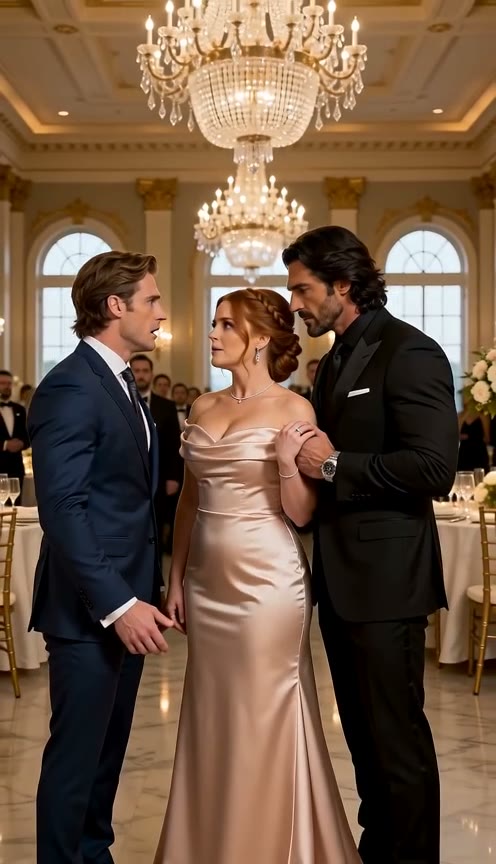
September became October. The gown arrived from the atelier — champagne-blush satin, off the shoulder, made for her body with the kind of respect she had once believed tailoring couldn't feel. Damian, called to Chicago on foundation business the week of the gala, looked at her standing in it at their bedroom door and was silent so long she laughed at him. "I'll be two hours behind you," he said. "Save me a dance and don't let the room forget who you are before I get there."
The night of the gala, Penelope got out of the car alone at the St. Regis, gathered the satin in one hand, set her chin the way she had taught herself on a gravel drive in the rain, and went up the great stairs to meet her past.
In her clutch, her phone buzzed once. Damian: Landing at nine. Save me the waltz.
She smiled. She had no idea that Bradley Farnsworth was already inside, already two drinks in, already scanning the room for the money — and that within the hour, the past was going to put its hand on her arm and ask her, in front of everyone, where her husband was.