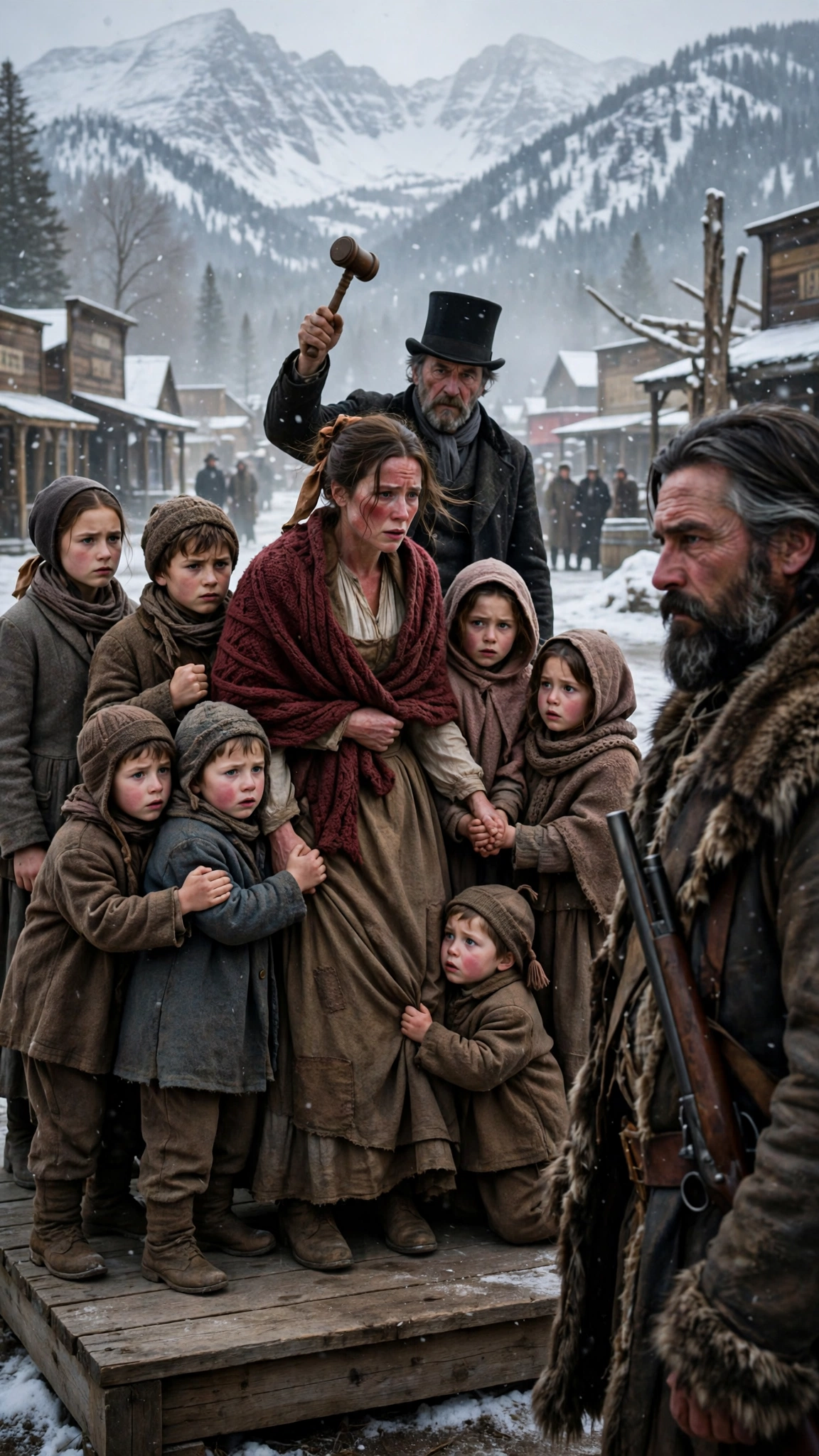
Caleb Roar did not speak to her again in the square. After the gavel fell, he signed the contract at the podium with a hand so large it made the pen look like a twig, and he paid the three hundred dollars in gold coins that he counted out of a leather pouch onto the auctioneer's podium, one by one, while the whole town watched in silence. Then he turned to Eleanor and said, in that same low, flat voice, "We leave in an hour. Bring what you have. Leave what you cannot carry."
He did not ask her if she agreed. He did not ask her if she was ready. He simply walked away through the crowd, and the crowd parted for him the way water parts for a stone, and Eleanor stood on the platform with her seven children and watched him go, and she understood that she had just been bought by a man she knew nothing about, and that she was going to follow him into the mountains because there was nowhere else in the world for her to go.
They had almost nothing to bring. The wagon and the surviving ox had been sold in St. Louis to pay for food on the trail, and what remained of their goods fit into three carpetbags and a wooden trunk. Sarah carried one bag, Thomas carried another, Eleanor carried the third and the trunk's handle with Edward on her hip, and the four middle children carried what they could. Caleb watched them gather their things without offering to help, and Eleanor did not ask him to. She had learned, on the trail, that asking a man for help was a debt, and she already owed this man three hundred dollars.
He had a wagon waiting at the edge of town — a heavy freight wagon pulled by two mules, loaded with sacks of flour and salt and coffee and tools. He stowed their bags in the back without a word, lifted Edward up onto the wagon bed as if the boy weighed nothing, and helped the children climb in, one by one, his huge hands gentle and impersonal. Eleanor climbed up last, and Caleb took the reins, and the mules leaned into their collars, and the wagon rolled out of Covenant Creek and onto the mountain road, and the town fell behind them, and the mountains rose up in front of them, white and silent and enormous.
No one spoke for the first hour. The children sat huddled together in the wagon bed, wrapped in blankets, watching the trees go by. The road climbed steadily, switchback after switchback, through pine forest so thick that the sunlight came down in green shafts between the branches. The snow was deeper here, and the wind was colder, and Eleanor pulled her burgundy shawl tighter around her shoulders and held Edward against her chest, and she watched the back of Caleb Roar's head — his dark hair streaked with gray, his fur-lined coat, his shoulders broad as a doorway — and she tried to remember everything she had ever heard about him.
She had heard his name only once before today, and that had been in the square, whispered by a man in the crowd. But on the trail, in the evenings around the fire, the men had told stories about the mountains, and some of those stories had been about a man who lived alone in a cabin high up in the Rockies, a man who had been a soldier in the war and had come home wrong, a man who had killed a man in a fight over a claim and been run out of three towns, a man who kept to himself and shot at anyone who came too close to his land. Eleanor had not known, listening to those stories, that the man in them had a name. Now she knew. His name was Caleb Roar, and he had bought her and her children for three hundred dollars, and he was taking them up into the mountains, and no one in Covenant Creek had tried to stop him.
Late in the afternoon, the wagon came around a bend, and Eleanor saw the cabin.
It stood in a clearing on the side of the mountain, built of heavy logs chinked with clay, with a stone chimney and a roof thick with snow. There was a barn behind it, and a corral, and a woodpile stacked as high as a man and as long as the cabin itself. Smoke rose from the chimney in a thin gray line, and the windows glowed with lamplight, and for a moment, looking at it in the cold blue light of the late afternoon, Eleanor thought it looked like the most beautiful house she had ever seen. And then she remembered that it belonged to a stranger, and that she was going to sleep in it tonight, and that she had no idea what he wanted from her.
Caleb stopped the wagon. He climbed down and unhitched the mules and led them to the barn without a word. Eleanor sat in the wagon bed with the children, waiting, until he came back and stood beside the wagon and said, "Inside. It is cold."
The inside of the cabin was one large room, with a stone fireplace at one end and a table and chairs in the middle and a kitchen along one wall. It was clean, in a rough, spare way, and it was warm from the fire, and it smelled of woodsmoke and coffee and pine. There were two doors at the back of the room. One stood open, and through it Eleanor could see a small bedroom with a narrow bed and a washstand. The other door was closed. It had a lock on it, a heavy iron lock, and the key was not in it.
Caleb set a pot of stew on the fire and put bread on the table and poured water into tin cups, and he did all of it without speaking, moving around the cabin with the economy of a man who has lived alone for a long time and has learned to do everything himself. The children sat at the table, wary and hungry, and they ate the way children eat when they are not sure there will be more. Eleanor ate slowly, watching him.
When the meal was done, Caleb stood up and said, "The children sleep in the loft. You sleep in the bedroom. I sleep by the fire." He pointed at the open door. "That room is yours. The other door stays locked."
"What is behind it?" Eleanor asked, before she could stop herself.
Caleb looked at her for a long moment, his pale eyes unreadable.
"Nothing that concerns you," he said. And then he turned away and began to bank the fire, and the conversation was over.
The loft was reached by a ladder, and it was warm up there, under the roof, and there were straw mattresses laid out in a row, and blankets, and the children climbed up one by one and settled themselves, and Eleanor tucked them in, each one in turn, and she kissed Edward's forehead, and she whispered to Sarah that she was just below, that she would hear if anyone called, and she climbed down the ladder and went into the small bedroom and closed the door.
The bedroom was plain: a narrow bed, a washstand, a small window that looked out onto the dark pines. Eleanor sat on the edge of the bed and unlaced her boots, and her hands were shaking. She had not cried in the square. She had not cried on the wagon. She had not cried at the table, in front of a stranger. But now, alone in a strange man's house, in a room with a locked door across the hall, she felt the tears come, and she let them come, silently, her face in her hands, because there was no one to see her, and because she had held them back for so long that she could not hold them any longer.
She cried for Daniel. She cried for the little house in Philadelphia, and for the trail, and for the platform in the square, and for the fear in her children's eyes. And when the tears were done, she wiped her face on her sleeve, and she lay down on the narrow bed in her clothes, with her burgundy shawl wrapped around her like armor, and she listened to the wind moving through the pines outside, and to the small sounds of the children settling in the loft above her, and to the low, steady sound of Caleb Roar banking the fire in the room beyond, and she thought about the locked door.
What was behind it? She had heard the stories on the trail. A man who had killed. A man who had been run out of three towns. A man who kept to himself. Perhaps behind that door was a room full of guns. Perhaps it was a room where he kept the things he had taken from the men he had killed. Perhaps it was nothing at all — a storeroom, a pantry — and the lock was only habit, the habit of a man who had lived alone for a long time and had learned to lock what was his.
She did not know. And not knowing was the worst part, because her children were asleep in the loft above a stranger's fire, and she had brought them here, and she had promised Sarah that they would stay together, and now they were together in the house of a man who kept a locked door and would not say what was behind it.
She lay awake for a long time. The wind moved through the pines. The fire settled in the grate. Somewhere in the dark, an owl called, and then was silent. And at last, exhausted, Eleanor slept, with her shawl wrapped tight around her, and her boots laced, and her hand resting on the small kitchen knife she had hidden under her pillow — because she was a mother, and a mother does what she must, and if the man in the next room came through that door in the night, she would be ready.
She woke before dawn, to the sound of an axe.
For a moment she did not know where she was. The room was dark and cold, and the window showed nothing but black pines against a gray sky, and then she remembered — the wagon, the mountain road, the cabin, the locked door — and she sat up, her heart hammering, and listened. The axe sounded again, steady and rhythmic, from somewhere outside, and beneath it she could hear the small sounds of the children waking in the loft above her, whispering to each other in the dark.
She dressed quickly, laced her boots, and went out into the main room. The fire had burned low in the night, and the room was cold, but Caleb had already been up: there was a pot of coffee on the hearth, and a loaf of bread on the table, and the door to the outside stood open, letting in a blade of cold gray light. Through it, Eleanor could see him in the yard, splitting wood with long, easy strokes, his breath fogging in the air, his fur-lined coat thrown over a fence rail, his rifle nowhere in sight.
She watched him for a moment from the doorway. He moved like a man who had done this ten thousand times, and his body knew the work so well that his mind did not need to be in it. There was something almost peaceful in the rhythm of it — the lift, the swing, the crack, the two halves falling apart — and Eleanor found herself thinking, against her will, that this was a man who knew how to keep a house warm, and how to keep a fire fed, and how to do the work that kept people alive through a mountain winter.
Thomas came down the ladder then, rubbing the sleep from his eyes, and he saw Caleb in the yard, and he stopped beside his mother, and his small hand found hers.
"Is he going to hurt us, Mama?" Thomas whispered.
Eleanor looked down at her son — eleven years old, his fists already clenching the way they had on the platform — and she chose her words with care, because Thomas was the kind of boy who remembered everything his mother said, and who would hold her to it.
"I don't know," she said honestly. "But I know this. He has had all night to hurt us, and he did not. He fed us, and he gave us a warm place to sleep, and now he is out there cutting wood so we will be warm today. A man who means harm does not cut wood for the people he means to harm. Do you understand?"
Thomas nodded slowly, though she could see he was not convinced. He was eleven, and he had decided, somewhere on the trail, that it was his job to protect this family, and he was not ready to give that job to a stranger, no matter how many logs the stranger split.
"Stay close to the house today," Eleanor said. "All of you. Do not go into the woods. Do not go near the barn alone. And do not touch that door." She nodded toward the locked door at the back of the room. "Do you understand me, Thomas?"
"Yes, Mama," he said, and he went to wake his brothers and sisters, and Eleanor stood in the doorway, watching Caleb split wood in the cold gray morning, and she thought about the locked door, and about the knife under her pillow, and about the promise she had made to Sarah — and she decided that today, whatever else happened, she would learn something about the man who had bought her family. She would watch him. She would listen. And she would not be afraid of a door she had not yet tried to open.