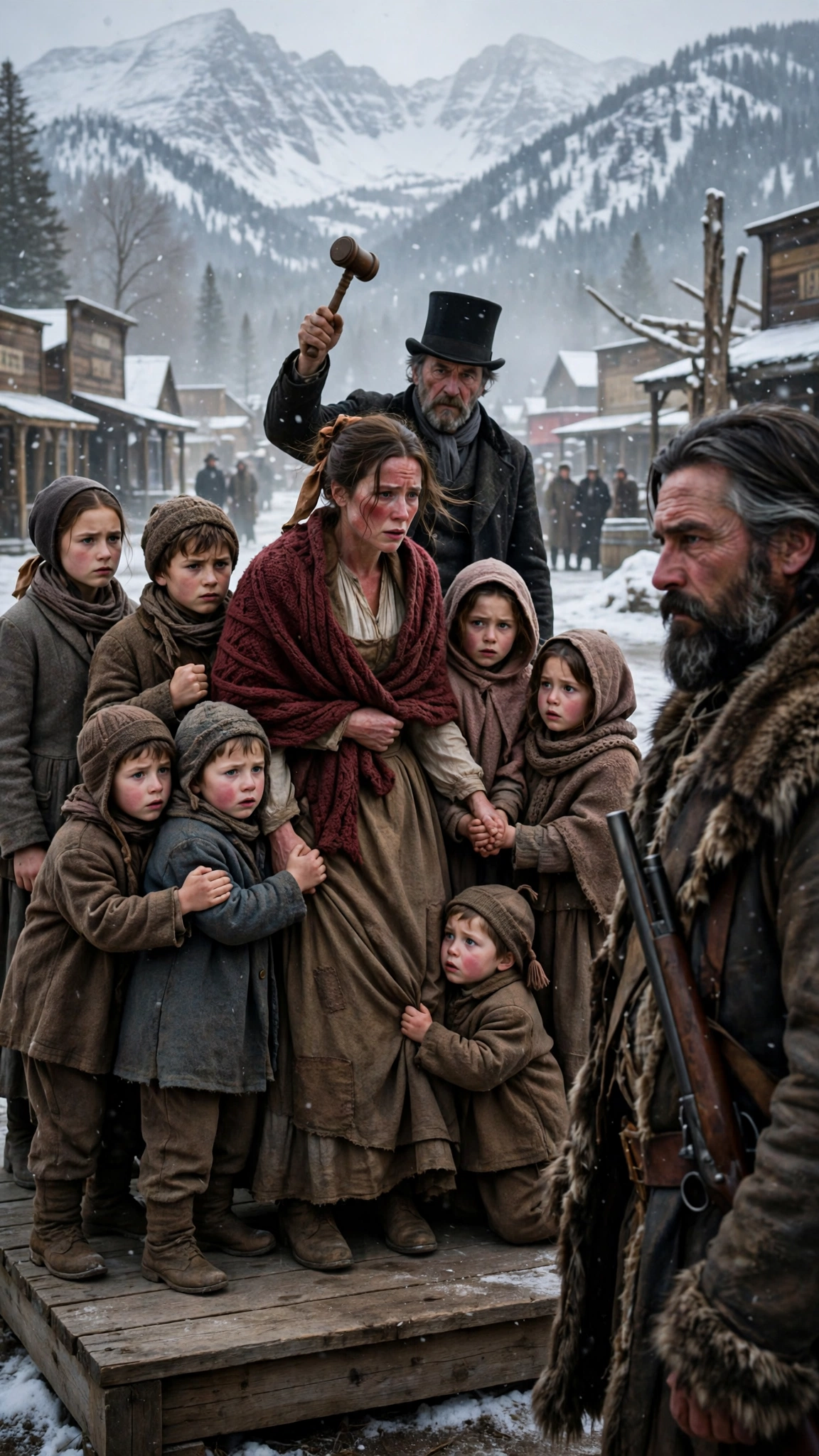
The first week at the cabin passed in a kind of held breath. Eleanor rose before dawn each morning, built up the fire, made coffee and porridge, and set the children to their chores — fetching water from the spring, gathering wood, sweeping the floor, mending clothes — and she watched Caleb the way a person watches weather, looking for the signs of what was coming.
He was not cruel. That was the first thing she learned, and it surprised her, because she had expected cruelty the way a person expects rain after thunder. He did not raise his voice. He did not strike the children, or threaten them, or even speak harshly to them. He simply went about his work — cutting wood, mending the barn, checking his traps in the woods, feeding the mules — and he expected the household to run itself, and when it did, he nodded, once, as if that were all the praise anyone needed.
But he was not kind, either. Not in the way Eleanor understood kindness. He did not ask the children their names. He did not ask Eleanor how she slept. He ate his meals in silence, his eyes on his plate, and when the children laughed — as children will laugh, even in a stranger's house, even in the mountains, even in winter — he would look up, startled, as if he had forgotten what laughter sounded like, and then he would look back down again.
The children, for their part, were wary. Sarah kept Edward close and watched Caleb from the corner of her eye whenever he was in the room. Thomas followed Eleanor everywhere, his stick from the trail still in his hand, though it was a poor weapon against a man the size of Caleb Roar. James and William whispered to each other in the loft at night, inventing stories about what was behind the locked door — a room full of gold, a room full of guns, a room where Caleb kept the bones of the men he had killed. Margaret and Catherine clung to each other and to their mother, and they flinched whenever Caleb's heavy boots sounded on the floorboards.
Only Edward seemed unafraid. He was three, and three-year-olds do not understand danger the way older children do. He followed Caleb around the yard like a small shadow, and he watched the mules with wide eyes, and one morning Eleanor found him sitting on the woodpile beside Caleb, solemnly handing the man pieces of kindling, one by one, as if he had been hired for the job. Caleb did not smile. But he did not send the boy away, either. He took each piece of kindling with his huge hand, and he set it on the pile, and he nodded, once, and Edward beamed as if he had been given a medal.
Eleanor began, slowly, to learn the shape of the household. Caleb rose before dawn and worked until dark. He trapped in the winter — marten and fox and beaver — and he sold the pelts in Covenant Creek in the spring, and that was where his gold came from, the gold he had paid for her. He kept a garden in the summer, and he hunted, and he cut enough wood to last three winters, because a man who lives alone in the mountains learns to prepare for the worst. He kept the cabin clean and the tools sharp and the pantry full, and he did it all without a word of complaint, and Eleanor began to understand that this was a man who had built a life out of silence and routine, and that her family — seven noisy, frightened, hungry children and their mother — had crashed into that life like a wagon going off a cliff.
She tried, in small ways, to make herself useful. She mended his shirts. She baked bread in the Dutch oven. She scrubbed the floor and washed the windows until the light came through clean. She taught the children to do their chores without being told twice. And slowly, day by day, the cabin began to feel less like a stranger's house and more like a place where people lived.
It was Thomas who tested Caleb first. It happened on the tenth day, in the yard, when Caleb was splitting wood and Thomas was supposed to be gathering kindling. Eleanor watched from the doorway, her heart in her throat, as her eleven-year-old son walked up to the biggest man he had ever seen and said, in a voice that shook only a little, "My mother says you are not going to hurt us. Is that true?"
Caleb stopped, the axe held in midair. He looked down at Thomas for a long moment, and his pale eyes were unreadable, and Eleanor's hand tightened on the doorframe, and she was already moving toward them when Caleb lowered the axe and set it down, slowly, against the chopping block, and crouched down so that his face was level with Thomas's.
"I have never hurt a child," he said, and his voice was low and rough and entirely serious. "I never will. That is my word. Do you understand what my word means, boy?"
Thomas swallowed. "Yes, sir."
"It means it does not break," Caleb said. "Not for weather. Not for money. Not for any man. My word does not break."
He stood up again, picked up the axe, and went back to splitting wood, and Thomas stood there for a moment, staring up at him, and then he picked up his basket of kindling and went back to work, and Eleanor saw, in the set of her son's shoulders, something she had not seen since Philadelphia: a boy who believed, if only a little, that the world might be safe again.
That night, after the children were in the loft, Eleanor found Caleb sitting by the fire with a book in his hands. It surprised her — she had not thought of him as a man who read — and she stopped in the doorway, and he looked up, and for a moment they looked at each other across the firelight, and Eleanor saw something in his face that she had not seen before: not hardness, and not suspicion, but a deep, old tiredness, the tiredness of a man who has carried something heavy for a very long time.
"You read," she said, because she could not think of anything else to say.
"My wife taught me," he said, and then he stopped, as if he had said more than he meant to, and he closed the book and set it aside, and he looked into the fire.
Eleanor's breath caught. His wife. He had been married, once. She had not known. She had not asked. She wanted to ask more — what was her name, what happened to her, why was there a locked door at the back of the cabin — but she could see, in the way his jaw had tightened and his hands had closed around the arms of his chair, that the door to that subject was locked too, and that she would not open it tonight.
"I am sorry," she said quietly. "I did not mean to pry."
He did not answer. He stared into the fire for a long time, and then he said, so quietly that Eleanor almost missed it, "Her name was Anna."
It was the first time he had told her anything about himself. It was a small thing — a name, nothing more — but Eleanor held onto it as she went to bed that night, the way a person holds onto a coal in the cold. Anna. His wife had been named Anna. And somewhere in that cabin, behind a locked door, there was a room that had belonged to her, and a man who had lived alone for years because he could not bear to let her go.
She did not know the whole story yet. But she knew, now, that there was a story. And she knew that the man who had bought her family was not a monster. He was a man who had lost something, and who had built a wall of silence around the loss, and who had just — for the first time in years, perhaps — let a stranger see a crack in the wall.
The next morning, she found a small thing on the kitchen table that had not been there the night before: a carved wooden horse, rough and simple, the kind of toy a man might whittle by the fire on a long winter evening. It was sitting on Edward's plate, where he would find it at breakfast. Caleb was already outside, splitting wood, and he did not mention it, and Eleanor did not mention it either. But when Edward found the horse and held it up with a shout of delight, she saw Caleb pause, just for a moment, in the yard, his axe held still in midair, listening to the sound of a child laughing in his house — and she thought, for the first time since the auction, that perhaps they were going to be all right.
Three days later, the blizzard came.
It came down from the high peaks in the night, and by morning the world outside the cabin was white and howling, and the snow was piling against the door in drifts as tall as a man. Caleb barred the door and banked the fire high and told the children, in his flat, certain voice, that no one was to go outside until the storm broke, and that the woodpile by the door would last them, and that there was nothing to be afraid of.
For two days the storm raged. The wind shook the cabin and found every crack in the chinking, and the snow hissed against the windows, and the fire was the only light in the world. Eleanor and the children stayed close to the hearth. She taught Margaret and Catherine to darn socks. She showed Sarah how to make a stew stretch for nine people. She read aloud to the younger children from the one book of stories she had carried all the way from Philadelphia, her voice steady in the dark, while the storm howled outside and the cabin creaked around them.
And Caleb — to Eleanor's surprise — stayed with them. He did not retreat to the barn or to the far side of the room. He sat by the fire and whittled, his huge hands working a piece of pine with a small, sharp knife, and the children, drawn by the sound of the blade and the curl of the shavings falling to the floor, crept closer, one by one, until they were sitting in a circle around him, watching.
He did not speak to them at first. But on the second day of the storm, when James asked him, in a small voice, whether the wind would blow the cabin down, Caleb set his knife aside and looked at the boy, and he said, "No. This cabin has stood through twenty winters. It will stand through this one."
"Have you lived here twenty years?" James asked.
"Near enough," Caleb said.
"What did you do before?" William asked, and Eleanor held her breath, because the children had never dared to ask him a direct question before, and she did not know how he would take it.
But Caleb did not grow angry. He looked into the fire for a long moment, and then he said, "I was a soldier. A long time ago. In the war."
"What war?" Thomas asked.
"The war between the states," Caleb said. "I was nineteen when I went. I came home when I was twenty-three, and nothing was the way I had left it, and so I came up here. And I have been here ever since."
He did not say more. But the children were silent, and Eleanor saw that something had shifted in the room — that her children were looking at Caleb Roar not as a stranger who had bought them, but as a man, a man with a past, a man who had once been nineteen and afraid, the way Thomas was afraid now. And she saw Thomas sit a little straighter, and she saw Sarah's shoulders relax, just slightly, and she understood that the storm, which had trapped them all inside together, had done something no amount of careful watching could have done: it had made them, for two days, a household.
When the storm finally broke, on the third morning, the world outside was white and silent and shining, and Caleb opened the door and the children rushed out into the snow, shouting, and they threw snowballs and fell down laughing, and Edward's wooden horse was lost and found again three times before breakfast. Caleb stood in the doorway and watched them, his arms folded, his face unreadable — but Eleanor, standing beside him, saw something in his eyes that had not been there when they arrived. It was not happiness. It was not yet trust. But it was the beginning of something — a man remembering what it felt like to have a house full of noise, and finding, to his surprise, that he did not mind it.